
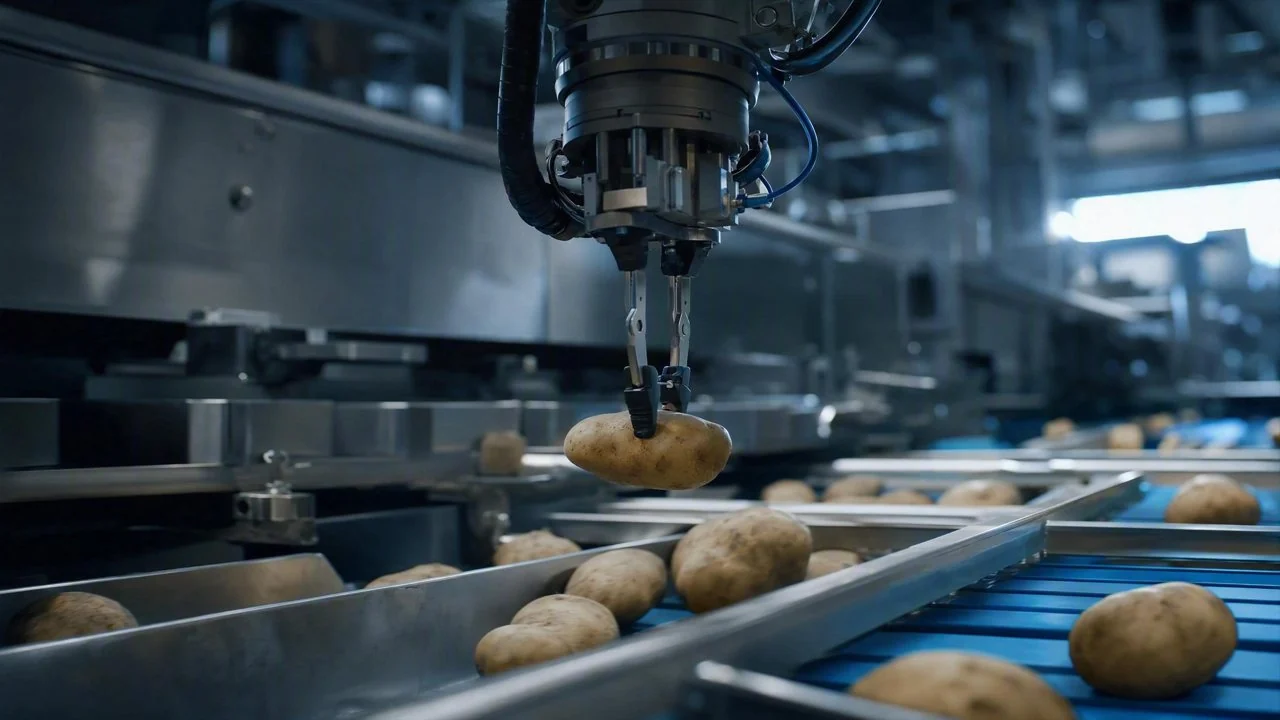
WeLinkirt's DaoAI 3D Robot Vision (proprietary 3D camera + 6D pose estimation, bin picking, dispensing/assembly/loading/unloading guidance, brain-eye-body closed-loop, sub-millimeter hand-eye coordination) utilizes precise 3D depth perception and intelligent defect recognition to reduce false positive rates in food foreign object removal and quality grading by 75%, while cutting manual re-inspection hours by 60%, significantly boosting production line automation efficiency and product quality stability.
In the foreign object removal and quality grading stages of food/agriculture production lines, WeLinkirt's DaoAI 3D Robot Vision (proprietary 3D camera + 6D pose estimation, bin picking, dispensing/assembly/loading/unloading guidance, brain-eye-body closed-loop, sub-millimeter hand-eye coordination) leverages precise 3D depth perception and intelligent defect recognition to reduce false positive rates in food foreign object removal and quality grading by 75%, while cutting manual re-inspection hours by 60%, thereby significantly enhancing production line automation efficiency and product quality stability. The global food supply chain demands increasingly stringent product safety and quality standards. Traditional manual inspection is inefficient and prone to subjective errors, while 2D machine vision often generates a large number of false positives due to lighting, shadows, and product deformation, leading to a heavy burden on subsequent manual re-inspection. This is particularly critical for high-value, high-margin agricultural products such as premium fruits, seafood, and meat, where any subtle foreign object or quality defect can result in significant losses. A leading seafood processing enterprise, for instance, faced a false positive rate of up to 15% in the foreign object removal and size grading of its frozen shrimp, severely hindering overall throughput and increasing operational costs.
Pain Points: Why This Hurdle Is So Difficult to Overcome
The foreign object removal and quality grading processes in the food/agriculture industry face multiple challenges: Firstly, **high false positive rates** are a common problem. Traditional 2D vision systems often misinterpret product textures, water stains, air bubbles, or even tiny shadows as defects when detecting irregularly shaped, similarly colored, or reflective foreign objects (e.g., plastic fragments, hair, insect residues), leading to false positive rates as high as 10%–15%. Secondly, **heavy manual re-inspection burden** is a significant issue. High false positive rates mean a large number of otherwise qualified products are misidentified, requiring substantial human labor for secondary confirmation and sorting. This not only increases operational costs but also slows down the overall production line, exacerbating labor shortages in an increasingly tight job market. Thirdly, **diverse defect types are difficult to standardize**. For example, blemishes from pests/diseases, mechanical damage, or under/over-ripeness in agricultural products vary widely in shape, size, and color, and may exist at different depths within the product, making it challenging for traditional rule-based vision to establish universal recognition standards. Fourthly, **product diversity and rapid changeover requirements** mean food processing enterprises often handle multiple specifications and batches of products. Traditional solutions require several hours for reprogramming and recalibration during each changeover, severely impacting production efficiency.
The root cause of these difficulties is that traditional 2D vision only acquires two-dimensional planar information, lacking depth perception. It cannot effectively distinguish height differences between surface textures and true foreign objects, nor can it accurately identify three-dimensional foreign objects or internal defects. Simultaneously, the non-standardized nature of food and agricultural products themselves, such as natural deformation, uneven surfaces, and color gradients, poses immense challenges for traditional vision algorithms based on fixed thresholds. In the current trend of humanoid robots achieving commercial deployment in specific industries, how to smoothly integrate the robot's “brain” (AI decision-making), “eyes” (3D visual perception), and “body” (robotic arm execution) to achieve more human-like intelligent fine operations is a key focus for the industry. High false positive rates are a critical bottleneck limiting the further adoption of robotic vision systems, not only reducing the ROI of automation but also hindering the truly efficient operation of the “brain-eye-body” closed loop.
Technical Principles
The core strength of WeLinkirt's DaoAI 3D Robot Vision lies in its proprietary 3D camera and advanced 6D pose estimation technology, combined with powerful AI vision foundation models. Our 3D camera employs structured light or laser triangulation principles to acquire high-speed, high-precision 3D point cloud data of the object, reconstructing its 3D morphology with sub-millimeter accuracy. This enables the system to accurately identify minute height differences between foreign objects and the product surface. Even similarly colored or reflective foreign objects can be precisely differentiated, fundamentally solving the false positive problem caused by lighting and shadows in 2D vision. WeLinkirt's DaoAI 3D Robot Vision's 6D pose estimation algorithm can obtain real-time 3D position and tri-axis orientation information of target objects, providing precise guidance for robotic arms to achieve sub-millimeter hand-eye coordination. This is crucial for bin picking and complex foreign object removal, ensuring the robotic arm operates with optimal angle and force.
Compared to traditional rule-based AOI or manual inspection, WeLinkirt's DaoAI 3D Robot Vision offers several advantages: Firstly, **more comprehensive 3D information** allows it to overcome the limitations of 2D vision, identifying volumetric defects, hidden defects, and surface morphological anomalies, reducing false positive rates by 75%. Secondly, **AI-driven semantic false positive filtering** is enabled by the DaoAI AI AOI software system's built-in vision foundation models, which possess powerful feature recognition and few-shot learning capabilities (APDT positive sample/few-shot learning, requiring only 1–20 good samples for training). This allows the system to learn and understand the semantic differences between normal product textures and actual defects, effectively filtering out false alarms caused by natural product characteristics or environmental factors, further reducing false positives. Thirdly, **brain-eye-body closed-loop integration** means DaoAI 3D Robot Vision not only provides visual perception but also deeply integrates with the robotic arm, forming a real-time perception-decision-execution loop. This enables precise localization, grasping, and removal of defects, reducing manual re-inspection volume by 60% and greatly enhancing automation levels. Fourthly, **0-code rapid changeover** is facilitated by the WeLinkirt DaoAI World Model, which provides a unified AI foundation supporting cross-scene generalization, making the introduction and switching of new product models simple and efficient, without complex programming.
Typical Application Scenarios
- **Foreign Object Removal in Frozen Seafood**:In the processing of frozen seafood like shrimp and fish fillets, WeLinkirt's DaoAI 3D Robot Vision identifies tiny foreign objects such as plastic fragments, metal wires, and insect residues. The challenge lies in the irregular, reflective surfaces of frozen seafood prone to ice formation, making 2D vision difficult. 3D vision accurately acquires height information of foreign objects, combined with AI recognition, for efficient removal.
- **Surface Defect Detection and Grading for Fruits and Vegetables**:Detecting surface abrasions, mold spots, insect holes, and lesions on agricultural products like apples, citrus, and potatoes, and grading quality based on defect severity and size. The difficulty arises from complex natural textures and variable defect features, potentially in depressions. DaoAI 3D Vision provides complete 3D information, combined with AI algorithms for accurate differentiation.
- **Bone Fragment and Fascia Removal in Meat Products**:During poultry and livestock meat processing, detecting and removing small bone fragments, shattered bones, and tough fascia. These foreign objects often share similar colors with the meat and may be partially obscured. DaoAI 3D Robot Vision uses depth information and morphological analysis for effective identification and guides robotic arms for precise cutting or grasping.
- **Grain Particle Impurity Sorting**:Sorting impurities (e.g., stones, weed seeds, moldy grains) from grains like rice, corn, and beans. The challenge involves small, numerous particles in high-speed flow, with impurities potentially similar in color to good products. WeLinkirt's DaoAI 3D camera rapidly acquires 3D morphology of particles, combined with AI to identify abnormal ones for high-throughput sorting.
- **Burnt and Deformed Baked Goods Detection**:After baking, detecting defects like burnt spots, cracks, incompleteness, or over-expansion on the surface of baked goods such as bread and biscuits. The difficulty is the significant variation in color and shape of baked goods. DaoAI 3D Vision accurately measures 3D dimensions and surface morphology, identifying non-compliant batches.
Case Study
A leading seafood processing enterprise located on the southeast coast, with an annual output value of billions, primarily engaged in exporting frozen shrimp and fish fillets. In the foreign object removal and size grading of its shrimp processing line, the company had long relied on manual inspection supplemented by traditional 2D vision. However, due to the irregular and reflective surfaces of shrimp, and the high speed of the production line, the traditional 2D vision system experienced a false positive rate of around 15%. This meant that a large number of qualified shrimp were misidentified as defective every hour, requiring 3–4 quality inspectors for round-the-clock re-inspection and secondary sorting. This led to high labor costs, and the accuracy of re-inspection was affected by human fatigue, indirectly increasing the risk of missed detections. To enhance automation and reduce false positive rates, the enterprise introduced WeLinkirt's DaoAI 3D Robot Vision solution. Before implementation, the client's re-inspection labor costs and rework rates due to false positives were consistently high. WeLinkirt's engineering team first conducted an in-depth analysis of the production line environment and product characteristics, deploying DaoAI's proprietary 3D camera array. This was integrated with their existing robotic arms, and the DaoAI 3D Robot Vision system was programmed for 6D pose estimation and bin picking. During the data modeling phase, we leveraged the APDT few-shot self-training capability, quickly training high-precision recognition models with only a small number of good and defective samples. After one month of debugging and optimization, the system was successfully launched.
WeLinkirt's DaoAI 3D Robot Vision reduced our false positive rate by 75% and manual re-inspection volume by 60%, truly achieving cost reduction and efficiency improvement.
After deployment, WeLinkirt's DaoAI 3D Robot Vision system not only reduced the false positive rate from 15% to <4%, a significant reduction of 75%, but also meant that the re-inspection position, which previously required 3–4 people, now only needed 1 person for spot checks and anomaly handling, reducing manual re-inspection hours by 60%. Concurrently, the system's accuracy in grading shrimp by size and shape significantly improved, ensuring high-standard consistency for export products and effectively reducing customer complaints and return risks. The enterprise stated that WeLinkirt's DaoAI 3D Robot Vision solution not only resolved the long-standing false positive issue but also laid the foundation for expanding more automated sorting applications in the future.
WeLinkirt Solutions and Products
WeLinkirt's DaoAI 3D Robot Vision is the core of this solution. It integrates WeLinkirt's self-developed high-precision 3D camera, capable of real-time capture of 3D point cloud data of the object, combined with advanced 6D pose estimation algorithms to provide robots with precise coordinate and pose information. In food foreign object removal and quality grading scenarios, DaoAI 3D Robot Vision, through deep learning algorithms, can accurately identify tiny foreign objects, surface defects, and irregular deformations from 3D data. WeLinkirt's DaoAI AI AOI software system acts as its intelligent brain, supporting APDT few-shot self-training, requiring only 1–20 good samples to quickly train models, significantly reducing the cycle for new product introduction and changeover, cutting changeover downtime from hours to minutes. Furthermore, the DaoAI World Model provides a unified AI foundation with powerful semantic understanding and cross-scene generalization capabilities, continuously learning from production line feedback to optimize recognition accuracy and efficiency. WeLinkirt supports 100% local private deployment (SDK / API / Docker) to ensure customer data security and compliance with strict food industry regulations. Our engineering team provides end-to-end services from initial evaluation, solution design, system integration, to post-deployment maintenance, ensuring stable and efficient operation of the DaoAI 3D Robot Vision system on the client's production line.
By deploying WeLinkirt's DaoAI 3D Robot Vision, the client achieved significant business value: false positive rates were reduced by 75%, manual re-inspection hours decreased by 60%, substantially lowering operational costs; improved detection accuracy and consistency ensured product quality stability, enhancing market competitiveness; 0-code rapid changeover capability increased production line flexibility and efficiency, allowing for smooth handling of multi-variety, small-batch production. The sub-millimeter hand-eye coordination capability of WeLinkirt's DaoAI 3D Robot Vision enables robots to perform intricate operations previously only possible by skilled workers, providing strong support for the intelligent upgrade of the food/agriculture industry.
FAQ
How does DaoAI 3D Robot Vision effectively reduce false positive rates in food foreign object detection?
WeLinkirt's DaoAI 3D Robot Vision acquires 3D depth information using its proprietary high-precision 3D camera, allowing it to differentiate height differences between foreign objects and product surface textures, avoiding misjudgments caused by lighting or shadows in 2D vision. Combined with the semantic false positive filtering capability of the AI vision foundation model, the system learns and understands the distinction between normal product features and true defects, significantly reducing false positives and improving detection accuracy.
Compared to traditional 2D vision systems, what unique advantages does DaoAI 3D Robot Vision offer in food quality grading?
DaoAI 3D Robot Vision provides comprehensive 3D morphological data, accurately measuring product volume, shape, and surface flatness, and identifying volumetric and hidden defects. This makes it far superior to 2D vision for complex defect detection and fine grading, such as disease spots on fruits and vegetables or bone fragments in meat, ensuring more consistent and high-standard product quality.
What is the deployment and maintenance cycle for WeLinkirt's DaoAI 3D Robot Vision? Does it support local private deployment?
The deployment cycle for WeLinkirt's DaoAI 3D Robot Vision typically ranges from a few weeks to 2 months, depending on the production line complexity and integration requirements. Thanks to APDT few-shot learning and 0-code rapid changeover, new model training and product switching are highly efficient. We offer 100% local private deployment options (SDK/API/Docker) to ensure data security without leaving the factory, along with comprehensive post-deployment maintenance and technical support.
This article was generated by AI. Customer cases are simulated scenarios based on real product capabilities and figures are illustrative; see product pages for official benchmarks.