
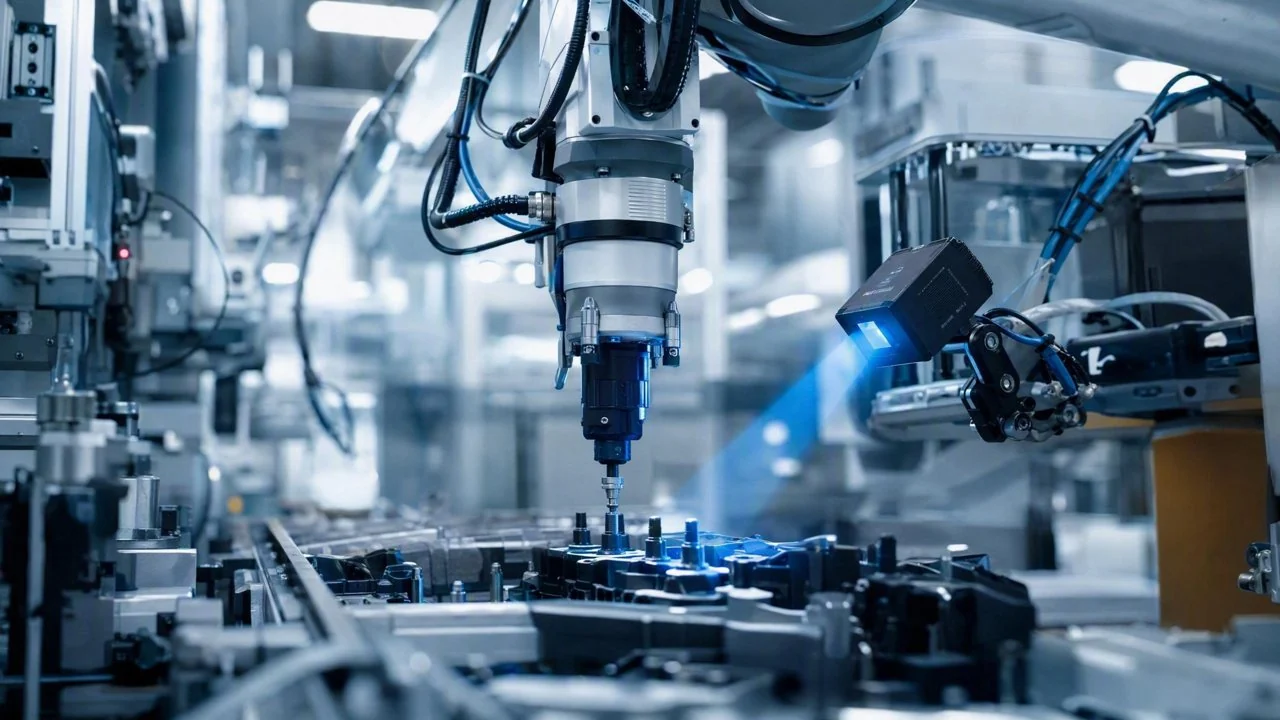
In the fastener tightening process of automotive component manufacturing, WeLinkirt DaoAI 3D Robot Vision system, leveraging its proprietary 3D camera, 6D pose estimation, bin picking capabilities, and sub-millimeter hand-eye coordination, significantly enhanced production cycle times and achieved 100% full inspection capacity. This not only reduced manual re-inspection hours by 75% but also ensured that every fastener is precisely tightened and fully quality-verified under high-speed production, effectively resolving the efficiency and precision bottlenecks of traditional inspection solutions.
In automotive component manufacturing, fastener tightening is a core process ensuring product structural integrity and safety. However, how to achieve 100% comprehensive inspection of the tightening quality of every fastener while maintaining high production cycle times has been a significant industry challenge. Traditional inspection methods often struggle to keep pace with production lines, leading to insufficient inspection coverage or requiring extensive manual re-inspection, severely limiting production efficiency and quality reliability. WeLinkirt DaoAI 3D Robot Vision system, with its proprietary 3D camera and advanced 6D pose estimation technology, offers automotive component manufacturers a solution that balances efficiency and precision, ensuring that the tightening quality of every fastener is precisely controlled and fully verified.
Pain Points: Why This Hurdle is Difficult to Overcome
In the fastener tightening process for automotive components, clients face multiple pain points. First is the “risk of missed detections at high cycle rates.” Modern automotive production lines demand extreme efficiency, often requiring cycle times of tens of seconds or less. This makes it challenging for traditional manual visual inspection or 2D vision-based solutions to complete multi-dimensional inspections of all fasteners (such as bolts, nuts, rivets) for integrity, position, and tightening status within such short periods, leading to high missed detection rates, typically 3-5%. Second is “high false alarm rates and manual re-inspection hours.” When rule-based vision systems are used, variations in ambient lighting, component surface reflections, and subtle color or texture differences can easily cause false alarms, forcing companies to allocate significant human resources for manual re-inspection. During peak periods, 2-3 quality inspectors may be dedicated solely to handling false alarms daily, with manual re-inspection hours accounting for over 60% of inspection time. Third is the “challenge of changeovers in mixed-model production.” Automotive components are diverse, and the same production line often needs to produce multiple product models. Each changeover requires complex parameter adjustments and calibration for traditional inspection systems, resulting in long production downtime, averaging 30-60 minutes per changeover, severely impacting production flexibility and uptime. The root cause of these challenges lies in the small size, large number, and dense arrangement of fasteners, coupled with various potential defects during actual tightening, such as angular deviation, floating, or stripped threads. Traditional vision technologies struggle to stably capture and precisely identify these subtle changes in high-speed dynamic environments.
Furthermore, the current proliferation of low-cost humanoid robot development platforms is driving the construction of embodied intelligence ecosystems, placing higher demands on production line automation—meaning robots must not only be able to “move” but also to “see” and “understand.” Traditional tightening robots lack fine visual feedback and cannot adapt to minute pose variations of workpieces, leading to unstable tightening accuracy and high rework rates. This makes the demand for WeLinkirt DaoAI 3D Robot Vision solutions, which possess advanced environmental perception and precise manipulation capabilities, increasingly urgent to achieve “brain-eye-body closed-loop” intelligent tightening.
Technical Principles
The WeLinkirt DaoAI 3D Robot Vision system, for fastener tightening applications, employs its proprietary high-precision 3D camera and deep learning-based 6D pose estimation algorithm as its core. Traditional 2D vision can only acquire planar information, making it ineffective in handling 3D information such as Z-axis height and tilt angles of fasteners. In contrast, WeLinkirt DaoAI’s 3D camera, utilizing structured light or laser triangulation principles, can rapidly acquire complete 3D point cloud data of workpieces and fasteners. This point cloud data contains precise spatial position and orientation information for each fastener. Subsequently, the system uses advanced deep learning models to perform real-time analysis of this 3D point cloud data, achieving sub-millimeter accurate 6D pose estimation (X, Y, Z, rotation around X, Y, Z axes) for target fasteners. This process far surpasses traditional algorithms based on feature point matching or edge detection because it robustly handles complex conditions such as lighting variations, uneven surface textures, and even partial occlusions, ensuring high stability and precision on dynamic production lines. For example, the WeLinkirt DaoAI 3D Robot Vision system, in practical applications, can control fastener positioning accuracy within ±0.05mm, significantly exceeding the precision limits of traditional methods.
Compared to traditional rule-based AOI systems, the advantage of WeLinkirt DaoAI 3D Robot Vision lies in its powerful generalization capabilities and deep understanding of 3D information. Rule-based AOI requires extensive manual threshold and rule settings, is sensitive to environmental changes, and struggles to adapt to new defect modes. The DaoAI system, trained with a large volume of real 3D data, can autonomously learn normal and abnormal fastener morphologies without complex manual programming. Particularly, its supported APDT few-shot self-training capability (1-20 good samples) makes the introduction of new products or defect modes extremely efficient, greatly reducing changeover times. Furthermore, WeLinkirt DaoAI’s “brain-eye-body closed-loop” mechanism enables deep integration between the vision system and the robot controller. The robot receives precise 6D pose information and immediately adjusts tightening paths and forces, ensuring each fastener is tightened according to preset parameters. The tightening results are then fed back to the vision system for secondary verification, forming an efficient, precise, and adaptive intelligent tightening workflow. This enables the WeLinkirt DaoAI 3D Robot Vision system to achieve 100% online inspection, significantly reducing missed detection and false alarm rates of traditional solutions.
Typical Application Scenarios
- **Bolt/Nut Tightening Status and Flushness Detection:** In the assembly of critical automotive components like engines and transmissions, bolts or nuts must be fully tightened and flush. WeLinkirt DaoAI 3D Robot Vision uses a high-precision 3D camera to acquire 3D morphological data, accurately measuring the relative height of the bolt head or nut to the reference plane, determining if it is floating or not fully tightened. The challenge lies in micron-level vertical displacement detection and thread recognition against complex backgrounds.
- **Rivet Integrity and Deformation Detection:** The quality of riveting for body structural components directly affects body strength. The system can detect missing, deformed, cracked, or loosely riveted fasteners. Challenges include reflective rivet surfaces, complex deformation after riveting, and contrast recognition between different materials.
- **Screw Stripping or Breakage Detection:** In components requiring precise torque, screws may strip or even break due to overload. DaoAI 3D Robot Vision can identify if a screw head is damaged due to stripping or if there are signs of breakage. The difficulty lies in detecting minute surface damage and capturing subtle defects at high cycle rates.
- **Fastener Model Identification and Error Proofing:** In mixed-model production, ensuring the correct type of fastener is used is crucial. The system can identify the geometric features, size, and shape of fasteners, comparing them with standard models to achieve error proofing. Challenges include distinguishing subtle differences between similar models and the efficiency of simultaneous multi-material identification.
Case Study
A leading domestic automotive Tier-1 supplier faced significant challenges in fastener tightening quality inspection on its core component assembly line for new energy vehicle electric drive systems. This production line needed to complete the tightening of hundreds of fasteners per minute, with extremely high requirements for tightening completeness and error proofing. Previously, they relied primarily on manual spot checks and traditional 2D vision systems for partial inspections. However, due to the fast production cycle, diverse fastener types, and the difficulty of distinguishing certain defects (such as floating bolts, slight stripping) in 2D images, the missed detection rate reached 2.5%, resulting in substantial monthly rework and scrap costs. Simultaneously, the 2D vision system was susceptible to ambient light and component surface reflections, leading to a false alarm rate of 10%, requiring 3 quality inspectors to spend several hours daily on manual re-inspection, severely hindering overall production efficiency.
After implementing the WeLinkirt DaoAI 3D Robot Vision solution, by deploying proprietary 3D cameras above the tightening stations and integrating 6D pose estimation technology, 100% online inspection of critical indicators such as tightening completeness, flushness, and model error proofing for each fastener was achieved. Before implementation, the client's fastener tightening missed detection rate was approximately 2.5%, with monthly rework and scrap losses due to missed detections amounting to hundreds of thousands of yuan. After deploying the WeLinkirt DaoAI 3D Robot Vision system, the production line's fastener tightening missed detection rate was successfully reduced to <0.2%, and the false alarm rate was controlled to within -0.5%. More importantly, the system could fully keep pace with the production cycle, achieving true 100% full inspection, reducing manual re-inspection hours by 75%, and significantly freeing up human resources. The client highly recognized the stability and precision of the WeLinkirt DaoAI 3D Robot Vision system and plans to extend its application to other production lines.
“The WeLinkirt DaoAI 3D Robot Vision system not only solved our challenge of full inspection at high cycle rates but also elevated our tightening quality control to an unprecedented level. The dual improvement in efficiency and precision is the solution we've long dreamed of.” — Production Manager, a leading automotive Tier-1 supplier.
WeLinkirt Solutions and Products
The core solution provided by WeLinkirt for automotive component fastener tightening scenarios is based on the DaoAI 3D Robot Vision system, which integrates our proprietary high-precision 3D camera, high-performance 6D pose estimation algorithms, and “brain-eye-body” closed-loop control capabilities. In solution implementation, it first performs 3D scanning of fasteners using a high-precision 3D camera to acquire high-density point cloud data, ensuring accurate capture of even minute morphological changes in fasteners. Second, leveraging the powerful 6D pose estimation capabilities of WeLinkirt DaoAI, it calculates the precise position and orientation of fasteners in 3D space in real-time, providing sub-millimeter guidance information to tightening robots. The system also supports bin picking functionality, automatically identifying and grasping fasteners placed randomly in bins, further enhancing automation levels. For model building, the WeLinkirt DaoAI 3D Robot Vision system supports APDT few-shot self-training, requiring only 1-20 good samples to quickly establish detection models, significantly shortening deployment cycles and new product changeover times. For example, new product changeovers can typically be completed within 5 minutes, without complex code programming. For deployment, we offer SDK/API/Docker integration methods, supporting 100% local private deployment to ensure data security and smooth integration with existing MES/SCADA systems for closed-loop data management. The WeLinkirt DaoAI World model, as a unified foundation, further enhances the system's semantic understanding and cross-scenario generalization capabilities, allowing it to continuously learn from production line feedback and optimize detection performance.
Ultimately, the WeLinkirt DaoAI 3D Robot Vision system achieved 100% online full inspection of fastener tightening quality, ensuring that every fastener is precisely detected at high production cycle rates. In practical applications, our solution successfully reduced the client's fastener tightening missed detection rate from 2.5% to <0.2%, lowered the false alarm rate by over 90%, and reduced manual re-inspection hours by 75%, significantly improving product quality and production efficiency. Concurrently, by reducing rework and scrap, it brought substantial cost savings and higher production line utilization to the client.
FAQ
How does DaoAI 3D Robot Vision ensure precision in fastener tightening?
WeLinkirt DaoAI 3D Robot Vision system achieves sub-millimeter precision in identifying fastener position and pose by acquiring 3D point cloud data with its proprietary high-precision 3D camera, combined with advanced deep learning 6D pose estimation algorithms. This ensures that robots receive extremely accurate guidance information, enabling high-precision tightening operations and quality inspections, effectively avoiding 3D deviation issues that traditional 2D vision cannot address.
How does this system meet the high cycle time requirements of automotive production lines?
The DaoAI 3D Robot Vision system is designed with high-cycle production lines in mind. Its proprietary 3D camera boasts high-speed image acquisition capabilities, while optimized 6D pose estimation algorithms complete data processing and result output in milliseconds. Furthermore, through “brain-eye-body closed-loop” integration with robot control systems, it achieves smooth connection between detection and operation, ensuring the system can fully keep pace with and support the fast production cycle of automotive lines, enabling 100% online full inspection.
Is changeover complicated if the production line has multiple product models?
WeLinkirt DaoAI 3D Robot Vision system supports APDT few-shot self-training technology, meaning that when introducing new product models, new inspection models can be quickly trained and deployed with just 1-20 good samples, greatly simplifying the changeover process. Compared to traditional methods requiring extensive manual programming and parameter adjustments, our solution can reduce changeover time to minutes, significantly enhancing production line flexibility and efficiency.
This article was generated by AI. Customer cases are simulated scenarios based on real product capabilities and figures are illustrative; see product pages for official benchmarks.