
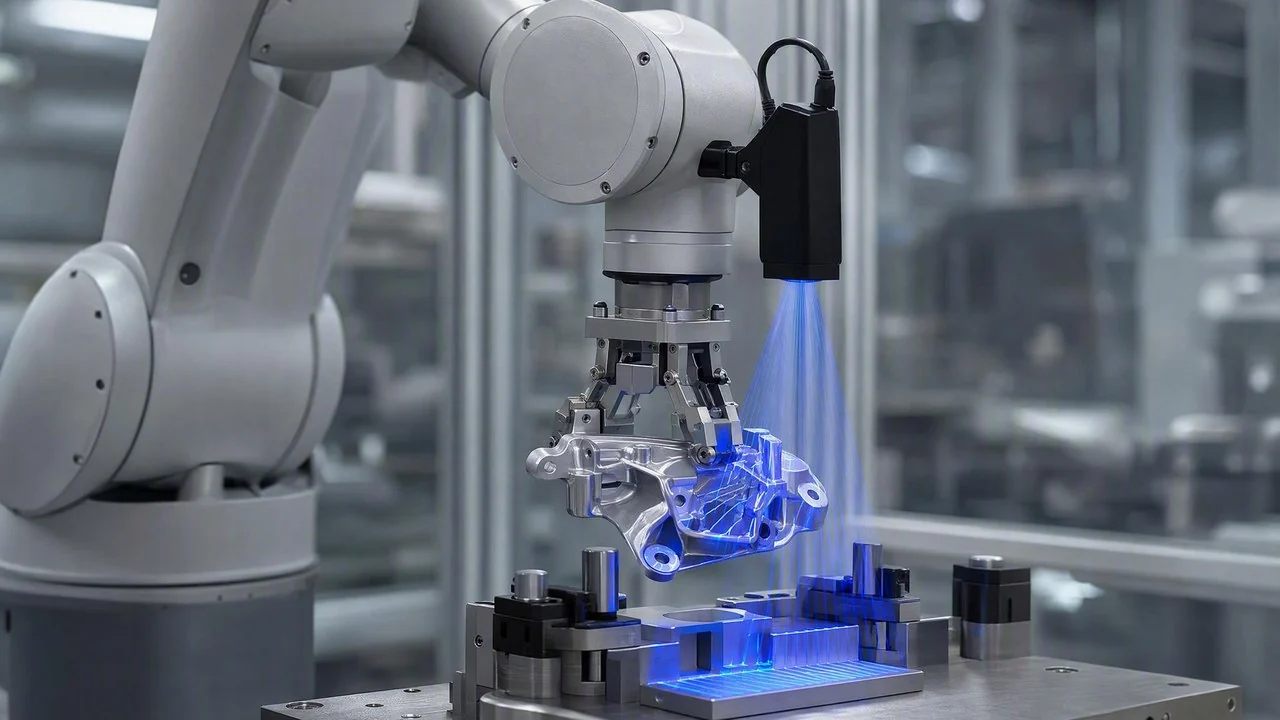
In the current rapid development of embodied intelligence, the application of robot vision in the automotive industry is becoming increasingly important. WeLinkirt's DaoAI 3D robot vision provides an effective solution for the detection of incorrect and missing assembly in automotive final assembly.
User Scenario: A leading automotive manufacturer's automotive final assembly production line is mainly engaged in the assembly process of core components such as automobile engines and transmissions. Its products are various automotive assemblies, and the detection objects are the incorrect and missing assembly of components during the assembly process to ensure the quality and safety of automobiles.
Pain Points: In the traditional detection of automotive final assembly production lines, manual inspection has significant limitations. The missed detection rate of manual inspection is as high as 4%, resulting in some automobiles with quality problems flowing into the market, which may cause potential safety hazards. At the same time, the false alarm rate reaches 6%, resulting in unnecessary re-inspection work and increasing labor and time costs. In addition, it takes 2 hours to change the production line model, with low efficiency and unable to meet the rapidly changing market demand. In the context of embodied intelligence, traditional methods are difficult to achieve effective interaction and precise operation between robots and the environment, limiting the application expansion of robot vision in actual scenarios.
Technical Principle
DaoAI 3D robot vision uses a self-developed 3D camera for image acquisition. The camera uses the principle of structured light imaging. By projecting a specific structure of light onto the object surface and then capturing the reflected light by the camera, high-precision 3D point cloud data is generated based on the deformation and displacement information of the light. At the same time, combined with the 6D pose estimation algorithm, the spatial position and attitude of components can be accurately calculated. In the bin picking of disordered bins, through the analysis of 3D point cloud data, the position and direction of components are identified to guide the robotic arm to accurately grab. In the gluing, assembly, loading and unloading guidance, 3D morphology reconstruction and semantic understanding algorithms are used to monitor and guide the assembly process in real-time to ensure the correct installation of each component. Its brain-eye-body closed-loop system can realize the integration of robot vision, decision-making and execution, ensuring sub-millimeter hand-eye coordination accuracy and effectively solving the problem of incorrect and missing assembly in the final assembly.
- Structured light imaging: Obtain 3D information of the object surface by projecting special light to improve imaging accuracy.
- 6D pose estimation: Accurately calculate the spatial position and attitude of components to provide accurate data for assembly.
- 3D morphology reconstruction: Build a 3D model of the object for easy identification and detection.
- Semantic understanding algorithm: Conduct semantic analysis on the image to more accurately judge the assembly situation.
- Brain-eye-body closed-loop: Realize the coordination of vision, decision-making and execution to ensure assembly accuracy.
WeLinkirt Solution and Product
WeLinkirt's core product, DaoAI 3D robot vision, provides a comprehensive solution for the detection of incorrect and missing assembly in automotive final assembly. During the system operation, first, the self-developed 3D camera quickly collects the 3D images of components to generate high-precision point cloud data. Then, the 6D pose estimation algorithm processes this data to accurately determine the position and direction of components. For components in disordered bins, they can be quickly identified and the robotic arm can be guided to accurately grab. During the assembly process, the assembly situation is monitored and fed back in real-time. Through the gluing, assembly, loading and unloading guidance functions, the correct installation of each component is ensured. At the same time, the brain-eye-body closed-loop system realizes the integration of robot vision, decision-making and execution, ensuring sub-millimeter hand-eye coordination accuracy. In addition, the supporting DaoAI ACI (AI-AOI) software system can further analyze and process the collected images. Using the feature recognition of the visual basic model and the APDT positive sample / few-sample learning technology, the accuracy and efficiency of detection are improved.
DaoAI 3D robot vision achieves efficient detection of incorrect and missing assembly in automotive final assembly with its advanced algorithms and hardware.
Quantitative Results: After the implementation of the DaoAI 3D robot vision system, remarkable results have been achieved. The missed detection rate has been reduced from the original 4% to <0.6%, effectively preventing products with quality problems from flowing into the market. The false alarm rate has been reduced by 63%, greatly reducing unnecessary re-inspection work and improving production efficiency. The production line model change time has been shortened from 2 hours to 5min, enabling a quick response to market demands and enhancing the enterprise's competitiveness.
FAQ
What types of incorrect and missing assembly problems can DaoAI 3D robot vision detect?
DaoAI 3D robot vision can detect the incorrect and missing assembly of components in automotive final assembly, such as the missing parts or incorrect installation positions of core components like engines and transmissions. It uses 3D cameras and algorithms for accurate identification.
What is the detection accuracy of this system?
The system has sub-millimeter hand-eye coordination accuracy. Through the self-developed 3D camera and 6D pose estimation, it can accurately calculate the position and attitude of components, effectively ensuring the detection accuracy.
Can the system quickly adapt during production line model changes?
Yes. The model change time of the system has been shortened from 2 hours to 5min, enabling a quick response to market demands. With advanced algorithms and models, it can efficiently adapt to new assembly requirements.
Full solution for this scenario: the full inspection solution for Automotive / parts · AI Vision Inspection for Vehicle Assembly Errors & Missing Parts
This article was generated by AI. Customer cases are simulated scenarios based on real product capabilities and figures are illustrative; see product pages for official benchmarks.