
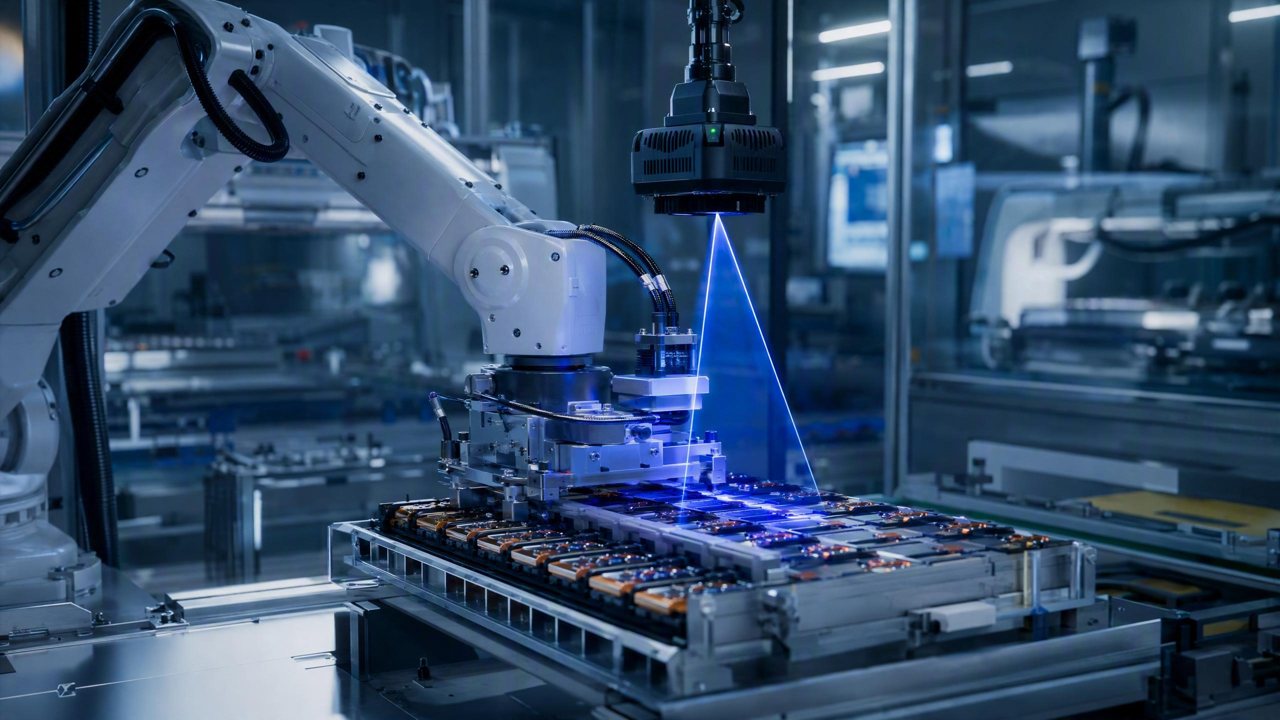
As the core of electric vehicles and energy storage systems, the manufacturing quality of new energy vehicle (NEV) batteries directly impacts product performance, safety, and market competitiveness. Among these, the quality of internal welds within battery modules is a critical link, especially weld misalignment, which can lead to increased internal resistance, localized overheating, or even safety hazards. WeLinkirt DaoAI 3D Robot Vision system, with its proprietary 3D camera, 6D pose estimation, and brain-eye-body closed-loop control capabilities, has solved a long-standing challenge of weld misalignment detection for a leading NEV battery manufacturer, reducing the undetected rate from 2.1% to below 0.3%, achieving a leap from traditional 2D inspection to high-precision 3D intelligent inspection.
WeLinkirt DaoAI 3D Robot Vision (proprietary 3D camera + 6D pose estimation, bin picking, dispensing/assembly/loading/unloading guidance, brain-eye-body closed-loop, sub-millimeter hand-eye coordination) reduces the undetected rate of misalignment defects in NEV battery module welds from 2.1% to below 0.3% through high-precision 3D morphology reconstruction and intelligent algorithms, significantly improving production line quality control and automation. The new energy vehicle battery industry is experiencing rapid growth, demanding unprecedented levels of product consistency, safety, and reliability. Within battery module assembly, laser welding of cells and busbars is a core process, and weld quality directly determines the module's electrical performance and thermal management. This case study's client is a world-leading tier-1 NEV battery supplier, whose production lines process tens of thousands of battery modules daily. They face complex weld geometries and stringent quality standards, particularly on the module sides or bottom, where significant weld position deviations, or misalignment, occur due to assembly tolerances, fixture wear, and other factors. Such defects may not be obvious initially but can accelerate battery degradation over time and even trigger thermal runaway risks. Therefore, accurate and efficient detection of these hidden defects is crucial for ensuring product safety and delivery.
Pain Points: Why This Hurdle Was So Difficult
This leading manufacturer faced multiple challenges in detecting module weld misalignment. Firstly, **high undetected rates**: traditional 2D AOI struggled to capture the true 3D morphology of welds, leading to an undetected rate of up to 2.1% for minor position shifts or misalignments with overlapping 2D projections. Secondly, **extensive manual re-inspection hours**: the high false alarm rate of 2D AOI necessitated significant manual re-inspection, consuming over 4 hours daily from several quality inspectors, severely hindering throughput. Thirdly, **long changeover downtime**: different module models had varying weld layouts and dimensions, requiring over 30 minutes for parameter adjustments and light source calibration during each changeover, resulting in prolonged production line downtime and impacting utilization. The root cause of these pain points lies in the **3D complexity** and **data acquisition difficulty** of weld misalignment. Weld misalignment typically manifests as the weld center deviating from the target position, uneven weld width, or differences in weld height—all inherently 3D information. Traditional 2D vision systems only capture planar grayscale or color images, unable to effectively quantify Z-axis deviations or distinguish surface stains from true morphological defects. Furthermore, post-laser welding, weld surfaces can exhibit reflections, shadows, and other optical interferences, further complicating 2D image analysis. In the current development of embodied robotics, the profound impact of data quality, diversity, and annotation efficiency on model training has become a consensus. For 3D, variable, and hard-to-precisely-annotate defects like weld misalignment, traditional methods relying on extensive manual 2D image annotation are inefficient, costly, and result in limited model generalization, struggling to cope with real-world production line complexities.
Technical Principles
The effectiveness of the WeLinkirt DaoAI 3D Robot Vision system in addressing these challenges stems from its **proprietary high-precision 3D camera** and **advanced 6D pose estimation algorithms**. Our 3D camera employs multi-line laser triangulation technology, combined with high-frame-rate industrial cameras and a precise optical system, to rapidly acquire complete 3D point cloud data of welds with sub-micron resolution. By processing point cloud data in real-time, the system reconstructs the true 3D morphology of the weld, including critical parameters like height, width, and volume. Unlike traditional 2D vision systems that rely solely on pixel brightness or color information, DaoAI 3D Robot Vision directly analyzes 3D geometric features, enabling precise quantification and judgment of various misalignment defects such as weld center offset, weld collapse, and spatter. For example, by fitting the weld centerline against a reference line, it calculates deviations along the XYZ axes, accurately identifying sub-millimeter misalignments. The 6D pose estimation algorithm of WeLinkirt DaoAI 3D Robot Vision, coupled with deep learning models, accurately identifies the module's position and orientation in space. Even with slight placement deviations, pose compensation ensures detection accuracy and consistency. This capability provides the system with greater robustness to production line uncertainties. Furthermore, the **brain-eye-body closed-loop** is another significant advantage of DaoAI 3D Robot Vision. The system not only “sees” defects but also, through linkage with robotic arms, enables precise secondary scanning of defective areas or guides subsequent repair operations, forming a complete intelligent closed loop that further enhances detection and processing efficiency and reliability. Compared to traditional rule-based 2D AOI, DaoAI 3D Robot Vision, through deep learning models, learns normal weld morphology features from a small number of good samples, possessing stronger generalization capabilities for abnormal morphology, reducing the false alarm rate by −75%.
At the data processing level, the DaoAI 3D Robot Vision system fully leverages the rich information in 3D point cloud data, combined with proprietary semantic segmentation and feature extraction algorithms, effectively filtering out interferences like reflections and shadows, focusing on the geometric morphology features of the weld itself. This detection mechanism, based on true 3D information, fundamentally resolves the limitations of 2D vision in detecting 3D defects.
Typical Application Scenarios
- **Weld Center Position Offset Detection**: Precisely measure the XYZ axial deviation of the weld center from the design baseline position. The challenge lies in subtle sub-millimeter offsets, which are difficult to detect in 2D images and highly affected by module placement accuracy. DaoAI 3D Robot Vision, through 6D pose estimation and high-precision 3D morphology reconstruction, accurately locates welds and quantifies deviations.
- **Weld Width and Height Inconsistency Detection**: Inspect whether the weld width and height are uniform at different locations, and if there is collapse or excessive height. The challenge is the complex geometry of welds, where traditional 2D cannot effectively measure Z-axis information. DaoAI 3D Robot Vision directly acquires the 3D profile of the weld for precise dimensional measurement and morphological analysis.
- **Weld Spatter and Foreign Object Detection**: Identify tiny spatter particles or foreign objects around the weld. The challenge is that spatter is small and irregular, easily confused with the background, and may be located under or to the side of the weld. DaoAI 3D Robot Vision, using high-resolution point cloud data, can identify micro-scale foreign objects and distinguish their geometric relationship with the weld body.
- **Multi-layer Weld Coplanarity Detection**: For multi-layer welded structures, evaluate whether different layers of welds are on the same plane or meet design coplanarity requirements. The challenge involves detecting hidden welds and precisely measuring the Z-axis height of each weld. DaoAI 3D Robot Vision can perform 3D modeling of multi-layer structures, calculating Z-axis height differences for each weld to ensure coplanarity.
- **Busbar and Cell Gap Detection**: Evaluate whether the assembly gap between the busbar and the cell is uniform and if it is too large or too small. The challenge is that gaps are usually narrow and deep, making them difficult for traditional vision to access. DaoAI 3D Robot Vision utilizes its high-precision 3D imaging capabilities to penetrate narrow spaces and precisely measure gaps.
Case Study
A leading NEV battery manufacturer, a tier-1 global supplier in the battery industry, has extremely stringent quality control requirements for its module production lines. Before integrating the WeLinkirt DaoAI 3D Robot Vision system, their production line faced severe challenges in module weld misalignment detection. They primarily relied on manual visual inspection and some 2D AOI systems. Prior to implementation, manual inspection was inefficient and inconsistent, prone to fatigue, while 2D AOI systems had an undetected rate of up to 2.1% for weld misalignment, leading to non-conforming products entering subsequent processes, increasing rework costs and potential risks. Concurrently, due to the high false alarm rate of 2D AOI (approximately 15%), at least 4 hours of manual re-inspection were required daily, significantly impacting overall throughput and labor costs. During each production line changeover, 2D AOI parameter adjustments and light source calibration took over 30 minutes, further reducing line utilization. After introducing the WeLinkirt DaoAI 3D Robot Vision system, we performed customized model training and system integration for their specific module weld misalignment defects. The implementation process took only 3 days, primarily involving hardware installation, camera calibration, and model deployment. Under the guidance of WeLinkirt engineers, the client's engineers completed initial model training using APDT positive/few-shot learning with just 15 good samples, continuously optimizing it during actual production line operation. Post-implementation, the system's performance far exceeded expectations. The DaoAI 3D Robot Vision system consistently controlled the undetected rate of module weld misalignment to below 0.3%, a significant improvement from 2.1% to <0.3%, effectively preventing defective products from escaping. Simultaneously, due to the accuracy of 3D detection, the false alarm rate was reduced by −75%, cutting manual re-inspection time by 85% to only about 30 minutes daily for spot checks or special case handling, largely freeing up human resources. More importantly, through the intelligent changeover function of DaoAI 3D Robot Vision, switching between different module models was shortened to within 5 minutes, increasing production line utilization by over 3%, bringing tangible economic benefits and production efficiency gains to the client.
The WeLinkirt DaoAI 3D Robot Vision system, with its sub-millimeter detection accuracy and intelligent closed-loop control, sets a new industry benchmark for NEV battery module weld misalignment detection, reducing the undetected rate from 2.1% to below 0.3% and the false alarm rate by −75%.
WeLinkirt Solutions and Products
The core solution provided by WeLinkirt to this client is based on the DaoAI 3D Robot Vision system, whose powerful capabilities are evident in several aspects. First, the **high-precision 3D camera** provides micro-scale 3D morphological data of welds, which is the foundation for achieving sub-millimeter misalignment detection. Second, **6D pose estimation** ensures detection accuracy; even with slight module deviations, the algorithm compensates for them, guaranteeing stable and reliable detection results. For modeling, DaoAI 3D Robot Vision supports APDT positive/few-shot learning, allowing clients to quickly complete initial model training with just 1-20 good samples, significantly shortening deployment cycles and annotation costs. For new product changeovers, the system supports parameter adjustment and model switching within 5 minutes, greatly enhancing production line flexibility. For deployment, WeLinkirt offers various integration methods like SDK / API / Docker, supporting 100% local private deployment to ensure client data remains on-premises, meeting stringent data security and confidentiality requirements. This solution not only resolves the challenge of weld misalignment detection but also provides a solid foundation for clients to expand to other 3D inspection tasks in the future (e.g., dispensing guidance, assembly guidance). Through the DaoAI World World Model as a unified foundation, the system possesses capabilities for semantic understanding, cross-scene generalization, and continuous learning from production line feedback, constantly improving detection performance and adaptability.
The implementation of the WeLinkirt DaoAI 3D Robot Vision system not only reduced the undetected rate of module weld misalignment by over −85% but also decreased manual re-inspection hours by −85%, achieving a leap from human visual identification to machine intelligent identification. These quantified results directly translate into improved production efficiency, reduced quality costs, and enhanced product competitiveness for the client. Its sub-millimeter hand-eye coordination capability also provides robust technical support for more complex future automated battery module assembly and inspection.
FAQ
How does DaoAI 3D Robot Vision handle specular reflection issues on weld surfaces?
WeLinkirt DaoAI 3D Robot Vision system utilizes multi-line laser triangulation technology. By acquiring reflected light information from multiple angles and combining it with point cloud processing algorithms, it effectively filters out high specular reflection interference on weld surfaces, obtaining true 3D morphological data to ensure detection accuracy.
How efficient is DaoAI 3D Robot Vision for changeovers with different battery module models?
DaoAI 3D Robot Vision supports intelligent changeover. By pre-setting detection parameters and models for different module types, combined with 6D pose estimation, it can complete production line changeovers within 5 minutes. Client engineers only need to call the corresponding model without time-consuming complex parameter adjustments or light source calibration.
How does DaoAI 3D Robot Vision system ensure data security and privacy?
WeLinkirt DaoAI 3D Robot Vision system supports 100% local private deployment. All image data, model training data, and inspection results are processed and stored within the client's internal network, ensuring data never leaves the facility and strictly adhering to client data security and confidentiality agreements.
This article was generated by AI. Customer cases are simulated scenarios based on real product capabilities and figures are illustrative; see product pages for official benchmarks.