
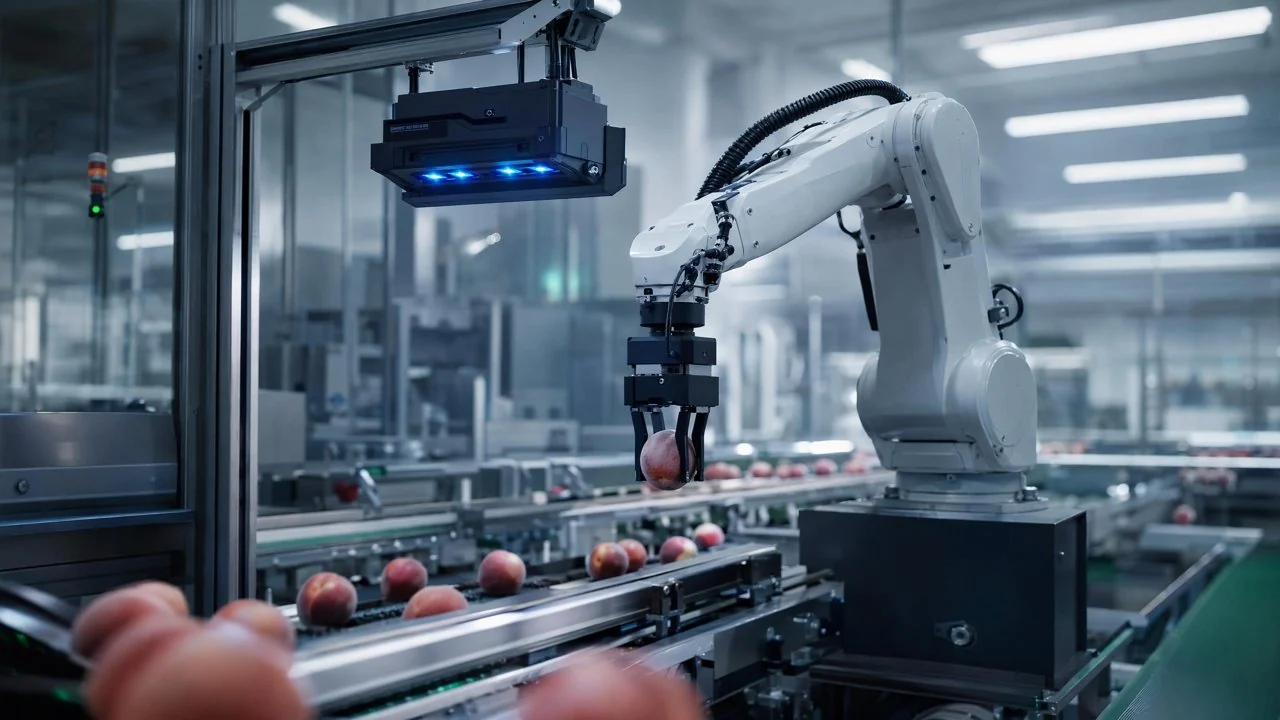
WeLinkirt's DaoAI 3D Robot Vision (proprietary 3D camera + 6D pose estimation, bin picking, gluing/assembly/loading guidance, brain-eye-body closed-loop, sub-millimeter hand-eye coordination) has reduced the micro-defect false negative rate for a leading agricultural processor from 2.1% to <0.4% through high-precision 3D morphology reconstruction and intelligent gripping guidance, significantly enhancing sorting efficiency and product quality. In the food and agriculture industries, every stage from harvesting to processing faces stringent quality control challenges, especially in deep processing where raw material quality requirements are extremely high. Traditional manual sorting is inefficient and prone to subjective errors, while most automation solutions struggle with complex, irregular agricultural product shapes and minute defects. Currently, the industry is moving towards intelligence and refinement, with an increasing demand for high-precision, high-efficiency, and highly flexible automated sorting systems. Particularly with the rise of embodied AI, deeply integrating robot 'perception' and 'action' to achieve stronger environmental adaptability and task execution capabilities is becoming a key industry focus.
Pain Points: Why This Hurdle Is So Difficult to Overcome
A leading agricultural processor, dealing with specific high-value agricultural products (e.g., premium berries, specialty nuts), faced severe quality control challenges. The core pain point was the automated detection and sorting of minute, irregular defects (e.g., slight indentations, tiny scratches, early mold spots, attached foreign objects). The existing production line primarily relied on manual visual inspection supplemented by a few 2D vision systems, leading to: 1. **High False Negative Rate**: For micro-defects smaller than 1 mm in diameter, manual inspection is prone to fatigue, and 2D vision is limited by lighting and surface textures, resulting in a false negative rate as high as 2.1%. 2. **Massive Manual Rework Hours**: To ensure quality, the production line required significant human labor for secondary re-inspection, exceeding 12 hours of manual rework daily, leading to high labor costs. 3. **High Product Scrap Rate**: If minute defects were not detected in time, they could escalate during subsequent processing or transportation, leading to the scrapping of entire batches of products and significant direct economic losses. 4. **Compliance Risks and Brand Reputation Damage**: Food safety regulations are increasingly stringent, and any undetected defects could trigger consumer complaints and harm brand reputation.
The difficulty in solving these issues stems from the inherent complexity of agricultural products and the challenges of the inspection environment. Firstly, **agricultural products vary widely in shape**, are non-standardized, and have significant differences in surface texture, color, and reflective properties, along with natural deformations. All these factors severely interfere with traditional 2D vision's feature extraction. Secondly, **imaging micro-defects is extremely challenging**; they may be hidden on curved surfaces, in depressions, or have colors similar to the product itself, leading to low contrast and difficulty in clear presentation in 2D images. Furthermore, **fast production cycle times** require processing hundreds of products per minute, leaving a very short time window for detection and gripping, placing stringent demands on the system's real-time performance and stability. Traditional rule-based AOI struggles to adapt to the varied forms of agricultural products, while manual inspection is limited by the physiological limits of human vision and subjective judgment. This is akin to the 'ChatGPT moment' for embodied AI not yet arriving, because robots not only need to understand instructions but also need to precisely perceive the real world and act. Traditional vision systems have inherent shortcomings in 'perceiving' minute, irregular defects, and the precision of robot 'action' is also limited by the lack of accurate 3D pose information.
Technical Principles
WeLinkirt's DaoAI 3D Robot Vision system effectively overcomes these challenges through a series of innovative technologies. Its core lies in our proprietary **high-precision 3D camera** and advanced **6D pose estimation algorithms**. Our 3D camera utilizes structured light or laser triangulation principles to perform millisecond-level 3D morphology reconstruction of agricultural product surfaces, acquiring precise Z-axis depth information for each pixel. Unlike traditional 2D images, 3D point cloud data is completely unaffected by lighting, color, surface texture, reflections, and directly captures the true geometric shape and minute deformations of the product. For tiny indentations, protrusions, scratches, and even early mold spots hidden in depressions, 3D data can reveal them with sub-millimeter accuracy, far exceeding the resolution capabilities of human eyes and traditional 2D vision. Based on this 3D data, we combine deep learning algorithms for defect detection, training models to recognize various micro-deformation features. For example, by analyzing local curvature and height gradients, we can precisely identify micro-pits or protrusions as small as 0.2mm in diameter.
In the robotic gripping phase, the system uses its powerful **6D pose estimation** capability to precisely calculate the 3D position (X, Y, Z) and 3D orientation (Rx, Ry, Rz) of the agricultural product in space. This is crucial for bin picking. By analyzing point cloud data, the system can accurately identify stacked, overlapping, or arbitrarily placed products and plan the optimal gripping point and path, avoiding collisions. Our 'brain-eye-body closed-loop' mechanism ensures tight coordination between visual perception and robot action: the 3D camera acts as the 'eye,' providing high-precision 3D perception; AI algorithms act as the 'brain,' making intelligent decisions and pose estimations; and the robotic arm acts as the 'body,' executing precise grips. Through continuous learning and feedback, the system continuously optimizes hand-eye coordination accuracy to achieve sub-millimeter precision. Compared to traditional methods, rule-based AOI struggles to write rules for complex 3D defects and is sensitive to lighting; manual inspection is inefficient, prone to fatigue, and inconsistent in accuracy; and 2D robot vision only provides planar information, unable to handle complex 3D scenarios like stacking and overlapping, let alone detect minute morphological defects. Therefore, DaoAI 3D Robot Vision achieves a qualitative leap in accuracy, robustness, efficiency, and flexibility.
Typical Application Scenarios
- **Micro-Indentation and Damage Detection for Berries**: For fragile berries like blueberries and strawberries, 3D morphology reconstruction accurately identifies minor indentations, damage, or stem damage smaller than 0.5mm in diameter. The challenge lies in the strong reflections and irregular shapes of berries, and the extremely minute nature of defects. DaoAI 3D vision bypasses reflection interference by using depth information to directly identify depressions or protrusions.
- **Foreign Object and Deformation Detection for Nuts**: For nuts like walnuts and almonds, detecting tiny cracks, defects on the shell, and foreign objects such as small stones or wood chips. The challenge lies in the complex surface texture of nuts and the similar color of foreign objects to the product. 3D vision can distinguish subtle height differences between foreign objects and products.
- **Early Disease Spot and Insect Bite Mark Recognition for Vegetables**: For leafy vegetables, detecting early disease spots, insect bite holes, or yellowed areas smaller than 1mm in diameter. The challenge lies in the similar color of disease spots to healthy tissue, and their potential location in leaf folds. 3D vision can identify surface deformations caused by disease spots and guide robots to precisely cut or sort.
- **Fruit Surface Blemish and Ripeness Assessment**: For fruits like apples and oranges, detecting tiny rust spots, abrasions, bumps, and assessing ripeness by combining color spectrum information. The challenge lies in the small color difference between blemishes and the background, and their potential location on curved surfaces. 3D vision, combined with DaoAI ACI (AI-AOI) software's semantic false positive filtering, effectively distinguishes natural textures from defects.
- **Unordered Sorting and Packing Guidance for Agricultural Products**: Before deep processing, precisely picking agricultural products (e.g., potatoes, onions) stacked randomly in bins and placing them onto conveyor belts or into packaging boxes. The challenge lies in the complex stacking and random poses of materials. 6D pose estimation ensures the robot can accurately identify each target and plan the gripping path.
Case Study
A leading agricultural processing enterprise, as a domestic leader in premium fruit and vegetable supply, faced severe quality control challenges on one of its high-value berry deep-processing lines. Before the introduction of WeLinkirt's DaoAI 3D Robot Vision system, this production line primarily relied on 20 workers performing manual visual inspection in three shifts, supplemented by a few 2D vision systems for rough screening of large defects. However, for micro-indentations, early mold spots, and attached foreign objects smaller than 1 mm in diameter, manual inspection suffered from high fatigue, and the false negative rate consistently hovered around 2.1%, leading to customer complaints and product recall risks. Furthermore, to mitigate risks, the company had to add a re-inspection step, investing an additional 12 hours of manual re-inspection labor daily, significantly increasing operating costs. The instability of product quality also indirectly affected its high-end brand image and market competitiveness.
DaoAI 3D Robot Vision successfully reduced the false negative rate for micro-defects in agricultural products from 2.1% to <0.4%, while increasing sorting efficiency by 35%.
To address this pain point, WeLinkirt deployed an automated sorting workstation integrating the DaoAI 3D Robot Vision system. This system includes a proprietary high-precision 3D camera, a six-axis industrial robotic arm, and the core DaoAI Robot Vision software. The deployment process was divided into three phases: First, collecting a small number (approximately 20) of good samples for model training, utilizing DaoAI ACI OS's APDT positive/few-shot learning capabilities to quickly establish a defect recognition model, and incorporating a semantic false positive filtering mechanism to reduce false positives caused by natural textures of agricultural products. Second, performing hand-eye calibration and gripping path optimization to ensure sub-millimeter gripping accuracy of the robotic arm guided by 3D vision. Finally, conducting production line integration and joint debugging, smoothly connecting with existing conveyor belts and PLC systems. After a month of trial operation and optimization, the system's performance exceeded expectations. After deployment, the false negative rate for micro-defects on this production line was consistently controlled at <0.4%, and the false positive rate was reduced by 63%, effectively reducing the need for manual re-inspection. Sorting efficiency increased by 35%, and the cost per piece was significantly reduced. The client highly recognized the system's high stability and precision and plans to extend this solution to other production lines.
The figures above are a typically achievable range in anonymized industry scenarios — a different line or a different batch of parts will move the result either way; on-site measurement governs.
WeLinkirt Solutions and Products
WeLinkirt provided the client with a core solution based on the **DaoAI 3D Robot Vision** intelligent sorting system. This system uses our proprietary high-precision 3D camera as the perception core, combined with powerful 6D pose estimation algorithms, to achieve precise detection of micro-defects in agricultural products and efficient gripping. For model building, we utilize the DaoAI ACI OS, which supports APDT positive/few-shot learning, allowing for rapid training of high-precision defect detection models with only a small number of good samples (1-20 images), significantly shortening the deployment cycle. At the same time, its semantic false positive filtering function effectively avoids misidentifying natural textures of agricultural products as defects. For changeovers, the system supports parametric configuration; for different varieties of agricultural products, only simple adjustments on the software interface are needed, typically completing a changeover within 5min without reprogramming. For deployment and integration, we offer various deployment methods such as SDK/API/Docker, supporting 100% on-premise private deployment to ensure customer data security remains within the factory. The system interacts with the client's existing production line equipment (e.g., conveyor belts, PLCs, SCADA systems) through standard interfaces for smooth integration. Furthermore, the DaoAI World Model, as a unified foundation, provides the system with stronger semantic understanding and cross-scenario generalization capabilities, and continuously learns from production line feedback to improve performance.
Through the deployment of DaoAI 3D Robot Vision, the client not only solved the long-standing problem of micro-defect detection but also achieved an intelligent upgrade of the sorting process. The system's sub-millimeter hand-eye coordination accuracy ensures zero-damage gripping of high-value agricultural products, enhancing product added value. Simultaneously, it significantly reduced labor costs and product scrap rates, improving production efficiency and overall economic benefits. In the long run, stable product quality guarantees brand reputation, enhances market competitiveness, and wins a larger share for the enterprise in the high-end agricultural product market.
FAQ
How does DaoAI 3D Robot Vision handle the irregular shapes and surface textures of agricultural products?
DaoAI 3D Robot Vision performs 3D morphology reconstruction using its proprietary high-precision 3D camera to obtain the true geometric shape and depth information of products. This allows the system to completely bypass interferences from irregular shapes, surface textures, colors, and reflections that affect 2D vision, directly identifying minute defects and deformations in 3D space for more precise detection and gripping.
How does DaoAI Robotics Vision ensure sub-millimeter detection accuracy for micro-defects in agricultural product sorting?
The system utilizes sub-millimeter precision point cloud data from the 3D camera, combined with deep learning algorithms to analyze 3D features such as local curvature and height gradients, enabling it to identify micro-pits, protrusions, or foreign objects as small as 0.2mm in diameter. Concurrently, our 'brain-eye-body closed-loop' and sub-millimeter hand-eye coordination technologies ensure precise correspondence between defect identification and robot gripping.
How does DaoAI 3D Robot Vision adapt to the production demands of multiple agricultural product varieties and rapid changeovers?
DaoAI 3D Robot Vision, combined with the DaoAI ACI OS, supports APDT positive/few-shot learning, allowing for rapid training of new models with only 1-20 good samples. Additionally, the system supports parametric configuration, enabling simple adjustments via the software interface for different agricultural product varieties, typically completing a changeover within 5min without reprogramming.
Full solution for this scenario: the full inspection solution for Food / agriculture · Food Foreign-Object Removal & Grading: Robot Vision Cuts False Positives
This article was generated by AI. Customer cases are simulated scenarios based on real product capabilities and figures are illustrative; see product pages for official benchmarks.