
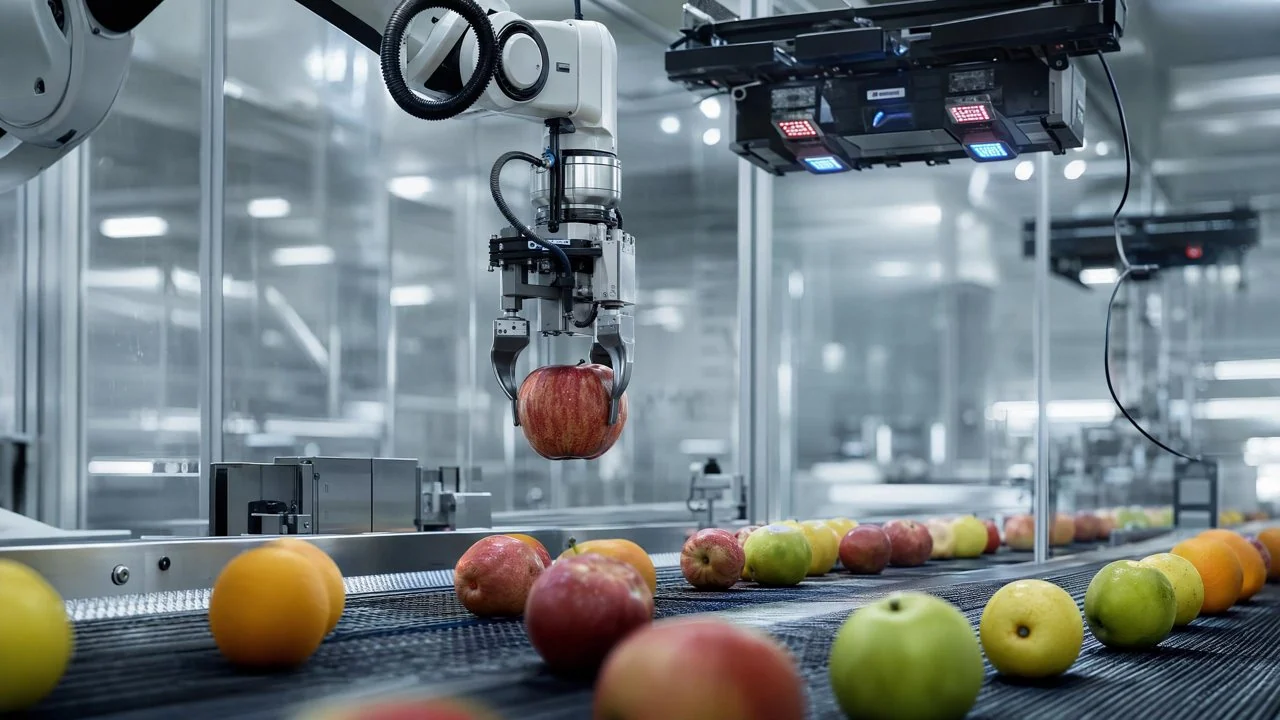
Amidst the convergence of embodied AI and world models, building intelligent systems capable of environmental perception, decision-making, and physical execution is becoming crucial for driving automation upgrades across industries. WeLinkirt DaoAI 3D Robot Vision is a vivid practical application of this trend in the industrial sector, particularly in industries like food/agriculture, where high flexibility and precision are paramount. By deeply integrating proprietary 3D cameras, 6D pose estimation, and a brain-eye-body closed-loop control, DaoAI 3D Robot Vision can precisely identify and sort subtle ripeness differences in agricultural products, elevating previously human-experience-dependent and approximate judgment processes to sub-millimeter hand-eye coordination accuracy.
WeLinkirt DaoAI 3D Robot Vision (proprietary 3D camera + 6D pose estimation, bin picking, glue dispensing/assembly/loading/unloading guidance, brain-eye-body closed-loop, sub-millimeter hand-eye coordination) precisely identifies subtle color, morphology, and texture features on agricultural products, reducing the defect rate for a leading agricultural processor from 3.5% to 0.8%, significantly enhancing the precision and efficiency of produce sorting. The food/agriculture industry faces increasing consumer demand for quality and freshness, coupled with rising labor costs and seasonal employment challenges. In the initial processing of agricultural products, especially for fruit and vegetable ripeness sorting, it directly impacts shelf life, taste, and final selling price. Taking a large fruit processing enterprise as an example, its production line processes tens of thousands of tons of various fruits daily. A critical process is the fine grading of freshly picked fruits according to ripeness to ensure subsequent storage, transportation, and sales strategies align perfectly with the product's state.
Pain Points: Why This Hurdle Was Difficult to Overcome
Traditional methods in agricultural product ripeness sorting face multiple insurmountable obstacles. First, **high false negative and false positive rates**: Manual inspection or conventional 2D vision systems struggle to accurately distinguish between products with similar ripeness but significant quality differences. For instance, a slight brown spot on the surface might indicate early spoilage or just a minor bruise. This leads to a false negative rate as high as 1.5% and a false positive rate around 5%, resulting in a large quantity of marketable good products being mistakenly rejected. Second, **enormous manual re-inspection hours**: To compensate for the shortcomings of automated systems, production lines require a large number of experienced quality inspectors for secondary re-inspection. This not only increases operational costs but also poses significant management challenges, sometimes requiring an additional 30% workforce during peak seasons. Third, **long changeover downtime**: Different varieties and batches of agricultural products have vastly different ripeness judgment criteria and appearance characteristics. Traditional rule-based vision systems often require several hours or even half a day of downtime for parameter adjustment and model switching, severely impacting production efficiency. From a process perspective, agricultural products are non-standardized; their shape, size, color, and surface texture inherently vary, and they are significantly affected by environmental factors such as lighting and humidity. Traditional 2D cameras often suffer from glare and shadows under complex lighting, making feature extraction difficult. Ripeness judgment often requires combining microscopic surface morphology and internal tissue structure, which is beyond the capability of 2D vision. This high variability and complexity make it difficult for traditional rule-based vision systems to build robust discrimination models. This is precisely where the “generality” and “generalization ability” emphasized by current world models and embodied AI manifest in real industrial scenarios: how to enable machines to make accurate judgments and precise operations in complex, unstructured environments, like humans, or even surpass humans.
The root cause lies in ripeness being a continuously changing physical quantity, not a discrete defect type. Its judgment criteria involve color gradients, surface gloss, slight depressions or bulges (3D morphological features), and indirect manifestations like internal tissue density. Traditional 2D vision only captures planar color information, unable to perceive depth and true surface morphology. This prevents accurate capture of critical 3D features such as “slight wrinkles due to dehydration” or “localized depressions caused by softening tissue due to early spoilage.” Furthermore, when agricultural product surfaces are highly reflective or have attachments like water droplets or soil, the signal-to-noise ratio of 2D images sharply decreases, further complicating identification. While manual sorting can compensate for some deficiencies with experience, its efficiency, consistency, and stability are far inferior to automated systems.
Technical Principles
The core of WeLinkirt DaoAI 3D Robot Vision lies in its proprietary industrial-grade 3D cameras and advanced 6D pose estimation algorithms. Our 3D cameras employ structured light or laser triangulation principles to reconstruct high-precision 3D point cloud data of agricultural product surfaces, capturing their precise geometry, surface undulations, and texture depth information with micron-level accuracy. Unlike traditional 2D vision, 3D data is unaffected by ambient light changes, consistently producing high-quality morphological data. After acquiring 3D data, the system uses deep learning-driven 6D pose estimation algorithms to calculate the real-time, robust spatial position (X, Y, Z) and orientation (Rx, Ry, Rz) of each agricultural product. This algorithm integrates point cloud feature extraction, deep neural network regression, and iterative optimization, achieving sub-millimeter position accuracy and sub-degree angular accuracy even when products are stacked, partially obscured, or irregularly oriented.
Compared to traditional methods, DaoAI 3D Robot Vision offers advantages in several aspects: **Upgraded Data Dimension**: From grayscale/RGB information of 2D images to 3D point clouds containing X, Y, Z coordinates, normal vectors, and surface reflectivity, providing richer and more intrinsic object features. This enables the system to identify microscopic morphological defects like slight bruises or localized wilting, which are imperceptible to traditional 2D vision. **Strong Anti-Interference Capability**: 3D vision is inherently immune to ambient light changes, shadows, and reflections, preventing misjudgments caused by lighting variations. **Intelligent Decision-Making and Closed-Loop Control**: Integrated with the DaoAI World Model, the system can semantically understand the acquired 3D data, identify 3D feature patterns corresponding to different ripeness levels, and form a “brain-eye-body” closed loop with the robotic arm's motion control system. This means the system can not only “see” but also “understand” and “execute,” achieving sub-millimeter hand-eye coordination for precise grasping and sorting of targets. This complete chain from perception to decision to execution is the essence of embodied AI, enabling robots to perform continuous, adaptive operations in complex environments, much like humans.
Typical Application Scenarios
- **Fine-grained Grading of Fruit and Vegetable Ripeness**: By analyzing surface color gradients, glossiness, and microscopic depressions or bulges (3D morphological features), the system accurately determines ripeness. Examples include apple redness distribution, citrus peel smoothness and color uniformity, and the uprightness and shade of leafy greens. The challenge lies in the continuous variation of ripeness and the differing judgment criteria between varieties.
- **Early Spoilage and Damage Detection**: Using 3D cameras to detect localized morphological changes on agricultural product surfaces due to early spoilage or mechanical damage, such as slight softening depressions, skin ruptures, or microscopic protrusions of mold spots. These defects might be obscured or confused with normal textures in 2D images, but 3D data clearly reveals their anomalous 3D structures.
- **Foreign Object and Adherent Removal**: Identifying and locating foreign objects like soil, stones, or withered leaves adhering to agricultural products. 3D vision effectively distinguishes the geometric shape and height differences between the product body and foreign objects, guiding robotic arms for precise grasping and removal, avoiding damage to the product.
- **Precise Grasping and Traying of Non-standard Products**: For irregularly shaped agricultural products, such as root vegetables or bulk fruits, 6D pose estimation enables bin picking from unstructured bins. The system quickly identifies the optimal grasp point and pose for each product, guiding robotic arms to efficiently and non-destructively pick and place them into designated positions, significantly improving packaging efficiency and automation.
Case Study
A leading agricultural product processing enterprise, with multiple large production bases in China, primarily engages in the washing, grading, and packaging of various fruits. Before the introduction of the WeLinkirt DaoAI 3D Robot Vision system, the enterprise's sorting lines heavily relied on manual labor, and some critical stages had attempted 2D vision solutions with unsatisfactory results. Taking its core citrus grading line as an example, manual sorters had to judge the ripeness and quality grade of citrus based on color, surface gloss, presence of scars, and softness. This work was labor-intensive, caused severe visual fatigue, leading to low sorting efficiency and poor consistency, especially for slight spoilage or damage, where the false negative rate remained high. The enterprise invested significant labor costs and faced customer complaints and brand reputation damage due to high defect rates. After integrating the DaoAI 3D Robot Vision system, we first retrofitted the production line, incorporating multiple sets of 3D cameras and high-precision robotic arms. By training on thousands of 3D point cloud data of citrus at different ripeness levels, the system quickly built a highly robust ripeness discrimination model. In the initial phase, the system operated collaboratively with human workers, and through continuous feedback from the production line and few-shot learning (APDT), the system's model accuracy and generalization ability rapidly improved. Six months after deployment, the production line achieved 24-hour fully automated operation, with citrus ripeness grading accuracy reaching 1.2 times that of human workers, and the detection rate for early spoilage increased by over 30%. Compared to before deployment, the production line's defect rate decreased from 3.5% to 0.8%, manual re-inspection hours were reduced by 63%, and changeover time was shortened from several hours to within 5 minutes, significantly improving production efficiency and product quality stability.
"DaoAI 3D Robot Vision not only solved our long-standing pain points in agricultural product sorting but also showed us the immense potential of embodied AI in agricultural production. It's not just a tool; it's an intelligent partner that continuously learns and evolves." — Production Director, a leading agricultural product processing enterprise
The figures above are a typically achievable range in anonymized industry scenarios — a different line or a different batch of parts will move the result either way; on-site measurement governs.
WeLinkirt Solution and Products
The WeLinkirt DaoAI 3D Robot Vision solution, with its proprietary 3D camera as the core sensing unit, combined with powerful 6D pose estimation software, provides high-precision, high-flexibility automated sorting capabilities for the agricultural processing industry. Our solution offers the following key capabilities: **High-Precision 3D Morphology Reconstruction**: The proprietary 3D camera can acquire complete 3D morphological data of agricultural products with sub-millimeter accuracy, unperturbed by complex lighting and product surface reflections. **Robust 6D Pose Estimation**: Deep learning-based algorithms stably and quickly identify targets and estimate their precise 6D pose, even in scenes with unstructured stacking and partial occlusion, providing accurate grasping guidance for robotic arms. **Brain-Eye-Body Closed-Loop Control**: The system smoothly integrates with mainstream robotic arm controllers, achieving full-link closed-loop control from 3D perception and intelligent decision-making to precise grasping, ensuring sub-millimeter hand-eye coordination accuracy. **Rapid Modeling and Changeover**: Utilizing the APDT positive sample/few-shot learning capability of the DaoAI ACI (AI-AOI) software system, new inspection models can be quickly trained with only 1–20 good samples, drastically reducing new-product introduction and changeover time to 5min. Concurrently, combined with the DaoAI World Model, the system possesses cross-scenario generalization capabilities, continuously learning from production line feedback to improve recognition accuracy and adaptability. For deployment, we offer SDK/API/Docker and other forms, supporting 100% local private deployment, ensuring data security remains on-site and meeting stringent customer requirements for data privacy.
Through the above solution, customers can achieve: **Significant Product Quality Improvement**: Defect rate reduced by 77%, product consistency greatly improved. **Substantial Reduction in Operational Costs**: Manual re-inspection hours reduced by 63%, saving significant labor costs. **Significant Increase in Production Efficiency**: Changeover time shortened to 5min, overall production line utilization increased by 15%. **Shortened Return on Investment Period**: Through efficiency improvement and quality optimization, customers can recoup their investment within 1.5 years. Our solution truly brings the concept of embodied AI from the laboratory to the industrial site, delivering new productivity enhancements for the agricultural processing industry.
FAQ
How does DaoAI 3D Robot Vision address the challenge of varying shapes and non-standardized agricultural products?
DaoAI 3D Robot Vision leverages its proprietary 3D cameras for high-precision 3D morphology reconstruction of agricultural products. Combined with deep learning-driven 6D pose estimation algorithms, it accurately identifies and locates irregularly shaped produce. The system learns intrinsic 3D geometric features of objects, rather than limited 2D contours, enabling robust handling and precise grasping of non-standardized items.
In agricultural product ripeness sorting, how does this system distinguish subtle color and morphological differences?
Our 3D camera not only acquires high-precision 3D morphology but also captures high-resolution color texture information simultaneously. Integrated with the semantic understanding capabilities of DaoAI AI vision foundation models, the system can deeply analyze complex features such as color gradients, glossiness, and microscopic depressions or bulges on the produce surface. Through multi-modal fusion, it determines ripeness levels, far exceeding the discriminative ability of the human eye and traditional 2D vision.
How does the DaoAI 3D Robot Vision system achieve rapid changeover and continuous learning?
The system utilizes DaoAI ACI OS's APDT positive/few-shot learning technology, requiring only 1–20 good samples to quickly train models for new product changeovers, reducing downtime to 5min. Furthermore, integrated with the DaoAI World Model, the system possesses the ability to continuously learn from production line feedback, optimizing models through edge computing and cloud collaboration, thereby enhancing generalization and adaptability to new scenarios and defects.
Full solution for this scenario: the full inspection solution for Food / agriculture
This article was generated by AI. Customer cases are simulated scenarios based on real product capabilities and figures are illustrative; see product pages for official benchmarks.