
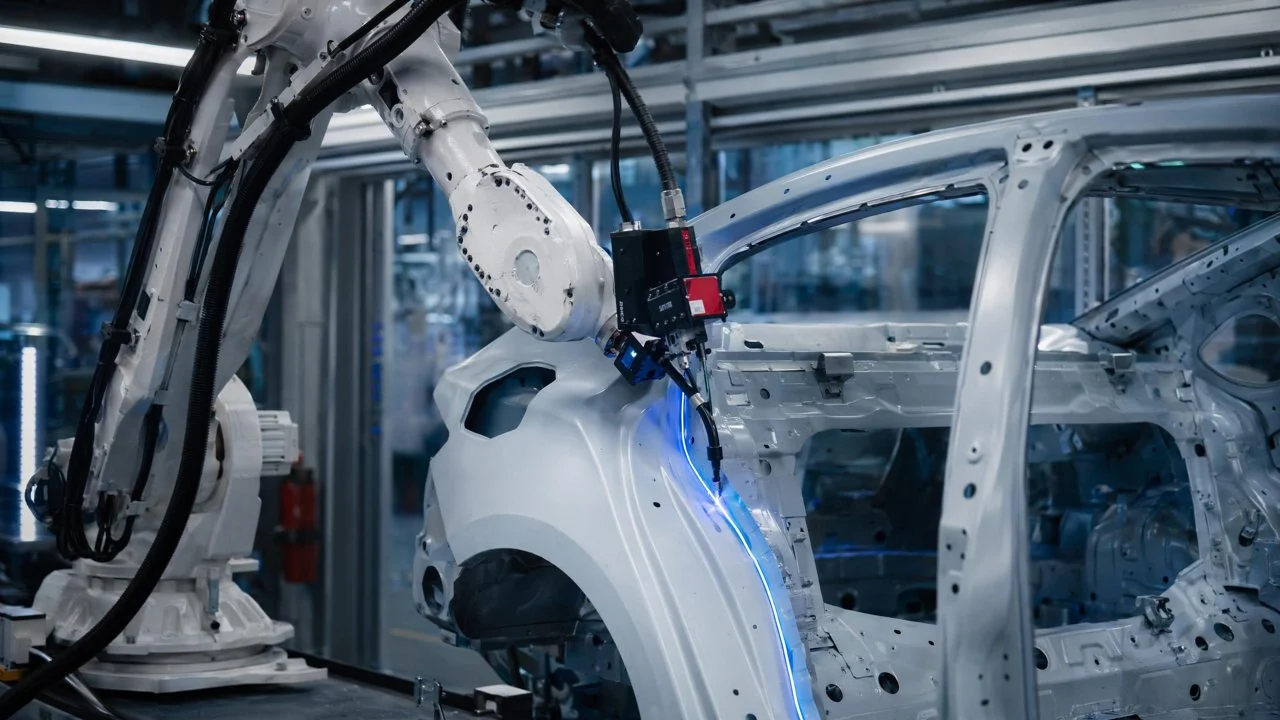
With the open-sourcing of the world's first embodied-specific MoE video model, it provides new impetus for the development of robot vision and 3D grasping and guiding technologies. WeLinkirt keeps up with the industry trend, and its DaoAI 3D robot vision plays an important role in the gluing/sealing process of the automotive/parts industry.
User Scenario: A leading automotive parts supplier has the gluing/sealing process as a critical link in its automotive parts production line. The products involve a variety of automotive parts, such as engine cylinder heads and door frames. The inspection objects are the quality and path of the glue, ensuring that the glue is evenly applied, has no breaks, and the path is accurate to guarantee the sealing performance and overall quality of the parts.
Pain Points: Traditional gluing inspection methods have many quantitative difficulties. The miss-detection rate is relatively high, about 3%, which causes some unqualified products to flow into subsequent processes. The false-alarm rate is also around 5%, increasing unnecessary re-inspection workload and time costs. In addition, the labor cost is high, and the changeover time is long. Each changeover takes 30 minutes, seriously affecting production efficiency. Although the open-sourcing of the world's first embodied-specific MoE video model provides new impetus for the development of robot vision, the existing technology is difficult to quickly use this advantage to solve the gluing inspection problem.
Technical Principle
DaoAI 3D robot vision uses a self-developed 3D camera. Its imaging principle is based on structured light depth perception technology. By projecting a specific structured light pattern onto the object to be measured and using the camera to capture the deformation of the pattern reflected from the object surface, the three-dimensional coordinates of each point on the object surface are calculated to achieve high-precision three-dimensional shape reconstruction. In terms of algorithms, a 6D pose estimation algorithm is used, which can accurately determine the position and orientation of the object in three-dimensional space. This algorithm combines the advantages of deep learning and traditional vision algorithms and is trained with a large amount of sample data, enabling the model to adapt to objects of different shapes, materials, and surface textures. For gluing inspection, by analyzing the reconstructed 3D image, features such as the position, width, height, and continuity of the glue are accurately identified, and it can quickly determine whether the gluing meets the standards. At the same time, based on the brain-eye-body closed-loop technology, the system can adjust the gluing path in real-time according to the inspection results, achieving sub-millimeter hand-eye coordination and ensuring the gluing quality. This technical principle is effective because the structured light depth perception technology can provide high-precision three-dimensional data, the 6D pose estimation algorithm and deep-learning model can accurately identify and analyze gluing features, and the brain-eye-body closed-loop technology can achieve real-time feedback and adjustment, thus effectively solving the deficiencies of traditional inspection methods.
- Structured light depth perception technology provides high-precision three-dimensional data.
- 6D pose estimation algorithm and deep-learning model accurately identify and analyze gluing features.
- Brain-eye-body closed-loop technology achieves real-time feedback and adjustment.
WeLinkirt Solution and Product
Centered around DaoAI 3D robot vision, this product has high-precision capabilities such as unordered bin picking, gluing/assembly/loading and unloading guidance. In the automotive gluing inspection scenario, the self-developed 3D camera performs 3D scanning and imaging on the gluing area to obtain accurate three-dimensional data of the glue. The 6D pose estimation algorithm determines the position and orientation of the glue in real-time. Through data analysis, it can judge whether there are defects in the gluing. At the same time, based on the brain-eye-body closed-loop technology, the system feeds the inspection results back to the gluing equipment and corrects the gluing path in real-time to ensure the gluing quality. The supporting DaoAI ACI (AI-AOI) software system can realize rapid programming and model training. One good product can complete zero-code automatic programming in 5 minutes. Using the APDT positive sample/few-sample learning (1-20 good products) and semantic false-alarm filtering functions, it improves the detection efficiency and accuracy.
DaoAI 3D robot vision realizes the efficient collaboration of gluing inspection and path correction, improving the production quality of automotive parts.
Quantitative Results: After using DaoAI 3D robot vision, the detection rate of gluing defects reaches over 99%, and the miss-detection rate is reduced to less than 1%. The false-alarm rate is reduced by 60%, greatly reducing the re-inspection workload. The changeover time is shortened from the original 30 minutes to 5 minutes, significantly improving production efficiency.
FAQ
What is the accuracy of DaoAI 3D robot vision in automotive gluing inspection?
DaoAI 3D robot vision uses a self-developed 3D camera and advanced algorithms to achieve sub-millimeter hand-eye coordination. It has high accuracy in detecting features such as the position, width, and height of the glue, ensuring the gluing quality.
Why can the changeover time be significantly shortened after using this product?
The supporting DaoAI ACI OS can perform zero-code automatic programming. One good product can complete the programming in 5 minutes, reducing the programming and debugging time during changeover. So the changeover time is shortened from 30 minutes to 5 minutes.
How does DaoAI Robotics Vision reduce the false-alarm rate?
Using APDT positive sample/few-sample learning (1-20 good products) and semantic false-alarm filtering functions, it analyzes and filters the detection data, effectively reducing the false-alarm rate and the re-inspection workload.
Full solution for this scenario: the full inspection solution for Automotive / parts · 100% Inline 3D Inspection & Path Correction for Automotive Glue Dispensing
This article was generated by AI. Customer cases are simulated scenarios based on real product capabilities and figures are illustrative; see product pages for official benchmarks.