
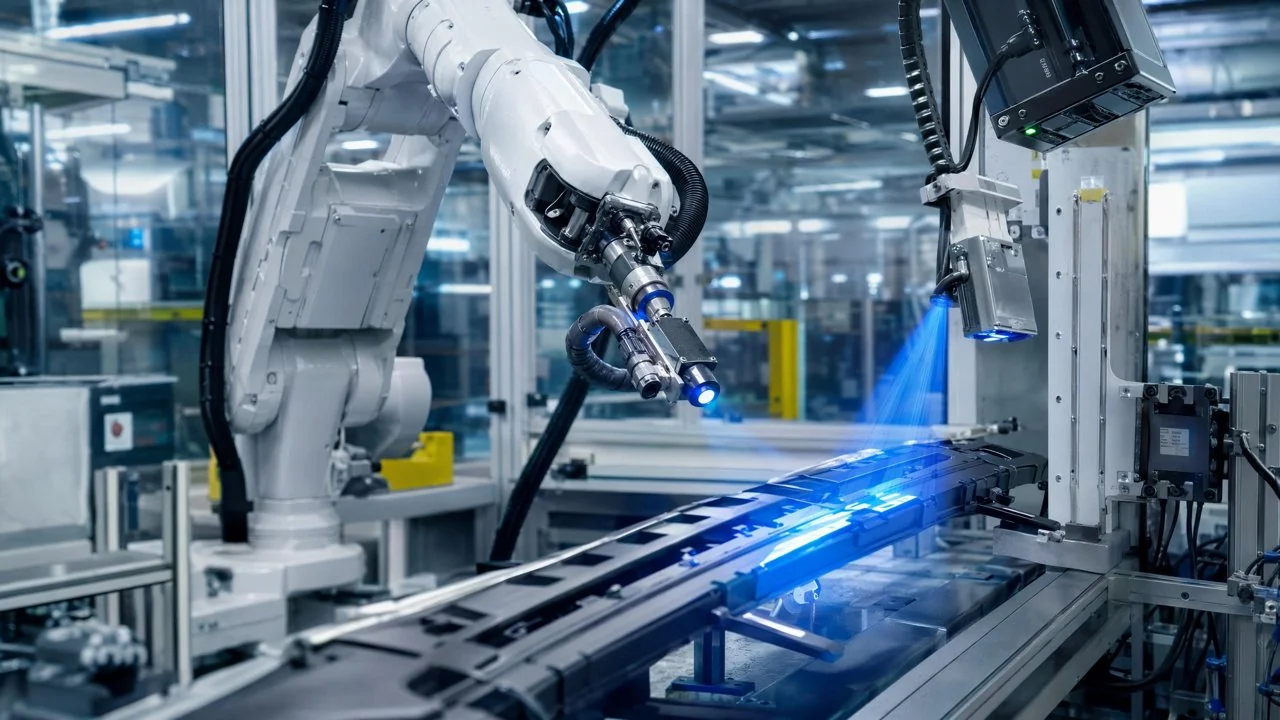
In the automotive/parts industry, the quality of the gluing/sealing process directly affects the performance and reliability of products. DaoAI 3D robot vision from WeLinkirt provides a reliable guarantee for this critical process with its high-precision detection and real-time correction capabilities.
Industry Background and User Scenario: The automotive/parts industry is an important part of modern manufacturing. The gluing/sealing process plays a crucial role in it. The quality of gluing not only affects the sealing, sound-insulation, and waterproof performance of automobiles but also impacts the service life and safety of parts. A leading automotive parts supplier's production line for the gluing/sealing process involves important parts such as automobile engine cylinder heads. During the gluing process, strict inspections are required for the width, height, and continuity of the glue to ensure that the gluing quality meets the product requirements. The main inspection object is the sealing strip on the engine cylinder head.
In-depth Analysis of Pain Points: Why is it Difficult?
Under traditional detection methods, the gluing process faces many challenges. Firstly, the false-negative rate is relatively high, reaching about 3%. This means that some unqualified products will flow into subsequent processes, which may lead to a decline in the performance of the entire product and even pose safety hazards. Secondly, the false-positive rate is around 5%, which increases the unnecessary re-inspection workload and reduces production efficiency. Quantitatively, a 3% false-negative rate and a 5% false-positive rate can accumulate into a considerable number in large-scale production. In addition, the gluing robot needs to accurately control the gluing path, but traditional methods have difficulty achieving real-time path correction. This is because traditional detection means usually only obtain two-dimensional information and cannot comprehensively understand the three-dimensional morphology of the glue, making it difficult to accurately judge the actual situation of the gluing. Moreover, traditional detection methods lack an effective feedback mechanism and cannot timely transmit the detection results to the gluing robot, resulting in unstable gluing quality.
Environmental factors during the gluing process also increase the difficulty of detection. For example, changes in light and impurities such as dust in the workshop may interfere with the normal operation of the detection equipment. At the same time, the gluing processes of different models of parts vary, and traditional detection methods have difficulty quickly adapting to new gluing processes. The model-change time is relatively long, usually about 20 minutes, which greatly reduces the flexibility and efficiency of production.
Technical Principle
DaoAI 3D robot vision uses a self-developed 3D camera for imaging, which is based on structured light technology. Structured light technology projects a specific light pattern onto the surface of the detection object, and the camera captures the deformation information of the reflected light. Since the shape of the object surface is different, the deformation of the reflected light is also different. Using the triangulation principle, the three-dimensional coordinates of the object surface can be calculated according to the deformation of the reflected light, thus achieving high-precision three-dimensional morphology reconstruction. Compared with traditional two-dimensional imaging technology, 3D imaging can provide more abundant surface information and more comprehensively reflect the actual situation of the gluing.
In terms of 6D pose estimation, a deep-learning algorithm is used to analyze the collected 3D data. The deep-learning algorithm can learn the features and geometric information of the object. Through a large amount of training data, it can accurately identify the position and pose of the object. Even in complex environments, such as changes in light and occlusion, it can accurately estimate the pose. For gluing detection, by analyzing the reconstructed 3D data, parameters such as the width and height of the glue can be accurately measured, and the continuity of the glue can be judged. Since 3D data contains rich surface information, it can detect gluing defects more comprehensively and accurately, while traditional methods are difficult to achieve such accurate detection due to the lack of three-dimensional information.
Typical Application Scenarios
- Glue Width Detection: During the gluing process of the engine cylinder head, the glue width needs to be strictly controlled within a certain range. DaoAI 3D robot vision can accurately measure the glue width by analyzing the reconstructed 3D data. The difficulty lies in the fact that the glue edge may be uneven, and traditional detection methods are prone to misjudgment. 3D vision can observe the glue edge from multiple angles to accurately determine whether the width meets the requirements.
- Glue Height Detection: The height of the glue directly affects the sealing effect. This technology can accurately measure the glue height through three-dimensional morphology reconstruction. The difficulty is that there may be slight undulations on the glue surface, and traditional two-dimensional detection methods have difficulty accurately measuring the height. 3D vision can capture these subtle changes to ensure that the glue height meets the standard.
- Glue Continuity Detection: The continuity of the glue is crucial for the sealing performance. DaoAI 3D robot vision can determine whether there is an interruption in the glue by analyzing the 3D data. The difficulty is that some subtle interruptions may be difficult to detect by the naked eye or traditional detection methods, while 3D vision can use its high-precision imaging ability to accurately detect these subtle defects.
- Glue Position Detection: The glue needs to be accurately applied to the specified position. This technology can accurately determine whether the glue position is correct through 6D pose estimation and 3D data matching. The difficulty is that the shape of parts such as the engine cylinder head is complex, and traditional detection methods have difficulty accurately determining the glue position. 3D vision can perform accurate matching according to the 3D model of the parts to ensure the accuracy of the glue position.
Implementation Case
A large-scale automotive parts supplier has a large-scale production and needs to process a large number of engine cylinder head gluing processes every day. Before introducing DaoAI 3D robot vision, the supplier used traditional detection methods and faced problems such as a high false-negative rate, high false-positive rate, and long model-change time. During the implementation process, the WeLinkirt team first conducted a detailed investigation and analysis of the supplier's production environment and process, and carried out customized development of the system according to the actual situation. Then, the equipment was installed and debugged, and the operators were trained professionally. After a period of trial operation and optimization, the system was officially launched.
After the system was launched, the detection rate of gluing defects increased from a low level to 98%, the false-negative rate decreased from about 3% to <2%, and the false-positive rate decreased from 5% to 1%. The model-change time was shortened from 20 minutes to 5 minutes, greatly improving production efficiency and product quality.
WeLinkirt's Solution and Product
The core solution is based on DaoAI 3D robot vision. During the detection process, the self-developed 3D camera collects the 3D data of the glue on the engine cylinder head in real-time. The 6D pose estimation algorithm accurately positions the cylinder head to ensure the accuracy of the detection. The system can analyze the gluing data in real-time and determine whether there are defects such as too narrow width, insufficient height, or glue interruption. When a defect is detected, through the brain-eye-body closed-loop mechanism, the information is timely feedback to the gluing robot to achieve real-time correction of the gluing path, ensuring the consistency of the gluing quality. At the same time, it can be paired with the DaoAI ACI (AI-AOI) software system, which uses its positive-sample/few-sample learning function to quickly program new gluing processes and reduce the model-change time.
Quantitative Results: By applying DaoAI 3D robot vision, the detection rate of gluing defects has been increased to 98%, the false-negative rate has been reduced to <2%, and the false-positive rate has been reduced to 1%, effectively reducing the unnecessary re-inspection workload. At the same time, the model-change time has been shortened from 20 minutes to 5 minutes, greatly improving production efficiency and meeting the production needs of different models of parts.
FAQ
What gluing defects can DaoAI 3D robot vision detect?
DaoAI 3D robot vision can detect defects such as too narrow glue width, insufficient glue height, and glue interruption. It collects 3D data through a self-developed 3D camera and then conducts precise analysis on the data, comprehensively understanding the gluing situation. The detection rate can reach 98%, ensuring accurate detection of various gluing defects.
How much can the model-change time be shortened after using this product?
When paired with the DaoAI ACI OS and using its positive-sample/few-sample learning function, new gluing processes can be quickly programmed. The model-change time can be shortened from the original 20 minutes to 5 minutes, greatly improving production efficiency and flexibility.
How does DaoAI Robotics Vision achieve gluing path correction?
Through the brain-eye-body closed-loop mechanism, the system detects gluing data in real-time. When a gluing defect is detected, the information is timely feedback to the gluing robot. The robot adjusts the gluing path according to the feedback to achieve real-time correction and ensure the consistency of gluing quality.
Full solution for this scenario: Automotive / parts industry solutions
This article was generated by AI. Customer cases are simulated scenarios based on real product capabilities and figures are illustrative; see product pages for official benchmarks.