
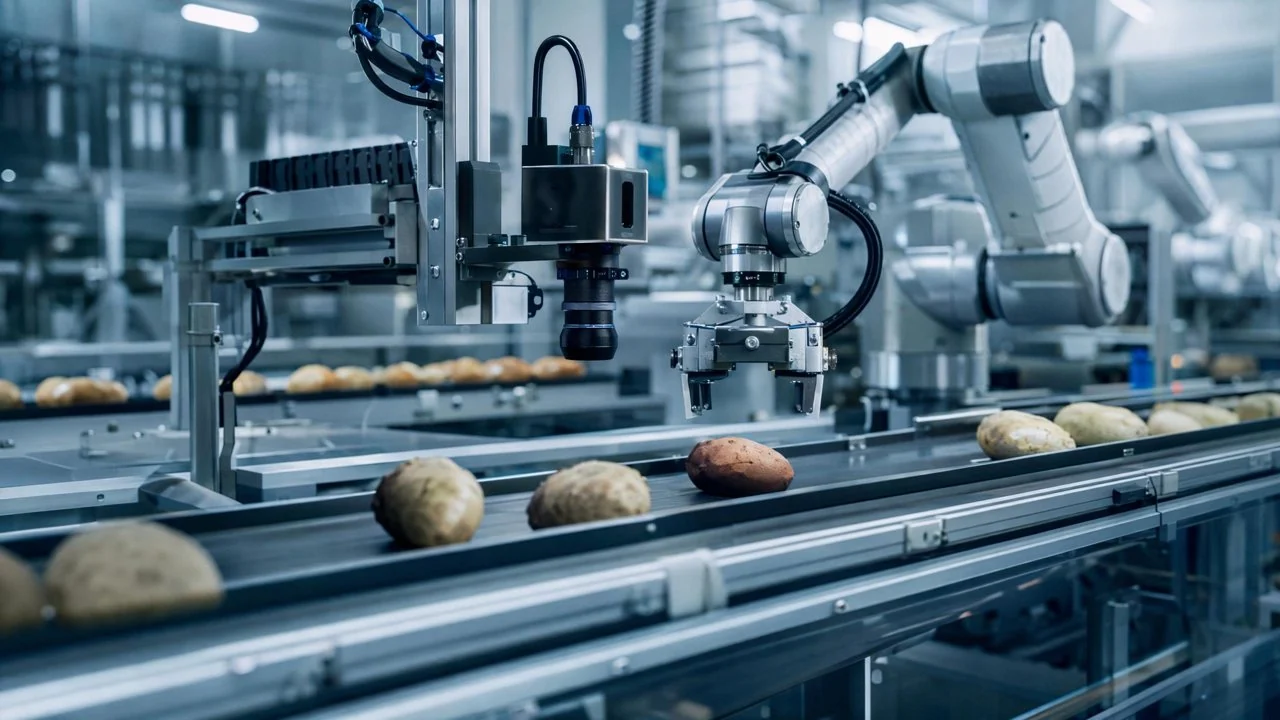
In the food/agriculture industry, accurate sorting of agricultural product maturity is crucial. DaoAI 3D robot vision from WeLinkirt brings an innovative solution to this process.
In the food/agriculture industry, the quality and maturity of agricultural products directly affect their market value and subsequent processing. A certain agricultural product processor's production line mainly deals with a variety of fruits and vegetables. In the sorting process, it is necessary to classify them into different grades according to their maturity. The traditional sorting method relies on manual labor, which is not only inefficient but also prone to misjudgment. This production line processes a large amount of agricultural products every day, and manual sorting can hardly meet the increasing production demand. Moreover, long-term manual work will cause fatigue and affect the accuracy of sorting.
Pain Points: Why is this hurdle difficult to cross?
From multiple dimensions, this production line faces many difficulties. In terms of the missed-detection rate, the manual sorting missed-detection rate is as high as 15%. This means that a considerable number of agricultural products that do not meet the specific maturity requirements will flow into the next process, affecting the quality of the final product. The false-alarm rate is also not negligible, reaching 20%, which will cause a waste of resources and an increase in subsequent processing costs. The manual re-judgment working hours account for 30% of the total working hours, greatly reducing the overall work efficiency. Due to the wide variety of agricultural products, the change-over downtime is relatively long, with an average of 30 minutes each time, seriously affecting the production rhythm. In terms of compliance risks, inaccurate sorting may lead to products not meeting market standards and face risks such as product recalls. The unit cost also remains high due to high labor costs and low efficiency.
The root causes of these problems lie in multiple aspects such as process, imaging, and materials. In terms of the process, there is no clear quantitative standard for judging the maturity of agricultural products. Different people have different judgment methods, lacking a unified specification. In terms of imaging, the appearance of agricultural products is complex, with different colors and shapes, and there may be stains, scratches and other interference factors on the surface. Traditional imaging technology is difficult to accurately capture the maturity features. As for materials, agricultural products are living organisms, and their maturity can change in a short time, increasing the difficulty of detection. Combining with today's hot topics, the traditional manual sorting method cannot quickly master a variety of maturity judgment standards and handle complex situations like robots that learn from a large amount of 'human work records'.
Technical Principle
DaoAI 3D robot vision uses a self-developed 3D camera to obtain the three-dimensional morphology information of agricultural products. Its 6D pose estimation algorithm can accurately determine the position and orientation of agricultural products in space, providing accurate positioning for subsequent grasping and sorting. In the bin picking function, the algorithm can identify the position and orientation of agricultural products and guide the robotic arm to grasp accurately. For glue application/assembly/loading and unloading guidance, through accurate visual feedback, the accuracy of the robotic arm during operation is ensured. The brain-eye-body closed-loop system enables efficient collaboration between the vision system, the control system, and the robotic arm, improving the overall work efficiency. The sub-millimeter hand-eye coordination ability ensures high precision when the robotic arm grasps and places agricultural products. This technology is effective because it comprehensively considers the three-dimensional features and spatial information of agricultural products, avoiding misjudgments caused by the unclear surface features of traditional two-dimensional imaging technology.
Compared with traditional rule-based AOI and manual visual inspection, DaoAI 3D robot vision has significant advantages. Rule-based AOI usually conducts detection based on preset rules. For agricultural products with complex appearance and maturity changes, it is difficult to formulate comprehensive and accurate rules, prone to missed detections and false alarms. Manual visual inspection is limited by human physiological limits and subjective factors, with low efficiency and unstable accuracy. DaoAI 3D robot vision can continuously optimize the detection algorithm by learning a large amount of sample data, adapt to the characteristics of different agricultural products, and improve the accuracy and efficiency of detection.
Typical Application Scenarios
- Color sorting: Obtain the color information of agricultural products through a 3D camera and combine it with the maturity model to judge their maturity level. The difficulty lies in that the color of agricultural products is affected by factors such as lighting and surface stains, and the algorithm needs to perform correction and analysis.
- Shape detection: Detect whether the shape of agricultural products meets the standards and screen out products with irregular shapes or damages. The difficulty lies in the large differences in the shapes of different varieties of agricultural products, and multiple shape models need to be established.
- Size classification: Classify agricultural products into different size grades according to the size measured by the 3D camera. The difficulty lies in accurately measuring the boundaries and sizes of agricultural products to avoid inaccurate classification due to measurement errors.
- Surface defect detection: Detect whether there are defects such as rot and wormholes on the surface of agricultural products. The difficulty lies in that the characteristics of defects are not obvious and are easily covered by natural textures or stains on the surface.
Implementation Case
A medium-sized agricultural product processing enterprise introduced the DaoAI 3D robot vision system for the sorting of agricultural product maturity. This enterprise processes about 5 tons of various agricultural products every day. Before using this system, the manual sorting efficiency was low, and the missed-detection and misjudgment situations were serious. During the implementation process, the technical team of WeLinkirt first conducted a detailed investigation and analysis of the production line, and carried out customized development of the system according to the enterprise's needs and the characteristics of agricultural products. After one week of debugging and optimization, the system was officially put into use. Before the implementation, the missed-detection rate was 15% and the false-alarm rate was 20%. After the implementation, the missed-detection rate was reduced to <1%, and the false-alarm rate was reduced to 3%. The change-over time was shortened from an average of 30 minutes to 5 minutes, greatly improving the production efficiency.
The application of the DaoAI 3D robot vision system has enabled the agricultural product sorting to achieve a leap from manual extensive-style to intelligent and precise-style.
WeLinkirt's Solution and Product
DaoAI 3D robot vision from WeLinkirt provides strong support for agricultural product sorting with its core self-developed 3D camera and advanced algorithms. In terms of modeling, by collecting a large amount of sample data of different varieties and maturities of agricultural products, an accurate maturity judgment model is trained. When changing the product type, the system can quickly adjust the parameters to adapt to new varieties of agricultural products, and the change-over can be completed in only 5 minutes. The deployment method is flexible, supporting SDK / API / Docker, and an appropriate deployment scheme can be selected according to the enterprise's actual situation. In terms of integration, it can be smoothly connected with the enterprise's existing production line equipment to achieve data sharing and collaborative work. At the same time, the supporting DaoAI ACI (AI-AOI) software system can further improve the detection accuracy, and quickly identify the features of agricultural products through the feature recognition of the visual basic model and few-shot learning.
Quantitative Results
The DaoAI 3D robot vision system has brought significant quantitative results to the enterprise. In terms of detection accuracy, the missed-detection rate has been reduced from 15% to <1%, and the false-alarm rate has been reduced from 20% to 3%, greatly improving the product quality. The change-over time has been shortened from an average of 30 minutes to 5 minutes, improving the production flexibility and efficiency. In terms of labor costs, due to the reduction of the workload of manual sorting and re-judgment, the labor cost has been reduced by 60%, saving a large amount of expenses for the enterprise and enhancing its market competitiveness.
FAQ
How many different types of agricultural products can the DaoAI 3D robot vision system adapt to?
The DaoAI 3D robot vision system has strong adaptability. By collecting sample data of different agricultural products for modeling, it can adapt to the maturity sorting of a variety of common agricultural products. In practical applications, it can handle the sorting of more than a dozen different fruits and vegetables.
Is the deployment of this system complicated?
No, it isn't. The DaoAI 3D robot vision system supports multiple deployment methods such as SDK / API / Docker. The technical team will customize a solution according to the enterprise's production line situation and can smoothly connect with existing equipment. The deployment process is efficient and smooth.
After using this system, how much can the production efficiency be improved?
After using the DaoAI 3D robot vision system, the production efficiency is significantly improved. The change-over time is shortened from an average of 30 minutes to 5 minutes. At the same time, the missed-detection and false-alarm rates are greatly reduced, reducing manual re-judgment and other processes. The comprehensive production efficiency can be improved by about 50%.
Full solution for this scenario: the full inspection solution for Food / agriculture
This article was generated by AI. Customer cases are simulated scenarios based on real product capabilities and figures are illustrative; see product pages for official benchmarks.