
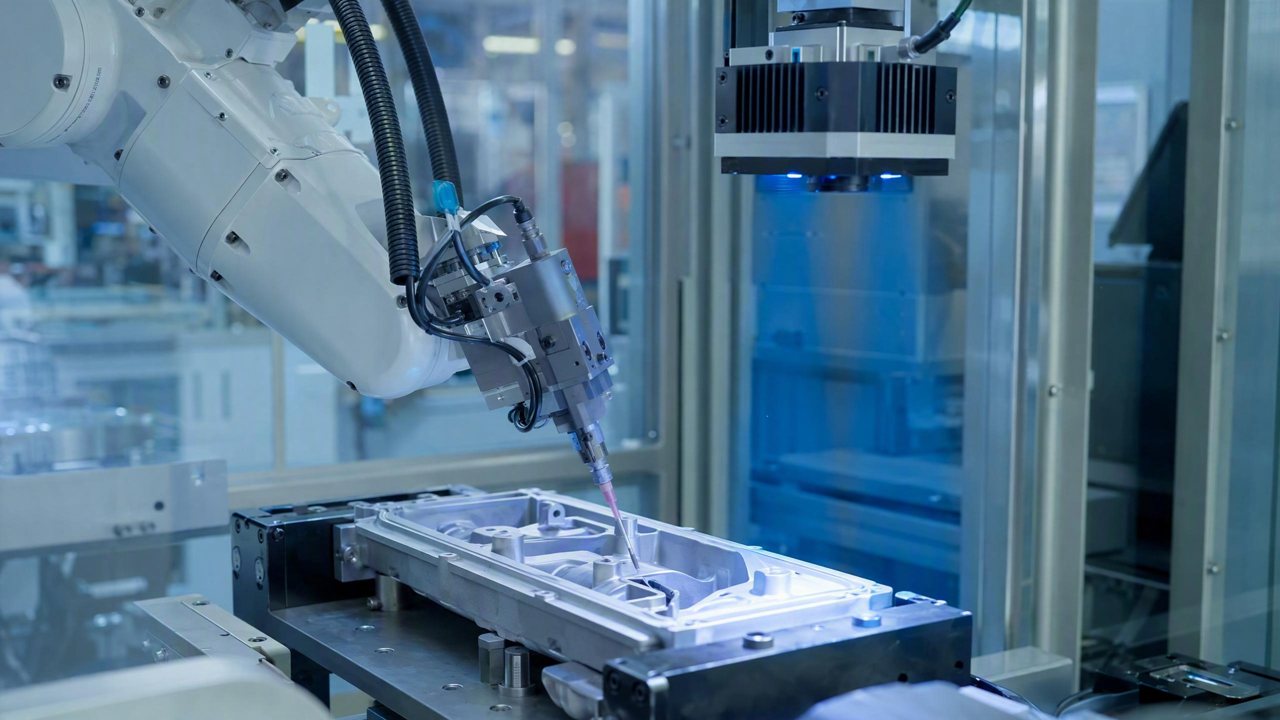
DaoAI 3D Robot Vision (proprietary 3D camera + 6D pose estimation, bin picking, adhesive application/assembly/load/unload guidance, brain-eye-body closed-loop, sub-millimeter hand-eye coordination), by integrating APDT few-shot auto-training, reduces the missed detection rate for automotive component adhesive sealing from a common >0.8% to <0.2%, effectively preventing rework and quality risks caused by adhesive defects.
DaoAI 3D Robot Vision (proprietary 3D camera + 6D pose estimation, bin picking, adhesive application/assembly/load/unload guidance, brain-eye-body closed-loop, sub-millimeter hand-eye coordination), by integrating APDT few-shot auto-training, reduces the missed detection rate for automotive component adhesive sealing from a common >0.8% to <0.2%, effectively preventing rework and quality risks caused by adhesive defects. In automotive and component manufacturing, precision adhesive application and sealing are critical processes for ensuring product performance and safety. Whether it's the seam sealing of car body panels, gasket application for engine components, or sealing of new energy battery packs, the quality of adhesive directly impacts the vehicle's waterproofing, dustproofing, NVH (Noise, Vibration, Harshness) performance, and even structural integrity. With increasing complexity in automotive design and demand for personalization, adhesive paths have become more intricate, posing higher demands on application precision and inspection efficiency. A leading Tier-1 automotive component supplier, specializing in high-precision body structure parts, requires automated adhesive application on various complex curved surfaces across its production lines, ensuring the continuity, uniformity, and width of adhesive beads meet design standards.
Pain Points: Why This Challenge Is So Difficult
The core challenge faced by this supplier was how to perform 100% in-line detection of adhesive defects on complex curved surfaces at high production speeds, while also achieving rapid changeovers and path correction. Traditional inspection methods presented several limitations: First, manual visual inspection was inefficient and prone to missed detections due to fatigue, especially during night shifts or extended operations, with missed detection rates potentially exceeding 1.5%, requiring significant human effort for re-inspection and leading to high manual re-inspection hours. Second, rule-based 2D vision systems struggled with inspecting adhesive application on complex curved surfaces. Due to varying viewing angles, lighting conditions, and differences in adhesive thickness and height, 2D images often failed to accurately distinguish between normal adhesive beads and defects such as overflow, discontinuity, or air bubbles, resulting in false alarm rates often above 8%, severely disrupting production decisions. Third, in multi-variety, small-batch production modes, each product changeover necessitated several hours for reconfiguring and debugging inspection programs, leading to excessive downtime and impacting overall production line utilization. Furthermore, for minute deviations during adhesive application, such as path misalignment or uneven adhesive volume, traditional methods struggled to provide real-time sensing and guidance for robot correction, often resulting in batches of defective products before issues were identified.
The root cause of these pain points lies in the inherent complexity of the adhesive application process. Automotive component surfaces are often curved, and the color, material, and reflective properties of adhesives vary, making it difficult to establish uniform visual inspection standards. Adhesive defects are often millimeter or even sub-millimeter level morphological changes, requiring high-precision 3D data for accurate capture. Simultaneously, current industry trends, such as the exploration of humanoid robot's general motion “cerebellum” in adapting to complex environments, also indirectly confirm that robots need stronger “perception” capabilities to cope with uncertainty and complex working conditions. This is precisely the core philosophy behind DaoAI 3D Robot Vision in addressing production line adhesive problems—providing robots with a “brain” capable of deeply understanding 3D space and continuously learning.
Technical Principles
The core of the DaoAI 3D Robot Vision solution from WeLinkirt lies in its proprietary high-precision 3D camera and advanced 6D pose estimation algorithms, combined with the APDT (Automated Pre-trained Detection and Training) few-shot auto-training technology within the DaoAI AI AOI software system. Our self-developed 3D camera utilizes structured light projection technology to rapidly and accurately acquire high-density point cloud data of the measured component surface, reconstructing real 3D morphology at millimeter or even sub-millimeter precision, completely overcoming the lack of height and depth information in 2D vision. Based on this high-precision 3D data, DaoAI's 6D pose estimation algorithm can determine the object's position and orientation in 3D space in real-time with high accuracy, providing the foundation for real-time correction of robot adhesive application paths. Notably, the APDT few-shot auto-training technology enables DaoAI 3D Robot Vision to complete model training with only 1-20 good samples when facing new products or defects, significantly shortening changeover times and ensuring high-precision inspection results.
Compared to traditional methods, the advantages of DaoAI 3D Robot Vision are clear. Traditional rule-based AOI systems require engineers to manually set numerous inspection rules and thresholds, which is time-consuming and labor-intensive, and their generalization ability for complex defects is poor, struggling to cope with subtle changes in adhesive color, thickness, and reflectivity. Manual visual inspection, moreover, is limited by human vision and subjective judgment. DaoAI 3D Robot Vision, however, uses deep learning models to automatically learn adhesive defect features from a small number of samples, such as the morphology of adhesive breaks, the volume of overflow, and the height of bubbles, possessing strong adaptability and generalization capabilities. Combined with 3D data, it can effectively distinguish surface reflections from actual defects, reducing false alarm rates by over -80%, significantly enhancing inspection reliability. Concurrently, its “brain-eye-body closed-loop” capability allows the system to provide real-time correction commands to the robot upon detecting adhesive path deviations, enabling adaptive adjustment during the application process to ensure sub-millimeter hand-eye coordination precision, thereby improving adhesive qualification rates to over 99.7%.
Typical Application Scenarios
- **Car Body Panel Weld Seam Sealing Inspection:** Performing 100% in-line inspection of sealant beads on weld seams during car body assembly. The challenge lies in the complex surface of the weld seam, which may have burrs or unevenness, and the adhesive bead is usually narrow. DaoAI 3D Robot Vision, through high-precision 3D imaging, can accurately identify the height, width, and continuity of the adhesive bead, effectively detecting defects such as breaks, thin areas, and air bubbles.
- **Engine/Gearbox Mating Surface Gasket Application Guidance and Inspection:** Precision adhesive application on the mating surfaces of engine blocks or gearbox housings to ensure sealing. The difficulty lies in potential microscopic deformation of mating surfaces and extremely high requirements for adhesive bead thickness and width consistency. DaoAI 3D Robot Vision can guide robots in real-time to adjust application paths and adhesive volume, and immediately perform 3D inspection after application to ensure no overflow, shortage, or misalignment of the adhesive bead.
- **New Energy Battery Pack Casing Sealant Inspection:** The sealing of new energy battery packs is directly related to battery safety and lifespan. The challenge is that battery pack casings are usually large, with long and often irregularly curved adhesive paths. DaoAI 3D Robot Vision can perform full-coverage inspection of the sealant beads on the entire battery pack casing, efficiently identifying cracks, bulges, unevenness, and other defects that could lead to leakage, ensuring sealing integrity.
- **Interior Trim Strip Adhesive Application Quality Inspection:** For automotive interior parts, such as decorative adhesive strips or sealing strips on door panels and center consoles, both functionality and aesthetic flatness and beauty are required. The difficulty lies in the variety of colors and materials of adhesive strips, and even minor flaws (such as scratches, misalignments, burrs) can affect the visual appeal. DaoAI 3D Robot Vision can perform high-precision identification of these minute defects, enhancing product appearance quality.
Case Study
A leading Tier-1 automotive component supplier encountered a bottleneck on its adhesive application production line for core car body structural parts. Their existing 2D vision inspection system frequently misidentified surface reflections as adhesive overflow, leading to false alarm rates exceeding 10%. This required at least 2 quality control personnel per shift for manual re-inspection, consuming significant time and severely impacting production rhythm. Furthermore, when new products were introduced, changes in adhesive paths and shapes necessitated several hours of reprogramming and debugging for the 2D system, making changeover times unacceptable. To address these issues, the supplier adopted the DaoAI 3D Robot Vision solution from WeLinkirt. We deployed our proprietary high-precision 3D cameras and integrated the APDT few-shot auto-training function through the DaoAI AI AOI software system.
After implementation, the DaoAI 3D Robot Vision system demonstrated significant advantages. During product changeovers, only 5 good samples were needed for APDT model to complete auto-training within 5 minutes, reducing changeover downtime from the original 3 hours to <10 min. In actual inspection, the system precisely captured micrometer-level changes in adhesive bead height and width, accurately identified defects such as breaks, air bubbles, and overflow, while effectively filtering out false positives caused by surface reflections. Prior to implementation, the production line's missed detection rate for adhesive application was approximately 0.7%, with a false alarm rate around 10%; with the adoption of DaoAI 3D Robot Vision, the missed detection rate was stably controlled at <0.2%, and the false alarm rate decreased by -85% to below 1.5%. This reduced the daily manual re-inspection workload, which previously consumed several hours, by -75%, freeing up quality control personnel for more valuable tasks. Additionally, the system achieved real-time 6D pose guidance and correction for adhesive application paths, further improving the first-pass yield and reducing rework rates by -50%.
"The APDT few-shot auto-training function of DaoAI 3D Robot Vision truly solved our pain point of small-batch, multi-variety production, and the improvement in changeover efficiency exceeded our expectations."
WeLinkirt Solution and Products
WeLinkirt's DaoAI 3D Robot Vision solution, with its powerful “brain-eye-body closed-loop” capability, provides comprehensive intelligent upgrades for automotive component adhesive application processes. The core lies in our proprietary high-precision 3D camera combined with advanced deep learning algorithms, achieving sub-millimeter precision detection for complex curved surface adhesive application. Through the DaoAI AI AOI software system, customers can leverage the APDT few-shot auto-training function to rapidly build and optimize inspection models. This means that when new component models or new adhesive requirements arise, only a minimal number (1-20) of good product images are needed for learning, and the system can automatically complete model training within minutes, without requiring intervention from professional vision engineers, greatly reducing maintenance costs and technical barriers. WeLinkirt also supports various deployment methods such as SDK/API/Docker, enabling 100% on-premise private deployment to ensure customer data security. Through the DaoAI World Model, we are building a unified visual AI foundation, endowing these capabilities with stronger semantic understanding and cross-scenario generalization, and continuously learning and evolving from production line feedback, providing robots with decision-making abilities closer to a “general motion cerebellum.”
This solution is not limited to adhesive quality inspection but can also feed high-precision 6D pose estimation results back to the adhesive robot, enabling real-time correction of the adhesive path. For example, when a slight position or orientation deviation of the workpiece is detected, the DaoAI 3D Robot Vision system immediately calculates the precise correction amount and sends instructions to the robot via standard interfaces, guiding it to dynamically adjust its trajectory during adhesive application, ensuring the adhesive bead always lands precisely on the preset location with an accuracy of up to ±0.05mm. This “observe-and-correct” closed-loop control mechanism significantly improves the first-pass yield of adhesive application, eliminating potential defects in traditional adhesive processes at their nascent stage. Concurrently, combined with the SkyVision video surveillance AI platform, customers can also perform real-time monitoring and anomaly pre-warning of the entire production line's operational status, further enhancing the intelligence level of the production line.
Ultimately, the DaoAI 3D Robot Vision solution from WeLinkirt brought significant business value to the client: missed detection rate reduced to <0.2%, effectively improving product quality; false alarm rate reduced by over -85%, saving substantial manual re-inspection hours; changeover time shortened to <10 min, significantly boosting production line utilization; meanwhile, with its sub-millimeter hand-eye coordination precision and brain-eye-body closed-loop capability, the first-pass yield for adhesive application increased to over 99.7%, effectively reducing rework costs and providing robust quality assurance for intelligent manufacturing of automotive components.
FAQ
How does DaoAI 3D Robot Vision's APDT few-shot auto-training technology work?
APDT (Automated Pre-trained Detection and Training) technology is a core function of WeLinkirt's DaoAI AI AOI software system. It leverages pre-trained visual foundation models and a small number (1-20) of good samples to quickly learn the normal features of the target product and automatically identify deviations from normal morphology as defects. This method avoids the need for extensive defect samples in traditional deep learning, significantly reducing model training and deployment time, making it particularly suitable for multi-variety, small-batch production scenarios.
How does this solution achieve real-time correction of adhesive paths?
WeLinkirt's DaoAI 3D Robot Vision solution obtains precise 3D morphological data of workpieces through its proprietary high-precision 3D cameras, combined with 6D pose estimation algorithms to determine the workpiece's position and orientation in space in real-time. If a deviation between the actual workpiece position and the preset adhesive path is detected, the system immediately calculates the correction amount and sends precise instructions (including position and orientation adjustments) in real-time to the adhesive robot via standard interfaces, guiding it to dynamically adjust its trajectory. This ensures the adhesive bead always follows the designed path precisely, achieving sub-millimeter hand-eye coordination and "brain-eye-body closed-loop" control.
What types of defects can DaoAI 3D Robot Vision identify in automotive adhesive inspection?
WeLinkirt's DaoAI 3D Robot Vision can high-precisely identify various types of defects in automotive adhesive application. These include, but are not limited to: adhesive breaks, overflow (adhesive beyond design boundaries), insufficient adhesive (adhesive shortage or discontinuity), air bubbles, inconsistent adhesive width, adhesive height deviation, foreign object inclusions, and path misalignment. With its ability to accurately capture 3D morphology and intelligently analyze it, the system can effectively distinguish these subtle defect features and provide accurate inspection results.
This article was generated by AI. Customer cases are simulated scenarios based on real product capabilities and figures are illustrative; see product pages for official benchmarks.