
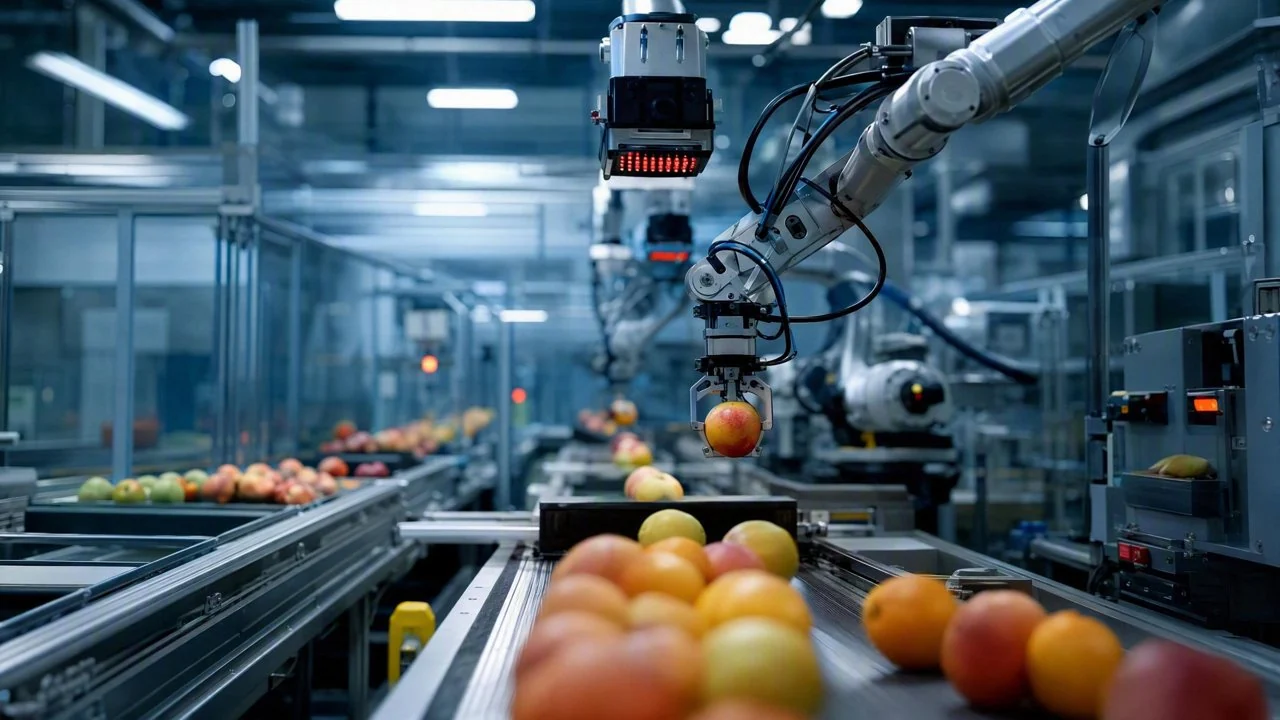
WeLinkirt DaoAI 3D Robot Vision (featuring proprietary 3D cameras + 6D pose estimation, bin picking, guidance for dispensing/assembly/loading/unloading, brain-eye-body closed-loop control, and sub-millimeter hand-eye coordination) precisely identifies agricultural product ripeness and surface defects, reducing traditional manual inspection labor costs by over 70%, significantly enhancing sorting automation and quality control consistency.
In the agricultural product ripeness sorting stage of food/agriculture production lines, especially during post-harvest primary processing, precise judgment of the ripeness, color, shape, and surface defects of fruits and vegetables is crucial for ensuring product quality and market competitiveness. However, this stage has long relied heavily on manual inspection, which is not only inefficient and costly but also inconsistent due to human eye fatigue and subjective judgment. WeLinkirt's DaoAI 3D Robot Vision system was developed to address this pain point. It leverages advanced 3D vision technology and robotic collaboration capabilities to achieve automated and intelligent sorting of agricultural products by ripeness, effectively replacing a large amount of repetitive and labor-intensive work.
Pain Points: Why This Hurdle Is Difficult to Overcome
Agricultural product sorting faces multiple challenges in agricultural production. Firstly, there are high labor costs. Especially with increasingly tight labor markets and rising costs, manual inspection in traditional sorting lines accounts for a significant portion of total operating expenses. For example, a major agricultural processing enterprise incurs millions of RMB annually in labor costs for sorting. Secondly, manual inspection is inefficient and unstable. The human eye, under long-duration, high-intensity work, is prone to fatigue, leading to increased missed detection rates, averaging 3-5%, or excessive false positive rates, affecting final product grading and market value. Furthermore, agricultural products vary widely in shape, have complex surface textures, and ripeness judgment standards often involve a degree of subjectivity—for instance, the redness of tomatoes, the luster of apples, or the plumpness of corn. These features are difficult to quantify precisely in 2D images, posing significant challenges for traditional vision solutions. Finally, traditional sorting methods lack data accumulation and analysis capabilities, making it difficult to optimize and trace production processes, and unable to effectively meet the rapid changeover demands for multi-variety, small-batch orders. The current trend of humanoid robots achieving commercialization and market share in industrial scenarios further highlights the urgent market demand for robots to replace manual labor, improve production efficiency, and reduce costs.
The root cause of these difficulties lies in the inherent complexity of agricultural products. For example, ripeness judgment for fruits and vegetables often requires combining color, size, shape, surface gloss, and even slight firmness. These multi-dimensional features in 2D images are susceptible to lighting, angle, and occlusion, making accurate extraction difficult. Traditional rule-based machine vision systems, facing the non-standardized and varied forms of agricultural products, are complex to program and lack robustness, making them difficult to adapt to rapid production line changes. While manual inspection can perform complex judgments, its efficiency bottleneck and cost disadvantages remain insurmountable.
Technical Principles
WeLinkirt's DaoAI 3D Robot Vision system provides a revolutionary solution for agricultural product sorting through its proprietary 3D cameras and advanced 6D pose estimation technology. Our 3D cameras can acquire high-precision three-dimensional morphological data of agricultural products, overcoming the limitations of traditional 2D vision that are sensitive to lighting and viewing angles. Combined with deep learning algorithms, the system can accurately identify geometric features (such as size, shape) and surface defects (such as spots, pest damage, damage) of agricultural products, and quantitatively evaluate their ripeness. More importantly, WeLinkirt's DaoAI 6D pose estimation capability can calculate the precise position and orientation of agricultural products in space in real-time, providing sub-millimeter hand-eye coordination accuracy for subsequent robot gripping, ensuring that robots can stably and accurately complete bin picking tasks and place products into designated sorting areas.
Compared to traditional methods, the advantages of WeLinkirt's DaoAI 3D Robot Vision are evident in several aspects. Rule-based AOI systems require significant human effort for feature setting and threshold adjustment, and have poor adaptability to non-standard products. In contrast, DaoAI uses deep learning models, which can be trained with a small number of samples to achieve high-precision recognition, reducing the false positive rate by 85%. While manual inspection offers some flexibility, it suffers from low efficiency, poor consistency, high costs, and inability to operate 24/7. DaoAI 3D Robot Vision provides stable, efficient, and traceable automated sorting, increasing sorting efficiency by 2.5 times while reducing manual labor costs by 70%. Its “brain-eye-body closed-loop” control philosophy enables the robot to adjust its grasping strategy in real-time based on visual feedback, adapting to changes in the position and orientation of agricultural products on the conveyor belt, achieving truly intelligent operation.
Typical Application Scenarios
- **Fruit and Vegetable Ripeness Grading:** For fruits like tomatoes, apples, and citrus, WeLinkirt's DaoAI 3D vision acquires 3D data of their color, shape, and surface texture to determine their ripeness level (e.g., unripe, ripe, overripe) and guide robots for precise sorting. The challenge lies in quantifying subtle color differences across varieties and batches, and mitigating the impact of lighting variations on color judgment.
- **Surface Defect Detection and Rejection:** Detects surface damage, mold, pest spots, or soil residue on root vegetables like potatoes and onions. The DaoAI 3D camera can reconstruct surface morphology at the micrometer level, clearly revealing even minor indentations or protrusions, guiding robots to precisely reject non-conconforming products. The challenge is distinguishing between normal growth textures and defects, and handling complex, varied surface reflections.
- **Irregular/Deformed Fruit Sorting:** Identifies and sorts out deformed fruits resulting from abnormal growth (e.g., Siamese strawberries, oddly shaped cucumbers), ensuring product appearance consistency. WeLinkirt's DaoAI 3D Robot Vision analyzes shapes based on 3D point cloud data to accurately determine if an object conforms to a standard geometric model. The challenge lies in establishing flexible criteria for deformity detection to avoid misjudgments.
- **Agricultural Product Weight and Volume Estimation:** Accurately estimates the weight of agricultural products by acquiring precise 3D dimensions via 3D vision, combined with density models, enabling preliminary sorting by weight or volume. This is crucial for packaging and sales. WeLinkirt's DaoAI robot vision system can achieve sub-millimeter measurement accuracy. The challenge is accurate volume calculation for irregularly shaped agricultural products and correcting for density variations across batches.
- **Bin Picking and Packaging of Unsorted Products:** For mixed, unsorted agricultural products after harvesting, WeLinkirt's DaoAI 3D Robot Vision guides robots to accurately pick individual items from bins and arrange them neatly or pack them according to preset rules. The challenge lies in multi-object recognition, collision avoidance, and stable grasping in complex stacking environments.
Case Study
A major domestic agricultural product processing enterprise, specializing in the washing, grading, and packaging of fresh fruits and vegetables, faced significant challenges in its tomato sorting line. Due to stringent market demands for tomato redness and surface integrity, the company had long relied on a large workforce for manual visual sorting, requiring 10-15 workers per production line during peak seasons. This resulted in high labor costs, high employee turnover, and difficulty in standardizing sorting criteria. To address increasing market demand and rising labor costs, the enterprise introduced WeLinkirt's DaoAI 3D Robot Vision sorting system. Before implementation, the manual sorting line processed an average of 20 tons of tomatoes daily, with a missed detection rate of about 2%, and frequently experienced production bottlenecks due to labor shortages during peak times. After deploying the WeLinkirt solution, only 3 workers are needed per two production lines for equipment maintenance and minimal re-inspection. The DaoAI 3D Robot Vision system operates 24/7, increasing the daily processing capacity of a single production line to 35 tons. The missed detection rate dropped to <0.4%, and the false positive rate was reduced by 85%.
WeLinkirt's DaoAI 3D Robot Vision has reduced our tomato sorting line labor costs by over 70%, not only increasing capacity but also elevating product quality control to an unprecedented level.
WeLinkirt Solutions and Products
The core of WeLinkirt's DaoAI 3D Robot Vision solution lies in its proprietary 3D cameras and powerful 6D pose estimation capabilities. In agricultural product ripeness sorting scenarios, we first use a customized 3D camera array to acquire dense point cloud data of agricultural products from multiple perspectives, precisely reconstructing their 3D morphology. This data is then combined with WeLinkirt's DaoAI World model for deep learning training, enabling the identification of subtle features such as color gradients, surface irregularities, and spot sizes, and quantifying ripeness levels. For different varieties of agricultural products, WeLinkirt supports APDT positive/few-shot learning, requiring only 1-20 good samples to complete model training and changeover within 5 minutes, significantly reducing production line downtime. For deployment, WeLinkirt's DaoAI 3D Robot Vision system supports SDK/API/Docker integration methods and allows for 100% on-premises private deployment, ensuring customer data security. Through smooth integration with existing robotic systems, we achieve a “brain-eye-body closed-loop”: the vision system (eye) perceives the environment, the AI brain (brain) decides the sorting strategy, and the robot (body) executes the grasping action, continuously optimizing based on real-time feedback to achieve sub-millimeter hand-eye coordination accuracy.
By applying WeLinkirt's DaoAI 3D Robot Vision system, customers have achieved significant quantifiable results. Firstly, manual inspection labor costs have been reduced by over 70%, substantially improving the enterprise's economic efficiency. Secondly, sorting efficiency has increased by 2.5 times, ensuring timely product delivery to market. Thirdly, product quality consistency has been greatly enhanced, with missed detection rates reduced to <0.4% and false positive rates reduced by 85%, mitigating customer complaints and losses due to quality issues. Furthermore, the system's rapid changeover capability allows enterprises to flexibly respond to multi-variety, small-batch orders, improving market responsiveness. These achievements collectively constitute the core business value of WeLinkirt's DaoAI 3D Robot Vision in agricultural product ripeness sorting.
FAQ
How does DaoAI 3D Robot Vision quantify ripeness in agricultural product sorting?
WeLinkirt's DaoAI 3D Robot Vision system acquires 3D morphological data of agricultural products using its proprietary 3D cameras. Combining features like color, texture, and size, it employs deep learning models for training. The model learns and quantifies characteristics of different ripeness levels, for instance, by comprehensively judging RGB color values, surface smoothness, and plumpness, providing precise ripeness scores to guide robot sorting.
What are the advantages of DaoAI 3D Robot Vision compared to traditional 2D vision solutions?
Traditional 2D vision is highly susceptible to lighting, viewing angles, and object occlusion, making it difficult to acquire precise 3D information and complex surface defects. In contrast, WeLinkirt's DaoAI 3D Robot Vision obtains high-precision 3D point cloud data through its proprietary 3D cameras, enabling complete object morphology reconstruction and true 6D pose estimation. This allows for more accurate identification of defects in irregular agricultural products, ripeness judgment, and guidance for bin picking with sub-millimeter precision, greatly improving robustness and application range.
How long does it take to deploy and reconfigure the DaoAI 3D Robot Vision system?
WeLinkirt's DaoAI 3D Robot Vision system supports rapid deployment, typically completing integration and debugging within a few days. Its APDT few-shot learning capability is key: for new product varieties or sorting standards, only 1-20 good samples are needed, and the system can complete self-training and rapid changeover within 5 minutes. This significantly reduces production line downtime, ensuring production flexibility and continuity.
This article was generated by AI. Customer cases are simulated scenarios based on real product capabilities and figures are illustrative; see product pages for official benchmarks.