
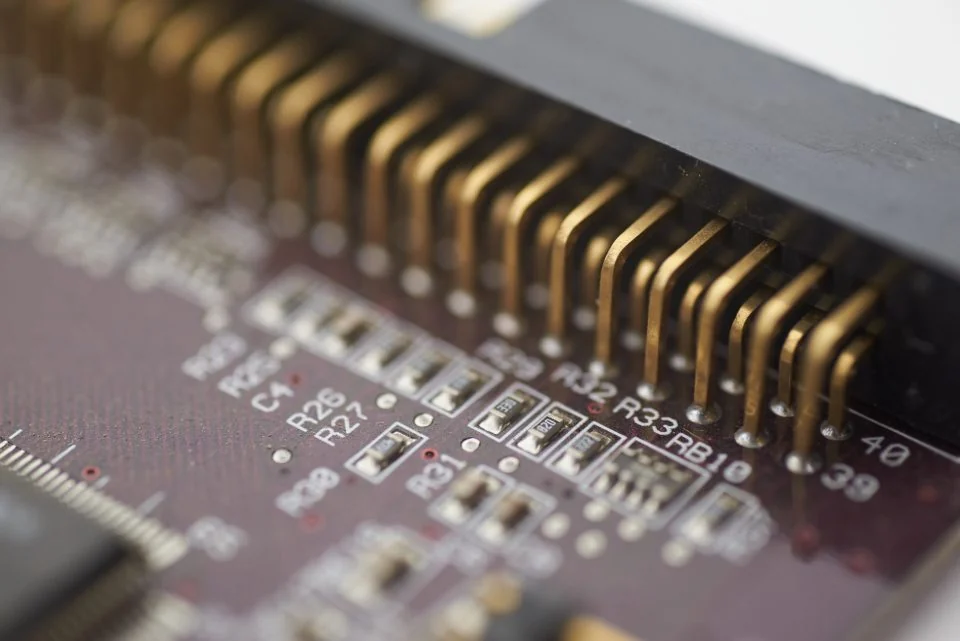
In the electronics/PCBA industry, gold fingers are the key connection parts, and their scratches and oxidation problems seriously affect product quality. WeLinkirt uses advanced technology to provide a high-precision inspection solution for this industry, effectively improving production efficiency and product quality.
In the electronics/PCBA industry, gold fingers are the key connection parts between PCBA boards and other devices. Their quality is directly related to the electrical performance and stability of the products. Take the production line of a leading electronics/PCBA manufacturer as an example. Before the assembly process, it is essential to inspect the gold fingers on the PCBA boards. Each gold finger needs to undergo high-precision inspection to ensure that the subsequent products meet high-quality standards. Because once there are scratches or oxidation problems on the gold fingers, it may lead to a series of faults such as poor contact and unstable signal transmission of the products, affecting the normal use of the products.
Pain Points: Why Is It Difficult?
Traditional automated optical inspection (AOI) equipment faces many difficulties in detecting gold finger scratches and oxidation. In terms of the false alarm rate, due to the influence of ambient light in the production environment, AOI equipment is prone to false alarms, with a false alarm rate as high as 30%. For example, the lighting conditions vary at different times of the day and in different positions in the workshop. This makes the equipment easily misjudge some normal features as scratches or oxidation during detection, increasing the workload of manual re-inspection and resulting in low production efficiency.
In terms of the missed detection rate, traditional AOI is limited by preset rules and has difficulty accurately identifying some slight scratches and oxidation, with a missed detection rate of 5%. This is because its rules are often set based on common and obvious defect features. For some tiny and atypical damages, it cannot effectively capture and judge, allowing these gold fingers with potential risks to enter the subsequent production process.
Product model change is also a major pain point for traditional AOI equipment. When the production line needs to switch to produce different models of products, traditional AOI equipment needs to spend a lot of time on programming and debugging, and the model change time can be as long as 30 minutes. This is because the specifications and positions of gold fingers for each product may be different, and the equipment needs to reset the detection parameters and algorithms. This process is complex and time-consuming, seriously affecting the continuity and progress of production.
Technical Principle
WeLinkirt uses a deep-learning algorithm combined with advanced imaging technology to solve the problem of gold finger scratch and oxidation detection. The deep-learning algorithm has a powerful feature-learning ability and can learn the characteristic patterns of gold finger scratches and oxidation from a large amount of image data. Different from the traditional rule-based detection method, the deep-learning algorithm can adaptively adjust the feature extraction strategy. By training the gold finger images under different lighting conditions, it can effectively reduce the influence of ambient light. For example, when encountering uneven lighting, the algorithm can automatically identify and eliminate the lighting interference and accurately extract the features of scratches and oxidation.
In terms of imaging, WeLinkirt uses a high-resolution camera and a special lighting system. The high-resolution camera can provide sufficient pixel information, enabling accurate identification of slight scratches and oxidation. The special lighting system uses multi-angle lighting technology. By illuminating the gold fingers with light from different angles, it can highlight the features of scratch and oxidation parts. For example, side lighting can highlight the depth and contour of scratches, and front lighting can more clearly show the color change of oxidation, thus improving the detection accuracy. In addition, WeLinkirt also uses 3D topography reconstruction technology to perform 3D modeling of the gold finger surface. By analyzing the 3D topography of the gold fingers, it can more accurately judge the degree of scratches and oxidation, further improving the detection accuracy, which is difficult to achieve with traditional 2D detection methods.
Typical Application Scenarios
- Pre-assembly inspection: Before the PCBA board enters the assembly process, a comprehensive inspection of the gold fingers is required. During the inspection, the equipment needs to quickly and accurately identify scratches and oxidation on the gold finger surface. The difficulty lies in processing a large amount of image data in a short time and ensuring the accuracy of the inspection to avoid missed and false detections.
- Post-placement inspection: The placement process may cause damage to the gold fingers, so a re-inspection is required after placement. At this time, the difficulty of the inspection lies in distinguishing normal marks generated during the placement process from real scratches and oxidation defects to avoid misjudging normal marks as defects.
- Post-soldering inspection: The soldering process may cause oxidation or thermal damage to the gold fingers. During the inspection, it is necessary to accurately judge the degree of oxidation and the location of thermal damage. The difficulty lies in the complex surface state after soldering, which may include solder residues and irregular solder joints, interfering with the inspection results.
- Pre-packaging inspection: This is the last inspection process before the product leaves the factory, requiring a comprehensive review of the quality of the gold fingers. The difficulty of the inspection lies in ensuring the integrity of the inspection and not overlooking any defects that may affect the product performance.
Implementation Case
A large-scale electronics/PCBA manufacturer has a large-scale production line and needs to inspect a large number of PCBA boards every day. Before introducing WeLinkirt's solution, the manufacturer used traditional AOI equipment and faced problems such as high false alarm rates, high missed detection rates, and long model change times. During the implementation process, WeLinkirt's team first conducted a detailed investigation of the manufacturer's production line to understand its production process and inspection requirements. Then, according to the actual situation, they customized and debugged the DaoAI ACI (AI-AOI) software system and the DaoAI 2D / 3D ACI equipment. After a period of trial operation and optimization, the system was officially launched.
By introducing WeLinkirt's solution, the manufacturer has achieved remarkable results in gold finger inspection, greatly improving production efficiency and product quality.
WeLinkirt's Solution and Products
WeLinkirt provides the DaoAI ACI OS and the DaoAI 2D / 3D ACI equipment to solve the problem of gold finger scratch and oxidation detection. The DaoAI ACI OS has a powerful feature recognition ability. Through the visual basic model, a good product can complete 0-code automatic programming in only 5 minutes. The system uses APDT positive/less-sample learning technology. With only 1-20 good product images, it can quickly learn the normal features of gold fingers, achieve semantic false alarm filtering, and effectively reduce the false alarm rate. The DaoAI 2D / 3D ACI equipment self-develops 3D cameras and 3D topography reconstruction technology, which can detect hidden solder joints, coplanarity, and micron-level topography. In gold finger inspection, the equipment can accurately identify scratches and oxidation on the gold finger surface and also detect parameters such as the height and flatness of the gold fingers to ensure that the quality of the gold fingers meets the requirements.
Quantitative results: By using WeLinkirt's solution, the manufacturer's detection rate of gold finger scratches and oxidation has reached 98%, and the missed detection rate has been reduced to <2%. The false alarm rate has been reduced by 65%, greatly reducing the workload of manual re-inspection. The product model change time has been shortened from 30 minutes to 5 minutes, improving production efficiency. These quantitative data fully prove the effectiveness and superiority of WeLinkirt's solution in gold finger inspection.
FAQ
What solution does WeLinkirt provide for gold finger inspection in the electronics/PCBA industry?
WeLinkirt provides the DaoAI ACI OS and the DaoAI 2D / 3D ACI equipment. The software system can perform 0-code automatic programming and uses APDT positive/less-sample learning technology to reduce the false alarm rate. The equipment self-develops 3D cameras and 3D topography reconstruction technology, which can detect various parameters to ensure the quality of gold fingers.
What are the pain points of traditional AOI equipment in gold finger inspection?
Traditional AOI equipment is affected by ambient light, with a false alarm rate as high as 30%, increasing the workload of manual re-inspection. Limited by rules, the missed detection rate reaches 5%, and it is difficult to identify slight defects. When changing product models, programming and debugging take 30 minutes, affecting the production progress.
What are the results of WeLinkirt's solution in gold finger inspection?
After using WeLinkirt's solution, the detection rate of gold finger scratches and oxidation has reached 98%, the missed detection rate has been reduced to <2%, and the false alarm rate has been reduced by 65%, reducing the workload of manual re-inspection. The product model change time has been shortened from 30 minutes to 5 minutes, improving production efficiency.
Full solution for this scenario: Electronics / PCBA industry solutions · Gold Finger Scratch & Oxidation Detection
This article was generated by AI. Customer cases are simulated scenarios based on real product capabilities and figures are illustrative; see product pages for official benchmarks.