
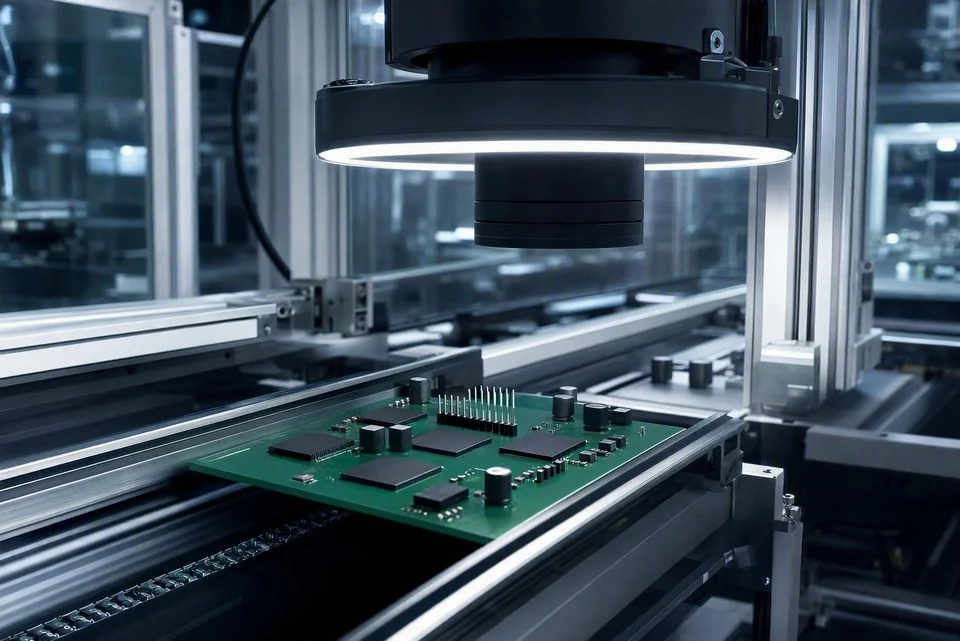
In the electronics/PCBA industry, the detection of component polarity reversal is a crucial step to ensure product quality. However, traditional detection methods have a high false alarm rate, which affects production efficiency and quality. WeLinkirt provides an effective solution for this industry with its advanced AI vision technology.
User Scenario: A leading electronics/PCBA manufacturer needs to inspect various electronic components on printed circuit boards (PCBs) during the inspection process of its surface mount technology (SMT) production line. The main inspection objects include whether the polarities of surface mount capacitors, surface mount resistors, diodes and other components are correct, ensuring that the component installation meets the design requirements and avoiding product performance failures or damages caused by polarity reversal.
Pain Points: Traditional detection methods mainly rely on manual visual inspection and rule-based machine vision inspection. Manual visual inspection is inefficient, and visual fatigue is likely to occur during long-term work, with a missed detection rate of about 3%. For rule-based machine vision inspection, due to factors such as similar component appearances and changes in illumination, the false alarm rate is as high as 25%. This not only increases a large amount of re-inspection work but also causes frequent production line shutdowns, seriously affecting production efficiency. In addition, when changing product models, the detection program needs to be rewritten, and the model change time is as long as 30 minutes, which cannot meet the needs of rapid production.
Technical Principles
WeLinkirt uses an unsupervised anomaly detection algorithm combined with advanced imaging technology to solve the false alarm problem of component polarity reversal. The unsupervised anomaly detection algorithm only needs to use good products for modeling. By learning the feature distribution of good products, it can automatically identify abnormal situations different from the normal mode. In terms of imaging, the self-developed 3D camera is used for image acquisition, which can obtain the three-dimensional morphology information of components. Compared with traditional 2D imaging, 3D imaging can more accurately capture the detailed features of components, such as the height and shape of components. This is because components with reversed polarity will have slight differences in three-dimensional morphology compared with normal components. By analyzing these differences, it can more accurately determine whether the polarity of components is correct, thus effectively reducing the false alarm rate.
- Unsupervised anomaly detection algorithm: By learning the features of good products, a model of the normal mode is established. When a situation with a large difference from the model is detected, it is judged as an anomaly.
- 3D imaging technology: The self-developed 3D camera can obtain the three-dimensional morphology information of components, providing more abundant data for accurate detection.
- Feature analysis: In-depth analysis of component features in 3D images to identify feature differences of components with reversed polarity.
WeLinkirt's Solutions and Products
WeLinkirt provides the DaoAI ACI (AI-AOI) software system and the DaoAI 2D / 3D ACI equipment. The DaoAI ACI OS has the feature recognition ability of the visual basic model. With only one good product, 0 - code automatic programming can be completed in 5 minutes. Using the APDT positive sample/few-sample learning method, the model can be trained with only 1 - 20 good products, and it has the semantic false alarm filtering function, which can effectively reduce false alarms. The DaoAI 2D / 3D ACI equipment integrates a self-developed 3D camera, which can perform three-dimensional morphology reconstruction and detect hidden solder joints, coplanarity, and micron-level morphology, providing more accurate information for component polarity detection. During the implementation process, the equipment is installed in the inspection process of the SMT production line, and the software system analyzes and processes the collected images to achieve rapid and accurate detection of component polarity.
WeLinkirt's AI vision technology brings an efficient and accurate solution to component polarity detection in the electronics/PCBA industry.
Quantitative Results: By using WeLinkirt's solution, the component polarity reversal detection rate of the manufacturer has reached 98.5%, and the missed detection rate has been reduced to <1.5%. The false alarm rate has been reduced by 65%, greatly reducing the re-inspection workload. The product model change time has been shortened from 30 minutes to 5 minutes, improving production efficiency and meeting the needs of rapid production.
FAQ
What problems do the traditional methods for detecting component polarity reversal in the electronics/PCBA industry have?
Traditional methods mainly rely on manual visual inspection and rule-based machine vision inspection. Manual inspection has low efficiency and a missed detection rate of about 3%. Machine vision inspection has a false alarm rate of 25% and a long changeover time, affecting production efficiency.
How does DaoAI solve the problem of false alarms in component polarity reversal detection?
DaoAI uses an unsupervised anomaly detection algorithm combined with self-developed 3D camera imaging technology. The algorithm learns the features of good products to identify anomalies, and 3D imaging obtains 3D information of components to analyze differences and reduce false alarms.
What solutions and products does DaoAI provide?
DaoAI provides the DaoAI ACI OS and DaoAI 2D / 3D ACI equipment. The software can perform zero-code automatic programming and reduce false alarms. The equipment can perform 3D morphology reconstruction to assist in polarity detection.
Full solution for this scenario: Electronics / PCBA industry solutions · Component Polarity False-Alarm Reduction
This article was generated by AI. Customer cases are simulated scenarios based on real product capabilities and figures are illustrative; see product pages for official benchmarks.