
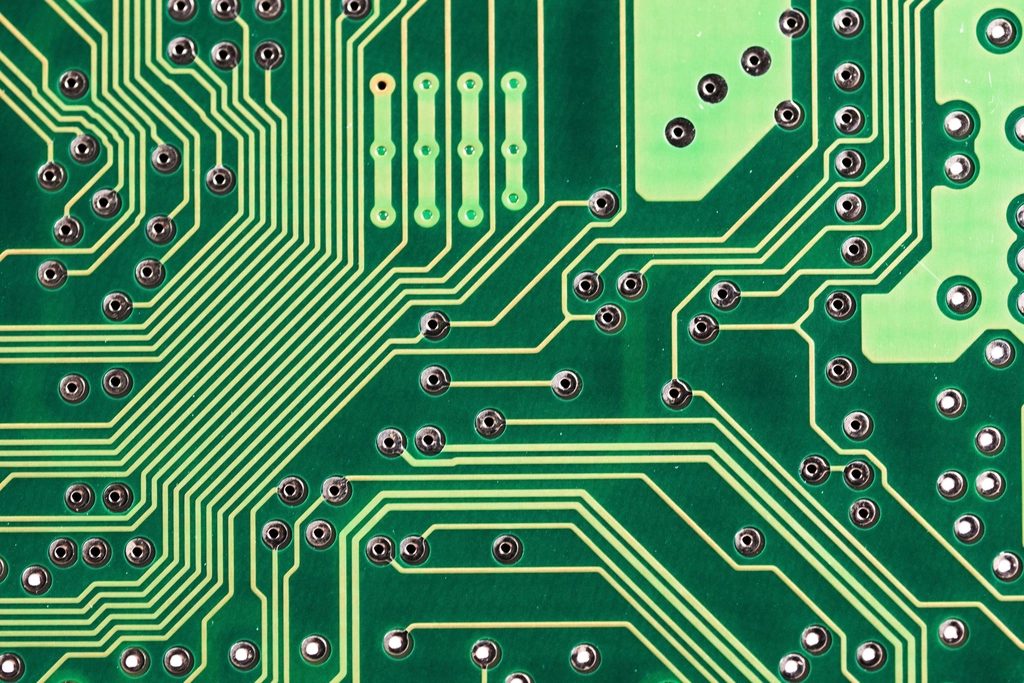
In the electronic/PCBA industry, accurate inspection of silk-screen printing and OCR characters on boards is a crucial part of ensuring product quality and traceability. WeLinkirt has brought a new inspection experience to this industry through innovative AI vision technology.
In the electronic/PCBA industry, product quality and traceability are of utmost importance. Silk-screen printing and OCR characters on boards contain key information such as product models, batch numbers, and dates. This information is not only used for product identification and management but also serves as an important basis for quality control and problem tracing. In the production line of a leading electronic/PCBA manufacturer, after the board-level assembly process, inspecting the silk-screen printing and OCR characters on the printed circuit board (PCB) is an essential step. Only by ensuring the accuracy and clarity of this information can the products meet the quality standards and smoothly enter the subsequent production and sales processes.
Pain Points: Why is it Difficult?
Traditional inspection methods face many challenges. Technically, due to the characteristics of the PCB surface, especially the mirror-like metal areas, they have strong reflectivity. This makes the 3D point cloud data collected sparse, noisy, and incomplete. For example, in actual inspections, reflections may cause inaccurate acquisition of point-cloud data in some areas, leading to failures in pose and inspection. The missed-detection rate reaches 3%. This is because traditional detection technologies are difficult to effectively handle this reflection problem and cannot obtain complete and accurate 3D information.
In terms of labor costs, manual inspection is inefficient and has a high false-alarm rate. Manual inspection requires operators to observe the silk-screen printing and characters on the PCB with high concentration for a long time. Due to fatigue from long-term work, the false-alarm rate is as high as 15%. Moreover, manual inspection requires a large amount of manpower, which undoubtedly increases the labor cost of enterprises. Statistics show that in some large-scale production lines, the proportion of labor costs for manual inspection is quite high, bringing a heavy economic burden to enterprises.
Production line changeover is also a tricky problem. When the production line needs to change the product model, traditional methods require reprogramming. This process is very cumbersome, and the average changeover time reaches 30 minutes. During this time, the production line is in a stagnant state and cannot carry out production, seriously affecting production efficiency. This is because traditional programming methods require technicians to perform complex parameter settings and code writing according to the new product requirements, which consumes a lot of time and energy.
Technical Principles
WeLinkirt uses multi-view active vision technology to solve the above problems. In terms of imaging, multiple cameras at different angles simultaneously image the PCB. This multi-view imaging method can obtain PCB images from different directions, reducing the impact of reflection occlusion. For example, when a camera at one angle is affected by reflection and cannot obtain a clear image, cameras at other angles may be able to capture clear images. At the same time, the use of active light sources provides stable lighting conditions for inspection. Active light sources can adjust the lighting intensity and angle as needed, reducing reflection interference and making the collected images clearer and more accurate.
At the algorithm level, WeLinkirt uses deep-learning algorithms to extract and analyze features from the collected images. Deep-learning models have powerful feature-learning capabilities and can accurately identify silk-screen printing and OCR characters from complex images. Compared with traditional algorithms, deep-learning algorithms do not require manual setting of complex feature-extraction rules but automatically learn the feature patterns in images through a large amount of data training. In addition, through the fusion processing of images from different perspectives, the missing 3D point cloud can be compensated. Images from different perspectives contain more information. After fusion, they can more comprehensively reflect the real situation of the PCB, effectively solving the detection problems caused by reflection and improving the accuracy of pose detection.
Typical Application Scenarios
- Silk-screen integrity inspection: After the PCB board-level assembly process, it is necessary to check whether the silk-screen printing is complete, without missing or blurred parts. The difficulty lies in that the silk-screen printing may be affected by reflections and stains on the PCB surface, leading to inaccurate inspection. WeLinkirt's multi-view imaging and deep-learning algorithms can obtain silk-screen images from different angles and accurately identify their features, improving the inspection accuracy.
- OCR character recognition: Accurately recognize the OCR characters on the PCB to ensure the accuracy of product information. Due to problems such as unclear printing and diverse fonts, traditional methods are prone to misrecognition. WeLinkirt's deep-learning algorithms can be trained with a large number of character samples to improve the recognition ability for different fonts and printing qualities.
- Silk-screen position inspection: Check whether the position of the silk-screen printing on the PCB is accurate and whether the deviation is within the allowable range. Due to certain errors in the PCB production process, the silk-screen position may also be offset. WeLinkirt's multi-view imaging and image-fusion technology can accurately obtain the 3D information of the PCB, thereby accurately detecting the position of the silk-screen printing.
- Hidden character detection: Some PCBs may have hidden characters or marks, which require special detection methods to discover. Traditional methods are difficult to detect this hidden information. WeLinkirt's active light sources and multi-view imaging technology can discover these hidden characters by adjusting the lighting and shooting angles.
Implementation Case
A large-scale electronic/PCBA manufacturer with multiple production lines and a large daily output. Before introducing WeLinkirt's AI vision inspection solution, the manufacturer used traditional inspection methods and faced problems such as high missed-detection rate, high false-alarm rate, and long production-line changeover time. During the implementation process, WeLinkirt's technical team first conducted a detailed investigation and evaluation of the manufacturer's production line to determine the installation position of the equipment and the parameter settings of the software. Then, the DaoAI 2D / 3D ACI (AI-AOI) equipment was installed on the production line, and the DaoAI ACI OS was integrated with the equipment. After debugging and optimization, the system was officially put into operation.
After introducing WeLinkirt's solution, the manufacturer's inspection efficiency and accuracy have been significantly improved.
WeLinkirt's Solutions and Products
WeLinkirt provides the DaoAI ACI OS and DaoAI 2D / 3D ACI equipment. The DaoAI ACI OS is based on the feature cognition of the visual basic model and has powerful automatic-programming capabilities. It can achieve zero-code automatic programming within 5 minutes for a good-quality product. Through APDT positive-sample/few-sample learning (only 10 good-quality samples are required), an accurate detection model can be quickly established. At the same time, the semantic false-alarm filtering function can effectively reduce the false-alarm rate and improve the inspection accuracy. The DaoAI 2D / 3D ACI equipment is equipped with a self-developed 3D camera, which can perform three-dimensional shape reconstruction. It can detect hidden solder joints, coplanarity, and micron-level morphology, providing more accurate basic data for silk-screen printing and character inspection. During the implementation process, the equipment is installed on the production line, and the software is integrated with the equipment to achieve automated inspection and improve production efficiency.
Quantitative results: After using WeLinkirt's solution, the detection rate has been increased to 98%, and the missed-detection rate has been reduced to <2%. The false-alarm rate has been reduced by 60%, from the original 15% to 6%. The production-line changeover time has been significantly shortened, from 30 minutes to 5 minutes, greatly improving production efficiency and bringing significant economic benefits to the enterprise.
FAQ
What are the pain points of traditional methods for the inspection of silk-screen printing/OCR characters on electronic/PCBA boards?
Traditional methods have many problems. Firstly, the reflectivity of the PCB surface causes the 3D point cloud to be sparse, noisy, and incomplete, leading to easy failures in pose and inspection, with a missed-detection rate of 3%. Secondly, manual inspection is inefficient, with a false-alarm rate of 15% and high costs. Thirdly, reprogramming during production-line changeover takes 30 minutes, affecting production efficiency.
What technology does WeLinkirt use to solve the detection problems?
WeLinkirt uses multi-view active vision technology. Multiple cameras image from different angles, and active light sources reduce reflections. Deep-learning algorithms are used to extract and analyze features, and images from different perspectives are fused to compensate for the missing 3D point cloud, improving detection accuracy.
What are the effects after using WeLinkirt's solution?
After use, the detection rate has been increased to 98%, the missed-detection rate has been reduced to <2%, the false-alarm rate has been reduced by 60% (from 15% to 6%), and the production-line changeover time has been shortened from 30 minutes to 5 minutes, improving production efficiency.
Full solution for this scenario: Electronics / PCBA industry solutions
This article was generated by AI. Customer cases are simulated scenarios based on real product capabilities and figures are illustrative; see product pages for official benchmarks.