
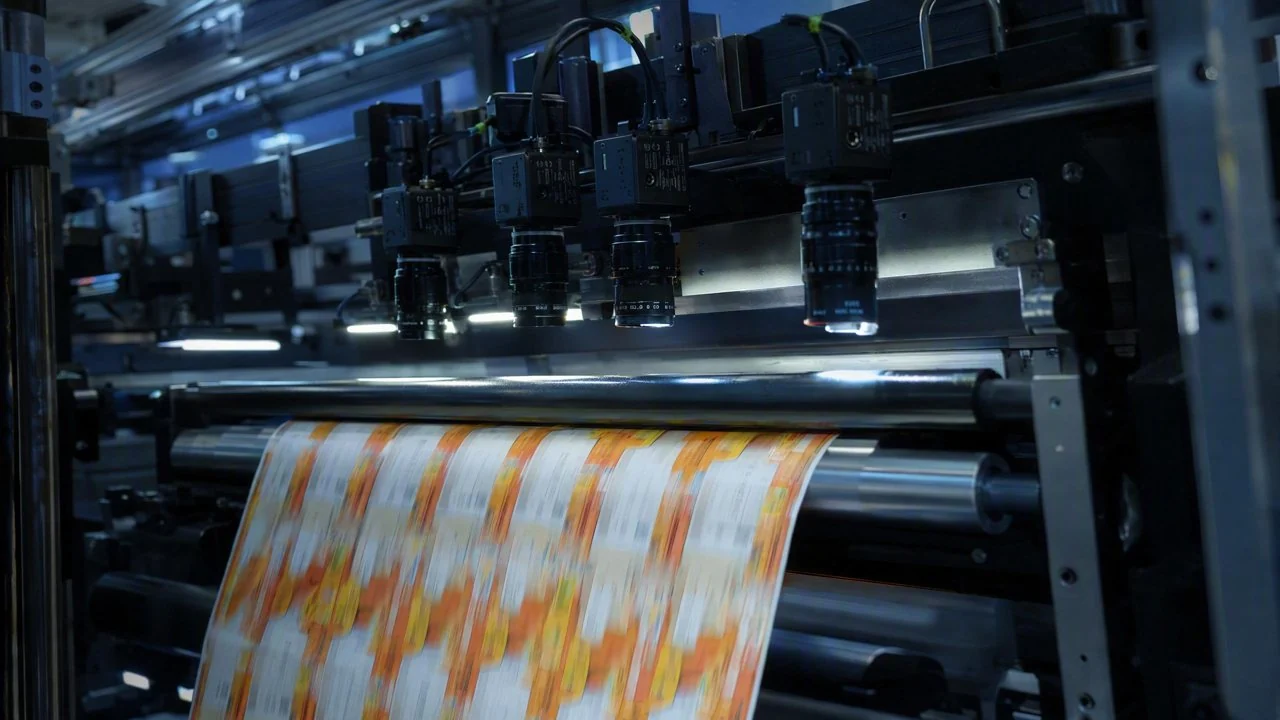
The DaoAI ACI OS (featuring visual foundation model for feature recognition, 5-minute 0-code programming with one good sample, APDT positive/few-shot learning with 1-20 good samples, semantic false positive filtering, and SDK/API/Docker support for 100% on-premise private deployment) effectively addresses the dual challenges of data security and inspection efficiency in the high SKU, data-sensitive consumer label printing industry. It reduces the average false positive rate caused by traditional manual inspection from 5% to below 1%, while simultaneously pressing the missed detection rate down to below 0.3%.
The consumer label printing industry, particularly for high-SKU, highly customized products, involves a vast amount of customer-specific designs, brand logos, and anti-counterfeiting information. This data is often a core asset for enterprises, demanding extremely high security. The DaoAI ACI OS, with its capability for 100% local private deployment, offers a solution that both ensures data security and significantly enhances inspection efficiency for such enterprises. In traditional label print quality inspection, especially when facing complex defects like micro-characters, misregistration of multi-color prints, and film scratches, manual inspection is inefficient and prone to subjective influence, leading to fluctuating inspection results. The average missed detection rate typically hovers around 1.5%, while the false positive rate can be as high as 5%, severely impacting production efficiency and product delivery cycles. Concurrently, due to rapid label design iterations, traditional rule-based AOI programming is complex, leading to long changeover times and an inability to adapt to high-SKU production models.
Pain Points: Why This Hurdle Is Difficult to Overcome
In high-SKU label printing scenarios, enterprises face multiple pain points: First, data security and compliance risks. Customer brand images, design drafts, and anti-counterfeiting information are highly sensitive trade secrets. Any leakage could cause immeasurable losses. Second, high missed detection and false positive rates. Traditional manual inspection struggles to catch tiny printing defects such as ink spots, scratches, color differences, blurry text, and misregistration on high-speed production lines, leading to persistently high missed detection rates. At the same time, overly strict manual standards result in a large number of good products being falsely rejected, with an average false positive rate exceeding 5%, significantly increasing re-inspection hours and scrap rates. Third, inefficient changeover programming. Each time a new product or batch goes online, detection parameters need to be reconfigured. Traditional rule-based AOI programming is complex, often taking hours or even a full day, leading to prolonged production line downtime, with average changeover downtime exceeding 30 minutes, severely restricting the flexibility and takt time of multi-variety, small-batch production.
The root cause of these challenges lies in the diversity of label printing materials (paper, film, metal foil, etc.), with complex surface reflective properties; and various printing processes including offset, flexo, and gravure, resulting in myriad and difficult-to-standardize defect forms. While not nanoscale like in semiconductor manufacturing, the stable, efficient, and low-false-positive detection of micrometer-level defects in consumer labels similarly relies on powerful visual recognition capabilities. Traditional rule-based AOI systems, due to the limitations of their preset rules, struggle to adapt to the complexity of label patterns and the diversity of defects, let alone handle new or undefined defect patterns. Manual inspection, constrained by the physiological limits and fatigue of the human eye, cannot achieve 100% stable full inspection, and inspection results lack consistency.
Technical Principles
The DaoAI ACI OS breaks through the bottleneck of traditional defect detection with its core visual foundation model feature recognition capability. This system employs an advanced deep learning architecture that autonomously learns and extracts deep features of label prints from vast image data, rather than relying on preset rules. This means it can identify subtle defects imperceptible to humans and classify defects more accurately. For example, for ink spots and scratches, traditional rule-based AOI might only judge by pixel grayscale differences, whereas the DaoAI ACI system can understand their texture, shape, and contextual information to distinguish between normal print textures and actual defects. Furthermore, its APDT (Adaptive Positive Sample Driven Training) few-shot learning technology requires only 1-20 good sample images to quickly complete model training, greatly shortening programming and changeover times. This stands in stark contrast to traditional rule-based AOI, which requires numerous defect samples for rule debugging, or manual inspection, which demands extensive experience accumulation.
Compared to traditional methods, the advantage of the DaoAI ACI system lies in its 'understanding' capability. Traditional rule-based AOI is akin to 'telling' the machine what a defect is, requiring engineers to manually write complex logic; whereas DaoAI ACI 'teaches' the machine how to 'see' and 'understand' the differences between good products and defects, allowing the machine to learn autonomously. This enables the system to handle unprecedented defect types and possess strong generalization capabilities. Its semantic false positive filtering mechanism effectively distinguishes between background noise, material textures, and actual defects, reducing the false positive rate by more than 80%, significantly alleviating the burden of manual re-inspection. Concurrently, the system supports 100% local private deployment via SDK/API/Docker, ensuring all production data and inspection results are processed within the customer's internal network, with data never leaving the factory. This completely eliminates the risk of data leakage, which is crucial for consumer label printing enterprises handling high-value, highly sensitive customer data.
Typical Application Scenarios
- **Micro-character and Barcode Detection:** Inspects small text, batch numbers, dates, barcodes/QR codes on labels for clarity, completeness, absence of errors, and ink bleed. The difficulty lies in extremely small characters and complex backgrounds, where traditional methods are prone to missed detections/false positives due to insufficient contrast or background interference. The DaoAI ACI OS accurately identifies character deformation and defects using its visual foundation model.
- **Multi-color Misregistration Detection:** Checks if multiple color layers are precisely aligned during printing, and if there is any misregistration, ghosting, or show-through. The challenge is that micrometer-level misregistration is difficult to identify with the naked eye or simple image processing, and different color combinations significantly impact detection difficulty. DaoAI ACI effectively detects and quantifies misregistration with pixel-level precision.
- **Surface Defect Detection (Scratches, Dirt, Ink Spots, Bubbles):** Identifies physical damage, foreign objects, or printing flaws on the label surface. The difficulty lies in the varied forms of these defects, which can be confused with the material's inherent texture or reflections. DaoAI ACI, combined with semantic false positive filtering, distinguishes between real defects and background noise, for example, differentiating slight material reflections from actual scratches.
- **Film Lamination and Die-cutting Quality Inspection:** Checks for bubbles or delamination in the label's laminated film, and verifies if die-cut edges are smooth, burr-free, or not cut-through. The challenge is that internal film defects are difficult to image directly, and minute irregularities in die-cut edges are hard to precisely determine. DaoAI ACI learns the characteristics of good die-cut edges to accurately identify anomalies.
- **Anti-counterfeiting Feature Detection:** Inspects anti-counterfeiting features on labels, such as holograms, micro-text, and fluorescent inks, for correct printing and integrity. The difficulty is that anti-counterfeiting features are typically intricately designed, requiring extremely high demands on lighting and imaging. The DaoAI ACI OS can, in conjunction with specific light sources, accurately identify and verify the authenticity and integrity of these complex anti-counterfeiting features.
Case Study
A leading consumer packaging label printing manufacturer, whose products span food, daily chemicals, and other fields, has a vast number of SKUs and fragmented orders. Previously, the manufacturer used a solution combining manual inspection with some rule-based AOI equipment. However, with the increase in production line speed and higher customer demands for product quality, manual inspection fatigue led to a missed detection rate consistently around 1.2%. Rule-based AOI was ineffective in practical application due to complex programming and high false positive rates, resulting in thousands of hours of re-inspection annually due to false positives. Furthermore, the customer's high concern for data security meant they could not accept any cloud-deployed solution. After introducing the DaoAI ACI OS with 100% local private deployment, the situation significantly improved. Before implementation, the production line processed an average of 20,000 labels per hour, with a false positive rate of approximately 4.5% and a missed detection rate of 1.2%.
After DaoAI ACI went live, our core production data achieved 100% local closed-loop operation, eliminating any security concerns. More importantly, detection efficiency and accuracy reached unprecedented levels, truly ensuring both quality and security.
After the DaoAI ACI system was implemented, its APDT few-shot learning capability reduced programming time for new label models from an average of 45 minutes to 5 minutes, improving changeover efficiency by approximately 88%, greatly enhancing production line flexibility. Concurrently, the system, through precise defect identification and semantic false positive filtering, reduced the false positive rate from 4.5% to <0.8%, decreasing re-inspection hours by more than 82%. More importantly, the DaoAI ACI OS consistently maintained the missed detection rate at <0.3%, significantly improving product quality and customer satisfaction. All inspection data, model training, and inference are completed on the customer's internal servers, fully meeting their stringent data security requirements and achieving complete local closed-loop management of production data.
DaoAI Solutions and Products
DaoAI provides a comprehensive solution for the consumer label printing industry, centered around the DaoAI ACI OS. This system, with its unique visual foundation model, achieves intelligent recognition and high-precision detection of label printing defects. For deployment, we offer various forms such as SDK/API/Docker, supporting 100% local private deployment for customers, ensuring that core assets like production data and customer design drafts never leave the factory, meeting the highest level of data security requirements. In terms of model building, the APDT few-shot self-training function is key, requiring only 1-20 good samples to complete model training for new products within 5 minutes, without complex code programming, greatly reducing technical barriers and changeover time. For complex printing defects, the semantic false positive filtering function of DaoAI ACI can accurately distinguish between real defects and background textures, significantly reducing the false positive rate and alleviating the burden of manual re-inspection. Additionally, we can integrate the DaoAI Robot Vision system for automatic grasping or marking of defective products, forming a more complete automation solution according to customer needs.
Through the application of the DaoAI ACI OS, customers can gain significant business value. First, a fundamental guarantee of data security, eliminating potential risks associated with cloud deployment. Second, a significant improvement in production efficiency, with drastically shortened changeover times, adapting to high-SKU, small-batch production models. Third, a leap in product quality, as reduced missed detection and false positive rates directly improve the product pass rate, reduce scrap and rework, thereby lowering production costs. Overall, the DaoAI ACI OS is not just a defect detection tool but a key partner for enterprises to achieve digital transformation and enhance core competitiveness, helping customers maintain a leading position in fierce market competition. The DaoAI ACI system can improve the overall inspection efficiency of the label printing industry by more than 70% while ensuring data security and compliance.
FAQ
What is the difference between DaoAI ACI OS and traditional AOI?
The DaoAI ACI OS utilizes a visual foundation model to autonomously learn and identify complex defects, eliminating the need for manual rule writing. It supports APDT few-shot learning, allowing rapid model training with only a small number of good samples, whereas traditional AOI requires extensive defect samples and complex rule programming, and struggles to adapt to new defects. Additionally, the DaoAI system features semantic false positive filtering, significantly reducing false alarm rates.
What data security guarantees does local private deployment offer?
Local private deployment means all data and inspection results are stored within the customer's own servers and network environment, ensuring sample and inspection images never leave the factory. This eliminates security risks that data might face during transmission or storage to third-party cloud services, guaranteeing the highest level of protection for customer trade secrets and production data, fully complying with internal enterprise data security requirements.
What are the costs and deployment timeline for the DaoAI ACI OS?
Deployment costs primarily depend on the required hardware configuration (servers, cameras, lighting, etc.), software licensing scope, and the complexity of integration services. The deployment cycle is typically short; the software itself is flexibly configured, and combined with APDT few-shot learning, model training and debugging can be completed within hours to days. Specific quotes and implementation plans require evaluation based on the customer's actual production line conditions. We recommend contacting the DaoAI professional team for a customized solution and budget.
Full solution for this scenario: the full inspection solution for Consumer / general · High-SKU Label Print Inspection
This article was generated by AI. Customer cases are simulated scenarios based on real product capabilities and figures are illustrative; see product pages for official benchmarks.