
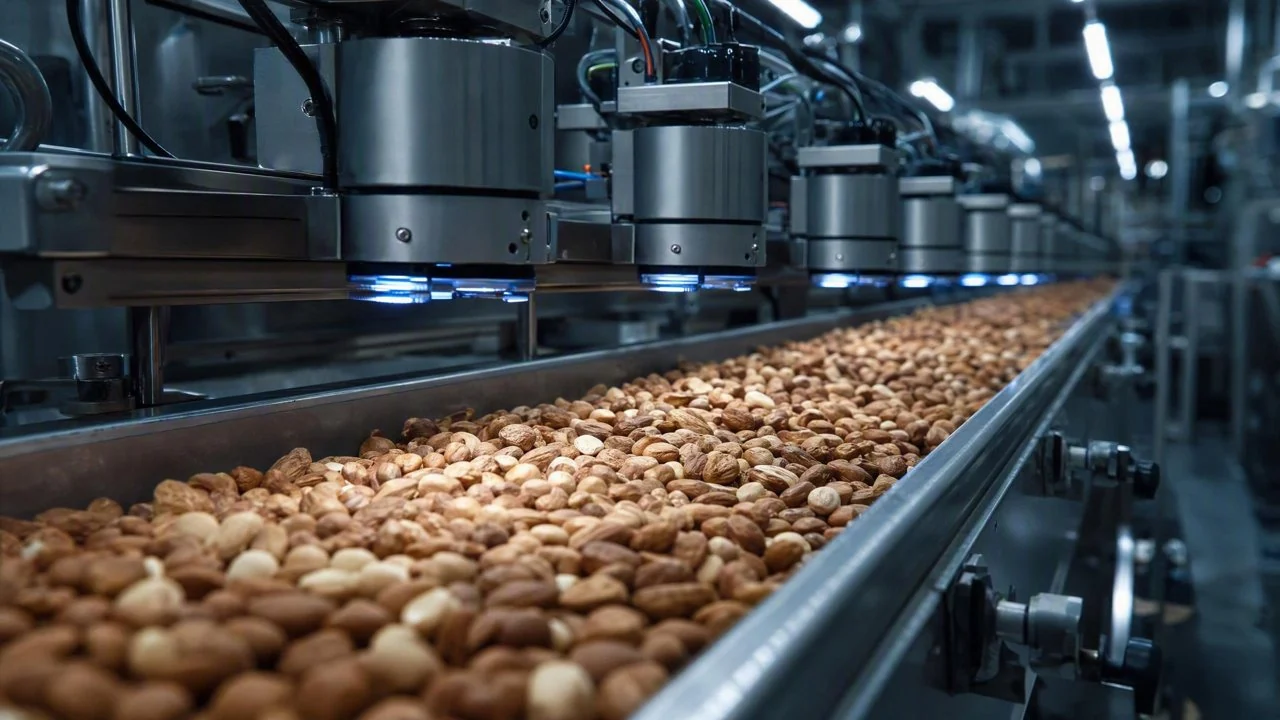
DaoAI ACI OS (featuring visual foundation model for feature recognition, 5-minute zero-code programming with one good sample, APDT positive/few-shot learning with 1–20 good samples, semantic false positive filtering, and SDK/API/Docker support for 100% local private deployment) leverages its robust visual foundation model and few-shot learning capabilities to reduce foreign object missed detection rates for a leading nut processing enterprise in the color sorting stage from a traditional average of 0.8% to <0.12%. This significantly enhances food safety detection rates and product consistency, effectively addressing the challenge of identifying minute defects against complex backgrounds.
In the food processing industry, especially for snacks like nuts and potato chips, color sorting is a critical process for ensuring product quality and food safety. Its purpose is to remove discolored particles, moldy kernels, shell fragments, insect parts, and even minute foreign objects such as glass or metal from raw materials. Traditional color sorters primarily rely on visible light spectrum analysis, using fixed color thresholds to distinguish between good products and defects. However, with increasingly stringent consumer demands for food safety standards and the growing complexity of raw material sources, traditional color sorting solutions are revealing bottlenecks in their ability to achieve high detection rates and reduce missed detections, especially when confronting defects with similar colors but different textures, or minute foreign objects in complex backgrounds with uneven lighting. Particularly on high-volume, high-speed production lines, any subtle missed detection can lead to batch-wide quality issues, or even food safety incidents, resulting in significant economic losses and reputational damage for enterprises. Therefore, there is an urgent industry need for an intelligent vision inspection solution that can significantly improve detection rates, effectively reduce missed detections, and offer greater robustness.
Pain Points: Why This Hurdle Is Hard to Clear
The challenges in nut and potato chip color sorting are multifaceted, making it difficult for traditional solutions to improve detection rates and reduce missed detections. Firstly, **high missed detection rates** are a core pain point; the industry average for foreign object missed detections typically ranges between 0.5% and 1.5%. This is especially true for foreign objects with colors similar to the product (e.g., shell fragments, slight mold) or extremely small fragments, which traditional color sorters struggle to identify, leading to defective products entering subsequent stages and increasing food safety risks. Secondly, **high false positive rates** also plague enterprises. Traditional rule- and threshold-based sorting systems often misclassify irregularly shaped but otherwise good nuts as defects, leading to increased rejection of good products and unnecessary material waste, typically reaching 3%–5%. Furthermore, **inefficient changeovers** are a problem; whenever product batches or types change, traditional color sorters require manual parameter adjustments, taking several hours or even half a day, severely impacting production rhythm and capacity utilization. Finally, **defect diversity and uncertainty** present a significant challenge. Defects in nuts and potato chips are numerous and varied—ranging from color anomalies, mold, insect damage, and physical damage to foreign object contamination. These defects vary in shape, size, and color intensity, appearing randomly, which complicates model training and recognition, further exacerbating the risk of missed detections.
The root causes of these pain points are manifold. From a process perspective, nuts and potato chips have complex surface textures and uneven color distribution. During high-speed conveyance, lighting conditions are difficult to maintain uniformly, often causing shadows and reflections that interfere with visual recognition. Moreover, high-precision sensor calibration in physical AI vision systems is crucial for enhancing defect detection accuracy and system robustness. If sensors are improperly calibrated, even subtle color differences or texture variations can be misread, leading to false positives or missed detections. Traditional solutions lack adaptability to ambient lighting and material posture changes, relying heavily on sensor calibration, which is often cumbersome to adjust. From an imaging perspective, traditional cameras are limited by their spectral range and resolution, making it difficult to capture subtle defect features that are highly similar in color to the background. Additionally, the scarcity of defect samples restricts the training of traditional machine learning models, as it is challenging to collect enough rare defect samples for sufficient learning. In terms of production rhythm, modern production lines demand extremely high inspection speeds. Traditional algorithms often struggle to maintain high-precision recognition while meeting real-time requirements when processing vast amounts of image data, further increasing the risk of missed detections.
Technical Principles
The DaoAI ACI OS fundamentally addresses the aforementioned pain points through its core visual foundation model and APDT (Adaptive Positive Data Training) positive/few-shot learning mechanism. Its technical principle is as follows: Firstly, the **visual foundation model** possesses powerful feature recognition capabilities. It doesn't simply identify color thresholds but rather learns deeper semantic features and texture patterns of objects through deep learning pre-trained on massive image datasets. This means that even under uneven lighting or complex backgrounds, DaoAI ACI can accurately understand “what is a nut” and “what is a foreign object,” identifying defects that are similar in color to good products but abnormal in texture or shape. This “understanding” of features far surpasses traditional rule-based vision algorithms, which can only passively execute preset instructions and cannot cope with unknown or mutated defect patterns. The DaoAI system also integrates a semantic false positive filtering function, which analyzes the contextual information of defect areas to effectively distinguish real defects from normal textures or reflections of good products, thereby significantly reducing false positive rates.
Secondly, **APDT positive/few-shot learning** is key for the DaoAI ACI OS to achieve efficient deployment and rapid changeovers. In industrial scenarios, defect samples are often scarce, while good product samples are relatively abundant. APDT allows users to provide only 1–20 good product images, enabling the system to complete zero-code automatic programming within 5 minutes, quickly building a model for “normal” product recognition. When new defect types emerge, only a small number of defect samples (or even none) are needed for iterative optimization through positive sample learning, unlike traditional deep learning that requires thousands or even tens of thousands of defect samples. This mechanism enables the model to quickly adapt to new product batches or defect types, significantly shortening changeover downtime. Compared to traditional methods (such as rule-based AOI or manual inspection), the DaoAI ACI OS offers overwhelming advantages: rule-based AOI relies on engineers manually writing complex rule sets, has poor generalization capabilities for defects, and struggles with diverse defect types; manual inspection is inefficient, inconsistent, and prone to fatigue. DaoAI ACI achieves high efficiency, high precision, and high robustness in detection through intelligent learning, reducing the missed detection rate to <0.12% and lowering the false positive rate by more than 70%, while also meeting the rhythm requirements of high-speed production lines.
Typical Application Scenarios
- **Removal of discolored kernels after nut roasting:** During roasting, some nuts may appear burnt, overly dark, or too light due to uneven heating or inherent quality issues. The DaoAI ACI system can precisely identify and remove these discolored kernels. The challenge lies in distinguishing subtle color differences from normal roasted hues and handling irregular roasting marks on the nut surface.
- **Detection of burnt or undercooked potato chip pieces after frying:** During the frying process, some potato chips may become excessively burnt or undercooked internally, affecting taste and quality. The DaoAI ACI OS can identify these potato chip pieces with abnormal colors and textures through its visual foundation model. The challenges include the oily surface and irregular shapes of fried chips, as well as rapid processing of large product volumes on high-speed conveyor belts.
- **Detection of minute foreign objects (e.g., shell fragments, insect parts) in raw materials:** In the initial processing stages of nuts or potato chips, raw materials often contain tiny shell fragments, wood chips, insect parts, etc. The DaoAI ACI OS, combining high-resolution imaging with the visual foundation model's micro-feature recognition capabilities, can precisely capture these minute foreign objects that are highly similar in color to the product. The difficulties lie in the tiny size of the foreign objects, their color proximity to the product, and their random distribution.
- **Identification and removal of moldy kernels:** Mold is a common quality issue in the nut industry, with moldy kernels often exhibiting faint spots or mycelia imperceptible to the naked eye. DaoAI ACI can learn the subtle texture and color change characteristics of moldy kernels, achieving high-precision identification. The challenge is that early mold features are not obvious and can easily be confused with the nut's natural texture.
- **Detection of physical damage (e.g., breakage, chipping):** Nuts may suffer physical damage such as breakage or chipping during transportation and processing. The DaoAI ACI OS, by understanding the complete morphology of nuts, can effectively identify these structural defects. The difficulty lies in the diverse forms of damage and the possibility of being obscured by other nuts.
Implementation Case Study
A leading nut processing enterprise, with an annual output value of several billion, operates multiple highly automated production lines, primarily producing various roasted nuts and mixed nut products. Before introducing the DaoAI ACI OS, the enterprise's nut color sorting relied mainly on imported traditional color sorters, supplemented by a small amount of manual re-inspection. However, as market demands for product quality and food safety standards continuously increased, traditional equipment struggled to maintain low missed detection rates when identifying slightly moldy kernels, shell fragments, and tiny foreign objects that were similar in color to the product, with an average missed detection rate of around 0.8%. This not only increased the workload of downstream manual re-inspection but also occasional consumer complaints negatively impacted the brand. Concurrently, whenever product formulations or batches changed, engineers spent 4-6 hours manually adjusting sorting parameters, severely affecting production efficiency.
To address this series of pain points, the enterprise decided to implement the DaoAI ACI OS for upgrading. In the initial phase, we first optimized the imaging conditions of the existing production line, ensuring high-precision sensor calibration to provide high-quality image input for subsequent AI recognition. Subsequently, the DaoAI technical team collaborated closely with the client. Using the APDT few-shot learning function of the DaoAI ACI OS, they completed the automatic programming of the first nut color sorting model in just 5 minutes, utilizing only 10 good product images and a small number of historical defect images. After several weeks of online testing and optimization, the system demonstrated astonishing performance improvements. After deployment, the enterprise's nut color sorting missed detection rate for foreign objects decreased from an average of 0.8% to <0.12%, **achieving a 85% reduction in missed detections**. Simultaneously, thanks to the semantic false positive filtering function, the good product false rejection rate also dropped from 3.5% to <1.0%. More importantly, product changeover time was reduced from the original 4-6 hours to less than 5 minutes, significantly enhancing the flexibility and efficiency of the production line. The enterprise's representative stated that the DaoAI ACI OS not only significantly improved product quality and food safety assurance capabilities but also brought considerable economic benefits, effectively reducing manual re-inspection costs and material waste.
DaoAI ACI OS, with its deep cognitive visual foundation model and APDT few-shot learning, reduced nut sorting foreign object missed detection rates from 0.8% to <0.12%, achieving a qualitative leap in food safety detection rates.
DaoAI Solutions and Products
DaoAI provides a comprehensive solution for the nut/potato chip color sorting scenario in the food/agriculture industry, centered around the DaoAI ACI OS. This system, leveraging its unique visual foundation model, can deeply understand and learn the surface features, textures, and color distributions of nuts and potato chips, rather than simply relying on preset rules. This means that even when faced with complex conditions such as varying lighting, diverse material postures, or subtle defect features, the DaoAI ACI OS can maintain extremely high recognition accuracy and robustness, effectively reducing missed detection rates. For model building, we employ an APDT positive/few-shot learning strategy, where customers only need to provide a small number (1-20) of good product images to complete model training and deployment within 5 minutes, achieving zero-code automatic programming. This greatly lowers the entry barrier and implementation cycle for AI vision, enabling enterprises to quickly respond to market changes and product upgrade demands. For changeovers, the system supports rapid model switching, combined with semantic false positive filtering, ensuring high detection rates while effectively controlling false positives and avoiding good product waste when transitioning between different product types. The DaoAI ACI OS is available in various forms such as SDK/API/Docker, supporting 100% local private deployment to ensure customer data security and independent operation of production systems, with data never leaving the factory, meeting the strict compliance requirements of the food industry. Additionally, DaoAI can also provide DaoAI 2D/3D ACI equipment, which, combined with self-developed high-precision 3D cameras, can perform three-dimensional inspection of nut morphology and size, further enhancing detection dimensions and accuracy to meet more complex quality control needs.
Through the deep application of the DaoAI ACI OS, customers not only achieved significant quantifiable results but also realized a comprehensive improvement in business value. Food safety assurance capabilities were unprecedentedly strengthened, product recall risks were greatly reduced, and brand reputation was significantly enhanced. Production efficiency and flexibility were vastly improved, with changeover downtime reduced from several hours to 5 minutes, effectively increasing capacity utilization and generating substantial economic benefits for the enterprise. Simultaneously, the burden of manual re-inspection was lightened, allowing human resources to be allocated more efficiently. The DaoAI ACI OS truly transforms AI vision technology into a core competitive advantage for the food processing industry, helping enterprises stand out in fierce market competition.
FAQ
How effective is the DaoAI ACI OS in reducing missed detections in nut sorting?
The DaoAI ACI OS, with its deep feature recognition from visual foundation models and APDT few-shot learning capabilities, can significantly reduce missed detections in nut sorting. Based on actual cases, the foreign object missed detection rate can be reduced from a traditional average of 0.8% to <0.12%, achieving an 85% reduction in missed detections. This greatly enhances food safety detection rates and effectively identifies minute defects similar in color to the product.
What are the advantages of the DaoAI ACI OS in terms of cost investment and payback period compared to traditional color sorters?
While the initial investment for the DaoAI ACI OS might be higher than traditional color sorters, it offers a quicker return on investment by significantly reducing missed detection rates, false positive rates (reducing good product waste), shortening changeover times (boosting capacity), and lowering manual re-inspection costs. Specific costs are influenced by factors such as detection precision, production line rhythm, and deployment method. We recommend scheduling an expert consultation for a customized quote and ROI analysis.
How does the DaoAI ACI OS handle diverse defects and complex backgrounds in nut and potato chip sorting?
The DaoAI ACI OS's semantic understanding of defects, powered by its visual foundation model, allows it to recognize diverse defect types, including color anomalies, mold, physical damage, and minute foreign objects. Its robustness enables it to adapt to complex backgrounds and lighting variations. The APDT few-shot learning mechanism allows the system to quickly learn and adapt to new defect patterns without requiring extensive defect samples, ensuring high precision and low missed detections across various complex scenarios.
Full solution for this scenario: Food / agriculture industry solutions
This article was generated by AI. Customer cases are simulated scenarios based on real product capabilities and figures are illustrative; see product pages for official benchmarks.