
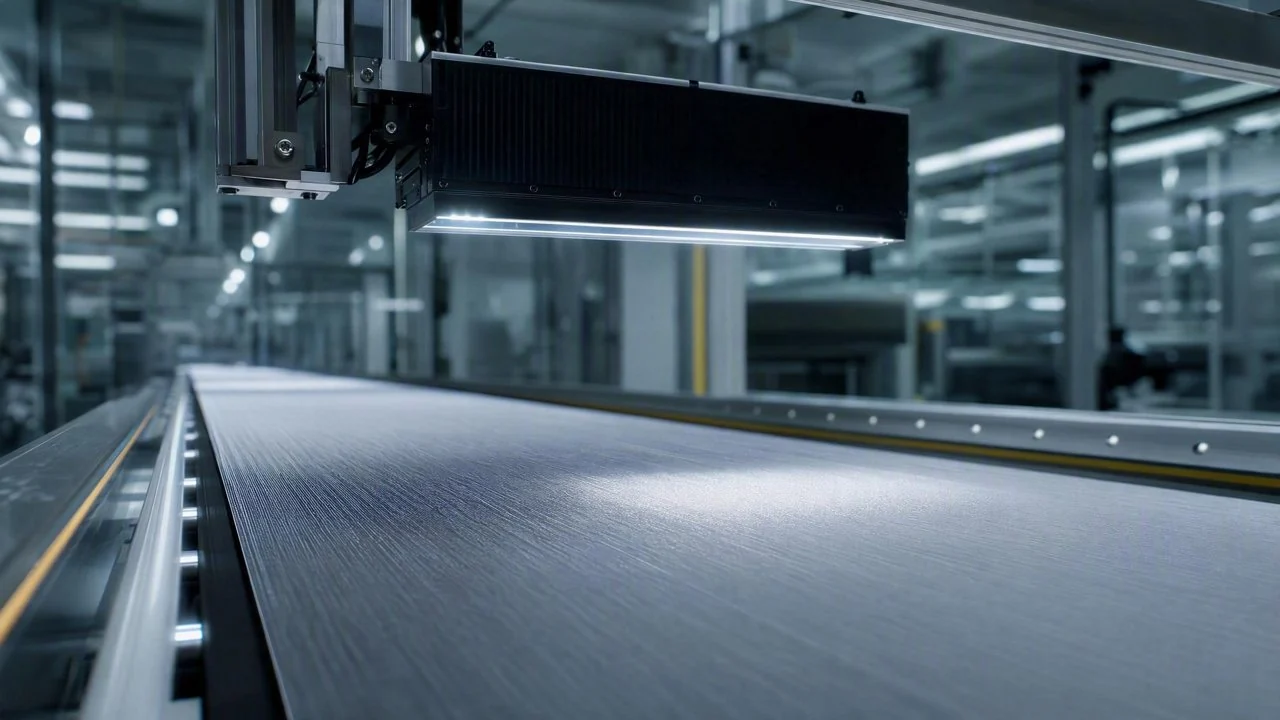
DaoAI's ACI OS, with its visual foundation model for feature recognition, 0-code automatic programming with one good sample in 5 minutes, APDT positive/few-shot learning (1–20 good samples), and semantic false positive filtering, has significantly improved product quality consistency and production efficiency in unsupervised anomaly detection of textured surfaces within the chemical/materials industry. By establishing a comprehensive data closure and quality traceability system, it has reduced manual re-inspection rates from 15% in traditional solutions to <2.2%. The system supports 100% local private deployment via SDK/API/Docker, ensuring data security and production autonomy.
DaoAI's ACI OS, leveraging its visual foundation model for feature recognition, 0-code automatic programming with one good sample in 5 minutes, APDT positive/few-shot learning (1–20 good samples), and semantic false positive filtering, has significantly improved product quality consistency and production efficiency in unsupervised anomaly detection of textured surfaces within the chemical/materials industry. By establishing a comprehensive data closure and quality traceability system, it has reduced manual re-inspection rates from 15% in traditional solutions to <2.2%. The system supports 100% local private deployment via SDK/API/Docker, ensuring data security and production autonomy. The chemical/materials industry is widely applied in high-tech fields such as new energy, electronics, and aerospace. Its products often exist as films, coatings, fibers, or composite materials, featuring complex and diverse surface textures. For instance, in the production of high-performance film materials, stringent inspection of the uniformity and continuity of microscopic surface textures, as well as the presence of anomalies like scratches, bubbles, impurities, or crystal points, is crucial. Such defects can degrade material performance and even pose safety risks. Traditionally, these inspections heavily relied on manual visual inspection or rule-based machine vision systems, but their limitations have become increasingly apparent with growing product complexity and production rhythms.
Pain Points: Why This Hurdle Is Difficult to Overcome
In the unsupervised anomaly detection of textured surfaces within the chemical/materials industry, traditional solutions face multiple challenges. First, there are **high manual re-inspection costs and inefficiency**. For materials with complex textures and randomly occurring defects, manual visual inspection typically results in a false negative rate of 3%–5%, with persistently high false positive rates. This leads to a large number of good products being misidentified, requiring manual re-inspection for about 15% of products, severely slowing down production lines and increasing labor costs. Second, there is a **lack of effective quality traceability mechanisms**. Traditional inspection results are often discrete, making it difficult to link them to specific production batches or process parameters. If product quality issues are discovered downstream, tracing the source is challenging, leading to increased rework rates and even recall risks. Third, **inspection standards are difficult to unify and quantify**. Due to the diversity of textured surfaces and the unstructured nature of defects, manual judgments are subjective, varying among inspectors, making it difficult to establish closed-loop quality management and effectively guide process optimization. Furthermore, in the domestic substitution path for nanometer-level precision inspection, one of the bottlenecks for AI vision technology is how to effectively identify and quantify non-preset texture anomalies that only manifest at the microscopic level under high resolution and throughput, while ensuring model generalization and robustness.
The difficulty in detecting textured surface defects stems from their **unsupervised nature and imaging challenges**. Many defects are not predetermined or structured but rather microscopic structural anomalies naturally formed during material production, such as texture variations caused by uneven coating thickness, disordered fiber arrangement, or subtle cracks hidden within complex backgrounds. These anomalies often appear as minute deviations in local texture rather than obvious geometric changes, making it difficult for rule-based machine vision to build precise models. Concurrently, **imaging highly reflective, translucent, or light-absorbing materials** presents a significant challenge. Uneven lighting or background noise can obscure real defects or generate numerous artifacts, further exacerbating false positive rates. For example, during the lamination of composite materials, internal stresses might cause microscopic wrinkles or lifting on the surface that are imperceptible to the naked eye. These defects only become apparent under specific lighting conditions and vary in form, posing a formidable challenge to traditional vision systems. DaoAI's ACI OS precisely addresses these deep-seated pain points by providing a new solution.
Technical Principles
DaoAI's ACI OS fundamentally transforms textured surface anomaly detection through its core **visual foundation model**. This system employs advanced self-supervised and unsupervised learning algorithms, pre-trained on vast industrial image datasets, enabling it to develop powerful feature recognition capabilities that understand the “normal” patterns of various complex textures. Unlike traditional rule-based or supervised learning methods, DaoAI's ACI OS does not require extensive defect samples for training. It can quickly establish a normal texture distribution model using APDT (Anomaly Pattern Discovery & Tracking) positive/few-shot learning technology, needing only 1–20 good sample images. When an area with significant deviation from the good sample model is detected, it is flagged as a potential anomaly. This method is particularly suitable for textured surface defects, as many defects are unknown or difficult to categorize, making it impossible to collect sufficient samples in advance.
Compared to traditional methods, DaoAI's ACI OS offers significant advantages in engineering depth. **Rule-based AOI** relies on manually set thresholds and feature extraction rules, exhibiting poor generalization capability for complex textures and variable defects, high changeover costs, and susceptibility to false negatives or positives. **Manual visual inspection**, on the other hand, suffers from strong subjectivity, low efficiency, and fatigue, making it difficult to ensure consistent quality. DaoAI's ACI OS further enhances detection accuracy through its **semantic false positive filtering** function. This feature utilizes deep learning models to conduct secondary analysis on initially identified anomalies, identifying and filtering out false positives caused by factors such as lighting variations, material edges, or normal texture fluctuations, reducing the false positive rate by 85% and ensuring the reliability of detection results. Furthermore, the system supports 100% local private deployment via SDK/API/Docker, ensuring customer data security and meeting the stringent requirements of the chemical/materials industry for data privacy and autonomous control. DaoAI's ACI OS can reduce changeover time from hours to 5 minutes, greatly enhancing production line flexibility.
Typical Application Scenarios
- **Surface Defect Detection for High-Performance Film Materials:** In the production of lithium battery separators, optical films, and packaging films, detecting surface scratches, bubbles, crystal points, foreign matter, wrinkles, and texture anomalies caused by uneven coating. Challenges include minute defects, complex optical properties, and high demands on inspection rhythm. DaoAI's ACI OS achieves stable detection of sub-micron defects.
- **Textured Surface Consistency Inspection for Composite Laminates:** Detecting disordered fiber arrangements, resin-rich or resin-poor areas, micro-cracks, and delamination leading to texture discontinuities on the surface of carbon fiber or glass fiber composite laminates. Challenges include material anisotropy and diverse, hidden defect morphologies.
- **Surface Defect Detection for Functional Coatings:** In the production of anti-corrosion, conductive, and insulating coatings, detecting texture anomalies caused by uneven coating thickness, orange peel, pinholes, sags, and particulate impurities. Challenges include significant variations in coating color and gloss, and low contrast between defects and background.
- **Weaving Defects on Textile Materials/Non-woven Fabrics:** Detecting broken threads, skipped stitches, holes, oil stains, color differences, pilling, and uneven weaving density on textiles or non-woven fabrics. Challenges include material flexibility, difficulty in imaging during motion, and a wide variety of defect types.
- **Surface Texture Defects on Metal Sheets:** Detecting roll marks, scratches, oxidation spots, pits, dents, and impressions causing variations in gloss and texture on metal materials like aluminum and steel sheets. Challenges include strong reflections from metal surfaces and low discriminability between defects and normal textures.
Case Study
A leading chemical materials manufacturer, specializing in the R&D and production of high-performance polymer films, whose products are widely used in high-end electronic device packaging. Previously, their film production line relied on a combination of manual visual inspection and some rule-based AOI for quality control. However, due to the complex microscopic textures on the film surface and the occasional occurrence of small, unstructured defects like scratches, bubbles, and crystal points during production, manual visual inspection resulted in a high false negative rate. Furthermore, significant human resources were required monthly for re-inspection, with approximately 1200 suspected defective products processed daily, 85% of which were ultimately deemed good, leading to considerable waste. To enhance inspection efficiency and accuracy, and establish a traceable quality management system, the manufacturer introduced DaoAI's ACI OS.
In the initial deployment phase, the DaoAI technical team collaborated closely with the client, deploying the DaoAI ACI OS. Leveraging its APDT few-shot learning capability, the system automatically programmed a defect detection model in 5 minutes using only 10 good film images. After deployment, the system's core capability was to capture and record the location, image evidence, defect type (after semantic filtering), and corresponding production batch and timestamp for each suspected anomaly in real-time. This data was integrated into the client's MES system, forming a complete quality traceability chain. Before deployment, the production line's manual re-inspection rate was as high as 15%, and product quality data was disparate, making traceability difficult. After deployment, DaoAI's ACI OS **reduced the manual re-inspection rate to <2.2%** and **controlled the false negative rate to <0.4%**. More importantly, by building a data closed-loop, if a film quality issue is discovered in downstream applications, the manufacturer can quickly pinpoint the specific production time, equipment parameters, and even raw material batch, **reducing quality traceability time from hours to minutes**, significantly improving problem-solving efficiency and customer satisfaction.
DaoAI's ACI OS has not only significantly improved detection accuracy and efficiency but, more importantly, it has built a full-link quality management closed-loop from production to traceability, providing a solid guarantee for the high-quality delivery of our products.
DaoAI Solutions and Products
DaoAI's core solution for this chemical materials manufacturer was its ACI OS. This system, as an independent software module, was integrated into the client's existing industrial cameras and edge computing platforms via SDK/API/Docker interfaces, achieving 100% local private deployment. During the modeling phase, DaoAI's ACI OS leverages its unique visual foundation model, requiring no extensive defect samples from the client, learning solely from good product images. Client engineers only need to upload 1–20 good sample images through DaoAI's intuitive interface, and the system can automatically program a detection model within 5 minutes. On the production line, the system uses real-time image data and the principles of APDT few-shot learning to perform unsupervised anomaly detection on textured surfaces. It then applies semantic false positive filtering technology to effectively distinguish between true and false defects, ensuring high accuracy and low false positive rates.
For quality traceability and data closure, DaoAI's ACI OS stores each inspection result (including coordinates, images, confidence levels of normal and abnormal areas, etc.) in a structured manner, and synchronizes this data with production management systems (e.g., MES/ERP). This data is used not only for real-time alarms and line stops but also to build a quality archive for the product's entire lifecycle. When the production line requires a changeover, DaoAI's ACI OS supports rapid model switching, with the entire changeover process completed within 5 minutes, minimizing downtime. Furthermore, DaoAI can also provide the DaoAI World universal model as a unified foundation, enabling cross-scenario generalization and continuous learning from production line feedback, further optimizing detection performance. Through this comprehensive solution, the client not only resolved current inspection pain points but also built an intelligent quality management system for the future, ensuring its competitive advantage in the chemical materials sector.
DaoAI's ACI OS brought significant quantifiable results to the client: **product quality consistency was greatly improved**, with the false negative rate reduced from 3%–5% in traditional solutions to <0.4%, ensuring high-quality product delivery. **Production efficiency significantly increased**, with the manual re-inspection rate reduced by 85%, from 15% to <2.2%, saving substantial human resources and time costs. **Quality traceability capability saw a qualitative leap**, with traceability time reduced from hours to minutes, effectively lowering recall risks and after-sales costs. **Production line flexibility and adaptability were enhanced**, with changeover time reduced from hours to 5min, improving production line utilization. These business values collectively reinforced the client's leading position in the market and laid a solid foundation for future product innovation and market expansion.
FAQ
How does DaoAI's ACI OS help chemical material enterprises achieve quality traceability?
DaoAI's ACI OS achieves quality traceability by associating and structurally storing each inspection result (including defect images, locations, types, and confidence levels) with production data such as batch numbers and timestamps, forming a comprehensive quality archive. This data can be integrated into the client's MES/ERP systems, building a full lifecycle quality traceability chain for products, ensuring quick source identification in case of quality issues.
How does DaoAI's ACI OS compare in cost-effectiveness to traditional machine vision or manual inspection for textured surface anomaly detection?
Traditional solutions incur high manual re-inspection costs and longer changeover times. DaoAI's ACI OS, through few-shot learning and semantic false positive filtering, significantly reduces false negative and false positive rates, cutting manual re-inspection rates by 85%. This drastically reduces labor input and waste due to misjudgments. Concurrently, its 5-minute rapid changeover capability minimizes downtime and increases production line utilization. Overall, long-term operating costs are significantly lower than traditional solutions. For specific ROI, we recommend contacting our sales team for a customized quote and benefit analysis.
How does DaoAI's ACI OS handle the inspection of highly reflective, translucent, or complex textured materials unique to the chemical/materials industry?
DaoAI's ACI OS features a built-in visual foundation model pre-trained on vast industrial images, possessing powerful feature recognition capabilities that adapt to various complex textures and lighting conditions. Combined with APDT few-shot learning and semantic false positive filtering, the system can effectively distinguish between the material's optical properties and true defects, avoiding false positives caused by artifacts and background noise, ensuring inspection accuracy and robustness on highly challenging materials.
Full solution for this scenario: Chemical / materials industry solutions · Unsupervised Anomaly Detection on Textured Surfaces
This article was generated by AI. Customer cases are simulated scenarios based on real product capabilities and figures are illustrative; see product pages for official benchmarks.