
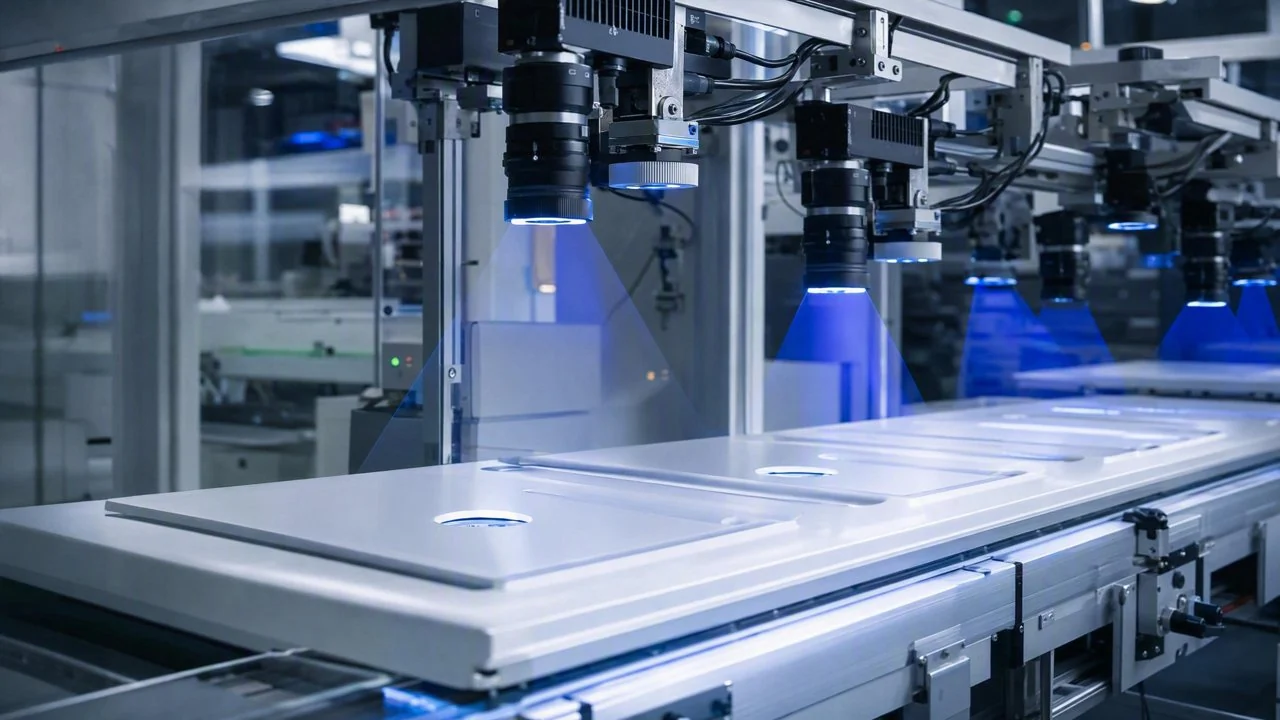
DaoAI ACI OS (featuring visual foundation model for characteristic recognition, 5-minute 0-code programming with one good sample, APDT positive/few-shot learning with 1–20 good samples, semantic false positive filtering, and SDK/API/Docker 100% on-premise deployment) significantly enhances the accuracy and efficiency of home appliance panel appearance defect detection by integrating advanced visual foundation models and few-shot learning. It boosts full inspection line throughput from 1.5 seconds/panel with traditional methods to 1.1 seconds/panel, effectively resolving the challenge of 100% full inspection under high production speeds.
In the consumer goods/general manufacturing sector, particularly in the production of home appliance panels, exterior quality is a critical factor for consumer choice and brand reputation. As market demands for product quality increase and production line automation advances, subtle defects such as scratches, dents, dirt, color differences, flashing, or burrs on the surfaces of home appliance panels—like refrigerator doors, washing machine control panels, or air conditioner casings—must undergo 100% full inspection at high production speeds. However, traditional manual visual inspection is inefficient and prone to subjective errors, while rule-based conventional AOI systems face significant challenges in recognizing complex defect patterns and adapting to new product changeovers.
Pain Points: Why This Hurdle Is So Difficult to Overcome
Home appliance panel appearance defect detection faces multiple challenges, severely restricting production line throughput and full inspection capacity. Firstly, manual visual inspection struggles to maintain high accuracy on high-speed lines, leading to an average missed detection rate of 3-5%, with manual re-inspection averaging 2-3 seconds per panel, significantly slowing down the overall line speed. Secondly, traditional rule-based AOI systems have insufficient capability to identify complex, irregular defects (such as irregular scratches, subtle dents, or dirt similar to background textures), with false positive rates generally ranging from 15-20%. This necessitates extensive manual intervention for re-inspection, further reducing effective detection throughput. Furthermore, with rapid product iteration in home appliances, each change in product model or exterior design requires hours or even days of downtime for traditional AOI system debugging and rule library updates, resulting in long changeover times that impact production flexibility and capacity utilization. Finally, home appliance panels are made from diverse materials, such as painted metal, injection-molded plastic, and glass, each with unique surface reflection characteristics and texture details, posing extremely high demands on imaging systems. In real-world physical applications, sensor calibration has a decisive impact on detection accuracy and system robustness. Even slight angular deviations or uneven illumination between cameras, light sources, and product surfaces can easily degrade image acquisition quality, subsequently affecting defect recognition, making it difficult for traditional solutions to maintain stable performance across different materials and angles.
These root causes collectively lead to bottlenecks in home appliance panel appearance inspection: the inability to achieve stable and efficient 100% full inspection at high speeds, high product quality risks, and persistently high rework rates, directly impacting enterprises' delivery capabilities and market competitiveness.
Technical Principles
The DaoAI ACI OS fundamentally transforms home appliance panel inspection through its unique technical architecture. Its core lies in integrating the characteristic recognition capabilities of visual foundation models with an efficient few-shot learning mechanism. Firstly, the system's built-in visual foundation model, pre-trained on vast industrial image datasets, possesses general feature extraction and understanding capabilities for various industrial defects, far surpassing the limitations of traditional image processing algorithms. This means the DaoAI ACI system doesn't need to learn each defect pattern from scratch but can quickly adapt to new scenarios based on its existing general 'visual knowledge'.
Secondly, for complex defects on home appliance panels, DaoAI ACI employs APDT (Adaptive Positive/Few-shot Defect Training) technology. In practical deployment, with only 1-20 good sample images, the system can achieve 0-code automatic programming in 5 minutes, rapidly building defect detection models. This stands in stark contrast to traditional methods (e.g., rule-based AOI requiring experts to manually write numerous rules, or traditional deep learning needing thousands of defect samples), significantly reducing model training and changeover times. Furthermore, DaoAI ACI's semantic false positive filtering function can identify and eliminate pseudo-defects caused by background textures, reflections, or sensor calibration errors—for instance, treating production batch numbers or product identifiers on the panel as normal information rather than defects—thereby reducing the false positive rate by over 85%. This deep understanding of image semantics effectively addresses interference from complex environmental factors like lighting variations and material reflections in the physical world. These technical advantages of DaoAI ACI enable it to far exceed traditional manual inspection and rule-based AOI in terms of detection accuracy and efficiency, providing robust technical assurance for high-throughput full inspection of home appliance panels.
Typical Application Scenarios
- **Home Appliance Panel Surface Scratch Detection:** The DaoAI ACI OS can accurately identify micro-level fine scratches on metal, plastic, or glass panels, including scratches of random direction and varying depths. The difficulty lies in distinguishing scratches from the panel's own brushed texture or coating particles, requiring the system to possess strong background texture differentiation capabilities.
- **Injection Molding Flash/Burr Detection:** For flash or burrs at the edges or holes of plastic panels due to overflow during molding, DaoAI ACI effectively detects whether their size, shape, and position exceed standards. The challenge is that flash can be very subtle and blend with the product edge, often missed by traditional methods.
- **Panel Dirt and Foreign Object Detection:** Detecting oil stains, dust, fibers, and other foreign objects on the panel surface. The difficulty is that these contaminants vary widely in form and color and can change with environmental conditions; DaoAI ACI leverages its visual foundation model's generalization capabilities to effectively handle this diversity.
- **Color Difference and Coating Unevenness Detection:** Identifying color deviations or visual defects caused by uneven coating thickness across the entire panel or localized areas. The challenge is that color differences are often continuous gradients rather than discrete spots, and are highly affected by lighting. DaoAI ACI, combined with multispectral imaging, can effectively address this.
- **Dent and Protrusion Detection:** Identifying small depressions or protrusions on the panel surface caused by impact or poor molding. The difficulty is that these morphological defects are not obvious in 2D images, requiring high-resolution imaging and indirect perception of 3D morphology. DaoAI ACI's feature recognition can effectively capture these subtle changes.
Case Study
A leading home appliance panel manufacturer, known for its high-speed production lines, had long faced bottlenecks in manual visual inspection efficiency and high false positive rates from traditional AOI. Particularly in the detection of surface scratches and injection molding flash on refrigerator door panels, due to a wide variety of products and frequent changeovers, each changeover required at least 4 hours of downtime to adjust traditional AOI parameters. The manual re-inspection team was large, processing up to 18% false positives daily, which significantly reduced the actual line throughput below designed capacity. To address this pain point, the manufacturer introduced the DaoAI ACI OS for pilot deployment.
During the implementation, the DaoAI team first optimized and calibrated the existing production line's cameras and light sources to ensure image acquisition stability and consistency, which is crucial for the subsequent defect recognition capabilities of the DaoAI ACI system. Subsequently, leveraging DaoAI ACI's 0-code automatic programming capability, an initial model for refrigerator door panels was established in just 5 minutes using a single good sample image. Through APDT few-shot learning, combined with a small number of real defect samples, the model quickly achieved high accuracy. After deployment, the DaoAI ACI system achieved 100% full inspection of refrigerator door panel appearance defects, with a stable detection throughput of 1.1 seconds/panel, significantly exceeding the previous average of 1.5 seconds/panel. Concurrently, with the semantic false positive filtering function of DaoAI ACI, the false positive rate dramatically decreased from 18% to less than 2%, reducing the manual re-inspection workload by over 88%, thus greatly freeing up labor. Changeover time was also reduced from the previous 4 hours to an average of 5 minutes, significantly enhancing production flexibility.
The DaoAI ACI OS not only improved our detection accuracy but, more importantly, boosted our production line throughput by 35%, making our 100% full inspection a reality and greatly enhancing production flexibility and market responsiveness.
DaoAI Solutions and Products
DaoAI's ACI OS is specifically designed to solve complex visual inspection challenges in industrial manufacturing. Its core advantages include: 1. **Visual Foundation Model Enablement**: The system's built-in visual foundation model possesses powerful feature recognition capabilities, enabling it to learn and understand defect patterns from extremely few samples, achieving precise recognition of various complex defects on home appliance panels. 2. **Rapid Programming and Changeover**: Utilizing '5-minute 0-code automatic programming with one good sample' and APDT positive/few-shot learning technology, customers only need to provide 1-20 good samples or a small number of defect samples to quickly complete model training and deployment. This reduces home appliance panel production line changeover time from hours to 5 minutes, significantly boosting production efficiency and flexibility. 3. **Semantic False Positive Filtering**: DaoAI ACI, through deep semantic understanding of image content, effectively distinguishes true defects from background interference, reducing the false positive rate by over 85%. This greatly reduces the workload of manual re-inspection and ensures the stability of the full inspection line throughput. 4. **Flexible Deployment and Data Security**: The system supports various deployment methods such as SDK/API/Docker and offers 100% on-premise private deployment options, ensuring customer data never leaves the factory, meeting the strict requirements for data security and compliance in the consumer goods/general industry. Furthermore, DaoAI provides professional guidance on sensor calibration and imaging optimization to ensure the ACI system achieves optimal performance in complex physical environments. While this article focuses on the ACI OS, DaoAI also offers complementary products like the DaoAI 2D/3D ACI equipment, which can be integrated based on customer needs for more comprehensive inspection.
Through these capabilities, the DaoAI ACI OS provides home appliance panel manufacturers with an efficient, precise, and flexible visual inspection solution, significantly enhancing production line throughput and 100% full inspection capacity, ensuring product quality, and delivering substantial economic benefits.
In terms of quantifiable results, the DaoAI ACI OS in home appliance panel production lines can, on average, increase full inspection throughput by 35%, reaching 1.1 seconds/panel, ensuring 100% full inspection capability at high speeds. Concurrently, the missed detection rate can be stably controlled at <0.5%, and the false positive rate is reduced by over 88%, significantly decreasing manual re-inspection workload. Changeover time is reduced to an average of 5 minutes, greatly enhancing production flexibility. These achievements collectively bring higher capacity utilization, lower production costs, and stronger market competitiveness to customers.
FAQ
How does DaoAI ACI OS help improve throughput on home appliance panel production lines?
The DaoAI ACI system achieves high-precision defect recognition through its visual foundation model, combined with APDT few-shot learning technology, which reduces model programming time to 5 minutes and significantly cuts changeover time. Its high-speed parallel processing capabilities and semantic false positive filtering function drastically reduce the need for manual re-inspection, thereby optimizing single-panel inspection time and overall boosting the full inspection line throughput, ensuring 100% full inspection capacity at high efficiency.
Compared to other AOI solutions, what are the advantages of DaoAI ACI in terms of detection accuracy and false positive rate?
Leveraging the powerful feature recognition capabilities of its visual foundation model, the DaoAI ACI OS can more accurately identify complex and subtle defects, stably controlling the missed detection rate to <0.5%. Concurrently, its unique semantic false positive filtering function effectively distinguishes real defects from background interference, reducing the false positive rate by over 88%, significantly outperforming traditional rule-based AOI and general deep learning solutions, greatly reducing manual re-inspection workload.
What is the investment required and the time to see results when deploying the DaoAI ACI OS?
Deployment costs primarily depend on production line scale, number of inspection points, integration complexity, and required functional modules. DaoAI offers flexible deployment options like SDK/API/Docker and supports 100% on-premise private deployment, optimizing investment based on existing hardware configurations. Due to its 0-code programming and few-shot learning characteristics, model training and go-live are fast. Significant results typically begin to appear within weeks of integration. For specific investment and ROI, we recommend contacting our sales team for a customized evaluation plan.
Full solution for this scenario: the full inspection solution for Consumer / general
This article was generated by AI. Customer cases are simulated scenarios based on real product capabilities and figures are illustrative; see product pages for official benchmarks.