
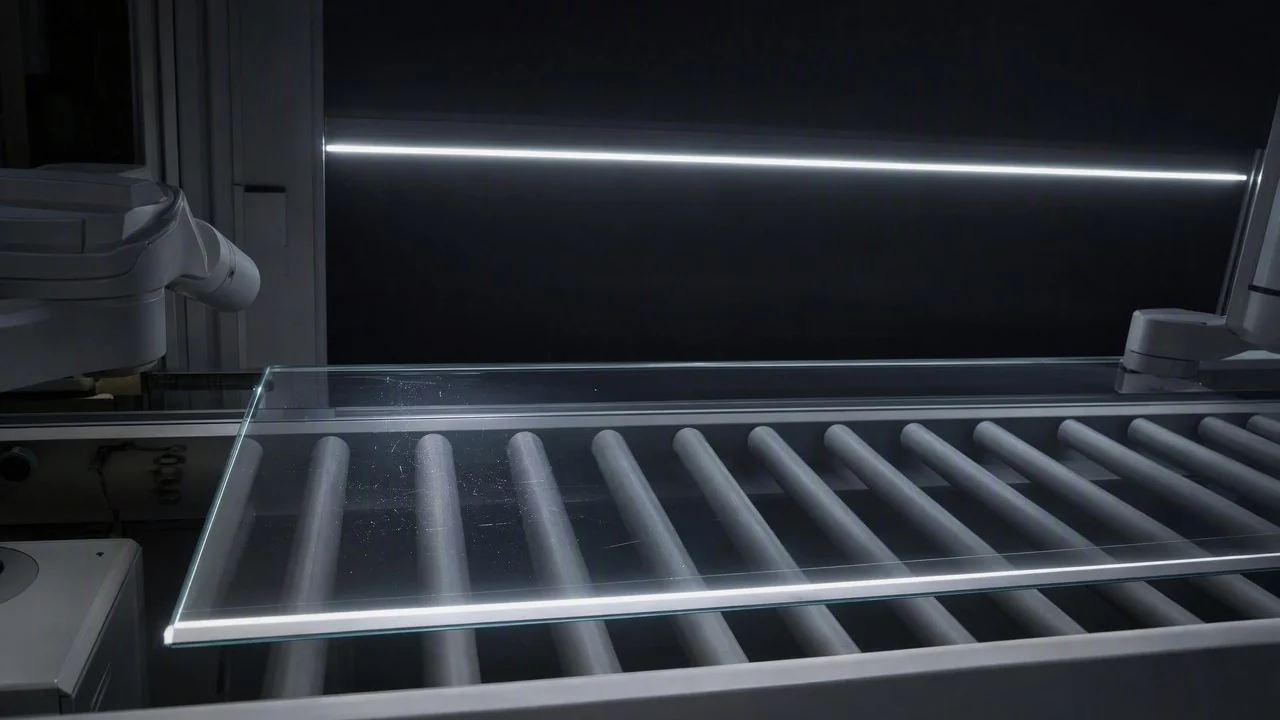
The DaoAI ACI OS (featuring visual foundation models for feature recognition, 5-minute 0-code automatic programming with one good sample, APDT positive/few-shot learning with 1–20 good samples, semantic false positive filtering, and SDK/API/Docker support for 100% on-premise deployment) precisely identifies minute surface scratches and bubbles in flat glass production within the chemical/materials industry. By integrating sensor calibration data from physical vision systems with advanced deep learning models, it reduces the undetected defect rate from a common industry baseline of 3.5% to <0.8%, achieving a significant boost in detection rate and optimizing production efficiency.
In the chemical/materials industry, surface defect detection in flat glass manufacturing is a critical step to ensure product quality and safety. Especially in high-end display screens, architectural curtain walls, and automotive glass applications, even minute surface scratches, bubbles, impurities, or pits can lead to product degradation or even scrap. Historically, such defects relied on manual visual inspection or rule-based traditional AOI systems. However, with accelerating production cycles and increasing product complexity, traditional methods face severe challenges in terms of accuracy, efficiency, and cost. The DaoAI ACI OS was specifically developed to address these pain points, offering an efficient and precise defect detection solution for glass manufacturers through advanced visual foundation models and few-shot learning technology, thereby significantly elevating quality control standards.
Pain Points: Why This Hurdle Is So Difficult to Overcome
Detecting surface defects in flat glass presents multiple challenges, leading to high undetected defect rates, typically around 3.5%, and false positive rates often ranging from 8% to 15%, severely impacting production efficiency and cost. Firstly, defects are diverse and varied in form, such as micron-level scratches, internal bubbles, surface pits, and even some translucent or low-contrast foreign objects, which are difficult to model uniformly visually. Secondly, the complex optical properties of glass, including reflection, refraction, and transmission, easily interfere with imaging, causing defect features to be blurred or masked by environmental noise. On high-speed production lines, the time window for inspection is extremely short, making it difficult for traditional rule-based AOI systems to achieve stable, high-precision, high-speed detection in such complex backgrounds. Furthermore, new types and processes of glass materials are constantly emerging, requiring significant engineer time to rewrite rules for each changeover, resulting in long downtime and inefficient programming.
Aligning with today's industry hot topic, the decisive influence of sensor calibration on system robustness and detection accuracy in physical AI vision systems is particularly prominent in glass defect detection. Microscopic defects on glass surfaces, such as fine scratches, exhibit significantly different imaging characteristics under varying lighting angles and sensor parameter settings. If sensors are not precisely calibrated, issues like uneven illumination, camera distortion, and image acquisition errors directly lead to instability in defect feature extraction, subsequently affecting the model's generalization capability and detection accuracy. For instance, a scratch clearly visible in one area might become blurred or even overlooked by the system due to uneven lighting in another. Traditional AOI systems have poor robustness to these physical uncertainties, making it difficult to adapt to complex and changing production environments. All these factors make precise detection of glass surface defects a formidable challenge.
Technical Principles
The primary reason why the DaoAI ACI OS can significantly reduce the undetected defect rate and improve the detection rate for glass surface defects lies in its integration of visual foundation models for feature recognition and the APDT few-shot learning mechanism. The system first undergoes deep learning on vast industrial image datasets through pre-trained visual foundation models, enabling it to acquire robust semantic understanding and feature extraction capabilities for complex backgrounds such as glass surface textures, lighting, and environmental noise. This means the system does not need to learn from scratch when encountering new glass products or defect types; instead, it can quickly transfer and adapt. Secondly, addressing the few-shot nature of glass defects (good samples are abundant, defect samples are scarce), DaoAI employs APDT (Automated Positive Defect Training) few-shot learning technology. Engineers only need to provide 1–20 good sample images, and the system automatically learns the normal feature distribution of good products. Combined with a small number (or even no) defect samples, it precisely identifies defect areas inconsistent with good product features through self-supervised learning and anomaly detection mechanisms. This method significantly reduces the reliance of model training on defect samples, solving the pain point of traditional deep learning models requiring large amounts of annotated defect data.
Compared to traditional rule-based AOI systems or manual visual inspection, the DaoAI ACI OS demonstrates overwhelming advantages. Traditional AOI relies on engineers manually writing complex rule sets, such as thresholding, edge detection, and morphological operations, to capture defect features. This method is highly sensitive to changes in lighting, product surface texture, and defect morphology. Any slight change in the production environment or product necessitates rule adjustments, leading to long changeover times and a high incidence of false positives and undetected defects. Manual visual inspection, on the other hand, is limited by human eye fatigue, subjective judgment, and low efficiency. It is almost impossible to achieve 100% full inspection on high-speed production lines, with significant undetected defect rates and consistency issues. The DaoAI system, through the generalization capability of visual foundation models and the flexibility of few-shot learning, can effectively address the diversity and complexity of glass defects. Coupled with its semantic false positive filtering mechanism, it reduces the false positive rate by over 85%, achieving higher detection rates and lower undetected defect rates, while also shortening new product changeover time from hours to 5 minutes, significantly boosting production efficiency and quality control.
Typical Application Scenarios
- **Flat Glass Surface Scratch Detection:** After cutting, grinding, and polishing, glass surfaces are prone to micron-level scratches. The DaoAI ACI OS, using multi-angle illumination and image fusion technology, combined with the visual foundation model's sensitive recognition of subtle texture changes, accurately detects these low-contrast, directionally inconsistent scratches, distinguishing them from normal processing marks to avoid undetected defects and false positives.
- **Internal Bubbles and Inclusions in Glass:** Bubbles or unmelted inclusions may form inside the glass during the melting process. As these defects are internal, imaging is challenging, and traditional methods struggle to capture them effectively. The DaoAI system, combining transmitted or polarized light imaging with its visual foundation model's deep learning capabilities for 3D structures and abnormal features within transparent media, can stably detect even tiny bubbles smaller than 0.1mm in diameter.
- **Surface Defect Detection for Coated Glass:** Coated glass surfaces have a film layer, and defects such as unevenness, detachment, or pinholes in this layer can cause glare under specific lighting, interfering with detection. The DaoAI ACI OS, through deep analysis of complex optical phenomena and semantic filtering, effectively separates film defects from background noise, achieving high-precision defect classification and localization.
- **Edge Chipping and Cracks in Shaped Glass:** Shaped glass is prone to edge chipping and micro-cracks during cutting or handling. These defects are often irregular and located at the edges, making detection difficult. The Wemio ACI OS, with high-resolution cameras and edge enhancement algorithms, combined with the visual foundation model's fine-grained recognition of edge details, ensures comprehensive coverage and precise detection of shaped glass edge defects.
- **Glass Substrate Dimension and Morphology Deviation Detection:** Beyond surface defects, the dimensions, flatness, and warpage of glass substrates are also crucial. While this article focuses on surface defects, DaoAI's broader product line, such as DaoAI 2D / 3D ACI equipment, can utilize proprietary 3D cameras for 3D morphological reconstruction, enabling precise measurement of micron-level morphological deviations, providing more comprehensive quality control for glass products.
Case Study
A leading domestic flat glass manufacturer primarily produces ultra-thin glass substrates for high-end display applications. Due to the extremely high surface quality requirements for their products, any minute scratch or bubble could lead to the scrapping of an entire batch. Previously, the manufacturer employed a combination of manual visual inspection and traditional rule-based AOI, but still faced severe challenges. Manual inspection, under high intensity, led to fatigue, resulting in an undetected defect rate of up to 4.2%, coupled with high personnel turnover and training costs. Traditional AOI, due to the complex optical properties of glass and diverse defect types, found rule programming difficult, maintaining a false positive rate around 12%, with significant time spent on manual re-inspection. When launching new products, traditional AOI changeover programming typically took 3-5 days, severely delaying new product time-to-market. To address these issues, the manufacturer introduced the DaoAI ACI OS for on-premise private deployment. After initial data collection and model training, the system used only 15 good sample images for few-shot learning and completed integration with the existing production line within 2 weeks.
“After the DaoAI ACI OS went live, our glass surface defect undetected rate dropped from 4.2% to <0.7%, while the false positive rate was reduced by 90%. This significantly eased the burden of manual re-inspection. More importantly, new product changeover time was shortened from days to less than 10 minutes, greatly enhancing our market responsiveness.”
Post-deployment, the DaoAI ACI OS demonstrated exceptional performance. The system consistently maintained a detection rate of over 99.3% for minute scratches and bubbles, successfully reducing the overall undetected defect rate to <0.7%. Concurrently, thanks to its powerful semantic false positive filtering capability, the false positive rate was reduced by 90%, from 12% to <1.2%, significantly decreasing the workload for manual re-inspection. In terms of changeover efficiency, benefiting from the “5-minute 0-code automatic programming with one good sample” feature, new product changeover time was shortened from the original 3-5 days to less than 8 minutes, greatly enhancing production line flexibility. Through 100% on-premise private deployment, the client's data security and privacy were also fully guaranteed.
DaoAI Solutions and Products
DaoAI provides a comprehensive solution for glass surface defect detection in the chemical/materials industry, centered around the DaoAI ACI OS. This system supports SDK/API/Docker 100% on-premise private deployment, ensuring that clients' core data remains within their premises, meeting stringent data security and compliance requirements. During implementation, our engineers first collaborate with clients to optimize image acquisition strategies based on actual production line conditions, including light source and camera selection, and physical vision system sensor calibration, to ensure high-quality raw data input. Then, using the APDT positive/few-shot learning module of the DaoAI ACI OS, models are trained with a small amount of good product data (1–20 images) provided by the client, rapidly building detection models tailored to specific glass products and defect types. The entire modeling process requires no complex code writing and can be completed through an intuitive graphical interface. For trained models, the system offers semantic false positive filtering to further optimize detection results and reduce unnecessary re-inspections.
In addition to the core ACI OS, DaoAI also offers complementary DaoAI 2D / 3D ACI equipment, which can be integrated with the software system to provide more comprehensive detection capabilities. For instance, for scenarios requiring precise measurement of glass substrate morphology, DaoAI 2D / 3D ACI equipment, combined with proprietary 3D cameras and 3D morphology reconstruction technology, can achieve micron-level morphological detection such as coplanarity and warpage. The DaoAI ACI OS not only addresses the challenges of detection rate and undetected defect reduction for glass surface defects but also helps clients improve production efficiency and optimize quality control through its flexible deployment options and powerful generalization capabilities. Clients can choose the most suitable integration scheme based on their needs, whether it's an independent software deployment or an integrated hardware-software solution, DaoAI provides professional technical support and customized services.
FAQ
What types of defects can DaoAI ACI OS primarily detect in the glass industry?
The DaoAI ACI OS can widely detect various surface defects in the glass industry, including micron-level scratches, internal bubbles, surface pits, foreign objects, chipping, cracks, and uneven coatings. Leveraging the powerful feature recognition capabilities of visual foundation models and few-shot learning mechanisms, the system effectively handles the complexity of glass's optical properties, achieving high-precision identification of low-contrast, morphologically diverse defects.
Compared to traditional rule-based AOI, what are the advantages of DaoAI ACI OS in terms of deployment and maintenance costs?
Compared to traditional rule-based AOI, the DaoAI ACI OS offers significant advantages in deployment and maintenance costs. It uses few-shot learning, requiring only a small number of good sample images for rapid model creation, greatly reducing programming and changeover times, and lowering engineering labor costs. Furthermore, the system's strong adaptability and generalization capabilities reduce frequent rule adjustments and maintenance caused by environmental changes or defect diversity, leading to lower long-term operational costs. Specific pricing requires evaluation based on project scope and functional requirements; please schedule a consultation for a customized quote.
My production line requires 100% on-premise private deployment. Can DaoAI meet this requirement?
Absolutely. The DaoAI ACI OS supports various deployment forms, including SDK/API/Docker, ensuring 100% on-premise private deployment. This means all data processing and model operations are completed within your factory, with no data leaving your premises. This fully meets your strict requirements for data security, privacy protection, and network isolation, safeguarding your critical production data assets.
Full solution for this scenario: the full inspection solution for Chemical / materials
This article was generated by AI. Customer cases are simulated scenarios based on real product capabilities and figures are illustrative; see product pages for official benchmarks.