
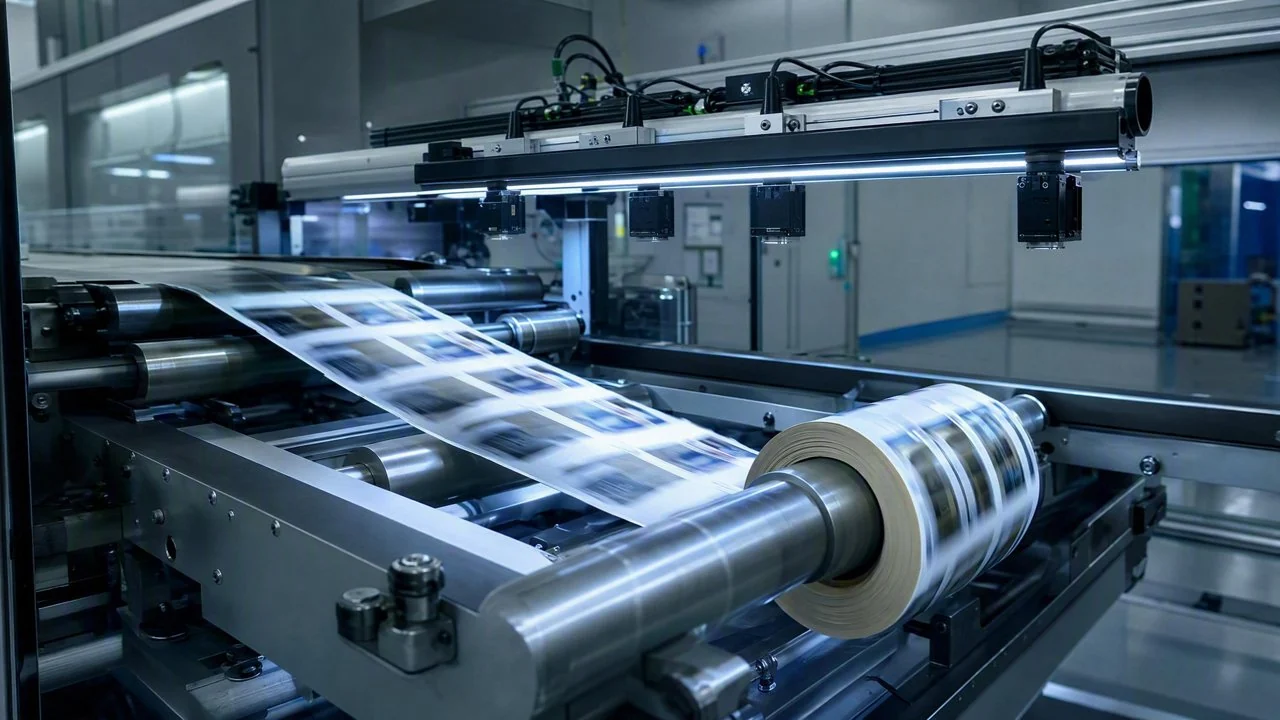
DaoAI ACI OS (featuring visual foundation model for feature recognition, 0-code automatic programming with one good sample in 5 minutes, APDT positive/few-shot learning with 1–20 good samples, semantic false alarm filtering, and supporting SDK/API/Docker for 100% local private deployment) operates on local servers, reducing the false alarm rate for complex defect detection in high-SKU label printing from approximately 10% with traditional rule-based AOI to below 2.5%, while ensuring all production data remains on-site.
High-SKU label printing is an indispensable part of the consumer goods industry, widely applied in food and beverage, daily chemicals, pharmaceuticals, and other fields. As market demand for product personalization and brand diversity grows, the variety, design complexity, and quality requirements for labels have also escalated. Against this backdrop, a leading manufacturer specializing in high-end customized label printing faced inspection challenges stemming from a vast number of SKUs on its production lines. Traditional manual visual inspection was inefficient and prone to subjective errors, while rule-based AOI systems struggled to adapt to frequent changeovers and the identification of complex, varied defects. Crucially, the client had extremely high requirements for protecting core production data and formulation information.
Pain Points: Why This Hurdle Was Difficult to Overcome
The label printing manufacturer faced several severe challenges in its production process. First, high SKUs meant frequent changeovers. Traditional AOI systems required several hours for parameter adjustment and model retraining for each changeover, leading to excessive production line downtime, averaging 3-5 hours per week due to changeovers. Second, label printing defects were numerous and subtle, such as ink spots, scratches, misregistration, missing prints, ink bleed, color differences, and hot stamping defects. These defects were often extremely small (micron-level) and difficult to accurately identify on complex backgrounds and high-gloss surfaces, leading to a traditional rule-based AOI false negative rate often exceeding 1.5%. Furthermore, traditional AOI systems frequently generated false alarms, especially at label edges, special textures, or reflective areas, with false alarm rates as high as 10%. A large number of good products were misidentified, significantly increasing the burden of manual re-inspection, requiring an additional 2-3 quality inspectors daily for re-evaluation. Finally, and most critically, was data security and privacy. As a provider of customized production services, the client’s printing designs, production process parameters, and defect sample data were highly sensitive business secrets. Any data leakage could cause irreversible losses. Traditional cloud-based AI inspection solutions were unacceptable because data needed to be uploaded to third-party servers. The manufacturer urgently needed a smart inspection solution that could be 100% locally deployed, ensuring data never left the factory.
The root cause of these difficulties lay in the complexity of label printing processes, the diversity of materials, and the minute and uncertain characteristics of defects. For example, different label materials (paper, film, metal foil) significantly impact lighting and imaging effects; special processes like hot stamping and UV curing introduce high reflections and texture variations that easily interfere with traditional vision algorithms; and high-speed production demands that inspection systems complete image acquisition and analysis in extremely short times. Traditional rule-based AOI relies on preset geometric features and brightness thresholds, making it difficult to generalize to unknown, variable defect patterns, let alone handle semantic-level false alarms, such as misidentifying slight burrs at label edges as scratches. Regarding data security, while current industrial AI vision inspection platforms emphasize the integration of data collection, analysis, and decision-making, they cannot meet the strict data sovereignty requirements of clients without offering local private deployment options.
Technical Principles
The DaoAI ACI OS precisely addresses these pain points through its unique technical architecture. Its core lies in employing an advanced visual foundation model for feature recognition, enabling the system to understand deep semantic information in images, much like a human expert, rather than just pixel-level differences. Unlike traditional rule-based AOI, which relies on manual threshold setting and feature extraction, DaoAI's foundation model, trained on large-scale image data, has built-in general understanding capabilities for various visual patterns. It can adaptively distinguish subtle differences between normal textures, background patterns, and true defects on labels. This powerful generalization capability allows the system to maintain high-precision detection when encountering new types of defects or complex backgrounds, with minimal manual intervention.
For model training, the DaoAI ACI OS incorporates APDT (Adaptive Positive/Few-shot Defect Training) technology. This means clients only need to provide 1–20 good sample images, and the system can complete 0-code automatic programming for the current SKU within 5 minutes. This learning method significantly shortens the model development cycle and reduces reliance on large numbers of defect samples, making it particularly suitable for high-SKU, small-batch production scenarios. Furthermore, the system's built-in semantic false alarm filtering mechanism intelligently determines whether a feature is an actual defect based on its contextual information and morphological characteristics. This effectively prevents misidentification of minor serrations at print edges, reflective spots, or background textures as scratches or stains, reducing the false alarm rate by over 75%. Most importantly, all computation and data processing by DaoAI support SDK/API/Docker 100% local private deployment, ensuring that clients' sensitive production data is processed entirely on in-house servers, with data never leaving the factory, fundamentally resolving data security concerns.
Typical Application Scenarios
- **Label Surface Ink Spot and Foreign Object Detection:** The DaoAI ACI OS accurately identifies tiny ink spots, dust, fibers, and other foreign objects on label surfaces. The challenge lies in these defects being extremely small and appearing differently on various backgrounds and gloss levels, leading to missed detections or false alarms with traditional methods. DaoAI's visual foundation model effectively distinguishes these subtle features from normal print textures.
- **Misregistration and Missing Print Detection:** For common misregistration or missing print in multi-color printing, the system can detect by comparing the alignment between different color layers or the completeness of the ink layer. The difficulty is that slight misregistration is hard to capture with fixed thresholds, while DaoAI's semantic understanding can identify subtle misalignments at pattern edges.
- **Hot Stamping/UV/Embossing Defect Detection:** For labels using special processes like hot stamping defects, UV coating bubbles, or blurred embossing, the DaoAI system can effectively cope. These processes introduce high reflections or complex textures that easily interfere with traditional AOI, whereas DaoAI's foundation model can handle complex optical effects to accurately identify defects.
- **Color Difference and Print Quality Consistency Detection:** The system analyzes the color distribution of the entire label or local areas to detect batch-to-batch color differences or color unevenness within the same batch. The challenge is that color is a continuous variable and affected by ambient light; DaoAI's feature recognition capabilities can build a more robust color consistency model.
- **Barcode/QR Code Print Quality Inspection:** Ensuring the clarity, readability, and data correctness of barcodes and QR codes. The difficulty lies in the fine lines and spacing of barcodes, and the complex patterns of QR codes; any tiny defect can lead to reading failure. The DaoAI Wemio engine precisely evaluates the print quality of these encodings.
Case Study
A leading label printing manufacturer operates dozens of high-speed printing lines, processing tens of thousands of different SKU label orders annually. Before implementing the DaoAI ACI OS, the manufacturer primarily relied on traditional rule-based AOI combined with manual re-inspection. Traditional AOI systems performed poorly in high-SKU scenarios, with persistently high false alarm rates, generating approximately 30-40 false alarm labels per hour. This required 2 quality inspectors for continuous re-inspection, leading to dual pressures of labor costs and production efficiency. More critically, the client had almost stringent requirements for data security, and no cloud-based solution could meet their compliance needs. After evaluating various solutions, the manufacturer ultimately chose DaoAI's 100% local private deployment solution.
During the implementation process, the DaoAI Wemio team first deployed the ACI OS on the client's local servers and integrated it with existing production line vision hardware. For the client's most frequently used 500 SKUs, using APDT technology, models for each SKU were programmed in 5 minutes with only 1-5 good samples. After deployment, the system showed significant improvements: the false alarm rate dropped from approximately 10% to below 2.5%, reducing re-inspection volume by over 75%. This meant that a position previously requiring 2 quality inspectors now needed only 1, with significantly reduced workload. Concurrently, the false negative rate also decreased from over 1.5% to <0.4%, significantly enhancing outgoing quality. Most importantly, all production data, image samples, and inspection results were stored on the client's local servers, fully complying with their data security policies and eliminating their concerns. The deployment of the DaoAI ACI OS not only improved inspection efficiency and quality but also provided robust assurance for data security and compliance for the client.
The DaoAI ACI OS not only reduced our false alarm rate by over 75%, but more importantly, it achieved 100% local deployment, completely addressing our concerns about core production data security.
DaoAI Solution and Products
The DaoAI ACI OS is at the core of this solution. It is based on an advanced visual foundation model, possessing powerful feature recognition and generalization capabilities, capable of handling various complex and variable defect types in label printing. For deployment, DaoAI provides flexible SDK/API/Docker interfaces, enabling clients to easily integrate it into existing MES/SCADA systems and achieve 100% local private deployment. This means all AI model inference, data storage, and processing are completed on the client's local servers, ensuring sensitive data never leaves the factory and meeting the highest level of data security compliance requirements. For new products or SKU changeovers, the DaoAI ACI OS utilizes APDT positive/few-shot learning technology, requiring only 1-20 good sample images to complete model automatic programming within 5 minutes, greatly shortening changeover times and reducing reliance on human experience. Furthermore, the semantic false alarm filtering function effectively avoids misjudgments caused by background textures, reflections, or edge effects, significantly improving inspection accuracy and stability.
Through the application of the DaoAI ACI OS, the client not only achieved precise and efficient detection of defects in high-SKU label printing but also gained robust assurance in data security. Its business value is reflected in: significantly improved production efficiency due to greatly reduced downtime for changeovers; enhanced quality control capabilities with substantial reductions in both false negative and false alarm rates; optimized labor costs, allowing quality inspection personnel to focus on higher-value tasks; and most importantly, strict protection of core commercial data, mitigating potential data leakage risks. This solution from DaoAI Wemio provides a reliable path for smart manufacturing upgrades in the consumer goods/general industry for production scenarios with high SKU, high precision, and high security requirements.
FAQ
What is the difference between DaoAI ACI OS and traditional AOI?
The DaoAI ACI OS utilizes a visual foundation model for feature recognition, enabling 0-code automatic programming and APDT positive/few-shot learning, allowing rapid model creation with minimal good samples. In contrast, traditional AOI relies on rules and threshold settings, struggling to adapt to complex and varied defect types and frequent changeovers, often resulting in high false alarm rates. The DaoAI system also features semantic false alarm filtering, significantly enhancing detection accuracy.
What is the approximate budget for deploying the DaoAI ACI OS?
The budget for the DaoAI ACI OS depends on various factors, including the number of production lines, inspection complexity, required integration level, and potential hardware upgrade needs. We offer flexible licensing models and deployment options. We recommend contacting our sales team for a detailed, customized quote and ROI analysis based on your specific requirements to ensure an optimized solution.
How does the DaoAI ACI OS ensure data security?
The DaoAI ACI OS supports 100% local private deployment. This means all image data, defect samples, AI model inference, and production parameter processing are performed on the client's own local servers, with no data uploaded to any external cloud platform. We offer various deployment methods such as SDK/API/Docker to ensure clients have complete control over their data, fundamentally eliminating data leakage risks and meeting stringent enterprise data security and compliance requirements.
This article was generated by AI. Customer cases are simulated scenarios based on real product capabilities and figures are illustrative; see product pages for official benchmarks.