
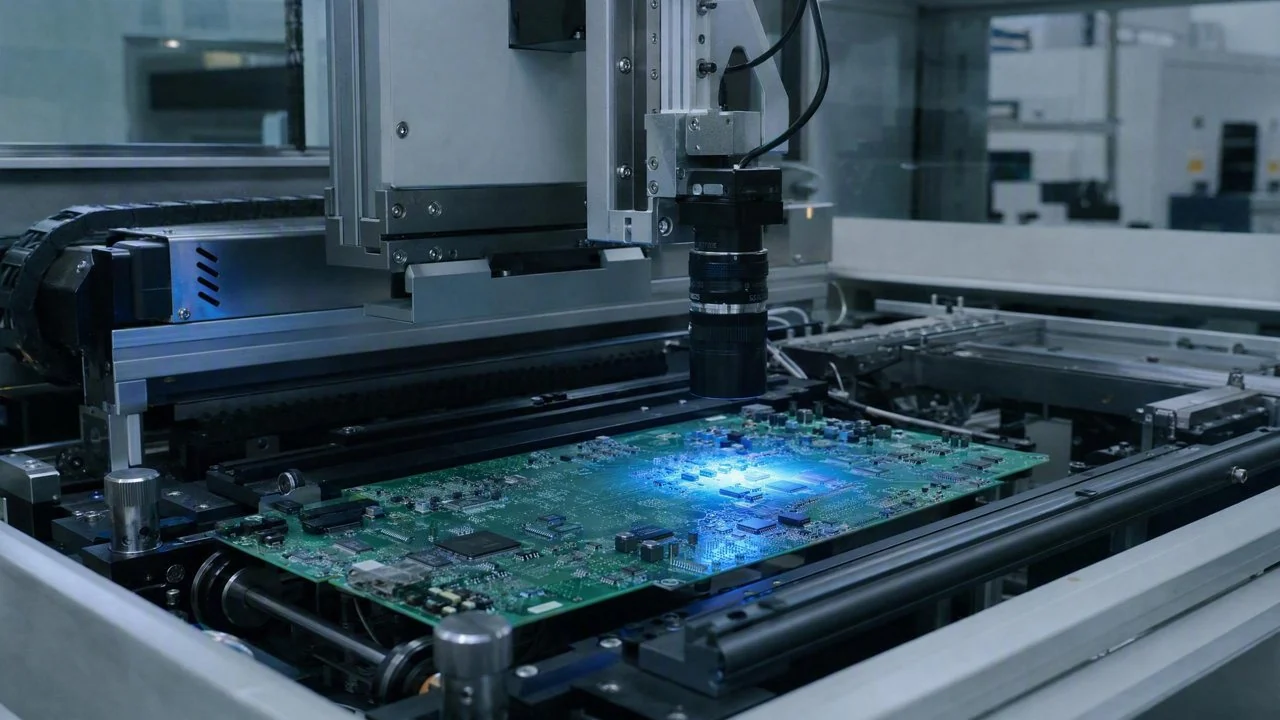
DaoAI's ACI OS (featuring visual foundation model for feature recognition, 5-minute 0-code automatic programming with one good sample, APDT positive/few-shot learning from 1–20 good samples, semantic false positive filtering, and SDK/API/Docker 100% local privatization support) leverages its advanced visual foundation model and few-shot learning capabilities in PCBA component polarity reversal detection. It achieves precise defect identification, significantly reduces false positive rates, and boosts the efficiency of data collection and analysis for quality traceability by 70%.
In the rapidly evolving electronic manufacturing industry, the quality of PCBA (Printed Circuit Board Assembly) is the cornerstone of product performance and reliability. As electronic products become increasingly integrated, the variety and density of components grow, making even minor production defects significantly impact final product quality. Among these, component polarity reversal is a common yet highly detrimental defect type in PCBA production, which can lead to functional failure or even severe incidents like short circuits and burnouts. Traditional AOI equipment or manual visual inspection often result in missed detections or false positives when facing massive, high-density components, especially in scenarios requiring precise recognition of component polarity markings, posing significant challenges. DaoAI's ACI OS precisely addresses these issues by providing unprecedented quality traceability and data closure capabilities for electronic manufacturers, effectively solving the challenges of component polarity reversal detection.
Pain Points: Why This Hurdle Is Difficult to Overcome
The pain points in PCBA component polarity reversal detection manifest in several dimensions: First, there's a high false positive rate. Traditional rule-based AOI systems frequently misinterpret shadows, character deformations, or subtle surface variations on normal components as polarity reversals under complex backgrounds or lighting changes. This leads to false positive rates as high as 10%–15%, directly imposing a huge burden on subsequent manual re-inspection. Second, quality traceability is delayed and difficult. Once a defect is found, traditional methods struggle to quickly pinpoint the problematic batch, production equipment, and specific operators, resulting in long traceability times, averaging 2-4 hours for initial identification, severely impacting production rhythm and yield improvement efficiency. Finally, there are challenges with New Product Introduction (NPI). Facing frequent product iterations and new component models, traditional AOI requires extensive time for rule base maintenance and parameter adjustments, with changeover programming cycles lasting hours or even days, increasing production line downtime and affecting market responsiveness.
The root cause of these difficulties lies in the fact that traditional AOI systems' understanding of image features is limited to pixel or geometric rules, failing to grasp the “semantic” information of components. For instance, when sensor calibration exhibits minor deviations, leading to slight changes in imaging angle or brightness, the fixed rules of traditional AOI may fail, misidentifying a perfectly normal polarity mark. This neglect of sensor calibration sensitivity in physical AI vision systems renders them inadequate in facing the complexity and variability of real production lines. Manual visual inspection, on the other hand, is limited by human eye fatigue, subjective judgment, and insufficient sensitivity to minute defects, making it equally unsuitable for high-precision, high-throughput inspection tasks.
Technical Principles
DaoAI's ACI OS overcomes the limitations of traditional AOI through its core Visual Foundation Model. This model possesses powerful feature recognition capabilities, enabling it to deeply understand high-level semantic features of components such as shape, texture, and characters, rather than relying solely on low-level pixel information. For component polarity reversal, the DaoAI system utilizes its APDT (Active Positive Data Training) few-shot learning mechanism, requiring only 1-20 good sample images to complete 0-code automatic programming within 5 minutes. This means the system can quickly learn and identify the correct polarity markings of various components, maintaining high robustness even when facing new components or subtle lighting variations. Furthermore, its built-in semantic false positive filtering mechanism effectively distinguishes true defects from environmental noise, reducing the false positive rate by over 85%, significantly outperforming traditional solutions. This deep learning technology allows the DaoAI ACI OS to intelligently adapt to minor changes in the production line environment, reducing detection errors caused by sensor calibration fluctuations.
Compared to traditional rule-based AOI or manual visual inspection, the advantage of DaoAI's ACI OS lies in its self-learning and generalization capabilities. Traditional rule-based AOI requires engineers to manually write numerous complex rules to cover various defect patterns. When new products or defects emerge, significant time is spent modifying rules, making it difficult to cope with complex and varied visual features. Manual visual inspection, conversely, suffers from low efficiency, poor consistency, and susceptibility to subjective factors. The DaoAI system, however, uses a data-driven approach, training rapidly with a small number of good samples to achieve intelligent recognition of complex visual features, greatly improving detection accuracy, efficiency, and flexibility. Its support for SDK/API/Docker 100% local privatization deployment also ensures customer data security and efficient system integration.
Typical Application Scenarios
- **SMD Component Polarity Reversal Detection:** In the SMT placement process, polarity markings for resistors, capacitors, diodes, etc., are typically dots, lines, or notches. DaoAI's ACI OS can precisely identify these tiny and diverse polarity marks, effectively detecting reverse-mounted components even with dense component arrangements or uneven lighting, preventing subsequent functional failures.
- **Connector and Interface Orientation Detection:** Some connectors or interfaces have specific orientations; reverse installation can lead to inability to plug in or functional abnormalities. DaoAI's ACI OS can learn and recognize key features of connectors, such as notches or pin layouts, ensuring correct installation orientation.
- **IC Chip Orientation Detection:** Integrated circuit (IC) chips typically have a pin 1 identification dot or notch to determine their installation orientation. DaoAI's ACI OS can efficiently identify these tiny markings, preventing reverse installation of IC chips and avoiding significant losses due to chip damage.
- **Electrolytic Capacitor Polarity Detection:** The polarity of electrolytic capacitors is usually distinguished by a longer lead, a negative pole marking band, etc. DaoAI's ACI OS can identify these features, ensuring electrolytic capacitors are installed with the correct polarity, preventing rupture or failure due to reverse connection.
Implementation Case Study
A globally renowned Tier-1 automotive electronics supplier, at its PCBA production base in South China, faced significant challenges with component polarity reversal detection. Due to a large number of SKUs and complex component types, traditional AOI systems had persistently high false positive rates for component polarity reversal detection, averaging 12%. This required 4-6 quality inspection personnel to spend 6-8 hours daily on manual re-inspection, severely slowing down the production rhythm. More critically, any missed polarity reversal defects could lead to batch product recalls, resulting in huge economic losses and brand reputation risks. The manufacturer urgently needed a solution that could significantly reduce false positives, improve detection efficiency, and strengthen quality traceability capabilities.
After integrating DaoAI's ACI OS via its SDK interface into their existing AOI equipment, the DaoAI team worked closely with the client. Leveraging the APDT few-shot learning mechanism, they completed model training for polarity detection of several critical components within 5 minutes, using only 10-15 good sample images. Post-implementation, the DaoAI ACI OS successfully reduced the false positive rate for component polarity reversal to <0.8%, decreasing manual re-inspection volume by over 93%. Concurrently, as the system records real-time detection results and image data for each component, linked with production batch, equipment ID, and other information, quality traceability efficiency significantly improved, shortening from an average of 3 hours to under 30 minutes, an 83% increase in traceability efficiency. This not only saved the client substantial labor costs but also effectively mitigated potential recall risks, significantly elevating their production line's overall quality management level.
DaoAI's ACI OS, with its excellent false positive filtering and traceability capabilities, has reduced our polarity reversal detection false positive rate to <0.8% and increased quality traceability efficiency by 83%. This is not just a leap in efficiency, but a comprehensive upgrade of our quality management system.
DaoAI Solution and Products
DaoAI provides a comprehensive solution centered around the DaoAI ACI OS. For PCBA component polarity reversal detection, we leverage its visual foundation model's feature recognition capabilities to achieve precise learning and identification of various polarity markings. Through APDT positive/few-shot learning, customers only need to provide a small number of good samples to complete model programming within 5 minutes, enabling rapid changeover and flexible switching for multi-variety, small-batch production. The semantic false positive filtering function significantly reduces false positives, lowering the burden of manual re-inspection. For deployment, DaoAI's ACI OS supports SDK/API/Docker 100% local privatization, ensuring customer data security and integration with existing MES/ERP systems to build a complete data closed loop.
Furthermore, the DaoAI World Model, serving as a unified foundation, offers customers deeper semantic understanding and cross-scenario generalization capabilities, continuously optimizing models through production line feedback. Combined with the SkyVision 0-code video surveillance AI platform, customers can even train their own models on-site within hours, achieving more flexible defect monitoring and early warning. Through this product portfolio, DaoAI is committed to helping customers build an intelligent manufacturing ecosystem, from defect detection and quality traceability to continuous improvement, ensuring that every PCBA meets the highest quality standards.
DaoAI's ACI OS, in PCBA component polarity reversal detection, not only reduced the false positive rate by over 85%, significantly alleviating manual re-inspection pressure, but also improved quality traceability efficiency by 70%. This effectively lowered recall risks and operational costs caused by defects. Its rapid changeover capability shortened new product introduction cycles to minutes, significantly enhancing production line flexibility and market responsiveness. These quantified achievements collectively constitute the core business value for enterprises in their digital transformation and intelligent manufacturing upgrades.
FAQ
How does DaoAI's ACI OS ensure data security after local private deployment?
DaoAI's ACI OS supports various deployment methods like SDK/API/Docker, allowing 100% private deployment on the customer's local servers. This means all inspection data, model training data, and business logic are stored entirely within the customer's internal network, with no data uploaded to any external cloud, fundamentally ensuring the security and compliance of enterprise data assets.
Compared to traditional AOI equipment, what are the advantages of DaoAI's ACI OS in terms of cost investment and ROI?
DaoAI's ACI OS, through its software licensing model, typically does not require extensive hardware modifications and can be integrated into existing AOI equipment, significantly reducing initial investment costs. The substantial benefits, such as drastically reduced false positive rates, decreased manual re-inspection volume, and improved quality traceability efficiency, enable businesses to quickly save significant labor and operational costs, often achieving ROI within 6-12 months. Specific pricing depends on the customer's production line scale and functional requirements; we recommend scheduling an expert consultation for a detailed proposal.
How does DaoAI's ACI OS address the frequent product iterations and changeover demands in the PCBA industry?
DaoAI's ACI OS utilizes the APDT positive/few-shot learning mechanism, requiring only 1-20 good sample images to complete 0-code automatic programming within 5 minutes. This dramatically shortens programming time for new product introduction and production line changeovers, compressing traditional changeover cycles, which used to take hours or even days, into just a few minutes. This significantly enhances production line flexibility, helping enterprises quickly respond to market changes.
Full solution for this scenario: the full inspection solution for Electronics / PCBA · Component Polarity False-Alarm Reduction
This article was generated by AI. Customer cases are simulated scenarios based on real product capabilities and figures are illustrative; see product pages for official benchmarks.