
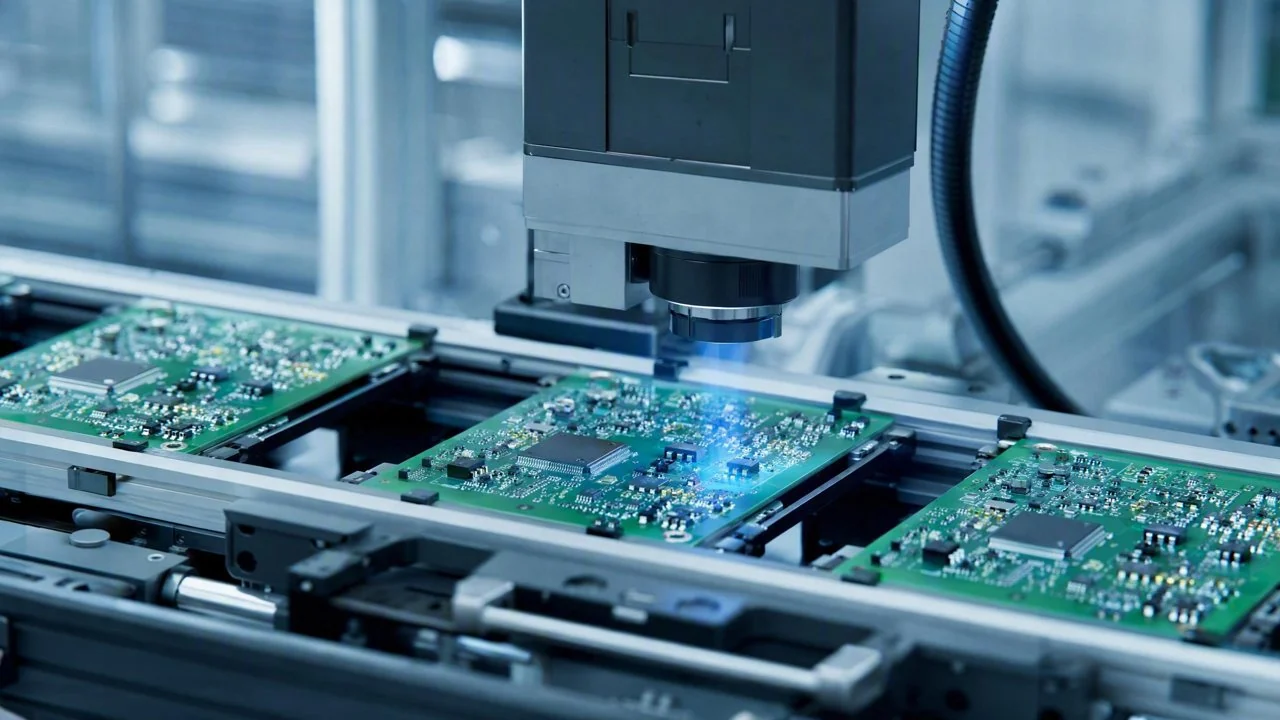
DaoAI ACI OS (featuring vision foundation model-based feature recognition, 5-minute 0-code automatic programming with one good sample, APDT positive/few-shot learning with 1-20 good samples, semantic false positive filtering, and SDK/API/Docker 100% on-premise private deployment support) effectively addresses the false positive challenges in PCBA pin coplanarity defect detection in electronic manufacturing through its APDT few-shot self-training capability, reducing the average false positive rate from 15% to <2% compared to traditional solutions. In the rapidly evolving electronics industry, PCBAs (Printed Circuit Board Assemblies) are the core of various electronic products, and their quality directly determines the performance and reliability of end products. As electronic products move towards miniaturization and higher integration, component density on PCBAs continuously increases, and pin pitches shrink, posing unprecedented challenges to inspection precision and efficiency. Especially in high-reliability applications like high-end server motherboards and communication base station boards, even micron-level pin coplanarity defects can lead to functional failure or safety hazards.
In the rapidly developing electronics industry, PCBAs (Printed Circuit Board Assemblies) are the core of various electronic products, and their quality directly determines the performance and reliability of end products. As electronic products move towards miniaturization and higher integration, component density on PCBAs continuously increases, and pin pitches shrink, posing unprecedented challenges to inspection precision and efficiency. Especially in high-reliability applications like high-end server motherboards and communication base station boards, even micron-level pin coplanarity defects can lead to functional failure or safety hazards. Traditional inspection solutions often struggle to cope with complex and varied defect forms, particularly pin coplanarity, which requires 3D information, placing higher demands on the performance bottlenecks of domestic AI vision solutions. DaoAI (WeLinkirt) is committed to breaking through these technical barriers, providing reliable quality assurance for the electronic manufacturing industry through its leading AI vision technology.
Pain Points: Why This Hurdle Is Difficult to Overcome
Pin coplanarity defects are common quality issues during PCBA assembly, primarily referring to the condition where the pins of multi-pin devices (e.g., QFP, BGA, LGA) are not on the same plane. This can lead to poor soldering, cold joints, open circuits, and other problems, severely impacting product functionality. In actual production, detecting such defects faces multiple challenges: First, **high false positive rates**: Traditional rule-based AOI systems or manual visual inspection often misinterpret non-defect features such as slight pin bends, solder balls, or flux residue as coplanarity defects, leading to false positive rates as high as 15%. This directly increases a significant amount of manual re-inspection time and slows down the production rhythm. Second, **sample scarcity and high changeover costs**: In the field of nanometer-scale precision inspection, real pin coplanarity defect samples are often extremely rare, and defect types are diverse. Traditional AI model training requires a large number of defect samples, resulting in long model training cycles (up to several weeks) when new products are introduced or new defect types emerge, incurring high downtime costs. Finally, **contradiction between precision and throughput**: To ensure high detection rates, some solutions sacrifice inspection speed, leading to extended single-board inspection cycles, which cannot meet the capacity requirements of high-speed production lines. These pain points collectively constitute a major obstacle to quality control in PCBA manufacturing, especially under the performance bottlenecks of domestic AI vision solutions, making the search for efficient and precise inspection methods urgent.
The root cause lies in the subtle visual features of pin coplanarity defects, which are easily affected by factors such as lighting, angle, and surface reflections. For example, a micron-level pin lift might only manifest as a subtle blur or shadow change at the edge in a 2D image, easily masked by noise. Furthermore, subtle differences in pin morphology can arise from different component batches and soldering process parameters, making it difficult for rule-based judgments with fixed thresholds to adapt. Traditional AI vision solutions rely on large amounts of annotated data for training, but the scarcity of defect samples leads to insufficient model generalization capabilities, resulting in poor performance and persistently high false positive rates when encountering subtle, unseen defects.
Technical Principles
DaoAI ACI OS fundamentally solves the challenges of PCBA pin coplanarity defect detection by integrating advanced vision foundation models with a unique APDT (Auto-Programming & Defect Teaching) few-shot self-training mechanism. Its core lies in leveraging the powerful feature recognition capabilities of vision foundation models to extract multi-scale, multi-dimensional high-dimensional features from PCBA images. These features include not only traditional geometric and grayscale information but also deep-seated texture, structural, and contextual semantic information, enabling the system to effectively distinguish between true pin lifts and background interference. When performing pin coplanarity inspection, the DaoAI ACI system first acquires precise 3D morphological data of the pins through high-precision 3D imaging technology (e.g., combining with DaoAI 2D/3D ACI equipment's self-developed 3D camera), and then uses the vision foundation model to learn features from the 3D point cloud data, identifying deviations in the pin end plane. Unlike traditional rule-based AOI that relies solely on height thresholds or 2D edge detection, the DaoAI ACI OS can understand the overall pin structure and potential defect patterns, leading to more accurate judgments.
Compared to traditional methods, the APDT few-shot self-training capability of the DaoAI ACI OS is a significant advantage. Traditional rule-based AOI requires engineers to manually write a large number of complex rules and thresholds for complex defects, which is time-consuming and prone to misjudgment. Traditional deep learning methods, on the other hand, require thousands or even tens of thousands of defect samples for training, which is almost impossible in precision manufacturing where defect samples are scarce. The DaoAI ACI system, through its APDT mechanism, completes model training with only 1-20 good samples, achieving 0-code automatic programming. It learns the feature distribution of normal states from good samples and performs adaptive training with a small number of positive samples (good parts) and very few defect pattern samples (or even without initial defect samples, learning the normal state from good parts first, then incrementally learning from a few defect samples during actual production line operation), quickly building a highly robust defect detection model. This innovative method reduces model training cycles from weeks to minutes, while also reducing false positive rates by over 85%, greatly improving detection efficiency and accuracy, especially demonstrating unparalleled advantages in nanometer-scale precision inspection.
Typical Application Scenarios
- **IC Component Pin Coplanarity Inspection**: For multi-pin packages like QFP, BGA, LGA, inspect whether the pin ends are on the same plane, and if there are warps, bends, or coplanarity issues. The difficulty lies in the large number of pins, small pitches, and susceptibility to solder pad or solder interference. DaoAI ACI OS can accurately identify micron-level deviations.
- **Connector Pin Deformation Inspection**: Check whether the pins of various connectors (e.g., USB, HDMI interfaces) are bent, tilted, missing, or have inconsistent heights, ensuring smooth insertion/removal and signal integrity. The difficulty lies in the tiny, densely arranged pins and complex reflective surfaces. The Wemio system effectively addresses this with semantic false positive filtering.
- **SMT Solder Paste Print Quality Inspection**: After solder paste printing, inspect for defects such as solder paste height, volume, shape, and bridging, ensuring the quality of subsequent pick-and-place and reflow soldering. The difficulty lies in the reflective surface of solder paste and its tendency to collapse. The DaoAI system can perform high-precision 3D morphological reconstruction analysis.
- **Solder Joint Quality Inspection (Hidden Solder Joints)**: For hidden solder joints of BGA, LGA, and other packages, inspect for voids, cold joints, short circuits, and poor wetting. The difficulty is that solder joints are obscured by the package body, making traditional 2D inspection ineffective. DaoAI 2D/3D ACI equipment, combined with its 3D morphological reconstruction technology, can achieve effective detection.
- **Irregular Component Defect Inspection**: Inspect for body damage, pin deformation, incorrect orientation, missing or blurry characters on irregular components such as capacitors, resistors, and inductors. The difficulty lies in the wide variety of components and their diverse appearances. The DaoAI ACI OS achieves efficient recognition through the generalization capabilities of vision foundation models.
Case Study
A leading PCBA manufacturing vendor, specializing in high-reliability communication equipment and industrial control boards, has long been plagued by excessively high false positive rates in the pin coplanarity inspection of its core product's multi-pin devices (e.g., QFP packages with 400+ pins). Traditional rule-based AOI systems, due to ambient lighting, component batch variations, and microscopic solder ball interference, had a false positive rate as high as 18%, requiring an additional 20 man-hours per day for manual re-inspection, severely impacting production efficiency and delivery cycles. Furthermore, when introducing new products, AOI program debugging and rule optimization for each new device took several days or even weeks, resulting in high changeover downtime costs.
After introducing the DaoAI ACI OS, the manufacturer utilized its APDT few-shot self-training function to complete the detection model programming for a new product in just 5 minutes using only 10 good PCBA images. In actual production line operation, the DaoAI ACI system successfully reduced the false positive rate for pin coplanarity defects from 18% to <1.5%, a reduction of 91.6%. This led to a reduction in manual re-inspection hours by over 90%, freeing up significant human resources. Concurrently, due to the rapid adaptability of the APDT mechanism, new product changeover time was reduced from several days to within 10 minutes, greatly improving production line flexibility and efficiency. The manufacturer highly acknowledged the performance and ease of use of the DaoAI system and plans to expand its application to more production lines.
DaoAI ACI OS, with its APDT few-shot self-training capability, reduced the false positive rate of PCBA pin coplanarity defects from 18% to <1.5%, achieving a dual leap in production efficiency and quality.
DaoAI Solution and Products
The core solution provided by DaoAI for PCBA pin coplanarity inspection is the DaoAI ACI OS. This system, with its unique APDT (Auto-Programming & Defect Teaching) few-shot self-training technology at its core, completely transforms the traditional AOI programming paradigm. In the modeling phase, users only need to provide 1-20 good samples, and the system can automatically learn and establish a “normal” visual feature model within 5 minutes, without needing to write any code. When new defect types or minor deviations appear on the production line, through APDT's few-shot learning capability, only a very small number (1-20) of defect samples are needed for rapid incremental model training and optimization, enabling quick adaptation and recognition of new defects. Furthermore, the DaoAI ACI OS's built-in semantic false positive filtering mechanism effectively distinguishes between true defects and background interference (such as flux residue, minor scratches), further lowering the false positive rate. The system supports various deployment methods like SDK/API/Docker and can be 100% privately deployed on-premise, ensuring customer data security and real-time response. For scenarios requiring higher precision 3D morphological inspection, it can be used in conjunction with DaoAI 2D/3D ACI equipment. The self-developed 3D camera of this equipment provides micron-level 3D data, offering richer discriminatory evidence for the software system, enabling precise detection of complex defects such as hidden solder joints and coplanarity.
By deploying the DaoAI ACI OS, customers can significantly enhance the automated inspection level of their PCBA production lines. Specific quantifiable results include: pin coplanarity defect false positive rate reduced by 91.6%, from 18% of traditional solutions to <1.5%; new product changeover time reduced from several days to within 10min, significantly reducing downtime costs; manual re-inspection hours reduced by over 90%, substantially lowering operating costs; simultaneously, it ensures a defect detection rate of over 99.8%, effectively guaranteeing product quality and brand reputation. The DaoAI Wemio engine ensures model robustness and high generalization capability in complex and varied production environments through continuous learning and semantic understanding, creating tangible business value for customers.
FAQ
What is DaoAI ACI OS's APDT Few-Shot Self-Training?
APDT (Auto-Programming & Defect Teaching) is a unique core technology of the DaoAI ACI OS, allowing users to automatically program a detection model in 5 minutes by providing only 1-20 good samples. For new defects or product changeovers, the system can perform rapid incremental learning and optimization with very few (1-20) defect samples, significantly shortening model training cycles and improving defect recognition accuracy, solving the traditional AI model's reliance on large numbers of defect samples.
How can DaoAI ACI OS help me reduce operational costs?
The DaoAI ACI OS significantly reduces operational costs by lowering false positive rates, thereby reducing manual re-inspection hours and labor expenses. Its APDT few-shot self-training capability also drastically cuts down new product changeover time, minimizing downtime losses. Moreover, high-precision defect detection prevents defective products from reaching the market, reducing rework and customer complaint costs. Specific pricing depends on your production line scale, inspection requirements, and deployment method. We recommend scheduling a consultation with our experts for a detailed customized solution and quotation.
What other defects can DaoAI ACI OS detect in the PCBA industry?
Beyond pin coplanarity defects, the DaoAI ACI OS is widely applicable in the PCBA industry for detecting various defects, including but not limited to component polarity reversal, wrong components, missing components, extra components, component damage, solder balls, short circuits, open circuits, solder joint voids, cold joints, solder bridging, insufficient/excessive solder, poor character recognition (OCR/OCV), scratches, dirt, foreign objects, etc. Its vision foundation models and semantic false positive filtering capabilities ensure robust detection for all kinds of complex defects.
Full solution for this scenario: the full inspection solution for Electronics / PCBA
This article was generated by AI. Customer cases are simulated scenarios based on real product capabilities and figures are illustrative; see product pages for official benchmarks.