
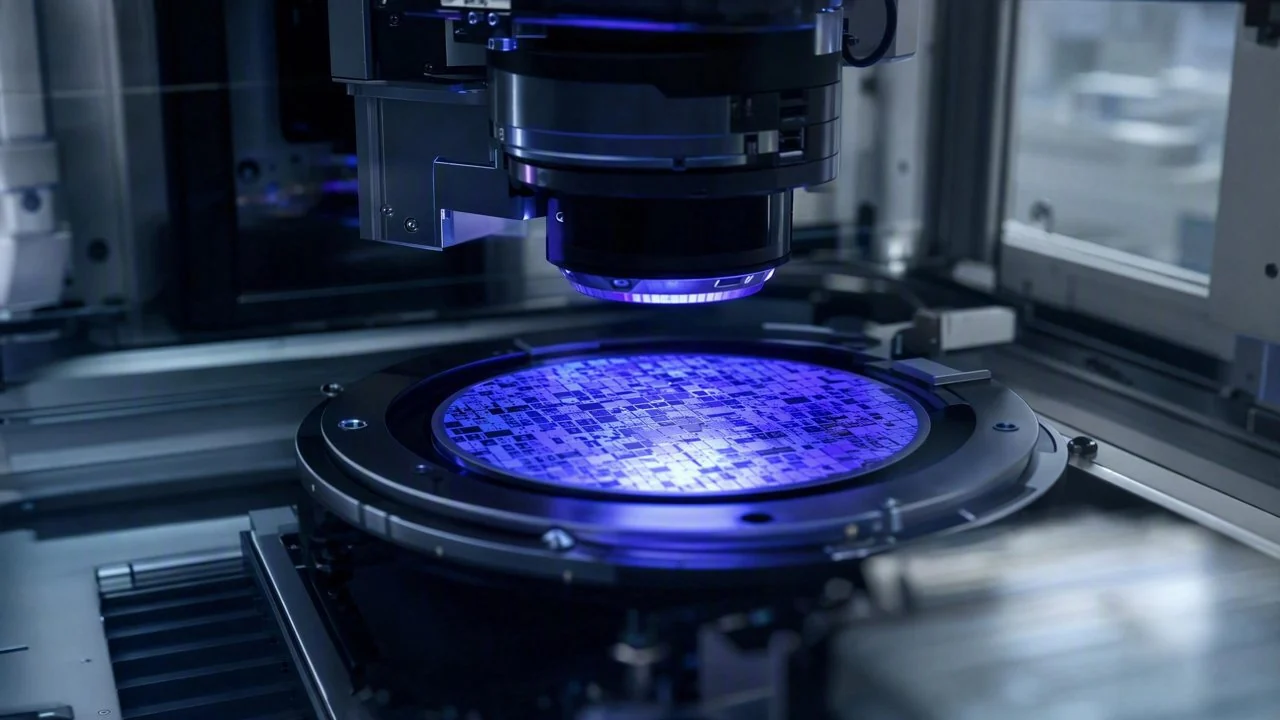
DaoAI ACI OS (featuring visual foundation model for feature recognition, 0-code automatic programming with one good sample in 5 minutes, APDT positive/few-shot learning with 1-20 good samples, semantic false positive filtering, and SDK/API/Docker support for 100% on-premise private deployment), by combining advanced visual foundation models with semantic false positive filtering mechanisms, has successfully reduced the false positive rate for rare defects in semiconductor advanced packaging processes from an industry average of 15% (traditional methods) to <1%. This significantly reduces manual re-inspection workload and effectively improves production line efficiency and quality control. Against the backdrop of increasing demand for high-integration, high-reliability chips in the semiconductor industry, advanced packaging technologies such as Wafer Level Packaging (WLP), System-in-Package (SiP), and 3D stacking are becoming crucial for improving chip performance and reducing costs. However, these complex processes also introduce unprecedented inspection challenges, particularly for rare defects that occur infrequently but have severe impacts. Accurate identification and false positive control for these defects have become critical bottlenecks limiting production line efficiency.
The DaoAI ACI OS (featuring visual foundation model for feature recognition, 0-code automatic programming with one good sample in 5 minutes, APDT positive/few-shot learning with 1-20 good samples, semantic false positive filtering, and SDK/API/Docker support for 100% on-premise private deployment), by combining advanced visual foundation models with semantic false positive filtering mechanisms, has successfully reduced the false positive rate for rare defects in semiconductor advanced packaging processes from an industry average of 15% (traditional methods) to <1%. This significantly reduces manual re-inspection workload and effectively improves production line efficiency and quality control. Against the backdrop of increasing demand for high-integration, high-reliability chips in the semiconductor industry, advanced packaging technologies such as Wafer Level Packaging (WLP), System-in-Package (SiP), and 3D stacking are becoming crucial for improving chip performance and reducing costs. However, these complex processes also introduce unprecedented inspection challenges, particularly for rare defects that occur infrequently but have severe impacts. Accurate identification and false positive control for these defects have become critical bottlenecks limiting production line efficiency. For example, a leading advanced packaging manufacturer faced challenges in detecting rare defects such as micro-foreign objects, solder bridging, and bump collapse after the bumping process, which were often minuscule in size and difficult to distinguish against complex backgrounds, leading to persistently high false positive rates with traditional inspection solutions.
Pain Points: Why This Hurdle Is So Difficult to Overcome
In the inspection of rare defects in advanced packaging, traditional solutions face multiple challenges, leading to high false positive rates and immense re-inspection pressure. Firstly, balancing the trade-off between missed detection and false positives is difficult. Traditional rule-based AOI systems, when encountering minute (e.g., <10 micrometers) and morphologically diverse rare defects, often require extremely high sensitivity to avoid missed detections. This, however, inevitably introduces a large number of false positives, significantly increasing manual re-inspection hours. Statistical data from one manufacturer showed that during peak periods, manual re-inspection could account for over 30% of the total inspection time. Secondly, the scarcity of rare defect samples makes it difficult to effectively train traditional supervised deep learning methods. Due to the extremely low frequency of these defects, it is challenging to collect enough defect samples for model training. Even if trained, models tend to overfit and have poor generalization capabilities for new defect variations. Thirdly, complex background interference is severe. Advanced packaging product surfaces often feature intricate metal layers, dielectric layer textures, and microstructures. These 'normal' textural features are easily misidentified as defects by traditional AOI, especially as 3D vision technology is increasingly applied to improve the gripping precision of industrial robots. Inspection systems need to accurately distinguish real defects from background noise in complex 3D topographical data, further complicating 2D image analysis. Furthermore, frequent product changeovers demand that inspection systems possess the ability to quickly adapt to new products and defects. Traditional solutions have long programming and tuning cycles, severely impacting production line takt time and OEE (Overall Equipment Effectiveness).
The root cause of these pain points lies in the 'small, scarce, and difficult' characteristics of rare defects. 'Small' refers to minute defect sizes with inconspicuous image features; 'scarce' means defect samples are rare, making sufficient training difficult; 'difficult' refers to diverse defect morphologies and complex backgrounds, making accurate identification challenging with fixed rules or limited samples. Traditional image processing algorithms struggle to effectively differentiate noise from real defects, while manual inspection faces issues of visual fatigue, inconsistency, and high labor costs. DaoAI deeply understands these challenges and has specifically developed the ACI OS to address these core problems.
Technical Principles
The reason why the DaoAI ACI OS can achieve a significant reduction in false positive rates for rare defects in advanced packaging inspection lies in its unique visual foundation model for feature recognition and APDT positive/few-shot learning mechanism, complemented by semantic false positive filtering. The visual foundation model embedded in the system acquires a deep understanding of general features in various industrial scenarios through self-supervised learning on massive unlabeled industrial images. This means it doesn't need to learn specific defects from scratch but possesses an 'analogy' capability, allowing it to identify abnormal regions that deviate from known good patterns, even if these abnormalities are previously unseen rare defects. Compared to traditional rule-based AOI systems, which require manual setting of numerous thresholds and geometric judgment rules, these rules are difficult to exhaust for complex and varied rare defects and are highly prone to false positives due to background interference. The visual foundation model of the DaoAI ACI OS, however, can capture deeper semantic features at the pixel level, thereby identifying defects more accurately. For instance, in one practical application, the DaoAI ACI OS reduced the false positive rate for rare defects from 15% to <0.8%, which is directly attributable to its powerful feature generalization capabilities.
Furthermore, APDT (Automated Positive-sample Defect Training) few-shot learning technology is another major highlight of the DaoAI ACI OS. Addressing the issue of rare defect sample scarcity, APDT allows users to provide only 1-20 good sample images, and the system can automatically learn good product features and build an inspection model. This 'learn good, find bad' paradigm avoids reliance on defect samples, greatly shortens the model training cycle, and enhances the detection capability for unknown defects. Compared to traditional deep learning methods that require hundreds or even thousands of defect samples for training, APDT offers a new improvement in efficiency. Concurrently, the semantic false positive filtering mechanism, after the model's initial judgment, performs a secondary semantic analysis of suspicious defect regions, combining contextual information to filter out false positives caused by background noise, reflections, or normal process variations, further solidifying the reduction in false positive rates. This multi-layered intelligent identification and filtering mechanism enables the DaoAI ACI OS to demonstrate exceptional robustness and accuracy in complex and dynamic advanced packaging environments.
Typical Application Scenarios
- **Defect Inspection After Wafer Bumping:** In wafer-level packaging, the integrity of solder bumps (e.g., C4 bumps, copper pillar bumps) is crucial. The DaoAI ACI OS can effectively detect defects such as solder bridging, bump collapse, missing bumps, size anomalies, displacement, and micro-foreign objects. The difficulty lies in the dense arrangement of bumps and strong surface reflections, which can easily lead to false positives with traditional methods due to uneven lighting and subtle morphological changes.
- **Pad and Substrate Defect Inspection Before Flip Chip Bonding:** Before flip chip bonding, it is necessary to check for foreign objects, scratches, oxidation, corrosion, and pad deformation on chip pads and substrates. These defects are often extremely small and may be obscured by complex circuit patterns on the substrate. The DaoAI ACI OS can accurately identify these rare and hidden defects, preventing subsequent bonding failures.
- **RDL Layer Defect Inspection in Fan-Out Packaging:** In fan-out packaging, the redistribution layer (RDL) has extremely narrow line widths and spaces, and a complex multi-layer structure. The DaoAI ACI OS can be used to detect open circuits, short circuits, foreign objects, scratches, corrosion, and interlayer misalignment in the RDL layer. The challenge lies in the transparent or semi-transparent nature of the RDL layer and micron-level line widths, requiring extremely high imaging and recognition precision.
- **TSV Via and Bonding Defects in 3D Stacked Packaging:** Through-silicon via (TSV) technology is critical for 3D stacked packaging. The DaoAI ACI OS, when integrated with DaoAI 2D/3D ACI equipment, can leverage 3D vision data to detect TSV via integrity, filling defects, and bonding quality between stacked chips (e.g., bonding voids, cracks). These defects are often located internally or obscured, making them difficult to detect with traditional 2D vision, and the rarity of such defects results in very few samples.
- **Package Appearance and Character Defects:** Even after final packaging, products may exhibit appearance defects such as package cracks, poor molding, lead deformation, blurry or missing characters. The DaoAI ACI OS can perform high-precision identification of these appearance defects, especially for character defects, effectively distinguishing between normal printing errors and actual omissions, thereby reducing false positives.
Case Study
A tier-1 semiconductor advanced packaging supplier had long faced a high false positive rate for rare defects (such as micro solder splashes, slight bump collapse) in the AOI inspection stage after the wafer bumping process. Due to the extremely low frequency of these defects, traditional rule-based AOI systems, to ensure very high detection rates, had to set sensitivity very high, leading to a large number of false positives daily, with an average false positive rate of around 15%. This forced the manufacturer to deploy a team of 8 experienced engineers for up to 6 hours of manual re-inspection daily, which not only incurred significant labor costs but also severely slowed down the production line takt time. After introducing the DaoAI ACI OS, the manufacturer conducted a one-month trial run. We used the APDT few-shot learning mode, completing the initial model programming with only 10 good wafer images. After fine-tuning and semantic false positive filtering, the system went live and successfully reduced the false positive rate for rare defects from an average of 15% to a stable <0.8%.
The DaoAI ACI OS achieved a leap in inspection efficiency and quality by reducing false positives for rare defects, cutting manual re-inspection time by over 90%.
This significant reduction in false positive rates directly led to a sharp decrease in manual re-inspection volume. The workload that previously required 8 people for 6 hours daily can now be completed by just 2 people in 1 hour, reducing manual re-inspection hours by over 90%. This not only greatly freed up the capacity of the engineering team, allowing them to focus on more valuable process optimization work, but also significantly improved the overall production line takt time. Furthermore, the DaoAI ACI OS helped the manufacturer reduce new product changeover programming time from several hours to within 5 minutes, further enhancing production line flexibility. The client highly praised the DaoAI ACI OS's performance in false positive control and efficiency improvement and plans to extend its application to other advanced packaging processes.
DaoAI Solutions and Products
The core solution provided by DaoAI for rare defect detection in semiconductor advanced packaging is based on our DaoAI ACI OS. This system, with its powerful visual foundation model at its core, achieves deep understanding of image features and generalization capabilities. In the modeling phase, users can leverage its '0-code automatic programming with one good sample in 5 minutes' feature to quickly establish a basic inspection model, greatly simplifying the cumbersome programming process of traditional AOI systems. For rare defects, we fully utilize the advantages of APDT positive/few-shot learning, training highly robust inspection models with just 1-20 good sample images, effectively overcoming the challenge of scarce defect samples. The DaoAI ACI OS also integrates an advanced semantic false positive filtering module, which performs secondary semantic analysis on defects initially identified by the model. By combining product process characteristics and background information, it intelligently distinguishes between true defects and non-defect features, thereby substantially reducing the false positive rate and minimizing the burden of manual re-inspection. For deployment, we offer various integration methods such as SDK/API/Docker, supporting 100% on-premise private deployment to ensure customer data security and the independence of the production environment, keeping data within the factory. Additionally, if customers have higher requirements for micron-level topographical inspection, they can consider integrating DaoAI 2D/3D ACI equipment, whose self-developed 3D camera and 3D morphology reconstruction technology can provide more comprehensive inspection capabilities, complementing the DaoAI ACI OS.
Through the DaoAI ACI OS, customers not only gain high-precision defect detection capabilities but, more importantly, achieve intelligent and automated inspection processes, significantly reducing operational costs. Its rapid programming and changeover capabilities enable production lines to more flexibly meet the demands of multi-variety, small-batch production, improving market response speed. The introduction of semantic false positive filtering effectively reduces manual intervention, freeing up valuable human resources from repetitive re-inspection tasks to engage in more innovative value-creating activities. Ultimately, these capabilities collectively ensure higher quality standards and faster time-to-market for advanced packaging products.
FAQ
How does the DaoAI ACI OS handle the issue of scarce samples for rare defects in the semiconductor industry?
The DaoAI ACI OS addresses the challenge of scarce rare defect samples by employing APDT (Automated Positive-sample Defect Training) few-shot learning technology. This technology allows users to provide only 1-20 good sample images, enabling the system to automatically learn good product features and establish an inspection model. This approach avoids reliance on a large number of defect samples, significantly improving the efficiency and accuracy of rare defect detection.
What advantages does the DaoAI ACI OS offer in false positive rate control compared to traditional rule-based AOI?
The core advantage of the DaoAI ACI OS in false positive rate control lies in its built-in visual foundation model and semantic false positive filtering mechanism. The visual foundation model understands deep semantic features at the pixel level, more accurately identifying anomalies. Semantic false positive filtering performs a secondary analysis to intelligently distinguish true defects from background noise or process variations, thereby significantly reducing the false positive rate, far surpassing the limitations of traditional rule-based AOI that rely solely on rigid thresholds.
What is the approximate budget required to deploy the DaoAI ACI OS?
The budget investment for the DaoAI ACI OS varies depending on the customer's specific needs, production line scale, integration complexity, and required functional modules (e.g., whether 3D equipment is needed). We offer flexible licensing models and deployment options (SDK/API/Docker), supporting 100% on-premise private deployment. We recommend contacting our sales team with your detailed requirements for a customized solution and precise quotation.
Full solution for this scenario: Semiconductor / chips industry solutions
This article was generated by AI. Customer cases are simulated scenarios based on real product capabilities and figures are illustrative; see product pages for official benchmarks.