
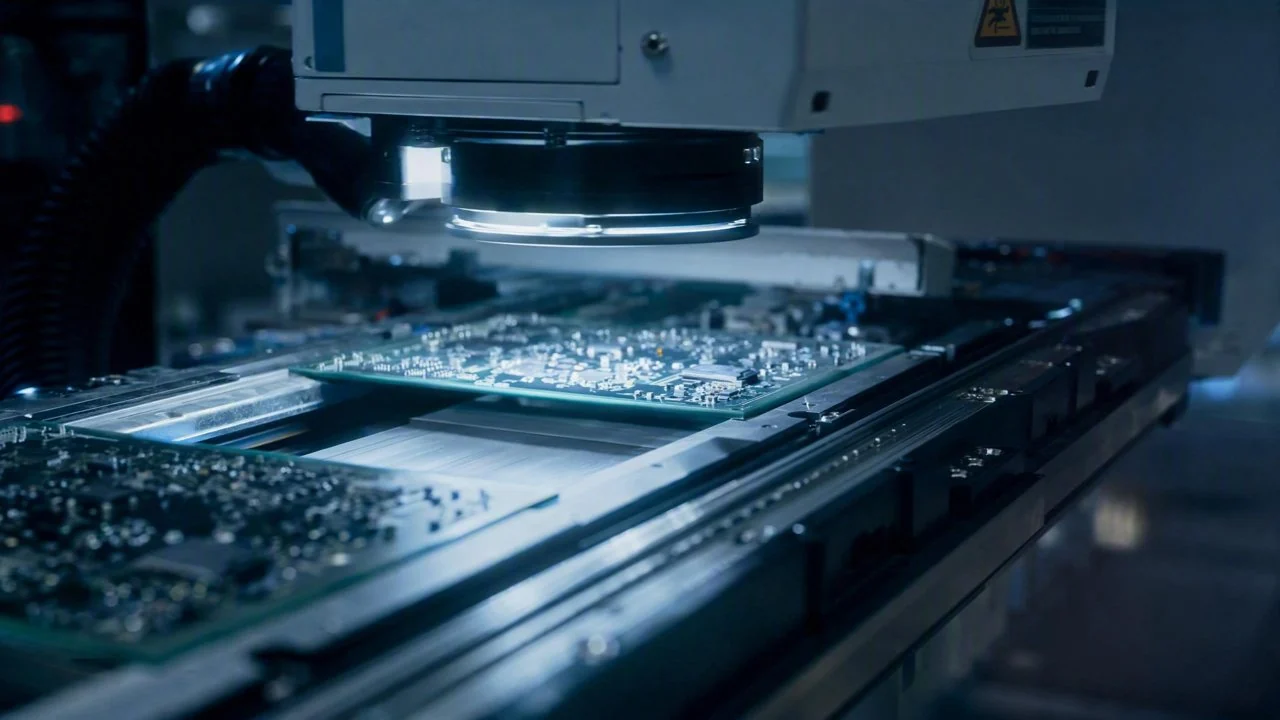
DaoAI ACI OS (featuring visual foundation model for feature recognition, 0-code automatic programming with one good sample in 5 minutes, APDT positive/few-shot learning with 1–20 good samples, semantic false alarm filtering, and SDK/API/Docker support for 100% local private deployment) leverages new 0-code programming and few-shot learning to reduce changeover time for multi-variety small-batch production in the electronics/PCBA industry from an average of 2 hours to under 5 minutes, and lowers false alarm rates by 85%, significantly boosting production efficiency and inspection accuracy.
In the electronics manufacturing industry, particularly PCBA (Printed Circuit Board Assembly) production, there is a growing trend towards multi-variety, small-batch manufacturing. This trend demands extremely high flexibility and rapid changeover capabilities from production lines to adapt to fluctuating market demands. However, traditional AOI (Automated Optical Inspection) systems often require significant time for manual programming and parameter adjustments when faced with frequent product model changes, severely limiting production efficiency. For instance, in component inspection after surface mount technology (SMT), precise identification of soldering quality, polarity, missing components, and misalignment of various components like resistors, capacitors, and ICs is required. DaoAI ACI OS precisely addresses this core pain point, offering an efficient, accurate, and highly flexible intelligent inspection solution for electronics manufacturers through its innovative 0-code rapid changeover and few-shot learning capabilities.
Pain Points: Changeover Barriers and High False Alarm Rates in Multi-Variety Small-Batch Production
The inspection stage of PCBA production lines, under multi-variety small-batch mode, faces multiple challenges. Firstly, time-consuming changeover programming: Traditional AOI relies on engineers manually writing complex inspection rules and parameters, with each changeover typically taking 1–3 hours or more. This results in lengthy line downtime and significantly reduced production efficiency. Secondly, persistently high false alarm rates: Due to the wide variety of components, subtle appearance differences, and variations in ambient lighting, traditional rule-based AOI systems often misjudge non-standard defects or visually similar good products, leading to false alarm rates typically between 5%–15%. This necessitates extensive manual re-inspection, increasing labor costs by at least 20%. Furthermore, traditional solutions have poor generalization capabilities when identifying new or rare defects, requiring re-training or rule-writing, resulting in slow response times and difficulty meeting rapid production iteration demands.
The root cause of these pain points lies in the limitations of traditional visual inspection. Traditional AOI relies on predefined rules and feature engineering, making it difficult to adapt to the increasingly complex component packages on PCBAs, subtle size variations, and continuously evolving production processes. For example, when inspecting solder joint quality, defects like solder balls, cold solder joints, bridging, insufficient solder, and excessive solder vary in form and are highly susceptible to lighting and angle variations; while issues such as reversed component polarity and misalignment demand extremely fine recognition capabilities from visual algorithms. Before the advent of industrial quality inspection foundation models, traditional solutions lacked generalization, meaning that whenever new products or defect types emerged, significant time and resources were spent on model iteration or rule adjustment, preventing truly flexible production.
Technical Principles: Visual Foundation Model Driven 0-Code Programming and Few-Shot Learning
The DaoAI ACI OS fundamentally addresses the pain points of traditional AOI through its core visual foundation model. This system employs an advanced deep learning architecture capable of high-dimensional abstraction and cognitive understanding of visual features in images, rather than relying on low-level features manually extracted by engineers. This means it can, like a human expert, understand 'semantic information' in an image, such as 'this is a capacitor, and its polarity is correct.' Through APDT (Advanced Positive Data Training) few-shot learning technology, the DaoAI ACI OS requires only 1–20 good sample images to complete model training and deployment within 5 minutes, achieving '0-code automatic programming with one good sample in 5 minutes,' drastically reducing changeover time.
Compared to traditional methods (such as rule-based AOI or manual inspection), the DaoAI ACI OS offers significant advantages. Traditional rule-based AOI, when confronted with diverse defects and complex backgrounds, involves complex rule writing that can hardly cover all possible scenarios, leading to high false alarm rates and poor generalization. While manual inspection offers some flexibility, it is slow, inconsistent, prone to fatigue, and costly. In contrast, the DaoAI ACI OS leverages the powerful feature recognition and generalization capabilities of its visual foundation model to identify subtle defects that traditional methods struggle with, and effectively filters semantic false alarms, reducing the missed detection rate to <0.4% and lowering the false alarm rate by 85%. This greatly enhances inspection accuracy and efficiency. Furthermore, the system supports SDK/API/Docker for 100% local private deployment, ensuring customer data security and independent operation of production lines.
Typical Application Scenarios
- SMT Component Placement Quality Inspection: Inspecting various surface-mount components like resistors, capacitors, inductors, and ICs on PCBAs before or after reflow soldering. The DaoAI ACI OS can precisely identify defects such as missing components, misalignment, reversed polarity, tombstoning, and side-standing. The challenges lie in dense, minute components, wide variety, and subtle visual features for certain defects (e.g., reversed polarity).
- Solder Joint Quality Inspection: Inspecting solder joints after solder paste printing (SPI) and reflow soldering, including defects like solder balls, cold solder joints, bridging, insufficient solder, and excessive solder. Traditional methods struggle to differentiate good solder joints from tiny solder balls, while the DaoAI ACI OS, through its visual foundation model, can accurately identify subtle anomalies in solder joint morphology, effectively reducing false alarms.
- Foreign Object/Scratch Detection: Detecting minute foreign objects, scratches, or contamination on PCBA surfaces or components. These defects are often irregular and difficult for traditional rules to capture. The DaoAI ACI OS, with its strong generalization capability, can effectively identify such unstructured defects.
- Character and Barcode Recognition: Recognizing and verifying silkscreen characters, batch numbers, 2D codes, etc., on PCBAs. In cases of poor character print quality or complex backgrounds, traditional OCR algorithms are prone to errors, whereas the DaoAI ACI OS enhances recognition robustness.
- BGA/QFN and Other Complex Package Component Inspection: Inspecting bottom or side solder joints of BGA, QFN, and other complex package components, often requiring 3D vision assistance. The DaoAI ACI OS can be combined with 3D vision equipment (e.g., DaoAI 3D ACI equipment) to achieve more comprehensive inspection, such as coplanarity and solder joint height.
Implementation Case: Flexible Production Line Upgrade for a Leading Electronics Manufacturer
A leading manufacturer specializing in high-end smart hardware faced challenges of frequent changeovers and high false alarm rates on its PCBA production lines. With over 300 PCBA product models and small batch sizes, traditional AOI programming for each changeover averaged 2 hours, significantly slowing down production rhythm. Before integrating the DaoAI ACI OS, the production line's false alarm rate was around 10%, requiring 5-8 quality inspectors daily for manual re-inspection, incurring substantial labor costs. After collaborating with the DaoAI team, the manufacturer integrated the DaoAI ACI OS into its existing AOI equipment and conducted a one-month trial run and optimization. Post-launch, the DaoAI ACI OS's capability of 0-code automatic programming with one good sample in 5 minutes reduced changeover time from an average of 120 minutes to under 5 minutes, significantly increasing production line utilization. Concurrently, the system lowered the false alarm rate by 85%, from 10% to <1.5%, drastically reducing the workload of manual re-inspection, freeing up at least 70% of re-inspection personnel, and improving overall inspection efficiency by 30%.
The DaoAI ACI OS enabled us to achieve truly flexible production; rapid changeover is no longer a bottleneck, and product quality has made a qualitative leap. – Production Manager, a Leading Electronics Manufacturer
DaoAI Solutions and Products
The DaoAI ACI OS, as the core product, provides an end-to-end intelligent inspection solution for the electronics/PCBA industry. Its key capabilities include: 0-code automatic programming, where engineers, through an intuitive GUI, can train and deploy detection models within 5 minutes by providing only a few good samples (1–20 images), without writing any code. APDT positive/few-shot learning technology enables the system to learn normal product features from extremely small numbers of positive samples, effectively identifying various anomalies, especially suitable for multi-variety small-batch production scenarios. Semantic false alarm filtering leverages the deep understanding capabilities of the visual foundation model to effectively distinguish true defects from visually similar good product features, reducing false alarms at the source. The DaoAI ACI OS also supports integration with existing AOI hardware, offering multiple deployment options like SDK/API/Docker, and can be deployed 100% locally and privately, ensuring data security and system stability. Furthermore, combined with DaoAI 3D ACI equipment, it can achieve precise inspection of three-dimensional morphological defects such as hidden solder joints and coplanarity, forming a more comprehensive quality inspection solution.
Through the DaoAI ACI OS, customers can achieve rapid iteration and optimization of detection models. For instance, when a new defect type emerges, the system can quickly update the model through its continuous learning mechanism by adding only a small number of defect samples (or even none), adapting rapidly to new inspection requirements. This continuous learning capability, combined with its powerful cross-scene generalization, enables the DaoAI ACI OS to demonstrate outstanding performance in complex and varied electronic manufacturing environments. Ultimately, the DaoAI ACI OS helps customers ensure product quality while significantly reducing operational costs and enhancing market competitiveness.
FAQ
How exactly is '0-code programming' achieved with the DaoAI ACI OS?
The DaoAI ACI OS achieves 0-code programming through advanced visual foundation models and APDT few-shot learning technology. Users do not need to write any code or complex rules; they simply import 1–20 good sample images via the graphical user interface (GUI), and the system automatically learns product features and generates a high-precision detection model within 5 minutes. This significantly simplifies the programming process, lowers technical barriers, and is particularly suitable for quick deployment and changeover by production line engineers.
How does DaoAI ACI OS help companies reduce costs in multi-variety small-batch production?
The DaoAI ACI OS primarily reduces costs by shortening changeover time, lowering false alarm rates, and reducing manual re-inspection. 0-code rapid changeover reduces downtime from hours to 5 minutes, significantly increasing equipment utilization. Concurrently, the system's high-precision detection capability reduces the false alarm rate by 85%, drastically decreasing the workload and personnel required for manual re-inspection, thereby lowering labor and operational costs. For a detailed ROI analysis, please contact our expert team for a customized evaluation.
Does the DaoAI ACI OS support integration with existing AOI equipment?
Yes, the DaoAI ACI OS supports integration with customers' existing AOI hardware through various methods such as SDK/API/Docker. We provide flexible interfaces to ensure the system can efficiently acquire image data and output inspection results, maximizing the utilization of customers' current investments. Additionally, the system supports 100% local private deployment, ensuring data security and production independence.
Full solution for this scenario: Electronics / PCBA industry solutions
This article was generated by AI. Customer cases are simulated scenarios based on real product capabilities and figures are illustrative; see product pages for official benchmarks.