
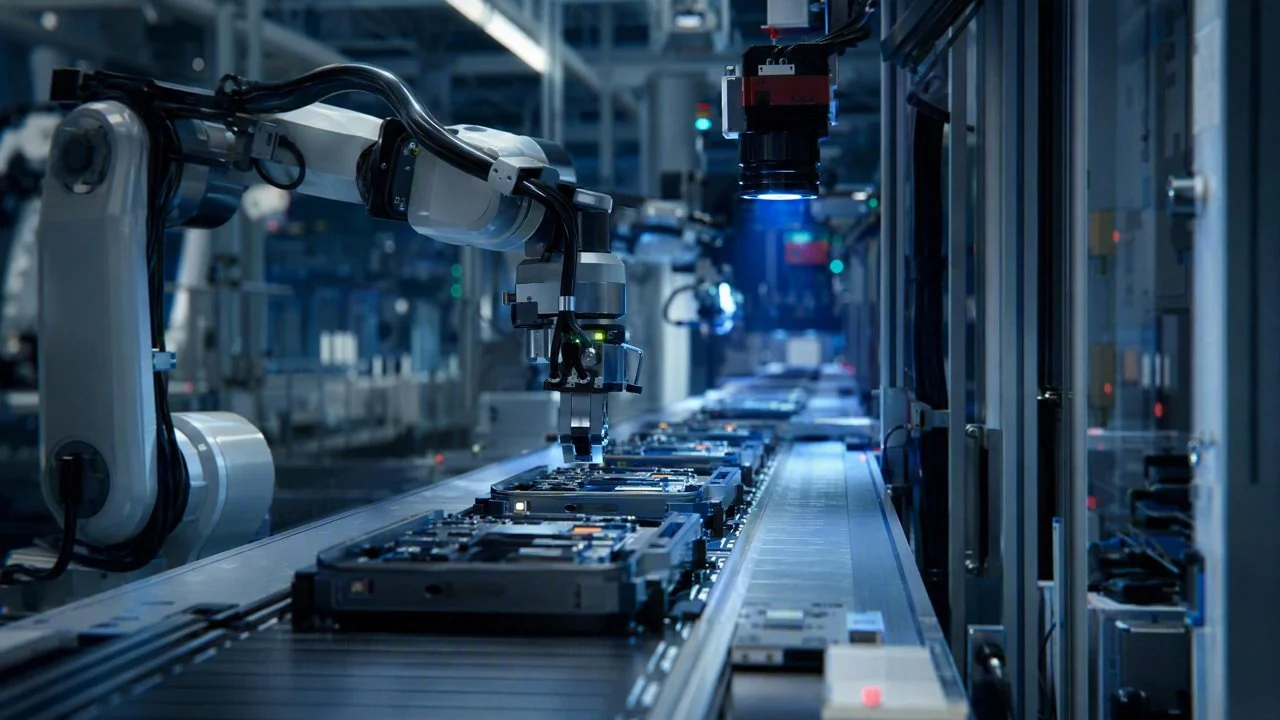
DaoAI ACI OS, leveraging its visual foundation model's feature recognition and APDT positive/few-shot learning mechanism, has significantly reduced false positive rates for missing/incorrect component detection in complex consumer goods assembly from 15% with traditional solutions to <2%. This is achieved through rapid self-training with just 1–20 good samples, greatly enhancing production line efficiency and product quality.
This is achieved through rapid self-training with just 1-20 good samples, greatly enhancing production line efficiency and product quality. In the consumer goods manufacturing sector, particularly in precision assembly stages such as small home appliances, smart wearables, or personal care products, there is an extremely high demand for the completeness, correctness, and precise positioning of product components. Any subtle missing, incorrect, or extra components can lead to product functional failure, degraded user experience, or even recall risks. Traditional manual inspection or rule-based machine vision solutions often struggle to balance efficiency and accuracy when faced with diverse product models, complex defect types, and variable lighting conditions in actual production environments.
Pain Points: Why This Hurdle Is So Difficult to Overcome
Defect detection in consumer goods assembly faces multiple challenges. Firstly, high false positive rates. Traditional rule-based vision systems are sensitive to environmental changes like lighting, product surface reflections, and background clutter, leading to a large number of good products being misidentified as defective. False positive rates often reach 10-15%, directly increasing the burden of manual re-inspection, with re-inspection labor accounting for 30-40% of total inspection time. Secondly, low changeover efficiency for new or modified products. Each product update requires engineers to spend hours or even days rewriting detection rules, severely delaying new product time-to-market. Finally, for some infrequent, irregular defects (e.g., a slightly tilted screw, a partially unseated buckle), traditional methods struggle to build robust detection models, leading to potential leak rates of 1-3%, posing a threat to product quality.
The root cause of these difficulties lies in the complexity of consumer goods assembly: a wide variety of small components, often with subtle differences in color and material. On high-speed production lines, the inspection cycle is fast, leaving a very short time window for image acquisition and algorithm processing. Furthermore, the sensor calibration issue highlighted in today's industry hot topic is particularly prominent on consumer goods production lines. Frequent product changeovers and minor changes in the production environment can lead to slight shifts or degradation in industrial cameras or lighting systems, resulting in unstable image quality and further exacerbating the difficulty of recognition for traditional vision systems, leading to persistently high false positive rates. DaoAI ACI OS precisely addresses these pain points with its innovative solutions.
Technical Principles
The core of the DaoAI ACI OS lies in its powerful visual foundation model's feature recognition capabilities and unique APDT (Anomaly Pattern Detection & Training) few-shot self-training mechanism. Unlike traditional machine vision based on feature engineering and hard-coded rules, DaoAI's visual foundation model, through pre-training on massive image data, possesses a deep understanding of general visual features such as object shape, texture, and color. It can abstract high-dimensional semantic features from the pixel level, thereby forming a more robust cognition of 'what is normal'. This means that even when facing environmental disturbances like lighting, angles, and backgrounds, the system can stably identify target components.
APDT few-shot self-training is another key innovation of the DaoAI Wemio engine. It completely overturns the traditional AI vision paradigm that requires a large number of defective samples to train models. In consumer goods assembly scenarios involving missing/incorrect components, the DaoAI system only needs 1–20 good sample images to quickly complete model training. The system learns the 'normal' patterns of good products and automatically identifies any 'anomalies' that deviate from these normal patterns as defects. This 'positive sample learning' mode, combined with APDT's incremental learning capability, enables the DaoAI ACI OS to rapidly iterate models when facing new defect types or product modifications, requiring only a few good samples instead of collecting a large number of defective samples. This reduces changeover programming time from hours to 5min, greatly enhancing production line flexibility. Furthermore, the semantic false positive filtering mechanism utilizes the foundation model's semantic understanding to effectively distinguish between true defects and background noise or normal tolerance variations, reducing false positive rates by over 85% and ensuring inspection accuracy.
Typical Application Scenarios
- **Multi-component assembly completeness inspection:** In products like smart speakers or electric toothbrushes, detecting whether all tiny components such as screws, springs, washers, and buckles are present and correctly installed. The challenge lies in the small size, large number, and easy obstruction of components, as well as potential subtle color or surface treatment differences between batches. The DaoAI ACI OS learns the overall features of complete good products to precisely identify any missing or misplaced components.
- **Connector insertion direction and depth inspection:** Checking if connectors like phone charging ports or headphone jacks are fully inserted and in the correct orientation. The difficulty lies in the complex internal structure of connectors, where insertion depth is hard to accurately determine from 2D images, and is susceptible to reflections. DaoAI's visual foundation model can extract deep features from multi-angle images to determine the insertion status.
- **Label/sticker position and flatness inspection:** Ensuring that serial number labels, warning stickers, etc., on products are accurately positioned, free of bubbles, and wrinkles. Challenges include diverse label materials, inconsistent reflections, and difficulty in identifying tiny bubbles. The DaoAI Wemio engine, through APDT few-shot learning, can quickly adapt to different label materials and defect types.
- **Button/knob assembly gap and coplanarity inspection:** Checking if buttons or knobs are flush with the casing and if gaps are uniform. The difficulty lies in micron-level dimensional tolerances and visual variations caused by different lighting angles. The DaoAI ACI OS can accurately identify these subtle morphological changes.
- **In-box item placement and quantity verification:** Detecting whether all accessories (e.g., charging cables, manuals, warranty cards) inside consumer product packaging are complete and neatly arranged. Challenges include a wide variety of items, flexible placement methods, and potential reflections from packaging materials. The DaoAI system can perform multi-object recognition and counting to ensure packaging contents meet requirements.
Case Study
A leading consumer electronics contract manufacturer faced severe challenges on one of its smart watch assembly lines. The product line had rapid model iterations, with 2-3 new or modified products launched monthly. Each changeover required senior engineers to spend 4-6 hours re-tuning the rule-based AOI system, leading to extensive production line downtime. Furthermore, due to the tiny internal components and high assembly density of watches, the traditional AOI system had a false positive rate as high as 12%, requiring 3-4 workers to perform manual re-inspection for 6-8 hours daily, severely impacting production efficiency and labor costs. After introducing the DaoAI ACI OS, the manufacturer completely changed its inspection process through the APDT few-shot self-training function.
Before implementation, the assembly line's average false positive rate for missing/incorrect component detection was approximately 12%, with a leak rate of about 0.8%. Each product changeover required an average of 5 hours for AOI system programming and debugging. After integrating the DaoAI ACI OS, using only 15 good sample images for training, the system was able to accurately identify various assembly defects. Post-implementation, the DaoAI ACI OS reduced the false positive rate to <1.5% and further reduced the leak rate to <0.2%. More importantly, product changeover programming time was shortened to 5min, enabling the production line to quickly respond to market changes. The system also supports SDK/API/Docker 100% local private deployment, ensuring the absolute security of customer production data and meeting their strict data compliance requirements.
The DaoAI ACI OS, with its APDT few-shot self-training capability, reduced false positive rates on consumer goods assembly lines to <1.5% and changeover time to 5min, truly achieving efficient, precise, and flexible production.
DaoAI Solutions and Products
The DaoAI ACI OS is the core of this solution. Its visual foundation model's feature recognition capability enables it to quickly understand and learn the visual characteristics of 'normal' products in complex and varied consumer goods assembly scenarios. Through the APDT few-shot self-training mechanism, customers only need to provide 1–20 good sample images to complete model training for new products or new defect types within 5 minutes, significantly shortening changeover time and enhancing production line flexibility. The semantic false positive filtering function further optimizes detection results, effectively distinguishing between true defects and background noise, reducing false positive rates by over 85%. The DaoAI ACI OS supports various deployment methods such as SDK/API/Docker and can achieve 100% local private deployment, ensuring customer data security and meeting the demands of customers with extremely high requirements for data privacy and compliance. Furthermore, the DaoAI World model, as a unified foundation, provides the ACI OS with powerful semantic understanding and cross-scenario generalization capabilities, enabling it to continuously learn from production line feedback and optimize detection performance.
By integrating the DaoAI ACI OS, customers have achieved significant business value. Firstly, detection accuracy has greatly improved, with false positive rates reduced by over 85% to <1.5% and leak rates reduced to <0.2%, effectively guaranteeing product quality and reducing rework and recall risks. Secondly, changeover efficiency has significantly increased, with programming time for new product launches or modifications shortened from hours to 5min, greatly enhancing production line response speed and flexibility. Finally, the burden of manual re-inspection has been substantially reduced, saving significant labor costs and allowing workers to focus on higher-value tasks. The DaoAI ACI OS, with its excellent performance and flexible deployment, provides strong support for the intelligent manufacturing upgrade of the consumer goods industry.
FAQ
How exactly does DaoAI ACI OS's APDT few-shot self-training work?
The APDT (Anomaly Pattern Detection & Training) few-shot self-training mechanism of DaoAI ACI OS works by learning the visual features of a small number (1-20) of good samples to establish a baseline for 'normal' patterns. The system can then identify any abnormal patterns that deviate from this baseline as defects. This method eliminates the need for numerous defective samples, significantly reducing model training and changeover times, making it particularly suitable for scenarios with scarce defect samples or rapid product iterations.
How does DaoAI ACI OS's cost-effectiveness compare to traditional rule-based AOI in consumer goods assembly inspection?
While the initial investment for DaoAI ACI OS might be slightly higher than traditional rule-based AOI, its long-term cost-effectiveness is significant. By drastically reducing false positive and leak rates, it lowers manual re-inspection costs and potential product recall risks. Simultaneously, the 5min rapid changeover capability significantly boosts production line utilization and accelerates new product launches, all contributing to substantial economic returns. The specific ROI period needs to be evaluated based on factors like customer production line scale and defect rates. We recommend contacting us for a customized quotation.
How does DaoAI ACI OS ensure the robustness and stability of detection results, especially under imperfect sensor calibration?
DaoAI ACI OS, based on a visual foundation model, possesses strong feature recognition and generalization capabilities, making it highly robust to environmental changes like lighting and minor sensor offsets. Even with imperfect sensor calibration, the system can effectively filter noise and stably identify true defects by leveraging learned deep semantic features. Furthermore, the APDT mechanism supports continuous learning, allowing the model to be continuously optimized from production line feedback, further enhancing long-term stability.
Full solution for this scenario: Consumer / general industry solutions · Assembly Missing-Part & Misassembly Detection
This article was generated by AI. Customer cases are simulated scenarios based on real product capabilities and figures are illustrative; see product pages for official benchmarks.