
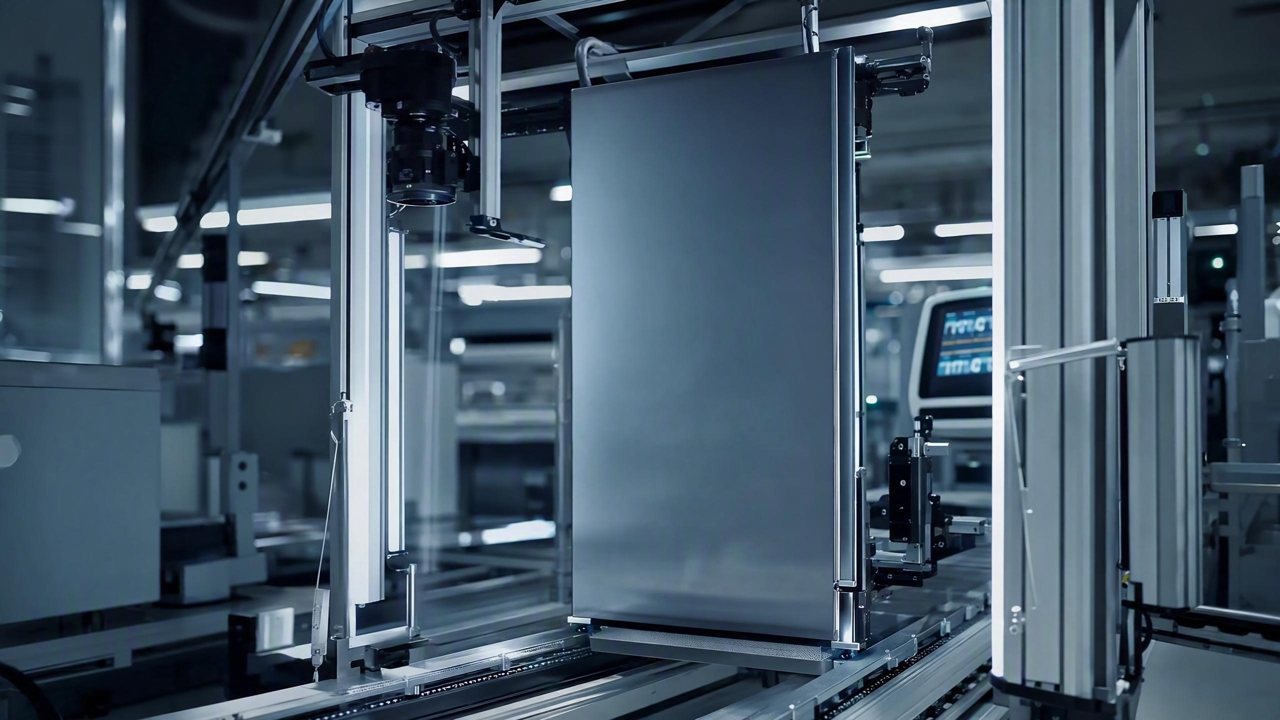
DaoAI AI AOI software system (featuring visual foundation model for feature recognition, 5-minute zero-code programming with one good sample, APDT positive/few-shot learning from 1–20 good samples, semantic false positive filtering, and SDK/API/Docker 100% on-premise deployment) has reduced scratch false positive rates on appliance panels by −85% and decreased manual re-inspection hours by −70% for a leading home appliance manufacturer, significantly improving production line inspection efficiency and product quality. In the consumer goods sector, particularly home appliance manufacturing, product appearance is the primary factor in consumer quality perception. With intensifying market competition and rising consumer aesthetic demands, the appearance inspection of home appliance panels, especially large, high-gloss surfaces like refrigerator doors and washing machine lids, has become increasingly critical. Customers demand zero tolerance for micron-level scratches, dents, and discoloration.
In the consumer goods industry, the production of home appliance panels typically involves complex processes such as stamping, spraying, and screen printing, where any stage can introduce subtle surface defects. These defects, such as scratches, stains, dents, and discolorations, not only affect product aesthetics but also directly relate to brand image and market competitiveness. Traditional inspection methods largely rely on manual visual inspection or rule-based AOI systems. However, manual inspection is limited by eye fatigue and subjectivity, making it difficult to ensure consistency and high efficiency. Traditional rule-based AOI systems, due to their rigid logic, often generate a large number of false positives when faced with the complex and varied surface textures, gloss changes, and non-standardized forms of subtle defects on home appliance panels. This leads to frequent production line shutdowns and requires significant human resources for secondary re-inspection, severely hindering production rhythm and increasing operational costs.
Pain Points: Why This Hurdle Is Difficult to Overcome
A leading home appliance manufacturer faced severe challenges in the final appearance inspection of large refrigerator panels. Due to the large panel size, strong surface reflections, and subtle brushed textures, traditional vision systems lacked sufficient accuracy in identifying scratches and discoloration, leading to a false positive rate exceeding 15%. This directly resulted in approximately 6 hours of manual re-inspection labor daily, tying up numerous skilled quality inspectors, and re-inspection results still suffered from subjectivity. High false positive rates not only reduced the utilization of automated inspection equipment but also slowed down the production line's takt time, decreasing overall efficiency by about 10%. Furthermore, when introducing new products or making minor adjustments to panel materials or colors, traditional AOI systems required days or even weeks for rule adjustments and parameter optimization, with changeover downtime reaching 4 hours, severely impacting production flexibility and market responsiveness.
The root cause of these difficulties lies in the complexity and diversity of surface defects on home appliance panels. The optical properties of panel materials (e.g., stainless steel, color-coated steel, glass) vary significantly, leading to prominent reflection, glare, and shadow issues. Simultaneously, scratch defects vary infinitely in form, with inconsistent depth, width, and direction, often blending with background textures. Traditional algorithms based on thresholds and edge detection struggle to distinguish between genuine defects and normal texture fluctuations. Moreover, with the trend of AI smart cameras simplifying manufacturing inspection processes, there is an urgent demand for more intelligent, less human-dependent solutions, making the limitations of traditional methods increasingly apparent.
Technical Principles
The DaoAI AI AOI software system fundamentally resolves the false positive challenge in home appliance panel defect detection through its core visual foundation model and APDT (Adaptive Positive Sample Domain Transfer) technology. This system does not rely on predefined rules but instead learns deep features from a large amount of good sample data to build a “normal” semantic model of product appearance. When an abnormal area is detected, the system leverages its powerful feature recognition capabilities to compare it with good product features. Crucially, DaoAI introduces a **semantic false positive filtering** mechanism. This is a post-processing module based on high-level semantic understanding, capable of secondary discrimination for “defects” initially detected. For instance, for subtle dust, water stains, or “pseudo-defects” caused by background textures on home appliance panels, the system can combine contextual information and multi-scale features to determine whether they constitute genuine structural defects requiring rejection, rather than simple pixel anomalies. Compared to traditional rule-based AOI systems, which only identify defects by setting fixed thresholds and cannot understand the “nature” or “context” of defects, they are prone to misclassifying normal textures or minor surface foreign objects as defects. Manual visual inspection, on the other hand, relies entirely on operator experience and attention, leading to low efficiency and poor consistency.
The engineering depth of the DaoAI AI AOI software system is also reflected in its **5-minute zero-code automatic programming with one good sample** capability. This means that production line engineers do not need deep learning expertise; they only need to provide a small number of good samples (APDT positive/few-shot learning supports 1–20 good samples), and the system can automatically complete model training and parameter optimization in a short time, reducing new product or batch changeover time from hours to minutes. This efficient self-learning and adaptive capability enables the DaoAI AI AOI system to demonstrate unparalleled flexibility and adaptability compared to traditional methods when facing the high-SKU, rapid iteration production demands of the home appliance industry.
Typical Application Scenarios
- **Refrigerator Door Panel Surface Scratch Detection:** Large, high-gloss stainless steel or color-coated steel refrigerator door panels are susceptible to subtle scratches during production and handling. The DaoAI AI AOI software system utilizes multi-angle illumination and image fusion technology, combined with deep learning models, to effectively distinguish genuine scratches from background textures or reflective artifacts, achieving precise identification of micron-level scratches while employing semantic false positive filtering to avoid misclassifying non-structural defects like fingerprints or water stains.
- **Washing Machine Lid Injection Molded Part Bubble/Shrink Mark Detection:** Injection molding defects in transparent or translucent washing machine lids, such as internal bubbles, surface shrink marks, or flow marks, significantly impact product appearance. The system analyzes transmitted or scattered light images to precisely locate internal and surface defects, and its few-shot learning capability quickly adapts to inspection requirements for different material and color lids.
- **Air Conditioner Casing Coating Discoloration/Particle Detection:** Air conditioner casing coating quality demands are high, with discoloration, uneven film, and dust particle adhesion being common defects. The DaoAI AI AOI software system analyzes high-resolution color images, combining color consistency and texture anomaly detection algorithms, to accurately identify coating defects and effectively filter out color deviations caused by ambient light changes.
- **Microwave Oven Panel Screen Print Character Missing/Blur Detection:** The integrity and clarity of screen-printed characters and patterns on microwave oven control panels are crucial. The system performs character recognition and integrity comparison, detecting defects such as broken characters, missing elements, ink bleed, or positional shifts, ensuring accurate information display.
Implementation Case Study
A leading home appliance manufacturer in East China faced challenges in inspecting scratches on large refrigerator door panels. Before adopting the DaoAI AI AOI software system, their production line relied on traditional rule-based AOI equipment and extensive manual re-inspection. The traditional AOI system's scratch false positive rate reached over 18%, requiring 4-6 quality inspectors daily to manually re-inspect panels marked as “defective,” with each person re-inspecting approximately 200 panels per day, which was time-consuming and labor-intensive. Manual re-inspection was not only inefficient but also caused production line bottlenecks during peak periods. After on-site deployment and model training by the DaoAI technical team, the AI AOI software system was successfully integrated into existing inspection equipment. During the model training phase, using only 15 good panel images, the system completed initial model deployment within 2 days through APDT few-shot learning. Post-launch, after fine-tuning and continuous learning, the DaoAI AI AOI software system successfully reduced the false positive rate for refrigerator panel scratches to <2.7%, while improving overall detection takt time by −20%, significantly alleviating the pressure of manual re-inspection. Quality inspectors could then dedicate more effort to complex defect analysis and process optimization.
“The DaoAI AI AOI software system has significantly reduced our false positive rate, freeing up substantial quality inspection manpower and making our production line run smoother and more efficiently.”
DaoAI Solutions and Products
The core solution provided by DaoAI is its AI AOI software system, which is built upon the feature recognition capabilities of its visual foundation model, combined with the APDT positive/few-shot learning mechanism. This enables defect detection models for home appliance panels to learn and generalize rapidly from an extremely small number of good samples. Specifically for the false positive issue of home appliance panel scratches in this case, the DaoAI AI AOI software system played a crucial role through its unique **semantic false positive filtering** function. It not only identifies potential defects but also understands their “semantics,” effectively distinguishing background textures and minor smudges from genuine structural defects, thereby reducing the false positive rate to an industry-leading level. The system supports SDK/API/Docker 100% on-premise private deployment, ensuring customer data security remains within the factory and can be smoothly integrated into existing MES/SCADA systems for closed-loop data management. In terms of modeling and changeover, the **5-minute zero-code automatic programming with one good sample** feature allows customers to quickly respond to changes in production demands, enabling model adaptation for new products or batches without the need for specialized AI engineers.
The DaoAI AI AOI software system not only provides powerful detection capabilities but also lowers the entry barrier for AI vision technology through its flexible deployment options and user-friendliness. It can be flexibly combined with industrial cameras, lighting, and other hardware to form a complete visual inspection solution. Integrated with the DaoAI World foundation model, the system possesses semantic understanding, cross-scenario generalization, and continuous learning capabilities from production line feedback, ensuring its long-term operational stability and accuracy. For home appliance manufacturing enterprises striving for improved production efficiency and refined quality, the DaoAI AI AOI software system is an indispensable tool for achieving intelligent manufacturing upgrades.
By implementing the DaoAI AI AOI software system, the false positive rate for panel scratches at this leading home appliance manufacturer successfully decreased by −85%, from over 18% to <2.7%, significantly reducing the workload of manual re-inspection. Manual re-inspection hours were consequently reduced by 70%, freeing up valuable quality inspection personnel. Simultaneously, overall production line inspection efficiency increased by −20%, ensuring stable output of high-quality products. New product changeover time was also shortened from several hours to 5min, significantly enhancing production line flexibility and responsiveness, bringing tangible economic benefits and market competitiveness to the enterprise.
FAQ
How does the DaoAI AI AOI software system achieve a low false positive rate?
The DaoAI AI AOI software system achieves a low false positive rate by combining the deep feature recognition of its visual foundation model with a unique semantic false positive filtering mechanism. This allows for high-level semantic understanding of detected anomalies, effectively distinguishing genuine defects from background textures, environmental interference, and other non-defect features. Additionally, its APDT few-shot learning capability ensures model robustness even with limited data.
How does the system ensure detection accuracy for highly reflective surfaces like home appliance panels?
For highly reflective home appliance panels, the DaoAI AI AOI software system can be integrated with multi-angle, multi-wavelength lighting and polarization cameras to effectively suppress reflections and glare, acquiring high-quality images. Combined with its powerful visual foundation model, the system can extract and identify micron-level defect features from complex backgrounds, ensuring high-precision detection.
Is model training and changeover complex when introducing new products with the DaoAI AI AOI software system?
No, it's not. The DaoAI AI AOI software system supports “5-minute zero-code automatic programming with one good sample” and APDT positive/few-shot learning. Users only need to provide 1-20 good product images, and the system can quickly complete model training and parameter optimization. This greatly simplifies new product introduction and changeover processes, eliminating the need for specialized AI engineers and significantly reducing downtime.
This article was generated by AI. Customer cases are simulated scenarios based on real product capabilities and figures are illustrative; see product pages for official benchmarks.