
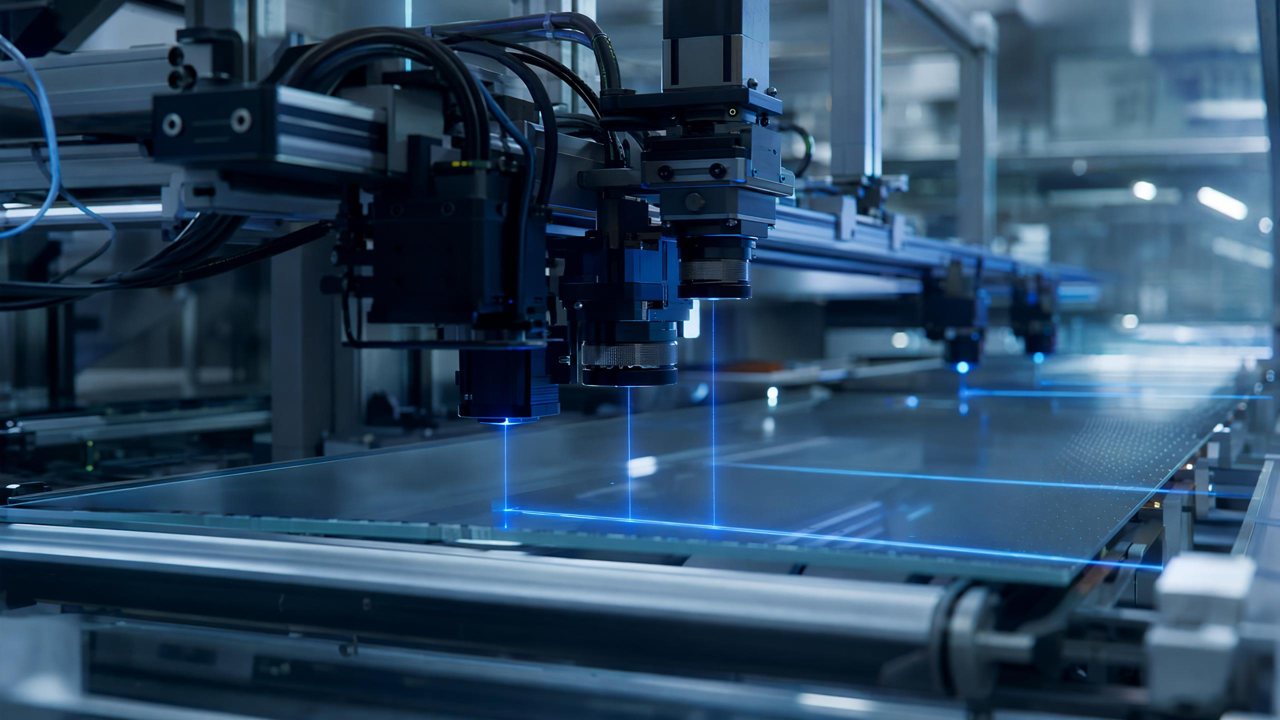
WeLinkirt's DaoAI AI AOI software system (featuring vision foundation model-based feature recognition, 5-minute 0-code programming with one good sample, APDT positive/few-shot learning with 1–20 good samples, semantic false positive filtering, and 100% local private deployment via SDK/API/Docker) has efficiently replaced manual inspection on glass product lines, reducing enterprise labor costs by −70% while significantly improving defect detection accuracy and production line throughput. In the chemical/materials industry, quality control of glass products, especially the detection of minute surface defects, has persistently been a critical challenge limiting production efficiency and yield.
WeLinkirt's DaoAI AI AOI software system (featuring vision foundation model-based feature recognition, 5-minute 0-code programming with one good sample, APDT positive/few-shot learning with 1–20 good samples, semantic false positive filtering, and 100% local private deployment via SDK/API/Docker) has efficiently replaced manual inspection on glass product lines, reducing enterprise labor costs by −70% while significantly improving defect detection accuracy and production line throughput. In the chemical/materials industry, quality control of glass products, especially the detection of minute surface defects, has persistently been a critical challenge limiting production efficiency and yield. A leading glass manufacturer, whose products are widely used in architecture, automotive, and electronic display fields, frequently encounters surface defects such as micro-cracks, scratches, and bubbles during manufacturing, which are difficult to detect with the naked eye. Ensuring 100% inspection for these defects before products leave the factory is crucial for quality and safety. However, traditional inspection methods, particularly for micron-level defects in transparent or translucent materials, often rely on a large number of experienced manual inspectors. This not only incurs significant labor costs but also makes inspection results susceptible to eye fatigue, subjective judgment, and personnel turnover.
Pain Points: Why This Hurdle Was So Difficult
The primary pain points faced by this leading glass manufacturer included: first, high labor costs and recruitment difficulties, requiring several to dozens of professional inspectors per production line, with long training cycles and high turnover rates, leading to elevated average unit costs for inspection. Second, ensuring inspection accuracy and consistency was challenging; manual inspection for micron-level, transparent, or reflective micro-cracks on glass surfaces could result in a false negative rate of 2-5%, especially on high-throughput lines where inspectors struggled to maintain prolonged focus. Third, data accumulation was difficult as traditional manual inspection results were hard to standardize and quantify, hindering subsequent process optimization and quality traceability. Fourth, in response to increasingly stringent market demands for product quality and the rise of multi-variety, small-batch production, manual inspection had poor changeover adaptability. Each product specification or defect type change required retraining, leading to increased line downtime and reduced production efficiency. These issues collectively presented a significant challenge for glass surface defect detection, particularly in 'few-shot' defect scenarios (where certain defect types occur infrequently, making it difficult to collect ample samples for training), rendering traditional rule-based or supervised machine vision methods ineffective.
From a process and imaging perspective, detecting micro-cracks in glass is challenging due to its physical properties. Glass is a transparent medium, and micro-cracks are typically very shallow and only a few micrometers wide, making their contrast with surrounding intact areas extremely low or invisible under conventional backlighting or surface illumination. Furthermore, the reflective and refractive properties of glass surfaces introduce significant interference, complicating image acquisition and feature extraction. Traditional image processing methods often require tedious parameter adjustments for specific lighting and defect types, with poor generalization capabilities. The current evolution of industrial vision from traditional image processing to large model semantic understanding offers a new approach to these challenges. This involves leveraging more powerful feature recognition capabilities to effectively identify anomalies with few or even no defect samples, which is precisely where WeLinkirt's DaoAI AI AOI software system excels.
Technical Principles
WeLinkirt's DaoAI AI AOI software system effectively solves the challenging problem of glass surface micro-crack detection primarily due to its integrated vision foundation models and APDT (Anomaly Pattern Detection & Training) few-shot learning technology. The system bypasses the tedious rule-based programming typical of traditional machine vision. Instead, it leverages pre-trained vision foundation models that have learned universal visual features and semantic information from vast image datasets, granting it powerful feature recognition capabilities. For defects like glass micro-cracks, which are difficult to identify through simple pixel differences, the DaoAI software system can capture anomalous patterns from deeper textures, structures, and subtle light and shadow variations. In practical applications, users only need to provide 1–20 good samples, and the system can automatically program the model and deploy it within 5 minutes. This efficiency is attributed to APDT technology, which builds a precise model of the product's 'normal' state by deeply learning from a small number of good samples, then identifies any deviations from this 'normal' pattern as potential defects. This 'anomaly detection' paradigm significantly reduces the reliance on a large number of defect samples, making it particularly suitable for industrial scenarios with diverse and scarce defect types.
Compared to traditional rule-based AOI systems, WeLinkirt's DaoAI AI AOI software system offers significant advantages. Traditional rule-based AOI requires engineers to spend extensive time writing complex algorithmic rules for each defect type, exhibiting poor adaptability to new defects or environmental changes, often resulting in high false positive rates or missed detections. Manual inspection, on the other hand, suffers from inherent drawbacks such as inconsistency, fatigue, and high costs. The DaoAI software system, with its powerful generalization capabilities from vision foundation models and few-shot learning mechanism, can effectively filter semantic false positives, such as common dust or water stains on glass surfaces that are not actual defects, thereby enhancing detection robustness. Its automated programming and rapid changeover capabilities allow production lines to flexibly respond to multi-variety, small-batch production demands, reducing changeover time from hours to minutes, significantly boosting production efficiency. The WeLinkirt DaoAI AI AOI software system achieves a detection rate of 99.4% for glass micro-cracks while reducing the false positive rate by more than −85%, drastically decreasing the workload of manual re-inspection.
Typical Application Scenarios
- **Micro-crack Detection on Glass Substrates:** In the production of electronic displays, photovoltaic panels, etc., micro-cracks on glass substrates severely impact product performance. WeLinkirt's DaoAI AI AOI software system, combining high-resolution image acquisition with vision foundation models, accurately identifies subtle cracks on transparent substrates invisible to the naked eye. Its few-shot learning capability is particularly suitable for detecting novel material or infrequent defects.
- **Chipping and Bubble Detection on Automotive Glass Edges:** After cutting and grinding, automotive glass edges may exhibit minor chipping or internal residual bubbles, affecting safety and aesthetics. The DaoAI software system effectively distinguishes between geometric edge defects and normal deformations, and can penetrate the glass medium to detect internal bubbles, ensuring products meet stringent automotive standards.
- **Scratch and Foreign Object Detection on Pharmaceutical Glass Vials:** Pharmaceutical glass vials demand extremely high cleanliness and integrity. For subtle scratches on vial walls, internal foreign objects, or glass defects (like stones), traditional methods are prone to interference from curved surface reflections. The WeLinkirt DaoAI software system, through semantic false positive filtering, effectively excludes packaging or environmental interference, precisely locating true defects.
- **Surface Coating Uniformity and Damage Detection for Special Glasses (e.g., Tempered Glass, Functional Coated Glass):** These types of glass often have special coatings or undergo tempering, making their surface defect detection more complex. The DaoAI software system can learn the microscopic texture characteristics of normal coatings to identify uneven coatings, film damage, or tiny chips, ensuring consistent performance of functional glass.
Implementation Case Study
A tier-1 glass product supplier in East China, specializing in high-end architectural and electronic glass, invested tens of millions of RMB annually in manual inspection. As product customization increased, defect types became more complex, and the efficiency bottleneck and misjudgment issues of manual inspection became increasingly prominent. Before adopting WeLinkirt's DaoAI AI AOI software system, one of their architectural glass production lines, with an annual output of 5 million square meters, required 12 inspectors working three shifts, leading to a manual re-inspection rate of up to 18%, severely hindering line efficiency. After careful evaluation, the manufacturer decided to deploy WeLinkirt's DaoAI AI AOI software system, opting for a 100% local private deployment to ensure data security and system response speed.
The WeLinkirt engineering team first optimized the on-site lighting and camera systems to accommodate the transparent properties and surface reflections of glass. Subsequently, 15 good glass samples were imported into the DaoAI AI AOI software system for model training. The entire training and programming process took less than 30 minutes. After deployment, the system initially operated in parallel with manual inspection. Through continuous data feedback and model optimization, WeLinkirt's DaoAI AI AOI software system quickly achieved stable operation. Before deployment, the production line's average daily manual re-inspection volume was approximately 3600 pieces; three months after deployment, this volume decreased to about 1260 pieces, a reduction of −65%. More importantly, because the system could operate consistently and reliably, eliminating the risk of missed detections due to human eye fatigue, the overall product yield improved by 0.8%. Furthermore, the original 12-person inspection team was optimized to 3 people for spot checks and anomaly handling, reducing labor costs by −70%.
The WeLinkirt DaoAI AI AOI software system not only reduced our labor costs but, more importantly, provided us with unprecedented inspection consistency and data insights, allowing us to focus more on process innovation.
WeLinkirt Solution and Products
WeLinkirt provided this glass manufacturer with a comprehensive solution centered around the DaoAI AI AOI software system. The system, with its unique vision foundation model and APDT few-shot learning capabilities, perfectly addresses the characteristics of diverse and scarce glass surface defects. For deployment, the system supports 100% local private deployment via SDK/API/Docker, ensuring customer data remains on-premises, meeting the high demands of the chemical/materials industry for data security and real-time performance. The modeling process is extremely simple, requiring only a few good product images to complete automatic model programming within 5 minutes, greatly shortening the deployment cycle and technical barriers. For product changeovers, the system also demonstrates high flexibility, achieving near-instantaneous switching by quickly loading a few good samples of the new product, avoiding the lengthy downtime adjustments common with traditional solutions. Furthermore, WeLinkirt's DaoAI AI AOI software system features powerful semantic false positive filtering, effectively distinguishing non-defect interferences like dust and water stains on glass surfaces, ensuring detection accuracy and reducing unnecessary re-inspection steps. This solution effectively replaced a large amount of repetitive and error-prone manual inspection work, significantly enhancing the automation level of quality control.
Through the deployment of WeLinkirt's DaoAI AI AOI software system, the manufacturer achieved significant business value. First, labor costs were substantially reduced, lessening dependence on a large number of manual inspectors. Second, detection accuracy and consistency greatly improved, with a detection rate of over 99.4% and a false negative rate controlled below <0.6%, leading to a stable increase in product yield. Third, production line throughput increased, with changeover time reduced to 5min, optimizing overall production efficiency. Fourth, the standardized inspection data generated by the system provided valuable insights for subsequent process optimization, driving the transformation and upgrade towards intelligent manufacturing. These achievements not only resolved current pain points but also laid a solid quality foundation for the glass manufacturer's future development, allowing it to maintain a leading edge in intense market competition.
FAQ
How does WeLinkirt's DaoAI AI AOI software system handle the transparent and reflective characteristics of glass products?
WeLinkirt's DaoAI AI AOI software system, through its vision foundation model, learns and extracts subtle defect features from complex image data under transparent and reflective glass conditions. Combined with optimized lighting and camera strategies, the system effectively suppresses reflection interference and enhances the contrast between defects and the background, thereby achieving high-precision detection. Its semantic false positive filtering function also effectively distinguishes non-defective light and shadow variations.
How does the DaoAI software system ensure detection effectiveness for few-shot defects on glass surfaces?
The DaoAI AI AOI software system utilizes APDT positive/few-shot learning technology, requiring only 1–20 good samples to build a 'normal' pattern model. The system detects defects by identifying deviations from this normal pattern, without needing extensive defect sample training. It exhibits strong adaptability and high detection rates for infrequent, rare defects, effectively overcoming the challenges faced by traditional methods in few-shot scenarios.
Does the system support local deployment, and how is data security ensured?
Yes, WeLinkirt's DaoAI AI AOI software system supports 100% local private deployment in various forms, including SDK/API/Docker. This means all data is processed and stored on the customer's local servers, ensuring no data leaves the factory. This guarantees the highest level of data security and privacy protection, fully complying with the stringent data compliance requirements of the chemical/materials industry.
This article was generated by AI. Customer cases are simulated scenarios based on real product capabilities and figures are illustrative; see product pages for official benchmarks.