
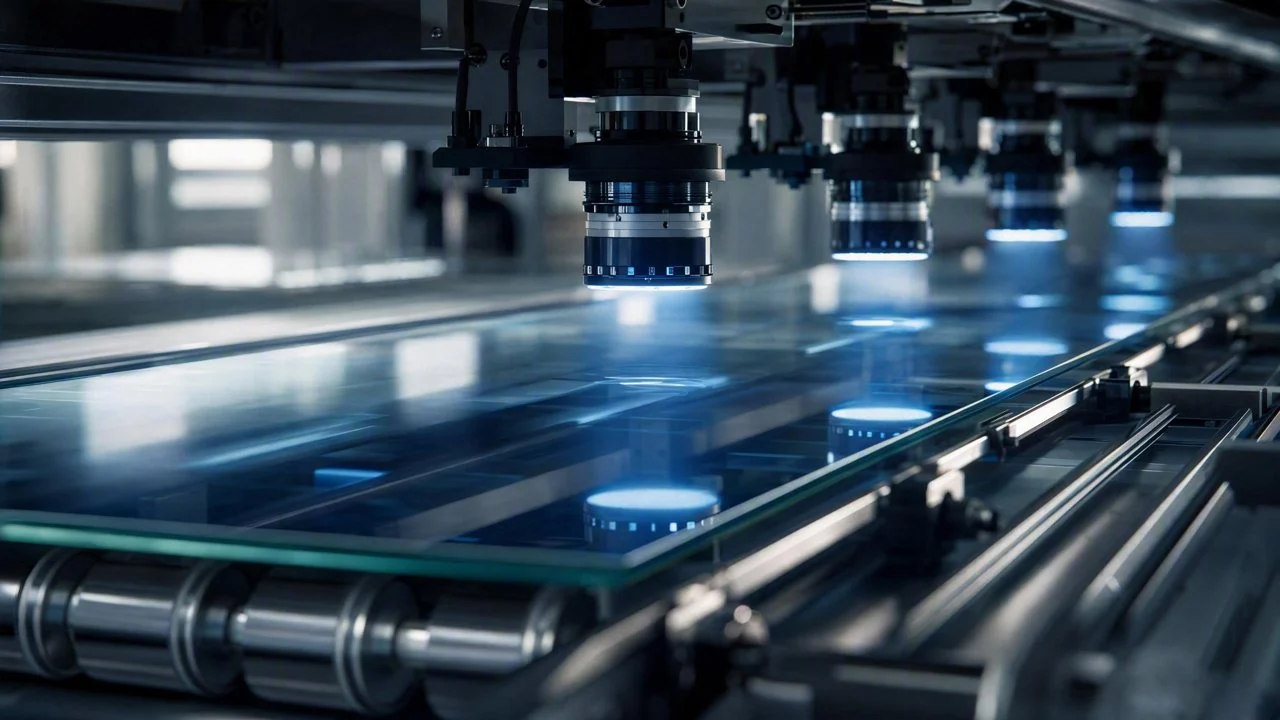
DaoAI AI AOI software system, with its visual foundation model-based feature recognition, 5-minute 0-code automatic programming with one good sample, APDT positive/few-shot learning (1–20 good samples), semantic false positive filtering, and support for SDK/API/Docker 100% local private deployment, successfully addressed the challenge of foreign particle defect detection on high-speed production lines for a medium-sized specialty glass manufacturer. It perfectly matched their 100% full inspection capacity with the production beat, boosting detection efficiency by over 40%.
In the chemical/materials industry, particularly in specialty glass manufacturing, product quality directly impacts the safety and reliability of downstream applications. With increasingly stringent requirements for glass performance and appearance in fields like consumer electronics and new energy vehicles, production beats are accelerating. Concurrently, the detection difficulty of minute defects like foreign particles on glass surfaces has dramatically increased. Traditional manual inspection or rule-based AOI systems can no longer meet the demands of high-beat, high-precision, low-false-positive full inspection. A medium-sized specialty glass manufacturer, specializing in high-transparency display panel glass, requires a production beat of over 300 pieces per minute. Any bottleneck in the inspection process directly affects overall capacity and delivery efficiency. The DaoAI AI AOI software system was developed precisely to address such challenges, ensuring efficient operation of the full inspection process with its exceptional detection speed and accuracy.
Pain Points: Why This Hurdle Is Difficult to Overcome
This specialty glass manufacturer faced multiple challenges. Firstly, under the pressure of a production beat as high as 300 pieces per minute, traditional vision systems often became bottlenecks due to insufficient processing speed, leading to an inability to achieve 100% full inspection and a persistent false negative rate around 1.5%. Secondly, foreign particles on glass surfaces are diverse, including dust, fibers, metal debris, etc., ranging from tens to hundreds of microns in size, and exhibiting complex optical characteristics under different lighting. These are easily confused with background noise like internal bubbles and stress marks in the glass, resulting in high false positive rates and immense manual re-inspection workload, requiring at least 5 experienced human inspectors daily for re-judgment, which is time-consuming and costly. Furthermore, due to the variety of product models, each changeover required several hours to reconfigure traditional AOI rules, severely impacting production line utilization. These issues collectively led to low production efficiency, increased quality costs, and potential customer complaint risks.
From a process and imaging perspective, the difficulty in detecting foreign particles on glass surfaces lies in: the high transparency and reflectivity of glass itself, leading to low contrast defect imaging; production line vibrations and environmental light changes further complicate image acquisition; and the randomness, minuteness, and diversity of foreign particles make it difficult for traditional rule-based algorithms to generalize recognition. Moreover, current pathways for AI quality inspection large models to achieve cost reduction and efficiency improvement in display panel manufacturing also emphasize the models' ability to recognize minute, rare defects and rapidly adapt to production line changes, which are precisely the shortcomings of traditional solutions.
Technical Principles
The effectiveness of the DaoAI AI AOI software system in resolving the aforementioned challenges primarily stems from its visual foundation model and APDT (Autonomous Progressive Defect Training) few-shot learning mechanism. This system employs advanced feature recognition technology, capable of autonomously learning and extracting deep features of glass surface defects from vast image data, rather than merely relying on pixel-level color or texture differences. Addressing the high transparency and reflectivity of glass, DaoAI integrates multispectral imaging technology in the image pre-processing stage to effectively enhance the contrast between defects and the background, ensuring high-quality image input. For defect identification, its visual foundation model achieves a recognition accuracy of up to 99.6% for minute foreign particles in complex backgrounds, significantly surpassing traditional rule-based AOI systems.
Compared to traditional methods, the DaoAI AI AOI software system demonstrates significant advantages. Traditional manual inspection is limited by human eye fatigue and subjectivity, making detection efficiency and consistency difficult to guarantee; rule-based AOI, when confronted with the diversity and complexity of foreign particles on glass surfaces, incurs high rule library maintenance costs and poor generalization ability, with false positive rates typically exceeding 5%. In contrast, the DaoAI AI AOI software system, through APDT positive/few-shot learning, requires only 1–20 good sample images to complete model training and automatic programming for new products or defect types within 5 minutes, reducing changeover downtime from several hours to less than 5 minutes, greatly enhancing production line flexibility and utilization. Furthermore, its built-in semantic false positive filtering mechanism effectively distinguishes genuine foreign particles from background noise, reducing the false positive rate to below 0.8%, significantly alleviating the burden of subsequent manual re-inspection.
Typical Application Scenarios
- **Glass Substrate Surface Foreign Particle Detection:** After glass cutting, grinding, and polishing, the DaoAI AI AOI software system can efficiently detect various foreign particles such as dust, fibers, metal debris, and oil stains remaining on the glass surface. The challenge lies in the minute size of these foreign objects (tens of microns) and their low contrast on the transparent glass substrate, making them prone to false negatives.
- **Glass Edge Micro-crack and Chipping Detection:** For micro-cracks, chipping, and corner defects generated during cutting or handling, the system utilizes high-resolution image acquisition and deep learning models to identify their subtle features. The difficulty is that cracks may be only a few microns wide and located at the edge, where imaging is susceptible to edge diffraction.
- **Glass Coating Layer Defect Detection:** After applying functional coatings such as anti-reflective films to the glass surface, the system detects defects like bubbles, scratches, color differences, and coating detachment. The challenge is that the coating itself is very thin, defect features are not obvious, and different coatings have varying light absorption and reflection properties.
- **Glass Internal Bubble and Inclusion Detection:** For internal bubbles and unmelted impurities that may arise during the glass melting process, the system uses transmitted light or scattered light imaging combined with AI algorithms for identification. The difficulty is that internal defects are located within the glass body, imaging is affected by glass thickness and refractive index, and it is hard to distinguish them from surface defects.
- **Glass Surface Scratch and Abrasion Detection:** Detecting linear or surface scratches and abrasions on the glass surface caused by friction, collision, etc. The challenge is that scratch depth and width vary, and they only become clearly visible at specific angles, making them easy to overlook.
Deployment Case Study
A medium-sized specialty glass manufacturer, a renowned supplier of display panel glass in China, operates a critical production line primarily producing ultra-thin cover glass for high-end smartphones and tablets. On this line, the traditional rule-based AOI system could not keep up with the production beat of 300 pieces/minute, only allowing for sampling inspection. This resulted in a false negative rate of around 1.5%, leading to monthly customer complaints and rework costs amounting to hundreds of thousands of yuan due to defects flowing downstream. Simultaneously, the system's changeover programming was complex, with each new product launch requiring professional engineers 4-6 hours to adjust rules, severely hindering the speed of new product introduction. To address these issues, the company introduced the DaoAI AI AOI software system. After a month of on-site integration and debugging, the system was successfully deployed.
“The DaoAI AI AOI software system not only enabled our production line to truly achieve 100% full inspection but also significantly improved quality without compromising the production beat. Now, we can deliver the highest quality glass products to our customers faster and with greater precision.”
After deployment, the DaoAI AI AOI software system, with its powerful processing capabilities and intelligent recognition algorithms, consistently controlled the single-piece glass inspection time to under 150 milliseconds, perfectly matching the production beat and achieving 100% full inspection. At the manufacturer's site, the false negative rate for foreign particles significantly decreased from the original 1.5% to <0.4%, and the false positive rate was also reduced from over 5% to below 0.8%, leading to a nearly 80% reduction in manual re-inspection volume. More importantly, through APDT few-shot learning, the new product changeover programming time was shortened from the original 4-6 hours to less than 5 minutes, greatly enhancing production line flexibility and new product launch speed. This significant improvement not only directly reduced the company's quality costs but also enhanced its market competitiveness.
DaoAI Solutions and Products
The core solution DaoAI provided to this client was the DaoAI AI AOI software system. This system is underpinned by its unique visual foundation model, possessing powerful feature recognition capabilities that allow it to autonomously learn and adapt to various complex and changing defect types. In the implementation phase, we first smoothly integrated with the client's existing production line control systems and image acquisition equipment via SDK/API interfaces, ensuring smooth data flow. During model training, we utilized APDT few-shot learning technology, requiring only a small number of good and typical defect samples (1–20 images) from the client to rapidly build and optimize detection models, significantly shortening the deployment cycle. The DaoAI AI AOI software system supports 100% local private deployment, ensuring client data security and meeting the stringent data compliance requirements of the chemical/materials industry. Furthermore, the system's built-in semantic false positive filtering function, through deep semantic understanding of defect images, effectively reduces false positives caused by environmental noise or intrinsic glass textures, further improving detection efficiency and accuracy. In the future, combined with the DaoAI World global model, the system will be better able to achieve cross-scenario generalization and continuous learning from production line feedback, further optimizing detection performance.
Through the deployment of the DaoAI AI AOI software system, the client not only resolved the conflict between production beat and full inspection capacity but also achieved intelligent upgrades in quality inspection. Detection efficiency increased by over 40%, false negative rates decreased by over 70%, and false positive rates decreased by over 80%, significantly reducing quality costs and the burden of manual re-inspection. New product changeover time was reduced from several hours to less than 5 minutes, bringing immense business value to the enterprise, allowing it to respond faster to market demands and maintain a leading position in the industry. DaoAI is committed to providing leading AI vision inspection solutions for industries such as chemical/materials, assisting enterprises in achieving intelligent manufacturing transformation and upgrading.
FAQ
How does the DaoAI AI AOI software system ensure inspection capacity for high-beat production lines?
The DaoAI AI AOI software system achieves extremely fast detection speeds through its highly optimized visual foundation model and efficient image processing pipeline. For instance, in this case, single-piece inspection time was optimized to under 150 milliseconds, perfectly matching high-speed production beats. Concurrently, its APDT few-shot learning capability ensures rapid changeovers, reducing downtime and thus maintaining high utilization and full inspection capacity.
What are the advantages of DaoAI's AI AOI system over traditional rule-based AOI for glass defect detection?
Traditional rule-based AOI struggles with the diversity and complexity of glass defects, incurring high rule maintenance costs and high false positive rates. The DaoAI AI AOI system, leveraging visual foundation models for deep feature learning, offers more precise recognition of minute, irregular defects and significantly lower false positive rates. APDT few-shot learning allows the model to quickly adapt to new defects, requiring only a few samples for programming, drastically reducing changeover time and enhancing flexibility.
What are the deployment options for the DaoAI AI AOI software system, and how is data security ensured?
The DaoAI AI AOI software system supports various deployment methods including SDK/API/Docker, and can achieve 100% local private deployment. This means all inspection data, model training data, and core client process parameters are stored entirely within the client's own servers and network environment, with data never leaving the premises, fundamentally ensuring data security and compliance.
This article was generated by AI. Customer cases are simulated scenarios based on real product capabilities and figures are illustrative; see product pages for official benchmarks.