
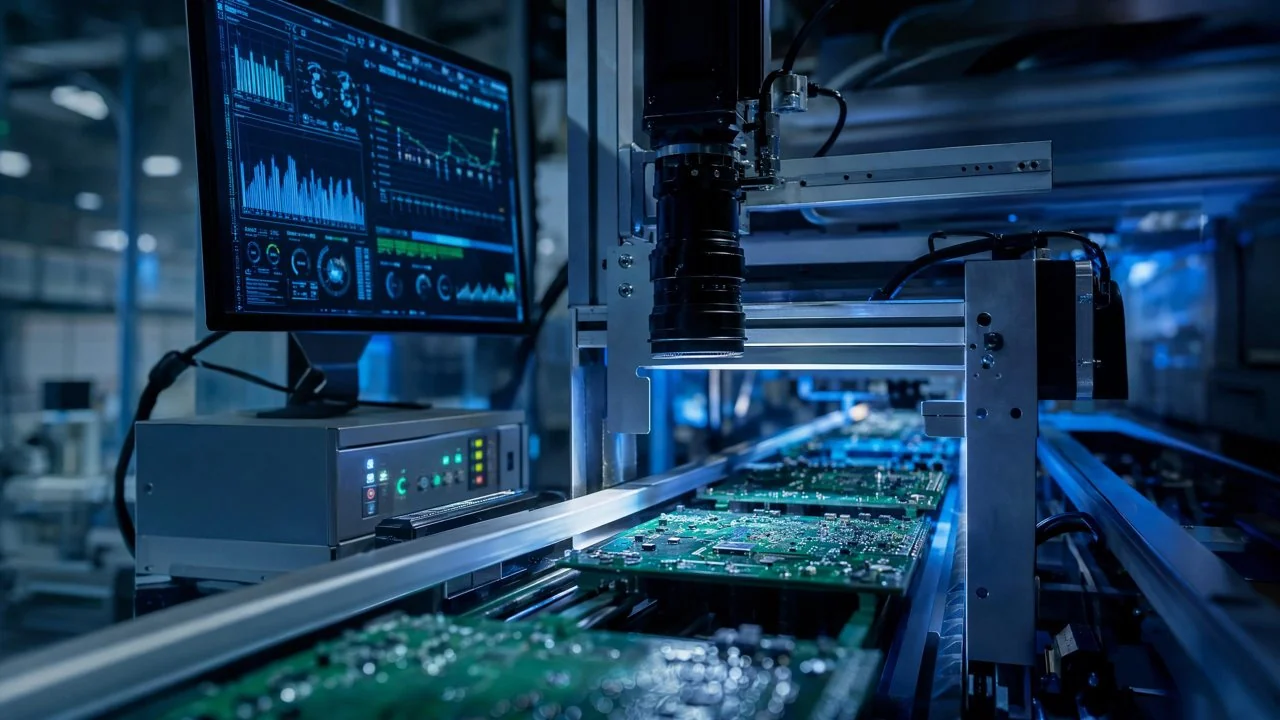
In the electronics/PCBA industry, false alarms for component polarity reverse have always been a difficult problem for enterprises. WeLinkirt's ACI OS provides an effective solution to this problem with advanced technology.
The electronics/PCBA industry is an important pillar of the modern technology industry, and its products are widely used in various electronic devices. A leading electronics manufacturer's production line mainly produces complex PCBA boards, which integrate a large number of electronic components. The detection objects include various surface-mount capacitors, resistors, diodes, etc. In the component mounting process, it is necessary to ensure the correct polarity of each component. Once the polarity is reversed, it may lead to a decline in product performance or even damage.
Pain Points: Why Is This Hurdle So Hard to Cross?
The manufacturer faces many difficulties in the component polarity detection process. In terms of quantitative indicators, the missed-detection rate is about 1.5%, which means that for every 1000 circuit boards produced, about 15 with polarity-reverse problems may flow into the market. The false-alarm rate is as high as 20%. A large number of false alarms lead to a significant increase in manual re-judgment man-hours. On average, the manual re-judgment man-hours for each circuit board reach 3 minutes. In addition, the change-over downtime is relatively long, and each change-over requires 30 minutes of downtime, seriously affecting production efficiency. At the same time, due to the risk of missed detection, the enterprise faces certain compliance risks, and the detection cost per unit product is also relatively high.
From the root-cause level, in terms of process, electronic components are constantly developing towards miniaturization and high-density, and the spacing between components is getting smaller and smaller, which brings great difficulties to imaging. In terms of imaging, traditional imaging technologies are difficult to clearly capture the polarity features of tiny components, and it is easy to have blurring or misjudgment. In terms of materials, some components have similar appearances, and it is difficult to accurately judge the polarity only through colors or markings. From the perspective of beat, the detection speed requirements on the production line are getting faster and faster, and traditional detection methods are difficult to meet the needs of high-speed production. Combining with the current hot direction of the open-source AI software stack SAIL in the field of defect detection, traditional detection methods lack intelligence and automation and cannot effectively use advanced algorithms and models to improve detection accuracy and efficiency.
Technical Principle
WeLinkirt's ACI OS uses the feature recognition technology of the visual foundation model. Through learning from a large number of good-product samples, the system can accurately identify the polarity features of components. Its core algorithm is based on deep learning, and it uses the APDT positive-sample/few-sample learning technology. With only 1-20 good-product samples, it can complete 0-code automatic programming in 5 minutes. In terms of imaging, the system uses advanced image enhancement and analysis technologies to clearly capture the polarity features of tiny components. In addition, the system also has a semantic false-alarm filtering function. Through semantic analysis of the detection results, it can effectively filter out false-alarm information.
Compared with traditional rule-based AOI and manual visual inspection methods, this system has obvious advantages. The rule-based AOI method requires manual writing of complex rules. For complex component polarity detection, rule writing is difficult and prone to loopholes. Manual visual inspection is limited by human visual fatigue and subjective judgment, and both the missed-detection rate and the false-alarm rate are relatively high. WeLinkirt's ACI OS can automatically learn and adapt to different component polarity features, with higher detection accuracy and faster efficiency, and can effectively reduce the false-alarm rate and the missed-detection rate.
Typical Application Scenarios
- Component polarity detection: The system judges whether the polarity of a component is correct by identifying its appearance features. The difficulty lies in that it is difficult to clearly image and accurately identify the polarity features of tiny components.
- Component missing detection: Detect whether there are missing components on the circuit board. The difficulty is that some small components may not be obvious in the image, and it is easy to miss detection.
- Component offset detection: Detect whether the component is installed in the correct position and whether there is an offset. The difficulty is that the offset amplitude of the component is relatively small, and a high-precision detection algorithm is required.
- Solder joint defect detection: Detect whether there are problems such as cold solder joints or bridging in the solder joints. The difficulty is that the shape of the solder joints is complex, and the imaging effect is easily interfered with.
Implementation Case
A large tier-1 electronics supplier introduced WeLinkirt's ACI OS. During the implementation process, the technical team first deployed the system locally to ensure that the data did not leave the factory. Then, they used 10 good-product samples for 0-code automatic programming and quickly completed the system initialization. Before the implementation, the component polarity detection missed-detection rate of the enterprise was 1.5%, the false-alarm rate was 20%, and the change-over downtime was 30 minutes. After the implementation, the missed-detection rate was reduced to <0.1%, the false-alarm rate was reduced to 3%, and the change-over downtime was shortened to 5 minutes.
WeLinkirt's ACI OS has brought significant improvements to component polarity detection in the electronics/PCBA industry, greatly improving detection accuracy and efficiency.
WeLinkirt's Solution and Product
Centered on the ACI OS, WeLinkirt provides a comprehensive solution. In terms of modeling, the APDT positive-sample/few-sample learning technology of the system can quickly and accurately establish a detection model. When changing models, through 0-code automatic programming, the model change operation can be completed in only 5 minutes, greatly shortening the downtime. In terms of deployment, the system supports 100% local privatization of SDK/API/Docker to ensure data security. At the same time, it can be integrated with the enterprise's existing production system to achieve data sharing and interaction. The supporting DaoAI 2D/3D ACI equipment can provide more accurate imaging, and the DaoAI robot vision can achieve automatic grabbing and assembly of components, further improving production efficiency.
In terms of quantitative results, the system has made the detection rate of component polarity detection reach more than 99.9%, the false-alarm rate has been reduced by 85%, and the change-over time has been shortened by 83%. These results not only improve product quality, reduce production costs, but also enhance the enterprise's competitiveness in the market, providing strong support for intelligent manufacturing in the electronics/PCBA industry.
FAQ
How many good-product samples does the ACI OS need for learning?
The system uses the APDT positive-sample/few-sample learning technology. It only needs 1-20 good-product samples to complete learning and quickly establish a detection model to meet the polarity detection needs of different components.
What are the deployment methods of the system?
The system supports 100% local privatization deployment of SDK/API/Docker to ensure that the enterprise's data does not leave the factory and guarantee data security. At the same time, it can be integrated with the existing production system to achieve data interaction.
How long does the model-change operation take?
With the 0-code automatic programming function, the model-change operation can be completed in only 5 minutes, greatly shortening the change-over downtime and improving production efficiency.
Full solution for this scenario: the full inspection solution for Electronics / PCBA · Component Polarity False-Alarm Reduction
This article was generated by AI. Customer cases are simulated scenarios based on real product capabilities and figures are illustrative; see product pages for official benchmarks.