
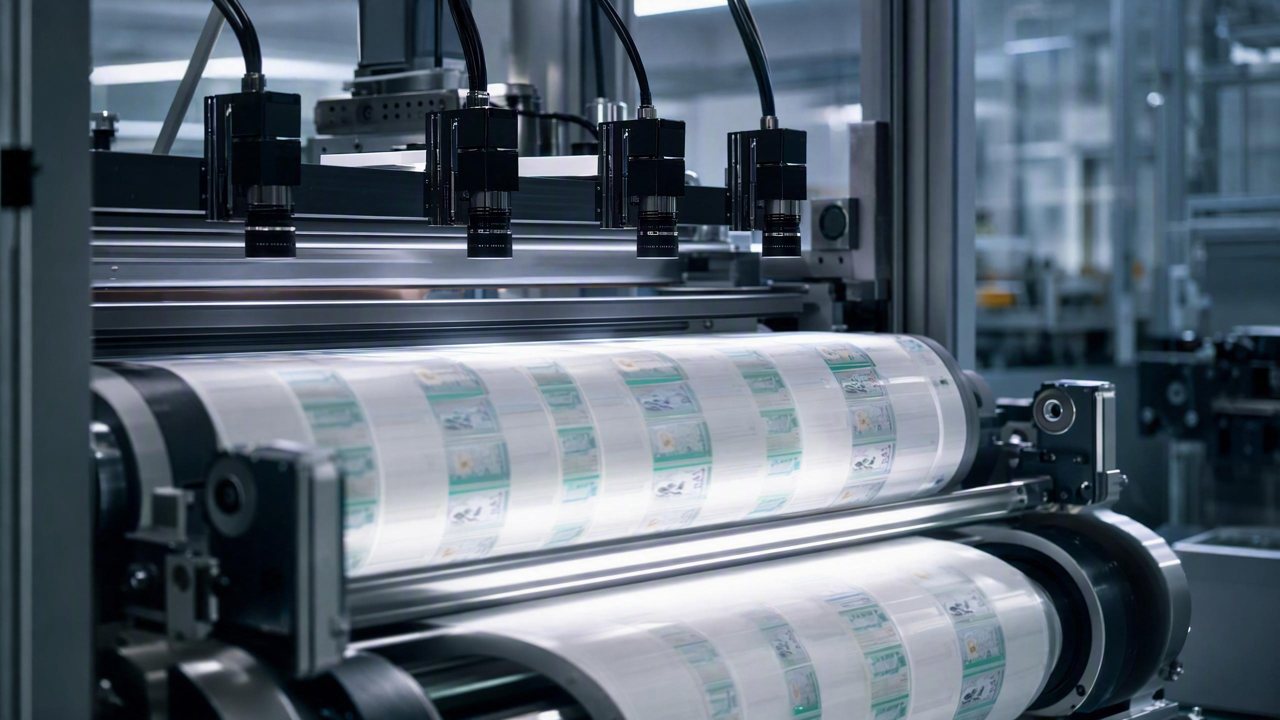
DaoAI AI AOI software system (featuring vision foundation model for feature recognition, 5-minute 0-code auto-programming with one good sample, APDT positive/few-shot learning with 1–20 good samples, semantic false positive filtering, and supporting SDK/API/Docker for 100% on-premise deployment) precisely identifies minute defects in high-SKU label printing, reducing traditional manual inspection labor costs by over -75% while suppressing leak rates to <0.5%. In the consumer goods industry, particularly food and daily chemicals, product labels are the first impression for consumers. Their printing quality directly impacts brand image and market competitiveness. Facing growing demands for personalization, small batches, and multi-batch production, high-SKU label printing has become the norm, posing unprecedented challenges to traditional manual quality inspection.
The DaoAI AI AOI software system (featuring vision foundation model for feature recognition, 5-minute 0-code auto-programming with one good sample, APDT positive/few-shot learning with 1–20 good samples, semantic false positive filtering, and supporting SDK/API/Docker for 100% on-premise deployment) precisely identifies minute defects in high-SKU label printing, reducing traditional manual inspection labor costs by over -75% while suppressing leak rates to <0.5%. In the consumer goods industry, particularly food and daily chemicals, product labels are the first impression for consumers. Their printing quality directly impacts brand image and market competitiveness. Facing growing demands for personalization, small batches, and multi-batch production, high-SKU label printing has become the norm, posing unprecedented challenges to traditional manual quality inspection. Traditional label printing lines, especially in small and medium-sized printing factories, heavily rely on manual final inspection to ensure labels are free of color differences, misalignment, dirt, or incompleteness. However, with the surge in product SKUs, where each batch involves numerous label types but smaller quantities, the efficiency bottleneck and cost pressure of manual inspection are increasingly prominent. For example, a certain small and medium-sized food label printing factory handles hundreds of different specifications and patterns of label orders daily, traditionally requiring multiple quality inspectors for round-the-clock manual inspection.
Pain Points: Why This Hurdle Is Difficult to Overcome
Quality inspection in high-SKU label printing faces multi-dimensional quantifiable difficulties. Firstly, **manual inspection labor costs are high**. According to feedback from an anonymous label printing client, their monthly salary expenditure for manual inspection reaches hundreds of thousands of yuan, accounting for 10-15% of total production costs, and they continuously face challenges in recruitment and high staff turnover. Secondly, **high leak rates and false positive rates** are common. On high-speed printing lines, the leak rate for manual inspection is typically between 1-3%, especially for subtle defects like slight color differences, burrs, or misregistration, which are difficult for the human eye to consistently identify with high precision over long periods. Simultaneously, fatigue-induced manual false positive rates can be as high as 5-8%, leading to many good products being misidentified and increasing rework and re-inspection costs. Thirdly, **long changeover downtime** occurs. Whenever different SKU labels are printed, traditional manual inspection requires re-familiarization with label patterns and adjustment of inspection standards, resulting in an average line downtime of 15-30 minutes, severely impacting production rhythm and order delivery. Finally, **difficulty in quality traceability and data management** exists. Manual inspection lacks systematic data recording, making it challenging to statistically analyze defect types and frequencies, hindering process optimization and quality improvement.
The root cause of these pain points lies in the complexity of label printing processes and the diversity of defects. Label materials range from paper to film, with surface treatments including lamination, hot stamping, and UV coating, leading to varied defect manifestations. For instance, tiny ink spots, scratches, bubbles, and slight jagged edges or misregistration of patterns on high-speed moving label rolls are extremely difficult for the human eye to identify. Traditional rule-based AOI systems, when faced with such varied defect features, often require extensive manual threshold settings and parameter adjustments, and have poor generalization capability, making them difficult to adapt to the demands of high-SKU rapid changeovers. Current industrial AI quality inspection is transitioning from traditional manual methods to large model-driven approaches, with technical challenges in enabling AI systems to understand complex visual information like humans and achieve few-shot or even zero-shot learning, while ensuring stable and efficient deployment at the edge. The DaoAI AI AOI software system from WeLinkirt is specifically designed to address these challenges.
Technical Principles
The DaoAI AI AOI software system from WeLinkirt leverages **vision foundation models' feature recognition capabilities** as its core, demonstrating exceptional performance in handling the complex and varied defects of high-SKU label printing. By pre-training on vast image datasets, this system can understand and extract rich visual features from label images, including texture, color, shape, and layout structure. This deep feature recognition capability far surpasses traditional rule-based image processing algorithms, which typically rely on manually set pixel thresholds or edge detection operators and struggle with variations in lighting, material reflections, and diverse patterns. When inspecting new label SKUs, the DaoAI AI AOI software system does not need to build a model from scratch. Instead, it utilizes its powerful foundation model and APDT (Adaptive Positive Sample Driven Training) few-shot learning technology, requiring only 1–20 good samples to achieve 0-code automatic programming within 5 minutes, quickly adapting to new inspection tasks. This efficient learning mechanism significantly reduces changeover time and greatly lessens the reliance on defect samples, compared to traditional AOI which often requires hours or even days for parameter adjustment and defect sample collection.
Compared to traditional manual inspection, the DaoAI AI AOI software system offers overwhelming advantages in accuracy and consistency. Manual inspection is susceptible to factors like fatigue, emotion, and lighting, leading to fluctuating leak and false positive rates, and inconsistent judgment standards among different inspectors. In contrast, the micro-chain DaoAI AI AOI system can operate continuously and stably 24/7, maintaining extremely high detection consistency, reducing the leak rate at a certain label printing factory to <0.5%. Furthermore, the system's **semantic false positive filtering** function intelligently distinguishes true defects from non-critical visual noise (such as unavoidable tiny ink spots or paper fibers during printing) by combining contextual information and the actual business meaning of defects. This effectively reduces the false positive rate, decreasing it by over -80% in one case study, and minimizing unnecessary re-inspection steps. This semantic understanding-based filtering mechanism is unparalleled by traditional AOI, which often flags all anomalies exceeding a threshold as defects, leading to numerous false positives.
Typical Application Scenarios
- **Label Surface Printing Defect Detection:** Detects microscopic defects on the label surface such as ink smudges, ink spots, scratches, bubbles, missing print, and ink overflow. The challenge lies in the small size of defects, their similar color to the background, and potential reflections or textures on the label surface, requiring high-resolution imaging and powerful feature recognition.
- **Color Deviation and Color Consistency Detection:** Compares the color of printed labels with standard samples to detect issues like color shift, color difference, and misregistration. The difficulty arises from subtle color variations between different print batches and inconsistent human perception of small color differences, requiring the system to possess high-precision color analysis capabilities and stability.
- **Text, Barcode, and QR Code Printing Quality Inspection:** Ensures that text on labels is clear and legible, without blur or breakage, and that barcodes and QR codes can be scanned and recognized normally. The challenge is that characters and codes can be very small, and printing quality issues may reduce recognition rates, necessitating high-resolution optical systems and precise character/code recognition algorithms.
- **Label Size and Die-Cutting Accuracy Detection:** Checks whether the overall size and shape of the label meet design requirements, and if the die-cut edges are smooth, free of burrs, and without deviation. The difficulty lies in quantifying subtle irregularities in die-cut edges using traditional methods, and the diverse shapes of labels, requiring high-precision edge detection and geometric measurement functions.
- **Defect Detection for Special Processes like Lamination/Hot Stamping/UV Coating:** Inspects for bubbles or wrinkles in the laminated layer, ensures hot stamping patterns are complete and clear, and verifies uniform application of UV varnish. The challenge is that these special process layers are often transparent or highly reflective, making it difficult for traditional vision to effectively capture their defects, requiring specific lighting and image processing techniques.
Case Study
A leading consumer goods label printing supplier, whose primary business is providing high-SKU product label printing services for daily chemical and food brands, faced immense pressure regarding capacity and cost, especially in the manual inspection phase. Before implementing the DaoAI AI AOI software system from WeLinkirt, their production line required 8 quality inspectors working three shifts, incurring monthly labor costs of 300,000 yuan, and experiencing high staff turnover due to intense work. Moreover, given the vast variety of label SKUs, line changeover downtime averaged 20 minutes when switching orders, reducing daily effective production time and impacting order delivery. Empirical data showed that traditional manual inspection had a leak rate of around 1.5%, primarily for subtle color differences and edge burrs, while the false positive rate was as high as 7%, leading to numerous good products being misidentified and increasing the burden of subsequent re-inspection and rework.
After the DaoAI AI AOI software system was deployed, this client's label printing line achieved a qualitative leap, with manual inspection labor costs reduced by over -75%, changeover time shortened to 5min, significantly improving line efficiency, and quality management becoming more precise and controllable.
By deploying the DaoAI AI AOI software system, the client successfully reduced manual inspection personnel from 8 to 2, with only a few staff members responsible for supervision and anomaly handling, cutting monthly labor costs by over -75%. After the DaoAI AI AOI system went live, the measured leak rate dropped to <0.4%, significantly lower than manual inspection levels, effectively preventing defective labels from entering the market. Concurrently, the semantic false positive filtering function reduced the false positive rate by over -85%, greatly reducing misidentified good products and rework. Furthermore, thanks to the 5-minute 0-code auto-programming capability of the DaoAI AI AOI software system's APDT few-shot learning, changeover downtime was reduced from an average of 20 minutes to 5min, significantly increasing line utilization and production rhythm, ensuring timely order delivery. The client also utilized the detailed inspection data provided by the DaoAI AI AOI system to optimize their printing process, further enhancing product quality stability.
WeLinkirt Solution and Products
For high-SKU label printing scenarios, WeLinkirt's core solution involves deploying the DaoAI AI AOI software system. This system leverages its powerful vision foundation model to achieve high-precision identification of various label printing defects. During implementation, we first integrate deeply with the client's existing production line, ensuring 100% on-premise private deployment through standardized SDK/API/Docker interfaces, guaranteeing that all data remains on-site and secure. In the model building phase, the DaoAI AI AOI software system supports APDT positive/few-shot learning, where clients only need to provide 1–20 good label images, and the system can complete automated model programming within 5 minutes. This greatly simplifies the new SKU onboarding process, requiring no specialized AI engineers. For complex or novel defects, the system can also continuously learn and optimize through its semantic false positive filtering function, incorporating feedback from line engineers to continuously improve detection accuracy.
The DaoAI AI AOI software system not only provides defect detection capabilities but also supports data integration with the client's MES/WMS systems, enabling real-time upload and traceability of quality data. This allows clients to manage the inspection results of each label with precision, providing data support for subsequent process optimization and quality improvement. Additionally, WeLinkirt can provide complementary DaoAI 2D / 3D AI AOI equipment, integrating self-developed high-resolution industrial cameras and stable light sources to ensure high-quality image acquisition, providing excellent input for the software system. Through this comprehensive solution, WeLinkirt is committed to helping clients transition from 'manual experience' to 'AI intelligence,' not only solving current high manual inspection costs and low efficiency but also laying the foundation for future flexible production and smart manufacturing. After a certain label printing factory implemented the DaoAI AI AOI system, labor costs were reduced by over -75%, achieving a significant return on investment.
Quantified Results
By deploying the DaoAI AI AOI software system from WeLinkirt, clients have achieved significant quantified results in high-SKU label printing scenarios. In one case, manual inspection labor costs were reduced by over -75%, leading to substantial monthly operational expenditure savings. Production line data indicates that the label printing leak rate decreased from 1.5% with traditional manual inspection to <0.4%, effectively improving product outgoing quality. Concurrently, the false positive rate was reduced by over -85%, greatly diminishing the workload for re-inspection and rework and enhancing overall line efficiency. Furthermore, thanks to the rapid changeover capability of the DaoAI AI AOI software system, average changeover downtime was shortened from 20min to 5min, significantly boosting equipment utilization and production rhythm, ensuring timely order delivery. These improved metrics collectively brought considerable economic benefits and market competitiveness to the client.
FAQ
How does DaoAI AI AOI software system help companies reduce labor costs?
The DaoAI AI AOI software system replaces traditional manual inspection with automated visual inspection. Its efficient few-shot learning capability and high-precision detection allow companies to significantly reduce the need for quality inspection personnel, lowering labor costs by over -75%. Simultaneously, the system reduces leakages and false positives caused by fatigue or subjective judgment, indirectly cutting rework and customer complaint costs, optimizing human resource allocation.
How long does it take to deploy the DaoAI AI AOI software system?
The DaoAI AI AOI software system supports SDK/API/Docker 100% on-premise private deployment, typically completing software environment setup and integration within hours. For new label SKUs, thanks to its APDT few-shot learning and 0-code auto-programming capabilities, the system can program and deploy a detection model within 5 minutes, requiring only 1–20 good samples. The overall go-live period depends on the complexity of the client's production line but is usually several times faster than traditional AOI solutions.
What is the pricing of the DaoAI AI AOI software system? What factors influence the price?
The pricing of the DaoAI AI AOI software system is determined by the client's specific needs and deployment scale. Key influencing factors include the number of production lines to be inspected, the number of cameras, required detection precision, integration complexity (e.g., integration level with existing MES/WMS systems), and whether customized features are needed. We offer flexible licensing models and can provide the most cost-effective solution based on your budget. We recommend contacting our sales team for a customized quote.
This article was generated by AI. Customer cases are simulated scenarios based on real product capabilities and figures are illustrative; see product pages for official benchmarks.