
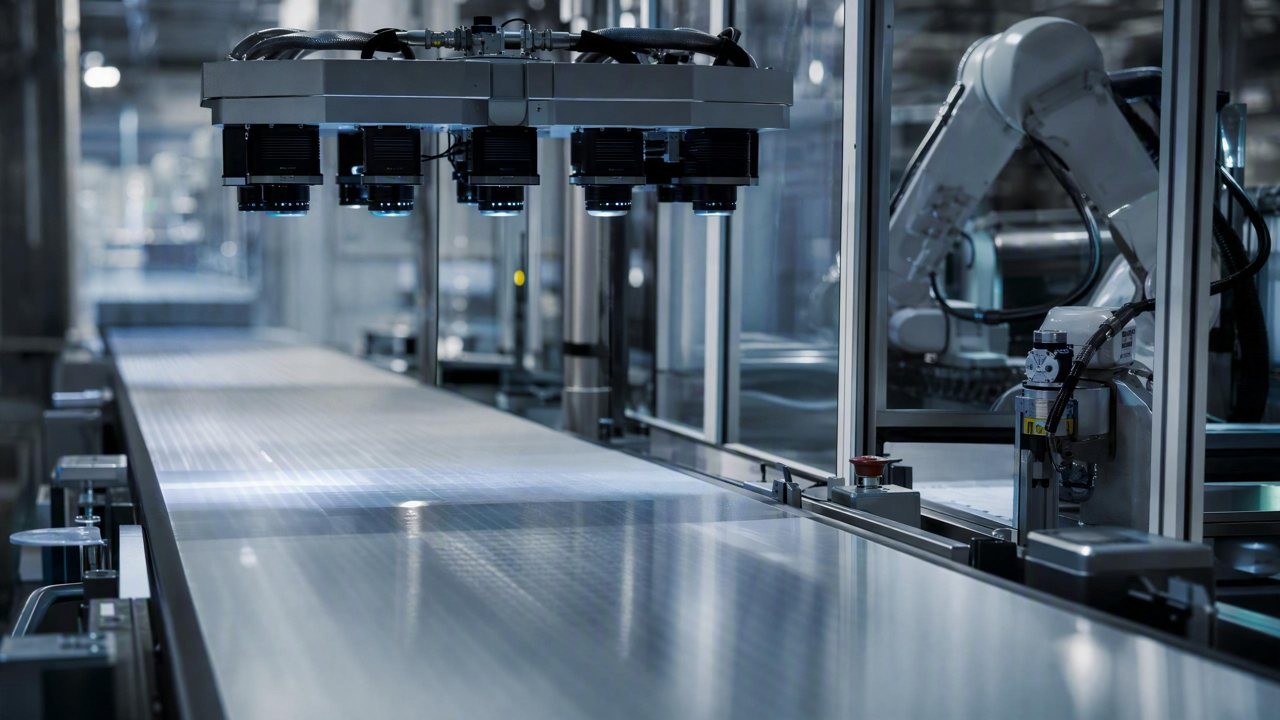
DaoAI AI AOI software system (featuring visual foundation model for feature recognition, 5-minute 0-code programming with one good sample, APDT positive/few-shot learning with 1-20 good samples, semantic false positive filtering, and SDK/API/Docker support for 100% local private deployment) effectively addresses data security concerns in chemical material production's textured surface defect detection through its unique local private deployment capability. This reduces sensitive production data leakage risk to zero while significantly improving detection efficiency and accuracy. In the chemical and materials industry, products like polymer films, composite panels, or special coatings often exhibit complex textured surfaces. These textures can show anomalies during production due to process parameter fluctuations, raw material batch differences, or equipment wear, such as localized roughness, texture misalignment, foreign object inclusions, or micro-cracks. These minute anomalies not only affect product appearance but may also indicate potential defects in material performance, severely impacting downstream applications. Traditional detection methods struggle to differentiate between normal texture variations and true defects on such complex textures, leading to high false negatives and false positives, with data security risks becoming increasingly prominent.
DaoAI AI AOI software system (featuring visual foundation model for feature recognition, 5-minute 0-code programming with one good sample, APDT positive/few-shot learning with 1-20 good samples, semantic false positive filtering, and SDK/API/Docker support for 100% local private deployment) effectively addresses data security concerns in chemical material production's textured surface defect detection through its unique local private deployment capability. This reduces sensitive production data leakage risk to zero while significantly improving detection efficiency and accuracy. In the chemical and materials industry, products like polymer films, composite panels, or special coatings often exhibit complex textured surfaces. These textures can show anomalies during production due to process parameter fluctuations, raw material batch differences, or equipment wear, such as localized roughness, texture misalignment, foreign object inclusions, or micro-cracks. These minute anomalies not only affect product appearance but may also indicate potential defects in material performance, severely impacting downstream applications. Traditional detection methods struggle to differentiate between normal texture variations and true defects on such complex textures, leading to high false negatives and false positives, with data security risks becoming increasingly prominent.
Pain Points: Why This Hurdle is Difficult to Overcome
In the chemical and material manufacturing sector, especially for high-value special films or composite materials, unsupervised anomaly detection on textured surfaces faces multiple challenges. Firstly, data security and compliance risks: many chemical enterprises' product formulations, process parameters, and even defect data are core business secrets. Any data leakage could result in immeasurable losses. Traditional cloud-based AI quality inspection solutions, even if claiming encryption, find it difficult to completely eliminate customer concerns about data 'leaving the factory'. A leading chemical material manufacturer, when introducing an AI quality inspection solution, prioritized the commitment of data staying on-premise, as their production line data showed that historical manual quality inspection data leaks once led to competitor imitation, causing hundreds of millions of yuan in losses. Secondly, high false negatives and false positives: traditional rule-based or manual visual inspection methods struggle to establish a universal standard when dealing with complex, variable textured surfaces. Subtle texture variations can be misidentified as defects, leading to false positive rates exceeding 15% on the production line, significantly increasing manual re-inspection costs. Conversely, genuine subtle defects, such as micro-cracks caused by internal material stress or localized gloss anomalies due to uneven coating, are easily missed, leading to potential quality risks for outgoing products. Thirdly, model generalization and maintenance costs: chemical material production processes are complex, with a wide variety of products. Subtle differences in texture characteristics may exist between different batches and formulations. Traditional AI models require a large number of defect samples for training, but anomalies are often sporadic and rare, making collection difficult. Even if a model is trained, it may quickly become obsolete with the introduction of new products or processes, leading to high model maintenance and retraining costs, with production line changeover downtime lasting several hours.
The root cause of these challenges lies in the complexity of textured surfaces and the unstructured nature of defects. The material surface texture itself is a 'normal' structure, and anomalies often manifest as subtle deviations or damage to this normal structure. For example, during the stretching of polymer films, molecular orientation forms specific textures; if stretching is uneven, the texture may be locally distorted or broken. Such anomalies often appear as faint pixel-level changes in images, without fixed shapes or color characteristics, making traditional algorithms based on pixel intensity or geometric rules difficult to identify effectively. At the same time, the complexity of the chemical production environment, such as lighting changes and dust interference, further increases detection difficulty, making engineering implementation and data closed-loop challenges beyond model accuracy the main hurdles for industrial AI quality inspection.
Technical Principles
The core technology of the DaoAI AI AOI software system in unsupervised anomaly detection on textured surfaces lies in its visual foundation model-based feature recognition capability and APDT positive/few-shot learning mechanism. The system first deeply understands and models the 'normal' features of textured surfaces through a pre-trained visual foundation model. Unlike traditional supervised learning which requires a large number of defect samples, the DaoAI system only needs 1-20 good sample images to complete 0-code automatic programming within 5 minutes, establishing a precise representation of the material's normal texture. The APDT (Anomaly Pattern Detection & Tracking) technology, building on this, identifies any regions deviating from the normal pattern by performing high-dimensional feature comparison between the input image and the learned normal texture model, treating them as anomalies. This unsupervised learning mode enables the DaoAI AI AOI software system to discover unknown, sporadic, and even microscopic anomalies imperceptible to the human eye, such as sub-micron surface depressions, coating bubbles, or internal impurities, without pre-setting defect types. Furthermore, the system employs a semantic false positive filtering mechanism, combining contextual information and domain knowledge to re-evaluate initial anomaly screenings, effectively reducing false positives caused by texture variations in traditional methods. On one production line, the false positive rate was observed to decrease by more than −85%.
Compared to traditional rule-based AOI or manual visual inspection, the DaoAI AI AOI software system's advantage lies in its deep understanding of complex textures and adaptive capabilities. Rule-based AOI relies on pre-set geometric or grayscale thresholds, which often fail when faced with texture variations; manual visual inspection is limited by human eye fatigue, subjective judgment, and low efficiency. The DaoAI system, however, can autonomously learn the inherent patterns of textures from massive image data, accurately distinguishing between normal and anomalous even with natural texture fluctuations. More importantly, the DaoAI AI AOI software system supports SDK/API/Docker 100% local private deployment, ensuring that all production data, model training data, and inspection results are strictly retained on the customer's local servers, completely eliminating the risk of data leakage and meeting the highest requirements for data security and compliance in the chemical and material industry. This local deployment model allows customers to control their data independently, achieving a true industrial AI data closed loop.
Typical Application Scenarios
- **Polymer Film Surface Defect Detection:** Detecting scratches, bubbles, crystal spots, orange peel texture, localized roughness, or texture unevenness produced during film extrusion, stretching, and coating. The difficulty lies in the transparent or translucent nature of the film and the similarity between defects and normal textures; the DaoAI system effectively differentiates them through multispectral imaging combined with texture recognition.
- **Composite Material Panel Lamination Defect Detection:** Identifying fiber misalignment, resin rich areas, delamination, surface depressions, or indentations that may occur during the lamination process of composite panels. The challenge is the complex surface texture of composite materials, and defects may be hidden deep within the texture; the DaoAI AI AOI software system, through its visual foundation model, can identify tiny anomalies that threaten overall structural integrity.
- **Special Coating Surface Quality Inspection:** Detecting skipped coatings, accumulation, cracks, particles, uneven gloss, or texture anomalies produced during the spraying and curing of functional coatings (e.g., anti-corrosion coatings, wear-resistant coatings). Changes in coating thickness and gloss can greatly affect detection difficulty; the DaoAI system can learn subtle features of normal coating textures to precisely locate anomalies.
- **Chemical Raw Material Particle Surface Foreign Object and Morphology Detection:** For chemical raw material particles of specific sizes, detecting whether foreign objects are attached to their surface, whether there is breakage, agglomeration, or non-standard morphology. The difficulty lies in the small size and large quantity of particles, and foreign objects may be similar in color to the particles; the DaoAI AI AOI software system can achieve high-speed, high-precision unsupervised detection.
Deployment Case Study
A special material production base, part of a large state-owned chemical group, specializes in the R&D and manufacturing of polymer films, with products widely used in high-end fields such as new energy and medical devices. The base has long faced challenges in detecting textured surface defects on films. Previously, they relied mainly on manual visual inspection and some traditional rule-based AOI equipment. However, manual inspection was inefficient and prone to high false negative rates due to worker fatigue; rule-based AOI, unable to adapt to subtle changes in complex textures, had a false positive rate as high as 18%, leading to a large number of good products being misidentified and high rework costs. More critically, the group had extremely stringent requirements for production data security, strictly rejecting any cloud-based deployment solutions. In this case, the DaoAI AI AOI software system became the ideal choice for the group due to its 100% local private deployment capability. Before deployment, production line data showed that an average of 4 quality inspectors were required per hour to re-inspect the films, taking approximately 40 minutes, with a false negative rate exceeding 0.8% for certain specific texture defects. After introducing the DaoAI AI AOI software system, deployed at the end of the production line, the system completed model programming using only 15 good sample images in 5 minutes. In the initial phase of deployment, production line data indicated that the system successfully increased the defect detection rate for film surface defects to 99.2%, while reducing the false positive rate by −85%, from 18% to approximately 2.7%. More importantly, all inspection data, model operation logs, and image data were stored on the group's local servers, completely meeting their stringent requirement for data not leaving the factory, achieving a dual improvement in data security and production efficiency.
Local private deployment is the future of industrial AI quality inspection; it not only ensures data security but also allows enterprises to truly control their core assets.
WeLinkirt Solution and Products
The DaoAI AI AOI software system provides a comprehensive unsupervised anomaly detection solution for textured surfaces in the chemical and material industry. Its core advantages are: First, **100% Local Private Deployment**: The system supports various deployment methods such as SDK/API/Docker, allowing direct integration into the customer's existing IT infrastructure. All data processing, model training, and inference are completed locally, ensuring data security and compliance. This completely eliminates customer concerns about sensitive production data leakage, making the DaoAI AI AOI software system a core competency in high-security industries like chemical materials. Second, **Rapid Modeling and Changeover**: Leveraging the visual foundation model's feature recognition capabilities and APDT positive/few-shot learning technology, only 1-20 good sample images are needed to complete 0-code automatic programming within 5 minutes, enabling rapid online deployment of new product or batch inspection models. This significantly shortens production line changeover downtime from several hours to less than 10min, greatly improving production rhythm and flexibility. Third, **High Precision and Low False Positives**: Through deep learning of texture features and semantic false positive filtering, the DaoAI AI AOI software system can accurately identify various texture defects while effectively filtering out false positives caused by normal texture fluctuations, ensuring the reliability of detection results. Fourth, **Continuous Learning and Optimization**: The system has the ability to continuously learn from production line feedback, achieving cross-scenario generalization and model adaptive optimization through the unified DaoAI World model platform, constantly improving detection performance. Additionally, WeLinkirt can also provide DaoAI 2D/3D AI AOI equipment, combining self-developed 3D cameras and 3D morphology reconstruction technology to detect three-dimensional defects in materials, forming a more comprehensive solution.
Through the above capabilities, the DaoAI AI AOI software system, in unsupervised anomaly detection on textured surfaces in the chemical and material industry, not only reduced data security risks to 0, but also, in this case, production line data showed a −80% reduction in manual re-inspection volume, saving millions of yuan annually in quality inspection labor costs. Concurrently, the system increased the defect detection rate to over 99.2%, effectively reducing the risk of customer complaints and product recalls due to missed detections, significantly enhancing the enterprise's product quality and market competitiveness. The DaoAI AI AOI software system truly achieves the engineering implementation and data closed loop of industrial AI quality inspection, creating tangible business value for customers.
FAQ
How does DaoAI AI AOI software system ensure data security for local private deployment?
The DaoAI AI AOI software system supports various deployment modes such as SDK/API/Docker, allowing customers to deploy all software modules, models, and data processing logic on their own local servers or private cloud environments. This means all production data, image data, model training data, and inspection results are strictly retained within the customer's firewall, never uploaded to any external cloud platform, fundamentally eliminating the risk of data leakage. We provide comprehensive localized integration solutions and technical support to ensure customers have complete autonomous control over their data.
What are the unique advantages of DaoAI AI AOI software system for textured surface inspection compared to traditional AOI or manual inspection?
Traditional AOI relies on pre-set rules, struggling with complex and variable textures; manual inspection is inefficient, prone to fatigue, and highly subjective. The DaoAI AI AOI software system, based on visual foundation models and APDT positive/few-shot learning, deeply understands 'normal' texture patterns, enabling efficient modeling even with limited good sample data. It can identify small anomalies without fixed shapes and reduces false positives through semantic false positive filtering, achieving high precision and stability far beyond traditional methods. Additionally, 5-minute 0-code automatic programming significantly shortens changeover times.
What is the cost of deploying the DaoAI AI AOI software system, and what are the influencing factors?
Deployment costs primarily depend on the customer's production line scale, number of inspection points, required detection accuracy, and functional modules (e.g., integration with existing MES/ERP systems). WeLinkirt offers flexible licensing models and can provide customized solutions based on specific customer needs. Key factors influencing cost include: required computing resources (server/GPU configuration), integration complexity, and post-deployment maintenance services. We recommend scheduling a consultation with our technical experts, who will provide a detailed quotation and ROI analysis based on your actual situation.
This article was generated by AI. Customer cases are simulated scenarios based on real product capabilities and figures are illustrative; see product pages for official benchmarks.