
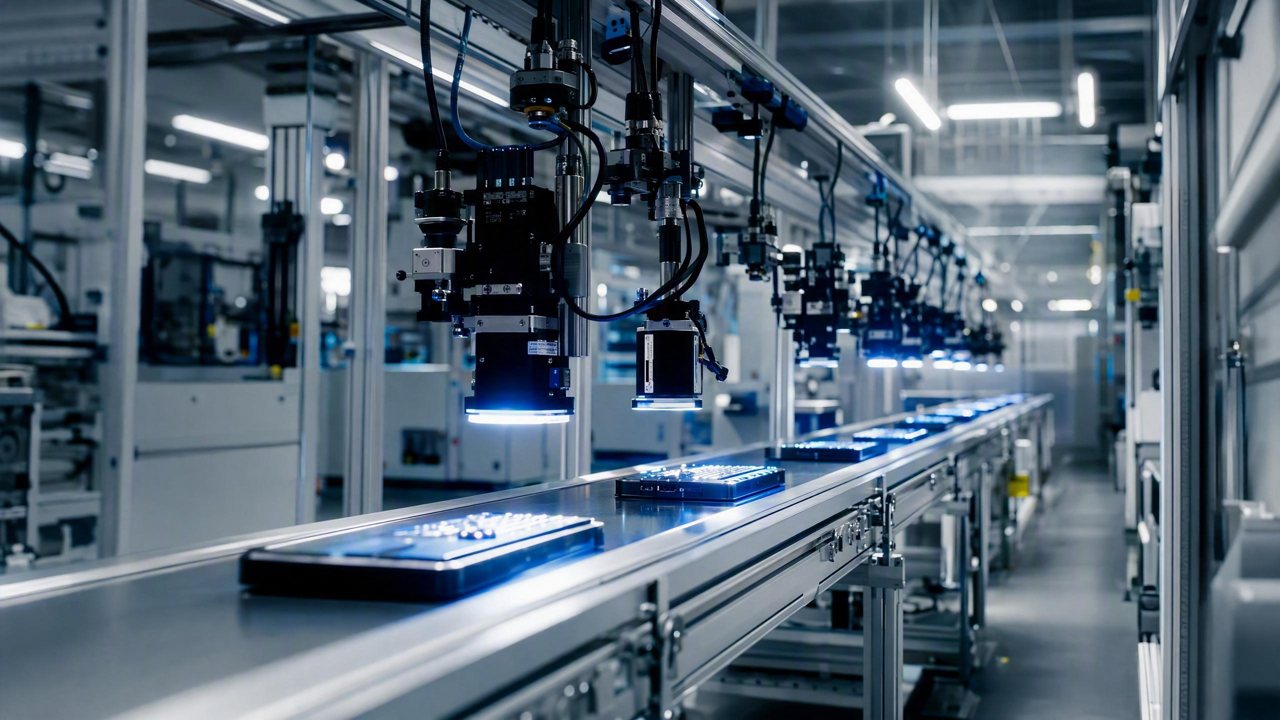
DaoAI AI AOI software (featuring visual foundation model cognitive recognition, 5-minute 0-code programming with one good sample, APDT positive/few-shot learning with 1–20 good samples, semantic false positive filtering, and SDK/API/Docker 100% on-premise deployment) reduces manual re-inspection workload for missing/incorrect parts in consumer goods assembly by −65% through semantic false positive filtering and few-shot learning, while increasing detection efficiency by over 30%.
In consumer goods manufacturing, missing or incorrectly assembled parts significantly impact product quality and brand reputation. DaoAI AI AOI software (featuring visual foundation model cognitive recognition, 5-minute 0-code programming with one good sample, APDT positive/few-shot learning with 1–20 good samples, semantic false positive filtering, and SDK/API/Docker 100% on-premise deployment) dramatically reduces false positives through its unique semantic filtering capability, cutting manual re-inspection workload by over −65% and substantially alleviating production line re-inspection pressure. This system is widely applied across various consumer products, such as electronic consumer goods housing assembly, internal wiring connections for home appliances, and toy component assembly, ensuring every product meets stringent quality standards. Facing increasingly complex consumer product structures and dynamic production demands, traditional inspection methods struggle, particularly with reflective surfaces or intricate textures, where false positives are a major issue, hindering overall production efficiency.
Pain Points: Why is this Challenge So Difficult?
Inspection in consumer goods assembly faces multiple challenges. Firstly, a high false positive rate. Traditional rule-based or simple image processing AOI systems often generate numerous false positives when inspecting reflective materials (e.g., plastic casings, metal decorative parts) or parts with complex textures, due to variations in lighting, surface reflections, material reflective properties, or subtle ambient light interference. False positive rates typically fluctuate between 5% and 15%. Secondly, a heavy re-inspection burden. Each false positive requires manual re-evaluation, which not only consumes significant human resources (often 30%–50% of total inspection man-hours) but also severely slows down the production line rhythm, reducing overall production efficiency. Thirdly, high changeover costs and cycles. Consumer products have rapid iterations and numerous models. Each new product launch or model change requires tedious parameter adjustments and rule writing for the inspection system. Traditional solutions often incur downtime for several hours or even half a day for changeovers, severely impacting production flexibility and market responsiveness.
The root cause of these pain points is the lack of deep semantic understanding of “defects” versus “normal variations” in traditional AOI. For instance, when inspecting reflective surfaces, variations in reflection angle and intensity might cause the same part to appear with different brightness or shadows at different times or locations, leading to misidentification as scratches, stains, or missing parts. Furthermore, minute tolerances of consumer components, subtle color differences, and unavoidable slight deformations during assembly pose significant challenges for pixel-based traditional algorithms. While manual inspection possesses some semantic judgment capability, its stability, consistency, efficiency, and cost cannot meet the demands of modern production. DaoAI deeply understands these challenges and offers innovative solutions through visual foundation model technology.
Technical Principles
The core of DaoAI AI AOI software system lies in its visual foundation model-based feature recognition and semantic false positive filtering capabilities. Unlike traditional AOI, which relies on engineers to manually write rules or extract features, the DaoAI system utilizes pre-trained visual foundation models for deep feature extraction and semantic understanding of images. This means the system can, like the human eye, distinguish between true assembly defects (e.g., loose screws, misaligned cables) and “normal” visual variations caused by lighting changes, material textures, or production tolerances. For example, when inspecting a highly reflective plastic part for missing components, traditional AOI might misinterpret strong reflections as a missing part. In contrast, the DaoAI system, by learning from numerous positive samples, builds a complete semantic model of the part, recognizing that reflective areas are actually surface features of the complete component, thereby reducing the false positive rate by over −65%. Furthermore, its APDT positive/few-shot learning mechanism (requiring only 1–20 good sample images) greatly simplifies the model training process, and the 5-minute 0-code automatic programming capability allows production line engineers to quickly deploy new inspection tasks without programming knowledge.
Compared to traditional methods, DaoAI's advantages are evident: Firstly, **semantic understanding**. Traditional rule-based AOI cannot interpret image semantics, only recognizing preset pixel features; the DaoAI system, however, understands the deeper meaning of a component's “presence” and “correct assembly,” effectively filtering out pseudo-defects caused by ambient light, material reflections, etc. Secondly, **generalization capability**. Based on visual foundation models, DaoAI possesses strong cross-scenario generalization capabilities, quickly adapting to new product models or working conditions with only a small number of samples, avoiding the tedious rule rewriting and debugging of traditional rule-based AOI. For instance, for a new model of mobile phone casing assembly inspection, the DaoAI system can be programmed and put into use within 5 minutes, whereas traditional methods might take several hours. Thirdly, **interference immunity**. Addressing the common difficulty of detecting defects on reflective surfaces in the consumer goods industry, the DaoAI system effectively suppresses the influence of noise such as reflections and shadows on detection results through multi-scale, multi-modal feature fusion analysis of images, ensuring detection stability under complex lighting conditions.
Typical Application Scenarios
- **Missing/Incorrect Part Detection in Electronic Consumer Goods Casing Assembly:** Inspecting for complete and correctly positioned screws, buckles, buttons, interfaces, etc., on casings of mobile phones, tablets, smart wearables. Challenges include tiny components, multiple reflective surfaces, diverse colors, making traditional AOI prone to misjudgments due to lighting.
- **Internal Wiring Connection Inspection for Home Appliances:** Checking if internal wiring harnesses in washing machines, refrigerators, air conditioners are correctly plugged in, color-matched, and secure. Challenges include dense, similarly colored wires in confined spaces, making manual inspection inefficient and prone to missed defects, and traditional AOI struggles to differentiate subtle connection states.
- **Assembly Inspection for Toys/Small Appliances:** Checking if multiple plastic/metal components inside or outside products like toy blocks, remote control cars, hairdryers, electric toothbrushes are correctly assembled, without omissions. Challenges include irregular component shapes, diverse materials, and small assembly tolerances, making traditional AOI difficult to adapt to complex 3D structures and various material properties.
- **Packaging Component Inspection for Cosmetics/Daily Chemicals:** Inspecting if caps, pump heads, labels, straws, etc., for products like lipsticks, shampoos, toothpastes are complete, correctly oriented, and not askew. Challenges include patterned/textual surfaces and often reflective materials on packaging, which frequently lead to false positives, affecting product appearance quality.
Case Study
A leading Tier-1 supplier of consumer electronic products, on its mobile phone charger production line, faced significant challenges in detecting missing components (e.g., uninstalled internal heat sinks, missing screws) and incorrect assembly (e.g., wrong charging port orientation) after assembly. Due to the compact product structure and highly reflective plastic casing, the traditional rule-based AOI system had a false positive rate as high as 12%, requiring 4 workers for full-time re-inspection daily, severely slowing down the production rhythm. After introducing DaoAI AI AOI software system, the supplier trained a deep learning model with a large amount of good sample data and specifically optimized it for reflective characteristics. During the deployment, DaoAI engineers used only 15 good sample images to complete the initial model training and deployment within 15 minutes. After integration into the existing production line, the DaoAI AI AOI software system maintained a detection rate of 99.7% while reducing the false positive rate from 12% to <0.4%. This resulted in a reduction of manual re-inspection workload by over −96%, significantly improving production line efficiency. The work that previously required 4 workers for re-inspection can now be managed by just 0.5 workers for occasional patrols.
“After implementing DaoAI AI AOI system, our production line re-inspection personnel decreased from 4 to less than 1, and the false positive rate dropped to an almost negligible level—an achievement we couldn't even imagine with traditional AOI.”
DaoAI Solutions and Products
DaoAI AI AOI software system provides a comprehensive solution for missing/incorrect parts detection in consumer goods assembly. Its core capabilities include: **Visual foundation model feature recognition**, which can learn and understand complex product geometry, materials, textures, and other deep features from vast image data to effectively identify subtle defects; **APDT positive/few-shot learning**, requiring only 1–20 good sample images to quickly build high-precision detection models, significantly shortening model development cycles and reducing reliance on defect samples; **Semantic false positive filtering**, which intelligently distinguishes true defects from non-defect visual variations (e.g., reflections, shadows, material textures) by understanding image context and part semantics, effectively reducing false positive rates and cutting manual re-inspection workload by over −65%; **0-code automatic programming**, allowing production line engineers without programming background to complete new inspection task configurations and deployments within 5 minutes; and **100% on-premise private deployment**, supporting various integration methods like SDK/API/Docker to ensure customer data remains on-site, meeting high-security demands. For scenarios requiring higher precision or 3D morphological inspection, the system can be combined with DaoAI 2D/3D AI AOI equipment, utilizing proprietary 3D cameras for micron-level morphology reconstruction to achieve high-precision detection of hidden solder joints, coplanarity, and other defects difficult for traditional vision to inspect.
By deploying the DaoAI AI AOI software system, customers can not only significantly reduce manual re-inspection costs and enhance production line automation but also ensure product quality consistency and stability. The DaoAI system reduces the false positive rate for consumer goods assembly inspection to <0.4%, greatly minimizing rework and resource waste caused by misjudgments. Concurrently, the 5min changeover time enables production lines to more flexibly adapt to multi-variety, small-batch production models, increasing overall production efficiency by over 30%, bringing tangible economic benefits and market competitiveness to enterprises.
FAQ
How does DaoAI AI AOI software effectively reduce false positives, especially in reflective surface inspection?
DaoAI AI AOI software leverages visual foundation models for deep feature recognition and semantic understanding. It learns to distinguish between true defects and visual variations caused by reflections, shadows, or material textures. In reflective surface inspection, the system identifies these reflective areas as normal features of the component rather than defects, significantly reducing false positives. The APDT few-shot learning mechanism also enhances the recognition of normal product variations, further minimizing misjudgments.
What are the deployment cycle and integration methods for this system in the consumer goods industry?
DaoAI AI AOI software supports flexible integration methods such as SDK/API/Docker, allowing for 100% on-premise private deployment to ensure data security. The deployment cycle is typically very short; model training requires only 1–20 good sample images, and the 0-code automatic programming enables production line engineers to configure new tasks within 5 minutes. The overall go-live period, depending on line complexity and integration depth, can range from a few days to several weeks, significantly faster than traditional solutions.
What are the main cost components for deploying DaoAI AI AOI software, and what is the typical ROI period?
The cost of DaoAI AI AOI software primarily includes software license fees, necessary hardware upgrades (e.g., industrial cameras, computing units, if existing equipment is insufficient), and integration service fees. The return on investment (ROI) period varies depending on client production line scale, labor costs, existing false positive rates, and downtime losses. However, due to its ability to significantly reduce manual re-inspection, minimize rework from misjudgments, and shorten changeover times, ROI is typically achieved within 6-18 months. Specific quotes and ROI analysis require an assessment of your actual needs; please contact our sales team for a customized solution.
This article was generated by AI. Customer cases are simulated scenarios based on real product capabilities and figures are illustrative; see product pages for official benchmarks.