
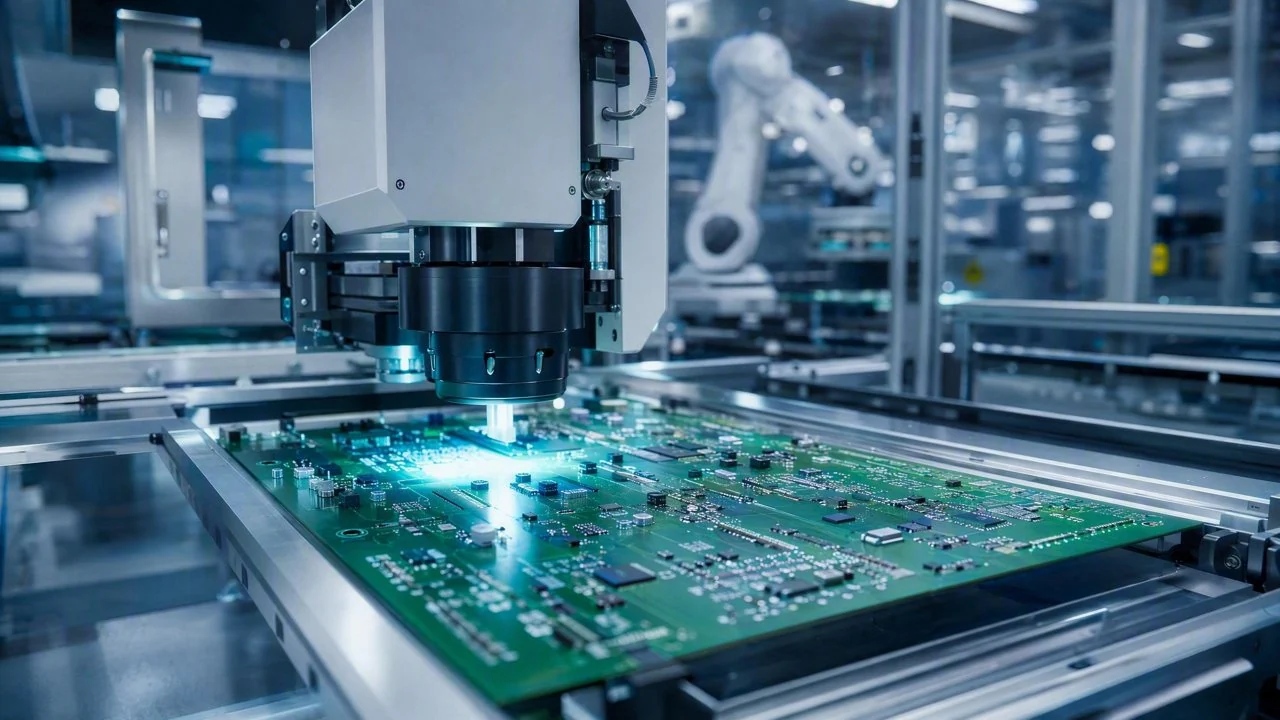
WeLinkirt DaoAI ACI OS (featuring visual foundation model for feature recognition, 5-minute 0-code programming with one good sample, APDT positive/few-shot learning with 1–20 good samples, semantic false positive filtering, and SDK/API/Docker for 100% on-premise deployment) leverages deep learning and few-shot self-training mechanisms to reduce the undetected rate of component polarity inversion in electronic PCBA production from an industry average of 1.5% with traditional visual solutions to <0.3%, while also reducing false positives by 75%. This significantly enhances detection accuracy and efficiency. In electronic PCBA manufacturing, component polarity inversion is a common yet critical defect, particularly in high-density, highly integrated modern electronic products, where its detection difficulty and importance are growing. Traditional Automated Optical Inspection (AOI) systems often struggle with identifying such defects, leading to undetected issues and false positives, which impact product quality and production efficiency.
PCBA (Printed Circuit Board Assembly), as the brain and nervous system of electronic products, its quality directly determines the performance and reliability of terminal products. In the Surface Mount Technology (SMT) process, the mounting direction of polarized components such as electrolytic capacitors, diodes, transistors, and ICs is crucial. Incorrect polarity can lead to functional anomalies, short circuits, burnouts, or even safety incidents. As electronic products trend towards miniaturization and high density, component sizes continue to shrink, and arrangements become more compact, making the identification of polarity markings increasingly difficult. For high-value or safety-critical products, such as automotive electronics and medical devices, any subtle polarity error can have catastrophic consequences.
Pain Points: Why This Challenge Is Difficult
Traditional PCBA production lines face multiple challenges in detecting component polarity inversion. Firstly, there's a **high undetected rate**. Traditional rule-based and template-matching AOI systems often see a significant drop in recognition accuracy when confronted with blurry polarity markings, printing defects, varying lighting conditions, component surface reflections, and highly similar components, leading to undetected rates typically ranging from 1.0%–2.0%. Secondly, there's a **high false positive rate**, especially in areas with dense pins or unclear silkscreen markings. Traditional AOI tends to misidentify normal components as having inverted polarity, resulting in extensive manual re-inspection work, consuming an average of 3-4 hours of manual re-inspection time daily, which significantly drags down production line efficiency. Furthermore, **long changeover downtime** occurs when product models switch, as traditional AOI requires several hours to rewrite inspection programs and adjust parameters, severely impacting production rhythm and capacity. These issues collectively lead to high quality costs, low production efficiency, and potential product recall risks.
The difficulty of detecting component polarity inversion stems from its inherent complexity. From a **process perspective**, the print quality of component polarity markings is influenced by various factors such as ink adhesion, printing precision, and component batch variations, potentially leading to blurry or inconsistent markings. At the **imaging level**, high-density mounting can cause component obstruction, and varying surface finishes of different components can lead to reflections or shadows, interfering with the vision system's accurate capture of polarity markings. Moreover, modern electronic products increasingly use leadless packages (e.g., QFN, BGA), where polarity markings might be located at the bottom or side of the component, making effective detection challenging for traditional 2D AOI. Facing the paradigm shift in industrial AI inspection from traditional vision to large model-driven approaches, WeLinkirt DaoAI ACI OS offers a breakthrough solution for identifying these complex defects, capable of understanding and learning deeper visual features rather than merely relying on predefined rules.
Technical Principles
The core of how WeLinkirt DaoAI ACI OS solves the component polarity inversion detection challenge lies in its **visual foundation model's feature recognition capabilities** and its **APDT (Automated Positive Data Training) positive/few-shot learning mechanism**. Unlike traditional AOI, which relies on engineers manually setting rules and extracting features, the DaoAI system employs pre-trained visual foundation models. These models have learned rich, general visual features from vast image datasets, enabling deep semantic understanding and feature extraction of various components, silkscreens, and pads on PCBs. This means the system doesn't just match pixels or geometric shapes; it can “understand” the meaning of polarity markings and their variations under different lighting, angles, and print qualities. When detecting new products, only 1–20 good sample images are needed, and the APDT mechanism quickly self-adapts to learn good product features, automatically building a polarity detection model. WeLinkirt DaoAI ACI OS, through this positive sample learning, avoids the reliance on large numbers of defective samples common in traditional AI solutions, significantly shortening model training cycles and greatly enhancing the model's generalization ability and robustness for polarity inversion defects.
Compared to traditional methods, WeLinkirt DaoAI ACI OS offers significant advantages. Traditional rule-based AOI requires engineers to write extensive and complex rules and thresholds when dealing with component diversity, complex backgrounds, or irregular polarity markings. It is also highly sensitive to lighting and component placement, easily disturbed, leading to high false positives and undetected defects. Any new component type or process change necessitates extensive rule base modifications, resulting in high maintenance costs. Manual inspection, on the other hand, is inefficient, susceptible to subjective factors, and prone to increased fatigue under high-intensity work, making undetected rates difficult to control. The WeLinkirt DaoAI ACI OS, with its powerful visual foundation model, can automatically identify and learn polarity features. Combined with its **semantic false positive filtering** function, it effectively distinguishes true defects from imaging interference, reducing false positives by 75%. Furthermore, its “5-minute 0-code automatic programming with one good sample” capability greatly simplifies the changeover process, reducing traditional program adjustment times from several hours to 5min, significantly improving production efficiency and flexibility. Through these advanced technologies, WeLinkirt DaoAI ACI OS can reduce the undetected rate of component polarity inversion to <0.3%, far below traditional solutions.
Typical Application Scenarios
- **Electrolytic Capacitor Polarity Detection:** Electrolytic capacitors typically have long/short leads or case markings (e.g., negative stripe). WeLinkirt DaoAI ACI OS accurately identifies these tiny and potentially blurry markings to ensure alignment with pad orientation, preventing functional failure or explosion risks due to inversion. The challenge lies in the diverse marking forms across different brands and models, and potential surface reflections.
- **Diode/Transistor Polarity Detection:** The cathode ring of a diode and the base/emitter/collector markings of a transistor are crucial for their polarity. The DaoAI system learns these specific shapes and positional features to ensure correct component installation. The difficulty is that these markings are usually very small and may be obscured by the component body or surrounding pads.
- **IC Chip Pin 1 Identification:** Most IC chips use a dot, notch, or chamfer for pin 1 orientation. WeLinkirt DaoAI ACI OS accurately identifies these subtle geometric features to verify chip mounting direction. The challenge includes high pin density, variations in markings due to production batches or package types, and susceptibility to lighting shadows.
- **Connector Anti-Fooling Structure Detection:** Some connectors have anti-fooling designs, but incorrect orientation during placement can still lead to poor contact. The DaoAI system can identify specific shape features or markings of connectors to ensure correct alignment. The difficulty lies in complex connector structures and the possibility of multiple similar anti-fooling designs.
- **LED Lamp Bead Polarity Detection:** LED lamp beads typically have a negative chamfer or internal electrode size difference to indicate polarity. WeLinkirt DaoAI ACI OS captures these microscopic features to ensure proper LED illumination. The challenge is the tiny size of lamp beads and potential uneven light reflection from their surface material.
Case Study
A leading PCBA manufacturer, a Tier-1 automotive electronics supplier, demands extremely high reliability for its products. Before implementing the WeLinkirt DaoAI ACI OS, the manufacturer's PCBA production line relied on traditional AOI supplemented by extensive manual re-inspection for component polarity inversion detection. Traditional AOI's undetected rate was about 1.5%, leading to dozens of product batches being reworked monthly due to polarity issues, severely impacting delivery times. Concurrently, the high false positive rate required 3-4 quality control personnel to spend up to 4 hours daily on re-inspection, resulting in high labor costs, and re-inspection efficiency was highly dependent on personnel status. When the production line switched product models, traditional AOI program adjustments typically took 2-3 hours, causing frequent downtime and affecting the overall production rhythm. After the WeLinkirt DaoAI ACI OS was implemented, the situation significantly improved. Through integration with existing AOI hardware, the system utilized its visual foundation model and APDT few-shot learning capabilities to deploy detection models for all critical polarized components in a short period. WeLinkirt DaoAI ACI OS reduced the undetected rate of component polarity inversion to <0.3%, drastically cutting down rework batches. Simultaneously, false positives were reduced by 75%, shortening manual re-inspection time from an average of 4 hours/day to less than 1 hour/day, freeing up significant labor for more valuable tasks. Furthermore, thanks to the “5-minute 0-code automatic programming with one good sample” feature, product changeover downtime was reduced to 5-10min, greatly enhancing production line flexibility and efficiency. The manufacturer highly praised the WeLinkirt DaoAI ACI OS's performance in improving quality and reducing costs and plans to extend its application to more production lines.
The WeLinkirt DaoAI ACI OS has not only significantly improved our PCBA inspection accuracy but also driven the undetected rate to an unprecedented low, while substantially reducing the burden of manual re-inspection, truly achieving a dual leap in quality and efficiency.
The figures above are a typically achievable range in anonymized industry scenarios — a different line or a different batch of parts will move the result either way; on-site measurement governs.
WeLinkirt Solutions and Products
The ACI OS provided by WeLinkirt is an ideal solution for component polarity inversion detection in the electronic PCBA industry. Its core capabilities include: **visual foundation model for feature recognition**, enabling deep understanding of image content rather than superficial features; **5-minute 0-code automatic programming with one good sample**, significantly lowering the barrier for model deployment and maintenance; **APDT positive/few-shot learning (1–20 good samples)**, solving the traditional AI solution's reliance on massive defect samples and accelerating model iteration and application; **semantic false positive filtering**, effectively reducing unnecessary re-inspections through deep analysis and learning of false positive causes. In practical implementation, WeLinkirt DaoAI ACI OS supports various deployment methods such as SDK/API/Docker, achieving 100% on-premise private deployment to ensure sample and inspection images never leave the factory, meeting strict data security and confidentiality requirements. Customers can integrate the WeLinkirt DaoAI ACI OS into existing AOI hardware to quickly upgrade their inspection capabilities and achieve intelligent transformation. Additionally, WeLinkirt also offers complementary products such as DaoAI 2D / 3D ACI equipment, providing integrated hardware and software solutions based on customer needs to address more complex detection requirements like hidden solder joints and coplanarity for 3D morphological defects.
The WeLinkirt DaoAI ACI OS brings tangible quantitative results and business value to customers. By reducing the undetected rate of component polarity inversion to <0.3%, it greatly enhances product quality and customer satisfaction, reducing costly rework, recalls, and other after-sales expenses. The 75% reduction in false positives directly reduces manual re-inspection hours, optimizes human resource allocation, and improves overall production efficiency. Concurrently, the 5min fast changeover capability allows production lines to respond more flexibly to multi-variety, small-batch production demands, enhancing market competitiveness. These improvements not only lower direct operating costs but also enhance the enterprise's brand reputation in quality control, laying a solid foundation for long-term development. WeLinkirt is committed to helping customers solve the toughest industrial inspection challenges through leading AI technology.
FAQ
How does WeLinkirt ACI OS achieve precise detection of polarity inversion?
WeLinkirt DaoAI ACI OS leverages the deep feature recognition capabilities of visual foundation models to learn and understand complex patterns of component polarity markings. Combined with the APDT few-shot learning mechanism, it can quickly build high-precision models with only a few good samples, effectively identifying polarity features under various lighting and print qualities, and further enhancing detection accuracy with semantic false positive filtering, reducing the undetected rate to <0.3%.
What are the cost and investment advantages of WeLinkirt ACI OS compared to traditional AOI?
Traditional AOI requires extensive manual programming and debugging, incurring high changeover costs, and often leads to high manual re-inspection costs due to false positives. WeLinkirt DaoAI ACI OS employs 0-code automatic programming, significantly reducing programming and maintenance costs. Its efficient few-shot learning and low false positive rate minimize manual re-inspection, lowering operational expenses. Additionally, the system supports 100% on-premise private deployment, ensuring data security and avoiding extra data transmission and storage fees, resulting in a higher overall return on investment. Specific pricing requires evaluation based on production line scale and integration needs.
How long does it take to deploy WeLinkirt ACI OS into an existing production line?
WeLinkirt DaoAI ACI OS supports various integration methods such as SDK/API/Docker, enabling rapid connection with customers' existing AOI hardware or production line systems. Typically, model deployment and integration can be completed within hours to a few days, depending on the customer's existing IT infrastructure and integration complexity. Our professional team will provide full technical support to ensure quick system launch and stable operation.
Full solution for this scenario: Electronics / PCBA industry solutions · Component Polarity False-Alarm Reduction
This article is an original publication by WeLinkirt (DaoAI).