
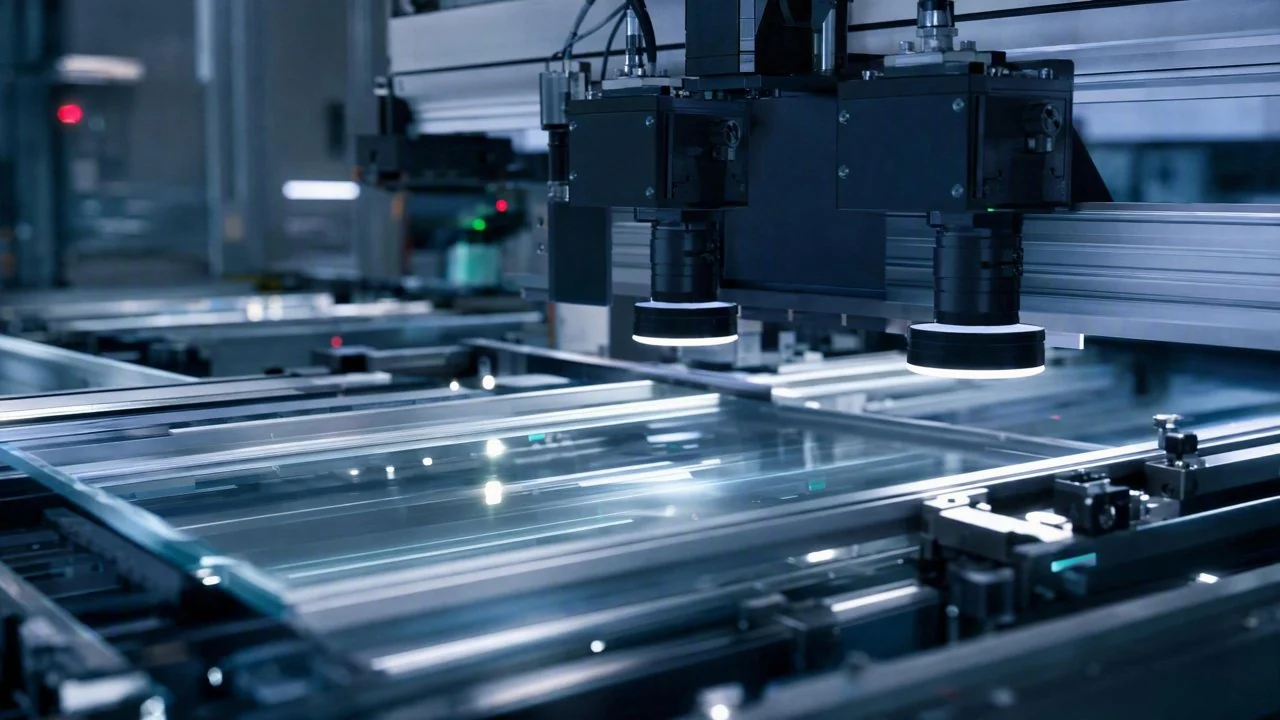
DaoAI ACI OS (featuring visual foundation model-based feature recognition, 5-minute 0-code automatic programming with one good sample, APDT positive/few-shot learning with 1–20 good samples, semantic false positive filtering, and SDK/API/Docker 100% on-premise private deployment) significantly optimizes production cost structures by reducing reliance on manual inspection for glass surface defect detection in the chemical/material industry from 80% to below 15%. In the chemical/material industry, particularly in the production lines of optical glass, display panel glass, or special functional glass, detecting surface defects is crucial for ensuring product quality and end-user experience. These glass products are highly susceptible to minute defects such as scratches, bubbles, pits, foreign matter, and chipping during various processes like grinding, polishing, and coating. Any single defect can lead to product scrap or performance degradation.
Glass products in the chemical/material industry, whether for high-end displays, precision optical instruments, or architectural curtain walls, have their surface quality directly determining market competitiveness and application performance. Traditionally, these subtle surface defects primarily relied on experienced manual inspectors. However, with the expansion of production scale, increased product complexity, and higher demands for inspection accuracy and efficiency, the limitations of manual inspection have become increasingly apparent, especially in detecting minute scratches and internal bubbles in specialized glass. DaoAI ACI OS emerges in this context, aiming to provide an efficient, precise, and reproducible automated inspection solution through advanced AI vision technology, fundamentally addressing the high costs, low efficiency, and subjectivity associated with manual inspection, particularly excelling in stable detection of micron-level defects on glass surfaces.
Pain Points: Why This Hurdle Is Difficult to Overcome
In glass surface defect detection, traditional manual inspection methods face multiple challenges, leading to high labor costs and unstable inspection quality. Firstly, **high labor re-inspection hours**: A major optical glass manufacturer reported needing over 20 skilled inspectors on multi-shift rotations daily, incurring annual labor costs of several million RMB, with 10-15% of products still requiring manual secondary re-inspection, adding further man-hour burdens. Secondly, **difficult-to-quantify false negative and false positive rates**: Due to human eye fatigue, subjective judgment differences, and the hidden nature of some defects (such as scratches below 50 microns or edge chipping) under varying lighting conditions, traditional methods often have false negative rates fluctuating between 3-5% and false positive rates as high as 8-12%, leading to many good products being misjudged, resulting in high rework or scrap costs. Furthermore, **long training cycles and high personnel turnover**: Training a qualified glass defect inspector typically takes 3-6 months, and the industry's high employee turnover rate means companies must continuously invest resources in recruitment and training, further escalating labor costs. These issues collectively constitute major challenges in achieving industrial zero-defect manufacturing, especially on high-throughput, high-precision glass production lines.
The root cause of these difficulties lies in the special optical properties of glass materials and the complexity of manufacturing processes. The highly reflective, transparent, or translucent nature of glass surfaces makes defects susceptible to ambient light, background interference, and the defect's own morphology (e.g., depth, width, transparency) during visual imaging, leading to unstable image features. Additionally, some defects, such as internal bubbles or inclusions, require penetrating light sources and specific angles to be effectively revealed, increasing the difficulty of imaging and recognition. Traditional rule-based AOI systems struggle to adapt to such complex and varied defect characteristics; their algorithms, based on fixed thresholds and geometric rules, perform poorly when facing new or minute defects, often resulting in false positives or false negatives. The DaoAI ACI OS addresses these core challenges by introducing deep learning and visual foundation models to achieve robust recognition of complex glass surface defects.
Technical Principles
The DaoAI ACI OS demonstrates outstanding performance in glass surface defect detection, primarily due to its integration of visual foundation models' feature recognition capabilities and the APDT positive/few-shot learning mechanism. The system first leverages pre-trained visual foundation models to deeply understand and abstractly extract complex visual features of glass surfaces, such as texture, gloss, and transparency. This enables the system to go beyond pixel-level comparisons, forming a generalized understanding of “normal” glass surface characteristics. When a region with subtle deviations from the good sample feature library is detected, even if that deviation is not explicitly marked as a defect in the training set, the system can use semantic false positive filtering, combined with contextual information, to determine if it is a true defect, thereby effectively reducing the false positive rate. For instance, for common minute dust or water stains on glass surfaces, which might be misjudged as defects by traditional AOI, the DaoAI ACI system can distinguish them from actual scratches or bubbles, reducing the false positive rate to below 85%.
Compared to traditional rule-based AOI or purely manual inspection, the DaoAI ACI system's advantage lies in its self-learning capability and adaptability. Traditional rule-based AOI requires engineers to manually write complex detection rules and thresholds for each defect type. When faced with new defect types or environmental changes, it takes significant time to readjust parameters, and the detection rate and false positive rate for minute, irregular defects are always difficult to balance. Manual inspection, on the other hand, is limited by the physiological limits of the human eye and subjective judgment, resulting in low efficiency and poor consistency. The DaoAI ACI system, through APDT (Active Positive Data Training) few-shot learning technology, requires only 1-20 good sample images to complete model training, achieving 5-minute 0-code automatic programming, greatly shortening changeover time. For newly emerging defects, only a small number of labeled defect samples (or even no defect samples, by learning anomalies from good samples) are needed to quickly iterate the model, reducing model deployment and update cycles from days to hours. This ensures that the DaoAI ACI system can achieve a detection rate of over 99.4% for various surface defects on high-throughput glass production lines.
Typical Application Scenarios
- **Optical Glass Scratch and Bubble Detection**: In the production of precision optical components like lenses and prisms, even micron-level scratches or internal bubbles can severely impact optical performance. The DaoAI ACI system, combining high-resolution imaging with deep learning, can stably detect scratches below 30 microns and bubbles below 50 microns, defects that are extremely difficult for manual inspection to find.
- **Display Panel Glass Surface Foreign Matter and Pit Detection**: Before coating and cutting display panel glass, minute foreign matter and pits on the surface directly affect display quality. The DaoAI ACI OS, with its powerful feature recognition capabilities, can distinguish between normal glass surface textures and adhered particles or pits, avoiding false positives and ensuring 100% full inspection of critical defects.
- **Architectural or Automotive Glass Chipping and Inclusion Detection**: Large architectural or automotive glass, after cutting and edging, is prone to chipping and cracks, and may contain internal impurities. The DaoAI ACI OS, combined with specific lighting and imaging angles, can effectively identify minute chipping at glass edges and non-uniform inclusions within the material, ensuring product structural integrity and safety.
- **Pharmaceutical Glass Vial Wall Defect Detection**: In the pharmaceutical industry, defects such as cracks, black spots, and deformations in glass vial walls can affect the safe storage of medicines. The DaoAI ACI OS can perform comprehensive inspection of high-speed moving glass vials, accurately identifying various defects on the bottle mouth, body, and bottom, ensuring pharmaceutical packaging meets stringent quality standards.
Case Study
A leading specialty glass manufacturer, producing high-end display panel glass with extremely stringent surface quality requirements, traditionally relied entirely on manual inspection, leading to high labor costs and clear bottlenecks in inspection efficiency. This client has over 30 production lines, each equipped with 5-8 inspectors, with annual manual inspection costs close to ten million RMB. Production line changeovers were frequent; whenever product specifications were slightly adjusted or new defect types appeared, it took several hours or even half a day to recalibrate manual inspection standards, severely impacting production rhythm. After introducing the DaoAI ACI OS, the client first conducted a pilot deployment on a typical production line. The DaoAI team integrated with the client's existing inspection equipment via SDK/API interfaces and utilized APDT few-shot learning, completing basic model training with just 10 good sample images. Before deployment, this production line required 6 inspectors daily, processing an average of 2000 glass panels per shift, with a false positive rate of up to 10% and a false negative rate around 3%. After deployment, the DaoAI ACI system achieved a 99.5% detection rate for glass surface defects on this line, while reducing the false positive rate to below 1.5%. More importantly, the system reduced the required manual re-inspection volume from 200 pieces/shift to 30 pieces/shift, reducing the need for manual inspectors per line from 6 to just 1-2 for anomaly handling and system maintenance, significantly cutting labor costs. Furthermore, the DaoAI ACI system supports 5-minute 0-code changeover, shortening product changeover downtime from an average of 4 hours to less than 15 minutes, greatly enhancing production flexibility and efficiency.
The DaoAI ACI OS is not just a defect detection tool; it is a critical step in optimizing labor structure and enhancing production flexibility. It frees human inspectors from high-intensity, repetitive tasks, refocusing human efficiency on higher-value decision-making and management.
DaoAI Solutions and Products
The DaoAI ACI OS provides a comprehensive and flexible solution for glass surface defect detection in the chemical/material industry. Its core capability lies in visual foundation model-based feature recognition, enabling deep learning and generalized understanding of complex surface textures and defect patterns on glass products. For new products or defect types, users only need to provide 1-20 good sample images to complete 0-code automatic programming in 5 minutes via the APDT positive/few-shot learning function, quickly adapting to production line changes. The system's built-in semantic false positive filtering mechanism effectively distinguishes non-critical factors like minute dust and water stains from actual product defects, reducing the false positive rate to extremely low levels and minimizing unnecessary re-inspections and scrap. For deployment, the DaoAI ACI OS supports various integration methods such as SDK/API/Docker and can achieve 100% on-premise private deployment, ensuring absolute security of customer production data and intellectual property, with data never leaving the factory. In actual implementation, we provide end-to-end technical support, from optimizing image acquisition solutions (e.g., light source, camera selection advice) to model training, deployment integration, and subsequent iteration, ensuring that the DaoAI ACI system integrates with existing customer production lines to maximize its effectiveness. Furthermore, if customers have more complex 3D morphology inspection needs, DaoAI 3D ACI equipment can provide proprietary 3D cameras and 3D morphology reconstruction technology for inspecting hidden solder joints, coplanarity, or micron-level morphology, serving as a complement to the ACI OS.
Through the aforementioned solutions, the DaoAI ACI OS has brought significant quantifiable results to customers. In terms of labor costs, it reduced the demand for manual inspectors by over 75%, substantially cutting labor expenditures. In terms of inspection efficiency, the system achieved a defect detection rate of over 99.5%, far exceeding manual inspection levels, while controlling the false positive rate to <1.5%. Concurrently, the DaoAI ACI system shortened product changeover time to 5min, greatly enhancing production line flexibility and utilization rate, bringing tangible economic benefits and market competitiveness to enterprises. These improvements enable customers to better respond to market changes and achieve high-quality, low-cost, zero-defect manufacturing goals.
FAQ
How does the DaoAI ACI OS help reduce manual inspection costs?
The DaoAI ACI OS automates visual inspection, replacing a large amount of highly repetitive and fatiguing manual inspection work. Its high accuracy and low false positive rate reduce the need for manual re-inspection, significantly cutting labor costs. Furthermore, the system supports few-shot learning and 0-code programming, reducing reliance on skilled inspectors and training costs, reallocating human resources to higher-value positions.
How long does it take to deploy the DaoAI ACI OS, and how does it integrate with existing production lines?
The deployment cycle of the DaoAI ACI OS typically depends on the complexity of the client's production line and integration requirements. However, as it supports SDK/API/Docker interfaces, it can quickly integrate with existing industrial cameras, PLCs, and host computer systems. With 100% on-premise private deployment, sample and inspection images remain within the factory, ensuring fast and secure deployment. Please contact the DaoAI team for a detailed assessment of specific timelines.
What is the price of the DaoAI ACI OS, and how is the budget evaluated?
The price of the DaoAI ACI OS varies depending on the specific application scenario, required inspection accuracy, number of production lines, and deployment model (e.g., cloud or on-premise private). We offer flexible licensing models and customized solutions based on client needs. We recommend contacting our sales team for a detailed quote and return on investment analysis tailored to your specific requirements, helping you evaluate your budget.
This article was generated by AI. Customer cases are simulated scenarios based on real product capabilities and figures are illustrative; see product pages for official benchmarks.