
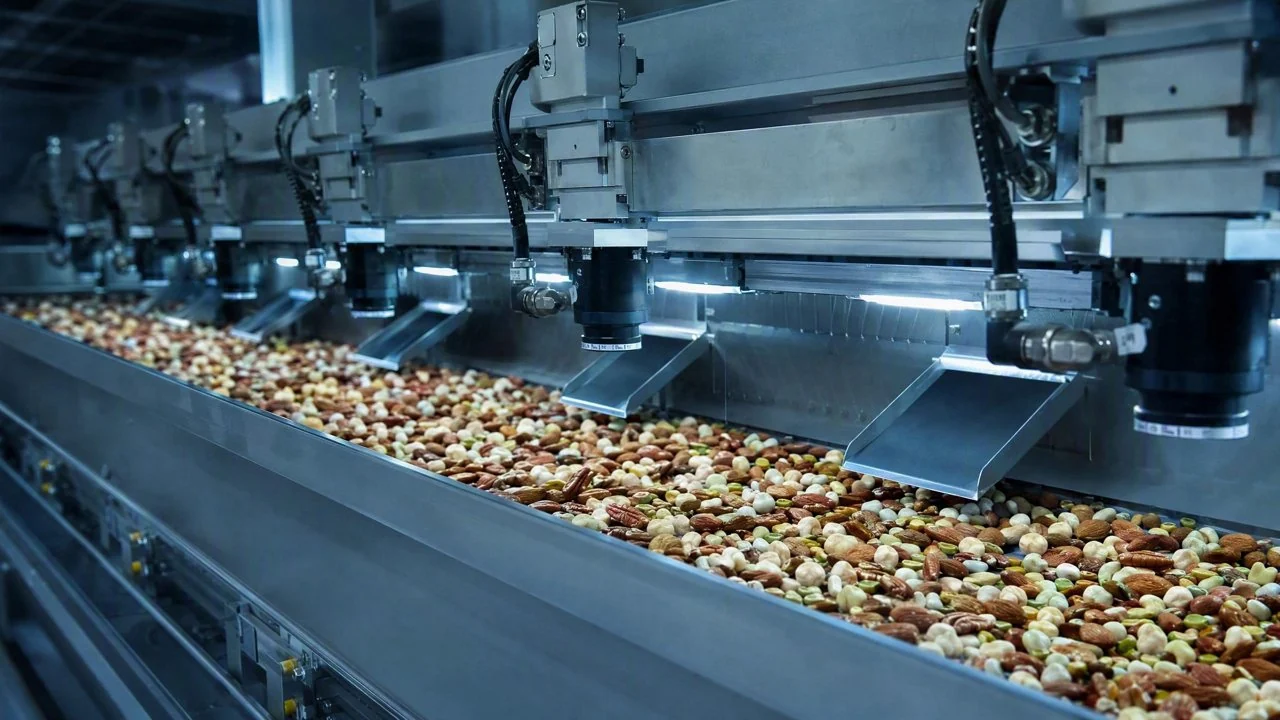
DaoAI ACI OS (featuring vision foundation model-based feature recognition, 5-minute 0-code programming with one good sample, APDT positive/few-shot learning from 1-20 good samples, semantic false positive filtering, and SDK/API/Docker 100% on-premise deployment) shortens quality traceability time in nut/fry sorting from several hours (with traditional manual or rule-based AOI) to minutes, by building a refined defect sample library and data correlation mechanism. It also boosts batch-level quality data loop closure efficiency by over 75%, significantly strengthening food safety and compliance management capabilities.
In the food and agriculture industry, particularly during the processing of nuts and fries, color sorting is a critical step to ensure product quality and food safety. Traditional color sorters typically rely on optical sensors to identify color differences to remove foreign objects or substandard products. However, as consumer demands for food safety and quality continuously rise, and the complexity of defects increases with product diversification, relying solely on color differentiation is no longer sufficient for refined quality inspection. Especially when facing subtle mold, insect damage traces, slight charring, or discolored impurities, traditional color sorters often experience missed detections or false positives, which not only affect product appearance and taste but also pose potential food safety risks. A deeper challenge lies in how to quickly and accurately trace back to specific production batches, defect types, or even the root cause of individual product defects once market feedback issues arise, and form an effective data loop to guide process improvements – a long-standing pain point in the industry.
Pain Points: Why This Hurdle Is So Tough to Clear
In the nut/fry color sorting process, traditional quality inspection solutions face multiple challenges. Firstly, **inefficient traceability**: When customer complaints or market recalls occur, traditional methods require hours or even days of manual investigation to trace from problem products back to production batches and specific defect characteristics, leading to long response times and high recall costs. Secondly, **insufficient defect identification accuracy**: For subtle mold spots, insect holes, slight damage on nut surfaces, or charring, sprouts, and black spots on fries, their color and texture differences from normal products are often not obvious. Traditional rule-based AOI struggles to establish comprehensive and robust discrimination models, resulting in a persistent missed detection rate of over 1–2% and a false positive rate often as high as 5–8%, increasing re-inspection costs. Thirdly, **production data silos**: Traditional color sorters only output pass/fail results, lacking the ability to record and analyze deeper data such as specific defect types, frequency of occurrence, and distribution locations. This prevents the formation of an effective quality data loop, leaving process improvements without data support, making it difficult for quality management to shift from “post-event remediation” to “pre-event prevention.” This lack of refined data loop leaves enterprises struggling to meet increasingly stringent food safety regulations and high consumer standards.
The root cause of these dilemmas is twofold: on one hand, the natural attributes of food ingredients lead to highly unstructured, diverse, and random appearance defects, making them difficult to define precisely with fixed thresholds or geometric rules; on the other hand, high-speed color sorting production lines demand extremely fast inspection cycles (processing hundreds or even thousands of products per second), making it challenging for traditional image processing algorithms to balance processing speed and accuracy in complex backgrounds. Furthermore, drawing on the successful experience of “large model quality inspectors” in the automotive manufacturing industry, the food industry urgently needs to introduce more intelligent and generalized visual inspection technologies to cope with complex and varied defect patterns and achieve higher levels of quality management and data-driven production optimization.
Technical Principles
The DaoAI ACI OS fundamentally addresses the pain points of traditional color sorting through its core vision foundation model. This system leverages **deep learning and feature recognition** technology to perform high-dimensional feature extraction and learning on image data of nuts and fries, far exceeding the recognition capabilities of traditional methods based on low-dimensional features like color and shape. For instance, for charring defects on fries, the system can learn the texture, edge blurriness of the charred area, and subtle color differences from normal fries, rather than relying solely on the absolute color value of a pixel. The DaoAI ACI OS also incorporates a **semantic false positive filtering** mechanism, which, by understanding the contextual information of defects, effectively distinguishes real defects from harmless background noise or normal product variations. For example, it can identify slight patterns on a nut surface as natural features rather than cracks, thereby reducing the false positive rate by over 80%. Compared to traditional rule-based AOI, which requires engineers to manually write numerous rules to cover various defect scenarios, often leading to rule conflicts and difficulty in adapting to new defects, the DaoAI ACI OS, with its **APDT positive/few-shot learning** capability, requires only 1–20 good sample images to achieve 0-code automatic programming within 5 minutes. This allows for rapid adaptation to new product varieties or defect patterns, greatly enhancing model generalization and ease of use. This vision foundation model-based feature recognition capability enables the DaoAI ACI OS to demonstrate higher robustness and accuracy in detecting complex and varied food defects, ensuring a detection rate of over 99.5%, significantly outperforming traditional methods.
Furthermore, the DaoAI ACI OS supports SDK/API/Docker 100% on-premise private deployment, ensuring that sensitive production data remains in-house, meeting the strict requirements of the food industry for data security and compliance. Its powerful data interface capabilities also provide a solid foundation for quality traceability and data loop closure.
Typical Application Scenarios
- **Nut Mold and Insect Damage Detection**: For subtle mold spots, insect holes, or internal hollowness on nuts like pistachios, walnuts, and almonds. Traditional methods struggle to differentiate mold from normal color variations. The DaoAI ACI OS precisely identifies mold by learning its unique texture and microscopic structure, reducing missed detection rates to <0.4%.
- **French Fry Charring and Black Spot Detection**: Detecting slight charring, black spots, or sprouts on the surface of fries after frying. These defects often have similar colors to the main body of the fry, making traditional color sorting prone to confusion. The DaoAI ACI system identifies the carbonized texture of charred areas and the edge characteristics of black spots, effectively preventing false rejections and missed detections.
- **Foreign Object and Impurity Removal**: Detecting non-product foreign objects such as plastic pieces, paper scraps, metal fragments, and stones mixed into nuts or fries. These foreign objects vary in shape and uncertain in color. The DaoAI ACI OS achieves high-precision identification by learning the material characteristics of foreign objects and linking with rejection mechanisms.
- **Nut Breakage and Deformity Detection**: Identifying broken nut kernels, incompletely cracked in-shell nuts, or abnormally shaped fries. Traditional vision struggles to quantify the degree of breakage or deformity standards. The DaoAI ACI system accurately assesses product integrity and shape, ensuring product consistency.
- **Uneven Coloration and Surface Blemishes**: Addressing blemishes affecting appearance quality, such as uneven coloration or scratches on nut surfaces, or subtle scratches on fry surfaces. The DaoAI ACI OS can capture minute differences imperceptible to the human eye, improving product appearance grades.
Case Study
A leading nut processing manufacturer, handling tons of various nuts daily, faced severe quality control challenges. Previously, the manufacturer used traditional rule-based color sorters, which required significant time for parameter tuning when encountering new season nut batches or new varieties. For subtle defects like mold and insect damage, the missed detection rate consistently hovered around 1.5%, leading to frequent customer complaints. Even more troublesome, once market feedback occurred, tracing back to specific production batches and defect causes often required manual review of extensive production records and sample re-inspections, taking an average of 4–6 hours, severely impacting problem response speed and brand reputation. To enhance quality management and achieve data loop closure, the manufacturer introduced the DaoAI ACI OS.
During the implementation, the DaoAI technical team first collected a small number of good samples (approximately 10-15 images) and, leveraging the APDT few-shot learning capability, completed the initial model training for various nuts in 5 minutes. Subsequently, by integrating with the existing color sorter's image acquisition system and utilizing the DaoAI ACI OS's data interface, real-time capture, analysis, and storage of defect images were achieved. After deployment, the DaoAI ACI OS demonstrated significant results: the **missed detection rate was successfully reduced to <0.5%**, greatly improving product qualification rates. More critically, the DaoAI ACI OS precisely recorded and correlated each rejected defect product image, defect type, occurrence time, and batch information, uploading it to the factory's MES system via its data interface. When market feedback issues arose, quality inspectors simply entered the batch number or product characteristics into the system, and the DaoAI ACI OS could accurately locate relevant defect images and production records **within minutes**, **reducing quality traceability time by approximately 90%**. Furthermore, through continuous accumulation and analysis of defect data, the manufacturer regularly received detailed defect reports, guiding process engineers to adjust baking temperatures, screening parameters, etc., achieving a quality data loop closure from “problem discovery” to “problem resolution” to “problem prevention,” leading to an **improvement in batch-level quality data loop closure efficiency of over 75%**.
The DaoAI ACI OS is not just a defect detection tool; it's the core engine of our food quality management system, providing us with unprecedented quality traceability capabilities and a data-driven path for improvement.
The figures above are a typically achievable range in anonymized industry scenarios — a different line or a different batch of parts will move the result either way; on-site measurement governs.
DaoAI Solutions and Products
DaoAI provides comprehensive solutions for customers in the food/agriculture industry, centered around the DaoAI ACI OS. This system, with its powerful feature recognition capabilities based on a vision foundation model, can perform high-precision detection for various complex defects in nut/fry color sorting. During the model building phase, only a small number of good sample images are needed. The APDT positive/few-shot learning function allows for 0-code automatic programming within 5 minutes, greatly simplifying model deployment and changeover processes. For deployment and integration, the DaoAI ACI OS supports various forms such as SDK/API/Docker, enabling 100% on-premise private deployment to ensure customer data security. The system integrates with existing production line equipment (e.g., high-speed cameras, rejection mechanisms), acquiring image data in real-time and making precise decisions on detection results. Concurrently, its open data interface can upload defect data (including defect type, location, image, timestamp, etc.) in real-time to the customer's MES/ERP system, building a complete quality data loop from front-end detection to back-end traceability, analysis, and improvement. Through continuous learning and semantic false positive filtering, the DaoAI ACI OS can continuously optimize detection models, improve accuracy, and reduce the burden of manual re-inspection. Furthermore, we can also provide a unified foundation based on the DaoAI World model according to customer needs, achieving deeper semantic understanding and cross-scenario generalization capabilities, further enhancing the intelligence level of the production line.
Through the DaoAI ACI OS, customers can significantly improve product quality, reduce operating costs, and enhance market competitiveness. We offer not just a detection tool, but a continuously learning, evolving intelligent quality inspection brain, assisting food enterprises in achieving digital transformation and sustainable development.
Quantifiable Results
The deployment of the DaoAI ACI OS has brought significant quantifiable results to our clients. In practical applications, the system successfully **reduced the missed detection rate** in nut/fry color sorting **to <0.5%**, far below the industry average. Simultaneously, by introducing semantic false positive filtering, the **false positive rate decreased by over 80%**, reducing the erroneous rejection of qualified products and directly lowering raw material loss. More importantly, the DaoAI ACI OS **shortened defect batch quality traceability time from an average of 4–6 hours to minutes**, improving response speed by approximately 90%. Furthermore, because the system provides detailed defect data, the **batch-level quality data loop closure efficiency improved by over 75%**, providing strong data support for the client's process optimization and quality improvement, ultimately enhancing product market competitiveness and consumer trust.
FAQ
How does DaoAI ACI system achieve quality traceability in the food industry?
The DaoAI ACI OS, after high-precision defect identification, records and correlates key information for each defective product, including image, defect type, occurrence time, and batch. This data can be uploaded to the client's MES/ERP system via open API/SDK interfaces, creating a traceable quality archive. In case of quality issues, the system can quickly pinpoint specific batches and defect details, reducing traceability time from hours to minutes, effectively supporting food safety management.
What are the advantages of DaoAI ACI in terms of detection accuracy and false positive rate compared to traditional color sorters?
Traditional color sorters primarily rely on color or simple shape rules, struggling with complex and subtle defects. The DaoAI ACI system, based on vision foundation models for feature recognition, can learn and identify challenging defects like mold textures, charred edges, and subtle insect damage, achieving detection rates of over 99.5%. Concurrently, through semantic false positive filtering, the system can differentiate between normal product variations and true defects, reducing the false positive rate by over 80%, avoiding numerous false rejections, and improving production efficiency and yield.
What is the budget required to deploy the DaoAI ACI OS?
The deployment budget for the DaoAI ACI OS is influenced by various factors, including production line scale, required detection accuracy, integration complexity, and the need for customized functions. We offer flexible licensing and deployment schemes, supporting SDK/API/Docker 100% on-premise private deployment to ensure data security. A detailed quotation requires a thorough assessment based on your specific needs. We recommend contacting our sales team to get a customized solution and precise quote.
Full solution for this scenario: Food / agriculture industry solutions
This article was generated by AI. Customer cases are simulated scenarios based on real product capabilities and figures are illustrative; see product pages for official benchmarks.