
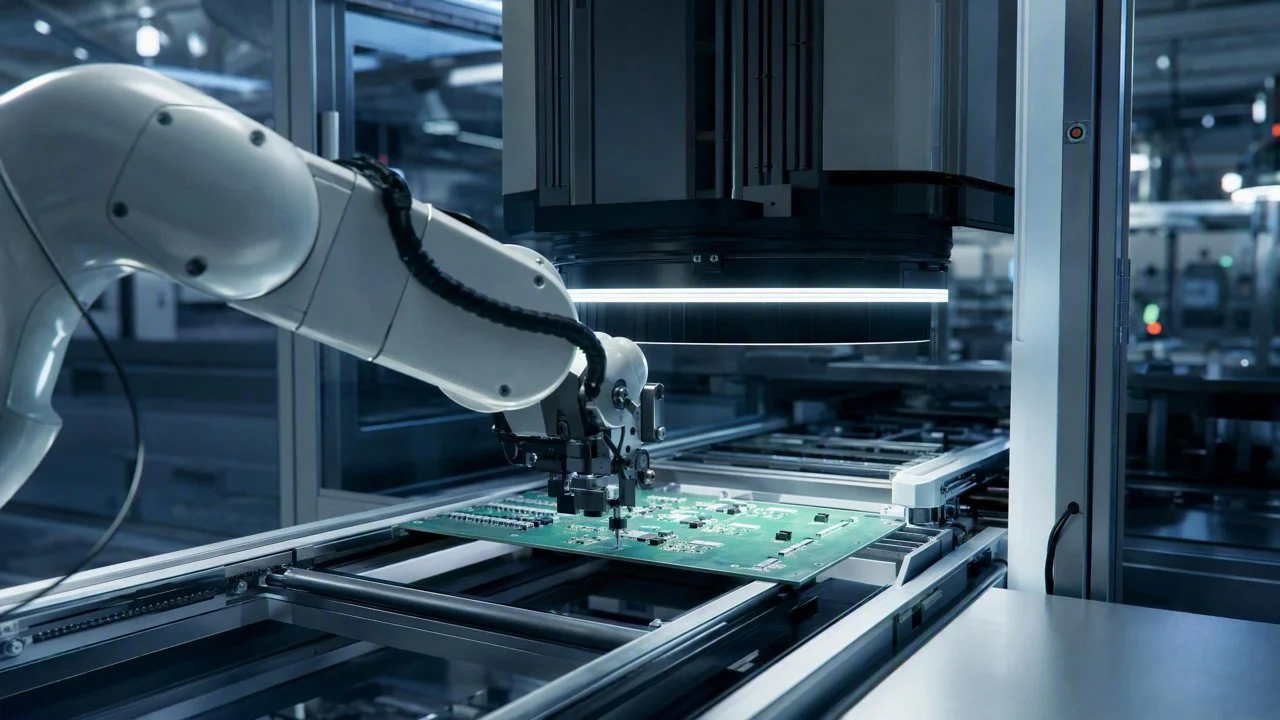
In the electronics manufacturing sector, DaoAI ACI OS, powered by its vision foundation model for feature recognition, 5-minute 0-code programming with just one golden sample, APDT few-shot learning (requiring only 1–20 good samples), and semantic false positive filtering, coupled with 100% on-premise SDK/API/Docker deployment, significantly boosts PCBA production line full inspection efficiency and cycle time. It reduces production line downtime caused by traditional quality inspection methods by 75%, ensuring reliable product quality under high-capacity demands. As electronic product iteration accelerates, PCBA production faces increasing demands for efficiency and quality, particularly in 100% full inspection of critical defects such as missing/misplaced components and connector misalignment. Traditional inspection solutions struggle to meet the high cycle time requirements of modern production lines.
A leading PCBA manufacturer, whose lines produce high-density PCBAs for industrial control and consumer electronics with frequent product changes and small batches, requires 100% full inspection after assembly to ensure all components (resistors, capacitors, IC chips, connectors, etc.) are correctly installed as designed, without missing, misplaced, or inverted issues.
Pain Points: Why This Hurdle Is Difficult to Overcome
The manufacturer faced several challenges: Firstly, traditional rule-based AOI systems had limited capabilities in identifying complex defects, especially with varying lighting conditions, reflective component surfaces, and subtle connector misalignments, often resulting in a false negative rate exceeding 1.5%. Secondly, a high false positive rate was common, with traditional AOI reaching 8-12%, leading to significant human effort in re-inspection. On average, 3-4 quality inspectors per shift were needed for manual re-inspection, severely slowing down the production line cycle time. Thirdly, during new product introduction or model changeovers, traditional AOI programming was time-consuming, typically requiring 2-4 hours, which directly increased line downtime and impacted overall throughput. Finally, in the context of industrial automation leaders like Rockwell Automation integrating AI quality inspection solutions to enhance data collaboration and decision-making efficiency, this manufacturer recognized that existing isolated quality inspection systems struggled to link effectively with upper-level MES/QMS systems, hindering real-time feedback and optimization of production data.
The root cause of these difficulties lies in the complexity of PCBA manufacturing. For instance, connector misalignment often involves only millimeter-level offsets or tilts, which are not obvious in 2D images. Micro-components on high-density boards might be missed or obscured by shadows from surrounding components. Traditional AOI relies on engineers manually setting numerous rules and thresholds. Faced with vast differences in component types, sizes, colors, and pin shapes, as well as minor deformations that may occur during production, the rule base struggles to cover all scenarios and is sensitive to lighting changes, leading to poor robustness. While manual visual inspection is flexible, it is inefficient and susceptible to subjective factors, failing to meet the stringent requirements of high cycle time and 100% full inspection.
Technical Principles
DaoAI ACI OS fundamentally addresses the limitations of traditional AOI through its core vision foundation model. This system does not rely on predefined rules but instead uses deep learning techniques, trained on vast image data, to acquire powerful feature recognition capabilities. It can autonomously learn and understand the normal forms and defect characteristics of various components on PCBAs. Even subtle connector misalignments or obscured missing components can be precisely identified. The DaoAI ACI system requires only one golden sample image to complete 0-code automatic programming within 5 minutes, significantly reducing changeover time. Furthermore, its APDT (Adaptive Positive/Few-shot Data Training) function, needing only 1–20 good sample images, allows for rapid adaptation to new product models, enabling efficient model iteration and deployment. Compared to traditional rule-based AOI, the DaoAI ACI system's detection rate has improved to over 99.5%, while reducing the false positive rate by 80%, significantly cutting down on manual re-inspection workload. The semantic false positive filtering mechanism further refines inspection results by understanding the contextual information of defects, effectively avoiding false positives caused by background interference or normal process marks, ensuring the accuracy and reliability of inspection results.
Compared to traditional AOI, the greatest advantage of the DaoAI ACI OS lies in its generalization and self-learning capabilities. Traditional AOI uses hard-coded rules, requiring manual rule modification when facing new defects or process changes, which is time-consuming, labor-intensive, and prone to omissions. In contrast, the DaoAI ACI, based on a vision foundation model, can learn high-dimensional features from a small number of samples, possessing a certain ability to recognize unknown defects. Moreover, it can continuously optimize its model through feedback from production line data, becoming 'smarter with use.' This deep learning-based solution not only improves detection accuracy but, more importantly, transforms quality inspection from 'rule maintenance' to 'model training and optimization,' greatly reducing reliance on engineers' specialized knowledge and enhancing the flexibility and intelligence of the production line.
Typical Application Scenarios
- **PCBA Component Missing/Misplaced Detection:** The DaoAI ACI OS performs 100% full inspection of all surface-mounted components (e.g., resistors, capacitors, inductors, IC chips, connectors) on PCBAs, accurately identifying missing, misplaced, inverted, tombstone, or side-standing defects. The challenge lies in the wide variety of components, significant size differences, and potential obscuration on high-density boards. The DaoAI system, through feature recognition, effectively distinguishes different components and accurately determines their installation status.
- **Connector Misalignment and Pin Deformation Detection:** For various board-to-board connectors, FPC connectors, USB interfaces, etc., the DaoAI ACI OS detects whether connectors are properly seated, if pins are bent or deformed, and if they are aligned with pads. Connector misalignment often involves millimeter or even sub-millimeter deviations, which are difficult for traditional vision to consistently identify. The DaoAI system's vision foundation model can capture these subtle features.
- **Screw/Nut/Washer Missing Detection:** In the later stages of PCBA assembly, missing or misplaced fasteners such as screws, nuts, and washers can severely impact product reliability. The DaoAI ACI OS accurately detects these small parts, ensuring all fasteners are installed as required, preventing functional failures due to loosening or detachment.
- **Foreign Object and Contamination Detection:** Dust, solder balls, fibers, and other foreign objects, as well as flux residue, fingerprints, and other contaminants introduced in the production environment, can lead to PCBA short circuits or performance degradation. The DaoAI ACI OS effectively identifies these minute foreign objects and surface contaminations, ensuring the cleanliness of PCBAs.
- **Barcode/Character Recognition and Verification:** Recognition and verification of barcodes, QR codes, and silkscreen characters on PCBAs to ensure product batch information, serial numbers, version numbers, etc., are consistent with production data. The challenge lies in inconsistent print quality and reflections. The DaoAI system, with its powerful OCR capabilities, can stably recognize characters even in complex backgrounds.
Case Study
A leading Tier-1 automotive electronics supplier, whose PCBA production lines are responsible for critical components like in-car entertainment systems and ADAS modules, has extremely high demands for product quality and line cycle time. Before integrating the DaoAI ACI OS, the production line faced severe challenges. Traditional AOI systems had a false negative rate as high as 1.8% when detecting connector misalignments and missing components on high-density boards, leading to high rework costs. Simultaneously, due to a traditional AOI false positive rate of 10%, 4 quality inspectors were needed daily for up to 6 hours of manual re-inspection, severely slowing down the production line cycle time. During new product introduction, AOI programming took over 3 hours, causing production line downtime.
After the deployment of the DaoAI ACI OS, the production line's full inspection efficiency achieved a qualitative leap. Not only was the false negative rate reduced to <0.4%, but the false positive rate also decreased by 85%, significantly improving line cycle time and overall throughput.
To address these pain points, the supplier introduced the DaoAI ACI OS. The deployment process took only 2 weeks, including system integration, line debugging, and model training. The DaoAI team, utilizing APDT few-shot learning, completed the model training for the first product with just 15 good sample images. Post-deployment, the DaoAI ACI system reduced the PCBA false negative rate to <0.4%, well below the industry average. Concurrently, the system's false positive rate decreased by 85%, reducing manual re-inspection time from 6 hours daily to less than 1 hour, effectively freeing up human resources. More importantly, the DaoAI ACI system shortened new product changeover time to 5min, greatly enhancing the line's flexibility and efficiency, ensuring 100% full inspection capacity under high cycle time demands.
The figures above are a typically achievable range in anonymized industry scenarios — a different line or a different batch of parts will move the result either way; on-site measurement governs.
DaoAI Solutions and Products
The core solution provided by DaoAI to this client is its DaoAI ACI OS. This system uses a vision foundation model for feature recognition, enabling high-precision identification of various components and defects on PCBAs. For modeling, the DaoAI ACI system supports 0-code automatic programming, allowing for rapid basic model construction with just one golden sample image. For new products or specific defects, the APDT positive/few-shot learning function enables clients to perform rapid incremental training with 1-20 good sample images, eliminating the need for a large number of defect samples and significantly reducing model training barriers and time costs. The system's built-in semantic false positive filtering effectively distinguishes real defects from normal process marks, further enhancing the reliability of inspection results. For deployment, the DaoAI ACI OS supports various integration methods such as SDK/API/Docker and can be 100% deployed on-premise, ensuring client data security and independent system operation. This allows clients to connect quality inspection data with existing MES/QMS systems, achieving data collaboration and improved decision-making efficiency, aligning with Rockwell Automation's trends in industrial automation. Additionally, clients can choose to pair the DaoAI ACI OS with DaoAI 2D/3D ACI equipment, utilizing self-developed 3D cameras and 3D morphology reconstruction technology, to detect more complex defects such as hidden solder joints, coplanarity, and micron-level morphology, forming a more comprehensive quality inspection solution.
By deploying the DaoAI ACI OS, the client not only achieved precise detection of critical defects and a significant reduction in false positive rates but, more importantly, substantially increased line cycle time, ensuring 100% full inspection under high-capacity demands. The DaoAI ACI system reduced production line downtime caused by quality inspection by 75%, directly improving the line's OEE (Overall Equipment Effectiveness). Concurrently, manual re-inspection workload decreased by 85%, allowing quality control personnel to focus on higher-value tasks. New product changeover time was reduced from several hours to 5min, greatly enhancing the line's flexible manufacturing capabilities. These quantified achievements collectively build significant business value, helping the client maintain a leading position in fierce market competition.
FAQ
What is the fundamental difference between DaoAI ACI OS and traditional AOI?
DaoAI ACI OS is based on advanced vision foundation models and deep learning technology, which does not rely on manually set rules but autonomously identifies defects by learning from vast amounts of data. This gives it stronger generalization capabilities and robustness, enabling it to effectively handle complex and varied defect types, and significantly reduce false positive and false negative rates. Traditional AOI, on the other hand, relies on fixed rules written by engineers, making it difficult to adapt to new products and complex defects, and easily affected by environmental changes.
How are the deployment cost and ROI period of the DaoAI ACI system evaluated?
The deployment cost of the DaoAI ACI system primarily depends on the required hardware configuration (e.g., cameras, lighting, industrial PC) and software licensing model. However, by significantly reducing false negative rates, false positive rates, cutting down manual re-inspection costs, shortening changeover downtime, and improving overall production line cycle time and throughput, clients typically achieve ROI within 6-12 months. The specific ROI period requires a detailed assessment based on the client's production line scale, product complexity, defect rate, and labor costs. Please contact us for a customized solution.
How can the DaoAI ACI system be integrated into an existing production line?
The DaoAI ACI OS offers flexible integration solutions, supporting SDK, API, and Docker deployment, and can be 100% deployed on-premise. This means it can be integrated into existing MES, QMS, or other automation control systems to achieve data sharing and process linkage. Our professional team provides full technical support to ensure system compatibility with existing equipment and assists with data interface docking and production line debugging.
Full solution for this scenario: Electronics / PCBA industry solutions
This article was generated by AI. Customer cases are simulated scenarios based on real product capabilities and figures are illustrative; see product pages for official benchmarks.