
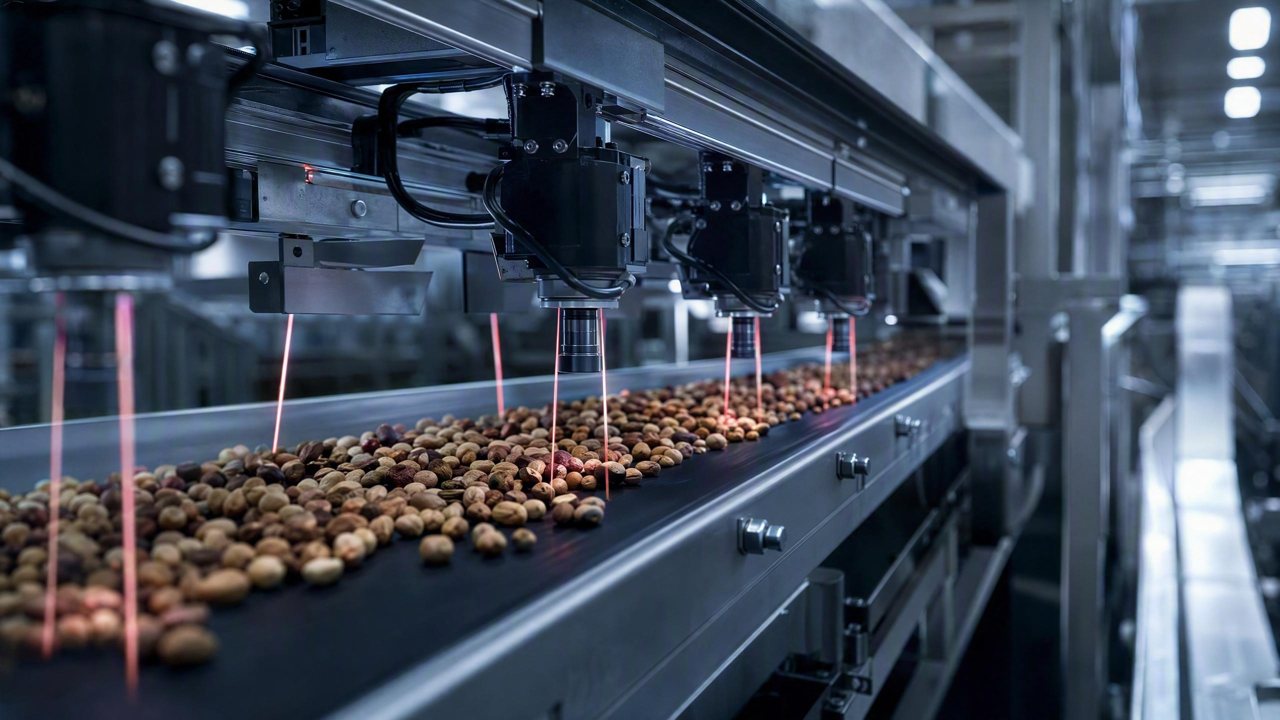
The DaoAI AI AOI software system (featuring visual foundation model-based feature recognition, 0-code automatic programming with one good sample in 5 minutes, APDT positive/few-shot learning from 1–20 good samples, semantic false positive filtering, and 100% on-premise private deployment via SDK/API/Docker) significantly reduces false positive rates in nut color sorting from 10% (due to traditional visual defect identification) to 1.8% through its advanced semantic false positive filtering and few-shot learning capabilities. This drastically cuts down manual re-inspection workload and boosts overall production line efficiency. The food and agricultural processing industry currently faces increasingly stringent quality standards and high consumer demands for product uniformity, especially for snack foods like nuts and potato chips. Appearance defects (e.g., mold, insect damage, discoloration, breakage) directly impact consumer purchasing intent and brand reputation. While traditional color sorters perform initial screening, their false positive rates remain high in complex backgrounds, varying lighting, or subtle defect scenarios. This leads to substantial amounts of good products being mistakenly rejected or requires immense human effort for secondary re-inspection, increasing production costs and slowing down overall throughput.
The food and agricultural processing industry currently faces increasingly stringent quality standards and high consumer demands for product uniformity, especially for snack foods like nuts and potato chips. Appearance defects (e.g., mold, insect damage, discoloration, breakage) directly impact consumer purchasing intent and brand reputation. While traditional color sorters perform initial screening, their false positive rates remain high in complex backgrounds, varying lighting, or subtle defect scenarios. This leads to substantial amounts of good products being mistakenly rejected or requires immense human effort for secondary re-inspection, increasing production costs and slowing down overall throughput. The DaoAI AI AOI software system, with its advanced visual foundation models and semantic false positive filtering capabilities, provides an efficient and precise solution for nut color sorting, effectively addressing these challenges.
Pain Points: Why This Hurdle Is So Difficult to Overcome
Despite the high level of automation in nut and potato chip color sorting, numerous pain points persist. Firstly, **high false positive rates** are common. Traditional color sorters frequently misidentify good products with uneven coloration, complex textures, or colors similar to defects, leading to 8%–12% of good products being erroneously rejected. Secondly, **exorbitant re-inspection costs** arise. To salvage mistakenly rejected good products, companies must invest significant manual labor in secondary re-inspection, increasing labor costs by over 30% and substantially reducing overall production line efficiency. Thirdly, **inefficient changeovers** occur. When processing different types or batches of nuts, traditional color sorters require several hours for parameter adjustments and recalibration, resulting in lengthy production line downtime and impacting order fulfillment. Finally, **limitations in defect identification** persist. Traditional rule-based vision systems struggle to effectively identify subtle, unstructured defects, such as nascent mold spots, minor insect damage, or foreign objects with colors similar to the product, leading to high undetected defect risks and inconsistent product quality. This mirrors the challenges addressed by the CV quality inspection large model developed by JAC Motors and Huawei in automotive manufacturing, where traditional quality inspection systems demonstrated insufficient generalization and robustness when confronted with complex and varied defect types.
The root cause of these difficulties lies in the diverse surface characteristics of nuts and potato chips. Natural textures, color variations, and shape differences can all be misidentified as defects by traditional vision systems. For instance, natural indentations or darker areas on some nuts might be mistaken for insect damage; slight scorch marks on potato chips from frying could be misjudged as burnt. Furthermore, on high-speed production lines, the imaging environment is complex, with factors like light reflection, product stacking, and high-speed motion blur further interfering with the accuracy of vision systems. Traditional vision systems rely on preset thresholds and rules, making them ill-equipped to adapt to such dynamic variability and diversity, resulting in both false positives and undetected defects.
Technical Principles
The DaoAI AI AOI software system addresses the pain points of traditional color sorting by integrating cutting-edge visual foundation models and deep learning technologies. Its core lies in the **feature recognition capability of visual foundation models**: this model, through large-scale pre-training, learns a vast array of image features, endowing it with powerful generalization capabilities and a deep semantic understanding of images. In the nut sorting scenario, this means the system can distinguish between the inherent differences in natural textures, color variations of good products, and actual defects (such as mold spots or discoloration), rather than merely relying on pixel-level color or shape matching. This stands in stark contrast to traditional rule-based AOI systems, which require manual setting of complex parameters and thresholds, and exhibit poor adaptability to new defect types or environmental changes.
The DaoAI AI AOI software system also incorporates an **APDT positive/few-shot learning mechanism**, enabling customers to provide only 1–20 good product images, and the system can complete 0-code automatic programming within 5 minutes for rapid deployment. This mechanism significantly lowers the threshold and time cost for model training, solving the challenge of traditional deep learning requiring a large number of defect samples to train models. Crucially, the system's built-in **semantic false positive filtering module** performs secondary semantic analysis on initially identified defects. By understanding the contextual information and feature correlations of defects, it effectively filters out false positives caused by lighting, background, or inherent characteristics of good products. For example, a nut with natural dark stripes might be directly classified as discolored by a traditional system, whereas the DaoAI system can recognize this as an inherent feature of a good product, thus avoiding erroneous rejection. In practical applications, the DaoAI AI AOI software system reduces color sorting false positive rates by over −80%, significantly outperforming traditional color sorters and rule-based AOI solutions, achieving a balance of high precision and efficiency.
Typical Application Scenarios
- **Mold and Discolored Nut Detection**: The system accurately identifies subtle mold spots, rotten areas, and discolored particles on nut surfaces that do not match the normal color. The challenge lies in the fact that early mold spots are similar in color to the nut itself and are irregular in shape, making traditional vision prone to undetected defects or false positives. The DaoAI AI AOI software system effectively distinguishes these subtle differences by learning from numerous positive and negative samples.
- **Insect-Damaged and Broken Potato Chip Detection**: High-speed detection of defects such as insect holes, breakage, and burnt spots on potato chips. The difficulty lies in the irregular shape of potato chips, complex broken edges, and the challenge of quantifying the degree of burning. The DaoAI system uses the semantic understanding of visual foundation models to accurately classify these complex textures.
- **Foreign Material Inclusion Detection (e.g., stones, shell fragments)**: Foreign objects such as stones, plant shell fragments, or metal debris mixed in with nuts or potato chips can be identified and removed by the system, even if their color is similar to the product. The challenge is the diverse characteristics of foreign objects and potential occlusion by the product. The DaoAI AI AOI software system, with its powerful feature extraction capabilities, can penetrate partial occlusions to improve foreign object detection rates.
- **Product Grading and Quality Uniformity Control**: Grading nuts or potato chips based on size, shape, color uniformity, and other indicators to ensure that outgoing products meet customized customer requirements. The difficulty lies in the comprehensive evaluation of multi-dimensional indicators and real-time decision-making. The DaoAI system can process multi-dimensional data simultaneously to achieve high-precision grading.
- **Minor Blemishes and Surface Texture Anomalies**: Detecting subtle blemishes such as minor scratches, cracks on nut surfaces, or uneven seasoning powder adhesion on potato chips that are difficult to perceive. The challenge is that these blemishes are often very subtle and have blurred boundaries with normal textures. The DaoAI AI AOI software system can capture these minute changes, avoiding the fatigue and inconsistency of manual visual inspection.
Case Study
A leading nut processing manufacturer in East China, whose products are sold worldwide, has extremely high demands for product quality and color sorting efficiency. However, their existing production line, equipped with traditional color sorters, frequently generated false positives when processing complex batches of macadamia nuts and cashews. This led to a large number of good nuts being rejected, requiring at least 5 workers to perform 8 hours of re-inspection daily. This not only increased annual labor costs by nearly a million RMB but also resulted in approximately 10% loss of good products and severely slowed down the overall production rhythm. Upon learning about the false positive reduction capabilities of the DaoAI AI AOI software system, the manufacturer decided to trial it.
With the assistance of the DaoAI technical team, the AI AOI software system was integrated into the backend data processing of the existing color sorters. Initially, we used only 15 good product images and a small number of defect images for training. Surprisingly, the system completed model deployment in just 30 minutes. After going live, thanks to the powerful semantic false positive filtering function of the DaoAI AI AOI software system, the re-inspection false positive rate, which was originally as high as 10%, rapidly dropped to 1.8%. This meant a drastic reduction in the number of good products mistakenly rejected each day, and the workload for manual re-inspection decreased by −82%. The original 5 re-inspection workers are now reduced to just 1 person for patrol inspection, significantly easing the labor burden. Furthermore, the system demonstrated extremely high accuracy in identifying new, subtle mold defects, keeping the undetected defect rate below <0.5%. The manufacturer's representative stated that the DaoAI AI AOI software system not only significantly improved the stability of product quality but, more importantly, brought tangible economic benefits and efficiency gains to the enterprise by substantially reducing false positive rates and re-inspection costs.
"The DaoAI AI AOI software system has truly enabled 'lights-out' operation for our color sorting production line. The reduction in false positives exceeded expectations, and our product quality is now more assured."
DaoAI Solutions and Products
DaoAI provides a comprehensive solution for nut/potato chip color sorting, centered around the DaoAI AI AOI software system. The system offers flexible deployment, supporting 100% on-premise private deployment via SDK/API/Docker, ensuring customer data security and non-disclosure. For model building, customers only need to provide a small number of good product samples (1–20 images), leveraging the DaoAI AI AOI software system's APDT few-shot learning capability to complete model training and programming within 5 minutes, significantly shortening the go-live cycle. For rapid changeover demands across different nut varieties or potato chip batches, the system achieves minute-level changeovers through parameterized configuration and model library management, avoiding hours of downtime associated with traditional solutions. The DaoAI AI AOI software system also supports smooth integration with existing color sorters and sorting equipment, acquiring image data and outputting rejection commands via standard interfaces to enable intelligent decision-making. Furthermore, the DaoAI World foundation model, as a unified base, can further enhance the system's semantic understanding and cross-scenario generalization capabilities, ensuring that the system continuously learns and optimizes from production line feedback to address more complex defect types that may arise in the future. For scenarios requiring higher precision and 3D morphological inspection, DaoAI 2D/3D AI AOI equipment can also serve as an auxiliary, providing more comprehensive inspection capabilities.
Through the DaoAI AI AOI software system, customers not only achieve a significant reduction in false positive rates but, more importantly, reduce the manual re-inspection workload by over −80%, greatly optimizing human resource allocation. The system's high-precision defect identification capability (achieving a detection rate of 99.5%) ensures product quality stability and consistency, enhancing brand competitiveness. Concurrently, the rapid changeover capability also improves production line flexibility and efficiency, enabling enterprises to respond more quickly to market demands and achieve cost reduction and efficiency gains.
FAQ
How does the DaoAI AI AOI software system achieve a low false positive rate?
The DaoAI AI AOI software system achieves a low false positive rate through its integrated visual foundation models and semantic false positive filtering module. The visual foundation models deeply understand product features, distinguishing natural variations of good products from actual defects. Semantic false positive filtering then performs secondary analysis on initial judgments, incorporating contextual information to effectively eliminate misjudgments caused by lighting, background, or inherent characteristics of good products, thereby significantly reducing the false positive rate to an industry-leading level.
What types of defects can this system detect in nut sorting scenarios?
In nut sorting scenarios, the DaoAI AI AOI software system can efficiently detect various defects, including but not limited to mold, discoloration, insect damage, breakage, burnt spots, and foreign material inclusions (e.g., stones, shell fragments). The system can also perform product grading and quality uniformity control, as well as identify minor surface blemishes and texture anomalies, ensuring comprehensive product quality control.
How does the system adapt to rapid changeover requirements for different types of nuts or potato chips?
The DaoAI AI AOI software system supports APDT few-shot learning, requiring only 1–20 good samples for 0-code automatic programming within 5 minutes. For changeovers between different products, the system achieves minute-level rapid switching through parameterized configuration and model library management. This significantly reduces the long downtime associated with traditional color sorters for adjustments, improving production line flexibility and efficiency.
This article was generated by AI. Customer cases are simulated scenarios based on real product capabilities and figures are illustrative; see product pages for official benchmarks.