
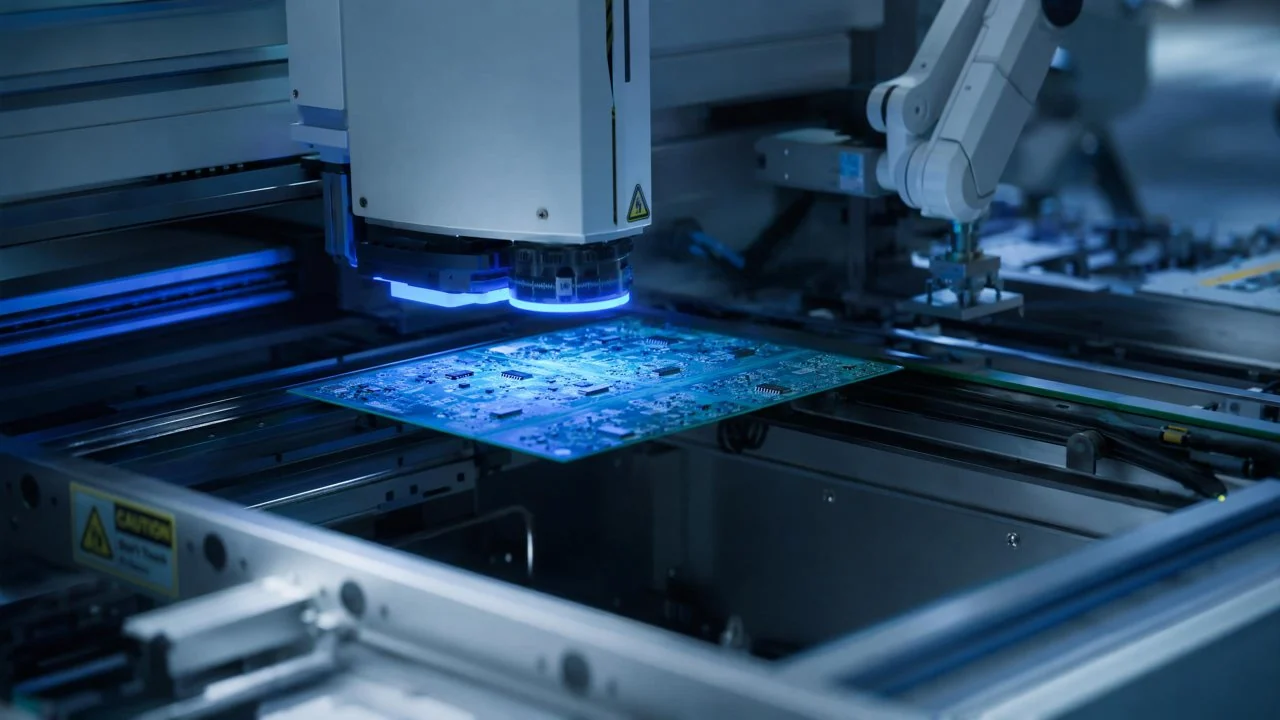
In the electronics manufacturing sector, particularly on PCBA production lines, component polarity reversal remains a persistent challenge. This directly impacts product functionality and reliability, potentially leading to significant rework costs or even batch scrap. Traditional AOI systems often struggle with complex component packages, minute markings, and varying lighting conditions, resulting in high rates of missed detections or false alarms. DaoAI ACI OS (featuring visual foundation model for feature recognition, 5-minute 0-code programming with one good sample, APDT positive/few-shot learning with 1–20 good samples, semantic false alarm filtering, and 100% on-premise deployment via SDK/API/Docker) addresses PCBA component polarity reversal detection. By integrating visual foundation models and semantic false alarm filtering, it reduces the traditional missed detection rate from 0.8% to <0.1% and decreases false alarm rates by 65%, significantly enhancing inspection efficiency and accuracy.
DaoAI ACI OS (featuring visual foundation model for feature recognition, 5-minute 0-code programming with one good sample, APDT positive/few-shot learning with 1–20 good samples, semantic false alarm filtering, and 100% on-premise deployment via SDK/API/Docker) addresses PCBA component polarity reversal detection. By integrating visual foundation models and semantic false alarm filtering, it reduces the traditional missed detection rate from 0.8% to <0.1% and decreases false alarm rates by 65%, significantly enhancing inspection efficiency and accuracy. In the electronics/PCBA industry, product quality is fundamental to the performance and safety of terminal devices. With the rapid development of 5G, IoT, and AI technologies, PCBAs are becoming increasingly integrated, components smaller, and production cycles faster. In Surface Mount Technology (SMT) production lines, accurately placing various components like chips, resistors, and capacitors onto circuit boards is a core process. Ensuring the correct polarity direction of polarized components (e.g., electrolytic capacitors, diodes, IC chips) is crucial. Incorrect polarity can lead to functional anomalies, short circuits, burning, or even safety incidents. A leading PCBA manufacturer, whose products are widely used in high-reliability fields such as automotive electronics and communication base stations, has extremely high zero-defect tolerance for component polarity reversal. Their challenge was how to achieve high-precision, low-false-alarm polarity detection for a vast number of micro-components across numerous SKUs on high-speed production lines, meeting stringent quality standards and increasing production pressure.
Pain Points: Why This Hurdle Was So Difficult to Overcome
This leading manufacturer has long suffered from high missed detection rates, high false alarm rates, and extensive manual re-inspection hours in polarity reversal detection. Traditional AOI systems exhibited the following pain points in detecting component polarity reversal: Firstly, a persistently high missed detection rate, measured at around 0.8%. This meant that for every 10,000 boards produced, approximately 80 boards might still have polarity reversal defects flowing downstream, leading to up to 15% rework costs and potential quality risks. Secondly, a high false alarm rate of 15-20%, resulting in numerous good products being incorrectly identified as defective. This required at least 4-6 man-hours daily for re-inspection, severely slowing down the production line and wasting human resources. Finally, new product changeover programming was time-consuming, averaging 1-2 hours, and highly dependent on engineer experience, impacting flexible production efficiency.
The 'difficulty' of traditional methods stems from deep-seated causes. From a process perspective, component polarity markings (such as dots, lines, notches, silkscreens) are often extremely small, with subtle variations across different batches and suppliers. Some polarity markings are located on the side or bottom, making them difficult to capture with conventional 2D imaging. From an imaging perspective, complex optical conditions such as high reflectivity on the PCBA surface, low contrast, component shadows, and solder pad reflections can easily interfere with image recognition, causing traditional rule-based or feature extraction algorithms to fail. For example, a laser-marked polarity dot on a component surface might have uneven brightness or even disappear under different lighting angles. Furthermore, fast production cycles allow very short time windows for inspection, making it difficult for traditional algorithms to maintain stable accuracy at high throughput. Traditional methods struggle to cope with highly complex, variable, and demanding scenarios for precision and real-time performance, necessitating more advanced intelligent agents for universal applicability.
Technical Principles
The core of how DaoAI ACI OS solves the polarity reversal detection challenge lies in its unique visual foundation model, APDT (Adaptive Positive Data Training) positive/few-shot learning mechanism, and semantic false alarm filtering technology. The system's built-in visual foundation model does not merely recognize pixel features; it possesses deep feature recognition capabilities. It is pre-trained on vast industrial image datasets, learning generic visual semantics of different component packages, materials, surface textures, and polarity markings, forming an abstract understanding of 'what a component is,' 'what a polarity marking is,' and 'how a polarity marking defines direction.' When inspecting new PCBAs, it leverages this pre-trained knowledge to automatically extract and understand the semantic information of component areas, rather than just pixel-level differences. For polarity detection, the model can identify key polarity features such as long/short leads on capacitors, notches or dots on ICs, and color bands on diodes, and determine if their orientation is consistent with the component body and PCBA silkscreen.
Unlike traditional rule-based AOI systems that require engineers to manually set numerous parameters, thresholds, and templates, DaoAI ACI OS employs a '5-minute 0-code automatic programming with one good sample' model. Engineers only need to provide 1–20 good sample images, and the system can quickly understand the feature distribution of good samples through APDT positive sample learning, automatically building a detection model. For defects with clear directionality like polarity reversal, APDT learns the correct orientation pattern from good samples. If a reversal occurs, even with lighting variations or slight deformations in the image, the model can identify it as an anomaly. Concurrently, the semantic false alarm filtering mechanism is a crucial component. High false alarms in traditional AOI often result from misclassifying normal scratches, smudges, or background interference as defects. Our semantic false alarm filtering, built upon the visual foundation model's semantic understanding, can differentiate between 'defect-like but non-impactful' features and 'true defects.' For example, it can identify that slight ink unevenness in component silkscreen is not a polarity reversal, thereby significantly reducing false alarm rates. Furthermore, the system supports 100% on-premise private deployment via SDK/API/Docker, ensuring that data never leaves the facility, meeting customer's stringent requirements for data security and privacy.
Typical Application Scenarios
- **Electrolytic Capacitor Polarity Detection**: Electrolytic capacitors typically have long/short leads or negative polarity bands on their casing. The challenge lies in the variety of marking methods across different brands and potential obstruction of leads or markings in dense placements. ACI, by learning from a large number of good sample images, can robustly identify these diverse markings and determine their orientation.
- **Diode/Transistor Polarity Detection**: These components usually have color bands, notches, or lead orientations to indicate polarity. The difficulty arises from the small component size, blurry markings, and sometimes slight component tilt due to soldering stress. ACI's visual foundation model can accurately extract these minute features from complex backgrounds and perform directional judgment.
- **IC Chip Polarity Detection (Pin 1)**: Integrated circuit chips typically indicate the Pin 1 position with a dot, notch, or chamfer. The challenge is that Pin 1 markings are often very small and manifest differently across various package types (e.g., QFN, BGA). ACI can generalize and learn Pin 1 features for different packages and determine if their orientation aligns with the silkscreen or pads on the PCBA.
- **LED Lamp Bead Polarity Detection**: LED lamp beads usually have larger/smaller pads or internal chip structures to indicate positive and negative poles. The difficulty is that the lamp beads themselves are transparent or translucent, making internal structures hard to image, and slight offsets may occur in mass production. ACI, combining high-resolution imaging with semantic understanding, can accurately identify pad sizes or internal structure orientations.
Deployment Case Study
A tier-1 automotive electronics supplier, whose PCBA products demand extremely high reliability, faced significant challenges in component polarity reversal detection on their SMT production lines before adopting the DaoAI ACI OS. Their traditional rule-based AOI system had a false alarm rate as high as 18%, requiring two senior engineers per line for 4 hours daily of re-inspection, severely impacting production efficiency. Concurrently, due to the difficulty in recognizing polarity markings on some micro-components, the missed detection rate remained at 0.7-0.8%, occasionally allowing PCBAs with polarity reversals to flow downstream, resulting in rework costs and customer complaint risks. After a one-month testing and deployment period, the DaoAI ACI OS was successfully implemented on multiple PCBA production lines at the manufacturer. Before deployment, for a PCBA board type containing 1500 polarized components, the traditional AOI system averaged 270 false alarms per hour and approximately 1 missed detection per hour. After deployment, using only 15 good sample images, APDT completed new board type programming in 5 minutes, and the system was immediately put into use. After two weeks of stable operation, the false alarm rate for this board type was reduced to an average of 95 per hour, and missed detections to an average of 0.05 per hour. Manual re-inspection hours decreased from 4 hours to less than 1.5 hours daily, and changeover time was reduced from 1-2 hours to 5 minutes, significantly improving overall line OEE.
DaoAI ACI OS, with its powerful visual foundation model and few-shot learning capabilities, transforms polarity reversal detection from 'experience-dependent' to 'intelligent adaptive,' truly achieving a universal breakthrough in industrial quality inspection.
DaoAI Solution and Products
The core solution provided by DaoAI to this client was precisely the DaoAI ACI OS. During deployment, we first ensured efficient image acquisition by smoothly integrating with the client's existing AOI hardware platform via SDK/API interfaces. For the modeling phase, client engineers only needed to upload 1-20 good sample images through our graphical interface. The system then utilized its visual foundation model for feature recognition and APDT training, automatically generating a high-precision detection model within 5 minutes, without any code writing. For new product changeovers, this process is equally fast and convenient, significantly reducing reliance on specialized vision engineers. During inspection, the system analyzes images in real-time, identifying component polarity directions. When potential defects are detected, the semantic false alarm filtering module further determines if it is a true defect, effectively preventing false alarms caused by background interference or non-critical features. Furthermore, we support 100% on-premise private deployment, ensuring all client data is processed within their facility, meeting their strict data security and compliance requirements. While the software system is the main focus here, if clients have higher demands, our DaoAI 2D/3D ACI equipment or DaoAI World model can also serve as a unified foundation to further enhance detection dimensions and generalization capabilities, achieving intelligent quality inspection coverage from single processes to entire production lines.
Through the implementation of the above solution, the client achieved significant quantitative results in the critical process of polarity reversal detection. Detection accuracy dramatically improved, with the missed detection rate dropping from 0.8% to <0.1%, ensuring product quality stability. The false alarm rate was reduced by 65%, directly alleviating a large amount of manual re-inspection workload, freeing up production line personnel, and increasing production efficiency. Concurrently, changeover time was shortened from several hours to 5 minutes, allowing production lines to more flexibly respond to multi-variety, small-batch production demands, enhancing market competitiveness. These improvements not only brought direct cost savings but also enhanced the client's product reliability and brand reputation in the automotive electronics sector, realizing a shift from 'reactive rework' to 'proactive prevention' in quality management.
FAQ
How does DaoAI ACI OS achieve low missed detection rates for polarity reversal?
The system utilizes a pre-trained visual foundation model for deep semantic understanding of component polarity markings (e.g., dots, lines, notches). Combined with APDT positive sample learning, it learns correct orientation patterns from a few good samples. This enables robust identification of reversed defects, even under complex lighting or blurry markings, reducing the missed detection rate to <0.1%.
How does the system effectively reduce false alarm rates?
DaoAI ACI OS incorporates a semantic false alarm filtering mechanism. It distinguishes between normal textures, scratches, or background interference on component surfaces and actual defects, preventing non-critical features from being misidentified as polarity reversals. This reduces the false alarm rate by 65%, significantly cutting down manual re-inspection efforts.
What is the programming efficiency for new product launches or changeovers?
The system supports '5-minute 0-code automatic programming with one good sample.' Engineers only need to provide 1–20 good sample images, and the system quickly self-learns and builds a detection model through APDT. This shortens the traditional programming process, which used to take hours, to just 5 minutes, significantly enhancing production line flexibility and efficiency.
Full solution for this scenario: Electronics / PCBA industry solutions · Component Polarity False-Alarm Reduction
This article was generated by AI. Customer cases are simulated scenarios based on real product capabilities and figures are illustrative; see product pages for official benchmarks.