
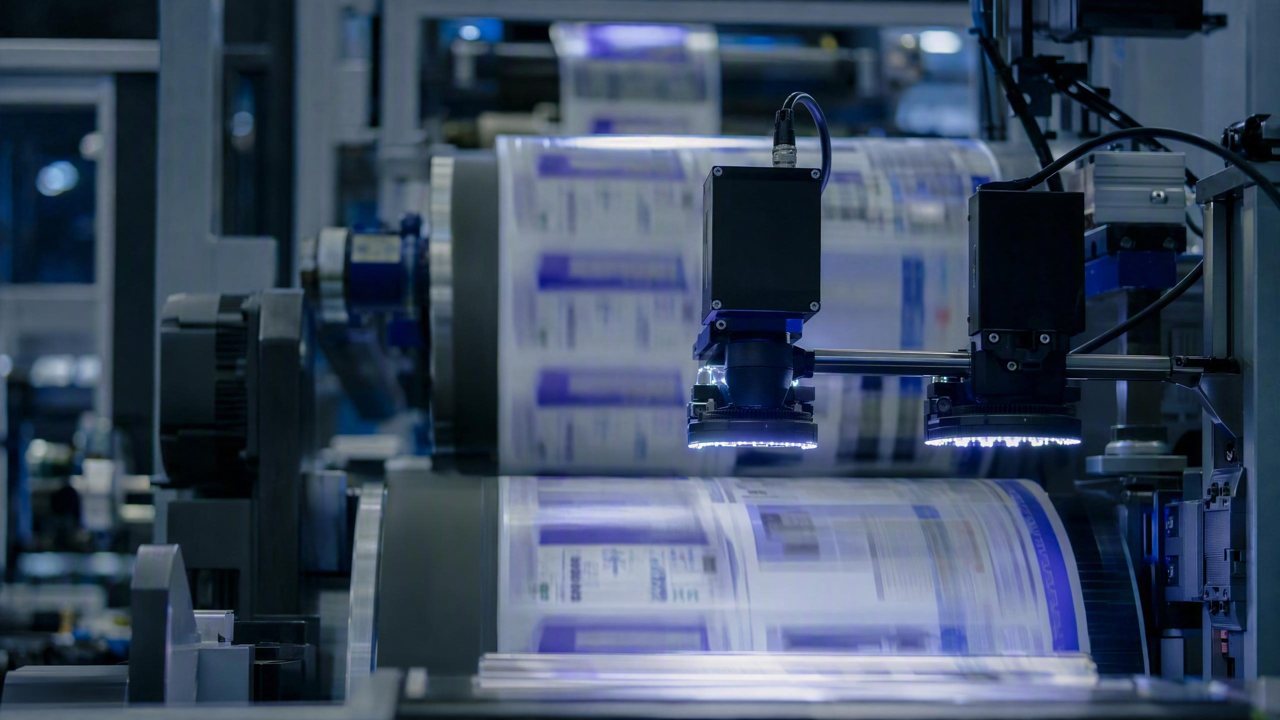
In the consumer goods industry, labels serve as the primary medium for product-consumer communication, with print quality directly impacting brand image and market competitiveness. Particularly in high-SKU (Stock Keeping Unit) label printing scenarios, the vast product variety, rapid design iterations, and small print batches pose extreme challenges for detecting print color deviations. It is against this backdrop that the DaoAI AI AOI software system, with its unique visual foundation model and few-shot learning capabilities, offers a disruptive solution to the industry.
The DaoAI AI AOI software system (visual foundation model for feature recognition, 5-minute zero-code programming with one good sample, APDT positive/few-shot learning with 1–20 good samples, semantic false alarm filtering, SDK/API/Docker 100% on-premise deployment) leverages industrial multimodal large model concepts to enable complex print color deviation detection. It reduces the undetected rate of print color deviations in high-SKU label printing from traditional methods' >1.5% to <0.4%, while decreasing manual re-inspection time by −65%. In the consumer goods industry, increasingly stringent requirements for product packaging mean that labels, as a crucial part of packaging, directly affect brand image and consumer purchasing intent. In high-SKU label printing scenarios, such as food and beverage, daily chemicals, and pharmaceuticals, clients often require customized, small-batch, multi-batch label products. These labels may feature complex patterns, gradients, multi-color overprinting, and special materials (e.g., pearlescent film, transparent film, metal foil), posing severe challenges for print quality inspection, especially the identification of subtle color deviations. Traditional inspection methods often rely on manual visual inspection or rule-based AOI systems, which are inefficient and inconsistent in high-SKU scenarios, becoming a bottleneck limiting capacity and quality improvement.
Pain Points: Why This Hurdle Is Difficult to Overcome
In high-SKU label printing, the pain points of print color deviation detection are particularly prominent. Firstly, there is an **extremely high undetected rate**: traditional AOI systems have limited ability to identify subtle color deviations, especially in areas with intertwined colors, gradients, or special inks that exhibit differences under various lighting angles, where the undetected rate can exceed >1.5%. Secondly, there are **high manual re-inspection costs and inefficiency**: when traditional AOI systems have a high false alarm rate, a large number of “defects” require manual re-inspection one by one, consuming significant human resources, leading to production line stoppages, with re-inspection time potentially accounting for over 40% of total inspection time. Finally, there are **severe changeover challenges and production efficiency bottlenecks**: high SKU implies frequent changeovers, each requiring re-setting inspection parameters. Rule-based AOI systems typically need several hours or even half a day for parameter adjustment and sample learning, severely impacting production rhythm and delivery cycles, with changeover downtime potentially occupying 15% of total production time.
The root causes of these challenges are: at the process level, minor fluctuations in ink batches, printing machine status, and substrate material characteristics can all lead to color deviations, and human perception of color differences is highly subjective; at the imaging level, the reflective and transmissive properties of label materials, along with the complexity of print patterns, make it difficult for single light sources or traditional image processing to capture true color deviation information; at the material level, special inks like metallic or pearlescent inks exhibit color variations at different angles, demanding multimodal recognition from vision systems; at the throughput level, high-speed printing requires inspection systems to complete image acquisition and analysis within milliseconds, which traditional algorithms struggle to maintain accuracy at high throughput. The current industrial trend toward industrial multimodal large models aims to integrate data from various sensors (e.g., images, spectra, 3D morphology) and process parameters, leveraging massive training data to learn more generalized feature recognition capabilities, thereby enabling intelligent decision-making and optimization in complex industrial scenarios. The DaoAI AI AOI software system applies visual foundation models and few-shot learning techniques to label color deviation detection within this paradigm, addressing the aforementioned fundamental challenges.
Technical Principles
The DaoAI AI AOI software system employs an advanced visual foundation model as its core. This model is pre-trained on vast amounts of general image data and industrial defect data, endowing it with powerful feature recognition and cross-scenario generalization capabilities. In label printing color deviation detection, it no longer relies on pixel-level color comparison or complex threshold settings. Instead, it builds a deep understanding of “normal” color distribution by learning semantic information and texture features from a large volume of label images. When a subtle deviation from the “normal” pattern is detected, even color differences imperceptible to the human eye can be accurately identified by the system. This feature-recognition-based approach makes the DaoAI system more robust to background noise and lighting variations, significantly reducing false alarm rates.
Compared to traditional rule-based AOI or manual visual inspection, the DaoAI AI AOI software system offers significant advantages. Traditional rule-based AOI requires engineers to manually set RGB/HSV thresholds for each color area of every label type. For gradients, multi-color overprints, or special inks, rule writing is difficult, error-prone, and requires significant time for reconfiguration during changeovers. Manual visual inspection, on the other hand, is limited by human fatigue and subjective judgment, leading to low efficiency, poor consistency, and inability to keep up with high-speed production rhythms. The DaoAI AI AOI software system's APDT (Anomaly Pattern Detection and Transfer) positive/few-shot learning mechanism requires only 1–20 good sample images to complete model training and deployment within 5 minutes, drastically shortening changeover times and enabling the identification of unknown defects, including subtle color deviations not present in the training samples. Its semantic false alarm filtering function, by semantically understanding defect areas, distinguishes true print color deviations from non-defect visual differences caused by material texture or reflections, reducing the false alarm rate by over −70%, significantly improving production efficiency and customer satisfaction.
Typical Application Scenarios
- **High-precision Print Color Deviation Detection**: For multi-color overprints, gradient areas, and color consistency inspection of critical visual elements like brand logos. The challenge lies in identifying subtle color differences against complex backgrounds and precisely quantifying color shifts between different print batches. The DaoAI AI AOI software system can detect color deviations of <5 deltaE.
- **Special Ink (e.g., Metallic, Pearlescent) Color Detection**: These inks exhibit different visual effects at various lighting angles, making stable detection difficult with traditional methods. The challenge is how to capture and analyze color characteristics from multiple angles. The DaoAI system effectively identifies color unevenness or defects in such special inks by learning multi-angle image data.
- **Text/Pattern Edge Bleeding and Blurring Detection**: Detecting ink bleeding, breaks, or blurring on the edges of text, barcodes, QR codes, or patterns on labels. The challenge is rapid localization and classification of micron-level defects in high-resolution images. The DaoAI AI AOI software system leverages its visual foundation model's fine-grained feature extraction capabilities to accurately identify these minute defects.
- **Lamination/Varnishing Layer Defect Detection**: Detecting defects such as bubbles, scratches, foreign objects, or uneven matte finish on the label's lamination or varnishing layer. The challenge lies in imaging and identifying defects in transparent or translucent materials. The DaoAI system effectively solves the problem of transparent layer defect detection through a combination of multiple light sources and deep learning algorithms.
Case Study
A leading consumer label printing manufacturer, producing tens of thousands of different SKU labels annually for food, beverage, and daily chemical sectors, faced increasingly stringent market demands for label quality, as well as frequent changeovers and color deviation detection challenges associated with high SKUs. Their existing rule-based AOI system could no longer meet production needs, with print color deviation undetected rates exceeding >1.5%, and enormous manual re-inspection workload, requiring at least 30 person-hours daily for re-inspection. To improve product quality and production efficiency, the manufacturer adopted the DaoAI AI AOI software system. After a month of on-site deployment and model training, the system was successfully launched and smoothly integrated with existing production lines. Before implementation, each changeover required at least 2 hours to reconfigure inspection parameters; after implementation, thanks to the DaoAI AI AOI software system's zero-code automatic programming and APDT few-shot learning capabilities, changeover time was reduced to an average of 5 minutes, an efficiency improvement of −95%. After system operation, the undetected rate for print color deviations was stably controlled at <0.4%, and the false alarm rate decreased by −75%, significantly reducing the manual re-inspection workload from 30 hours per day to less than 10 hours, saving substantial labor costs. Concurrently, precise online inspection led to a significant improvement in product quality, with customer complaint rates dropping by −60%.
DaoAI AI AOI software system, built on visual foundation models, enables 5-minute zero-code programming with one good sample, reducing high-SKU label printing color deviation undetected rates from >1.5% to <0.4%, redefining industry inspection standards.
DaoAI Solutions and Products
DaoAI provides a core solution for the high-SKU label printing industry, centered on the DaoAI AI AOI software system. This system, through its powerful visual foundation model, performs deep feature extraction and semantic understanding of label images, enabling precise identification of subtle print color deviations. In the modeling phase, we utilize the APDT positive/few-shot learning mechanism, requiring only 1–20 good samples from the customer to complete model training within 5 minutes, without any code writing. This greatly simplifies model deployment and maintenance processes, especially suitable for the frequent changeover demands in high-SKU scenarios. During changeovers, operators only need to select the corresponding label product model, and the system automatically loads the pre-trained model, achieving rapid switching and reducing changeover downtime from hours to minutes.
The DaoAI AI AOI software system supports various deployment methods such as SDK/API/Docker, enabling 100% on-premise private deployment to ensure customer data security remains in-house, meeting strict industry data compliance requirements. In addition to the core AI AOI software system, DaoAI can also provide integrated DaoAI 2D / 3D AI AOI equipment solutions based on customer needs, for example, conducting 3D morphology inspection for special material labels (such as those with embossing or hot stamping processes) to ensure their three-dimensional effect and surface integrity. Through the DaoAI World universal foundation model, various systems can achieve semantic understanding and cross-scenario generalization, continuously learning and optimizing from production line feedback, building an intelligent, efficient, and adaptive quality inspection ecosystem. This comprehensive solution not only improves inspection accuracy and efficiency but also effectively reduces operating costs, enhancing the customer's core competitiveness in fierce market competition.
With the DaoAI AI AOI software system, customers achieved a print color deviation undetected rate reduced to <0.4%, representing a significant quality assurance improvement compared to traditional methods. Simultaneously, manual re-inspection time decreased by −65%, substantially saving labor costs. Changeover time was shortened from several hours to an average of 5 minutes, leading to a 15% increase in production line OEE (Overall Equipment Effectiveness). These quantified results directly translate into economic benefits and market competitiveness for enterprises, helping customers maintain a leading position in the high-SKU label printing market.
FAQ
How does the DaoAI AI AOI system achieve rapid changeovers in high-SKU label printing?
The DaoAI AI AOI software system, with its APDT positive/few-shot learning mechanism and zero-code automatic programming, can complete model training within 5 minutes using just 1–20 good samples. This means that during frequent changeovers in high-SKU scenarios, operators only need to load the pre-trained model for the corresponding product type, eliminating complex parameter adjustments and significantly reducing downtime.
How does the system address the challenge of color deviation detection for special inks (e.g., metallic, pearlescent inks)?
For special inks like metallic or pearlescent, which exhibit varying colors at different lighting angles, the DaoAI AI AOI software system leverages its visual foundation model's powerful feature recognition combined with multi-source imaging technology. It learns and analyzes color characteristics from multiple angles, effectively identifying color unevenness or defects in these special inks, overcoming the limitations of traditional methods.
How does the DaoAI AI AOI software system ensure data security and privacy?
The DaoAI AI AOI software system supports various deployment methods such as SDK/API/Docker, enabling 100% on-premise private deployment. This ensures that all inspection data and models are stored on the customer's local servers, with data never leaving the factory. This strictly adheres to data security and privacy protection regulations, meeting enterprises' high demands for information security.
This article was generated by AI. Customer cases are simulated scenarios based on real product capabilities and figures are illustrative; see product pages for official benchmarks.