
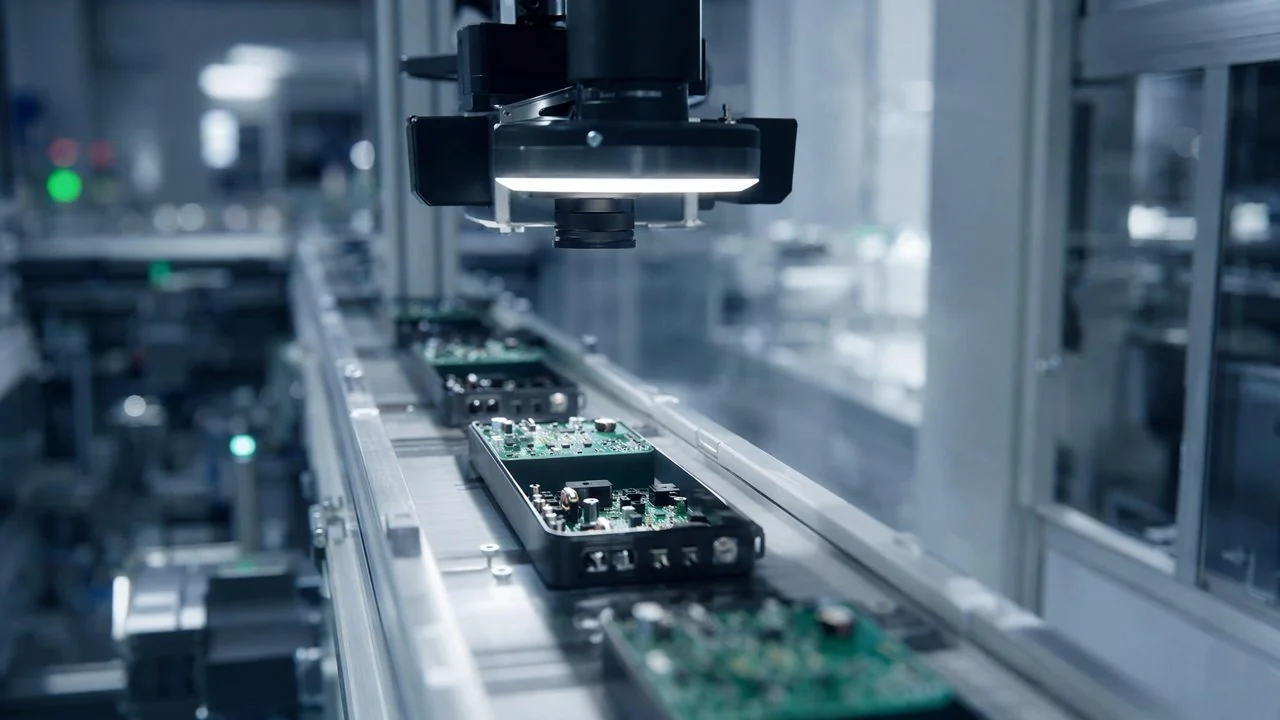
DaoAI ACI OS (visual foundation models for feature recognition, 0-code automatic programming with one good sample in 5 minutes, APDT positive/few-shot learning with 1–20 good samples, semantic false positive filtering, and SDK/API/Docker 100% on-premise deployment) leverages its robust generalization and few-shot learning capabilities to reduce the false positive rate for missing/misplaced component detection on charger circuit boards for a leading consumer electronics manufacturer from 15% to 5.5%, while shortening new product changeover time from 2 hours to 5 minutes.
Consumer product manufacturing, especially in sectors like consumer electronics and home appliances, is characterized by rapid product iteration, diverse SKUs, and extremely high demands for appearance and functional reliability. In the assembly process, even minor misplacements or omissions can lead to product functional failure, safety hazards, and even damage to brand reputation. With the advent of the 'Post-Moore Era,' the proliferation of AI terminals and the decentralization of computing power have made intelligent upgrades to production lines an inevitable trend. Traditional vision inspection solutions, such as rule-based AOI, often struggle when faced with complex and variable assembly defects in consumer goods. Taking a leading consumer electronics manufacturer's charger product as an example, its internal circuit boards contain numerous tiny components arranged densely. On a high-speed assembly line, ensuring the correct installation of every resistor, capacitor, connector, and even screw, without misplacement or omission, is crucial for guaranteeing product quality. However, traditional methods face severe challenges in such scenarios, especially in high-throughput production, where stable detection of minute defects and rapid changeover for new products are particularly important.
Pain Points: Why This Hurdle Is So Difficult
This leading manufacturer faced multiple pain points in inspecting charger circuit board assembly. Firstly, manual visual inspection had a high escape rate of 1.5% and was inefficient, unable to meet increasing production capacity demands. Secondly, the false positive rate of traditional rule-based AOI remained high at 15%, leading to numerous good products being misjudged and requiring additional manual re-inspection hours, significantly increasing production costs and labor burden, with approximately 8 hours of manual re-inspection required daily. Thirdly, for new product changeovers, traditional AOI consumed 2 hours or more for rule adjustments and parameter optimization, severely impacting production line flexibility and new product launch speed. These issues not only directly affected production efficiency and quality but also increased compliance risks, especially for misplacement or omission defects that could lead to safety concerns.
The root cause of these challenges lies in the complexity of consumer product assembly. At the process level, components vary widely in type and size, exhibiting diverse colors, materials, and reflective properties, which complicates imaging. For instance, certain connectors might cast subtle shadows due to angle or lighting changes, leading traditional AOI to falsely identify them as defects. At the imaging level, acquiring high-quality, blur-free images consistently at high production speeds is a challenge in itself. Coupled with densely packed components, occlusions are common, making both escapes and false positives difficult to avoid. Traditional rule-based AOI relies on manually setting numerous thresholds and geometric features; for minor process variations or novel defects, it often requires time-consuming and laborious reprogramming, and struggles to cover all potential scenarios. Furthermore, as product designs iterate, component layouts, colors, and even packaging forms can change, rendering old rules obsolete and exacerbating changeover downtime. This runs contrary to the 'Post-Moore Era' demands for 'plug-and-play' AI terminals that quickly adapt to new scenarios.
Technical Principles
The DaoAI ACI OS addresses these challenges through its core visual foundation models. The system employs self-supervised pre-training and transfer learning techniques in deep learning to build a powerful visual feature recognition backbone. Unlike traditional AOI, which relies on manual feature engineering, our foundation model can automatically learn rich, generalized visual semantic features from vast image data, such as the shape, texture, color distribution of components, and their relative positions on the PCB. When faced with new products or defect types, there is no need to train from scratch. Instead, by fine-tuning the pre-trained model and utilizing the APDT (Adaptive Positive Data Training) positive/few-shot learning mechanism, it can quickly adapt to new scenarios with just 1–20 good sample images, achieving 0-code automatic programming. This mechanism significantly reduces the demand for defect samples, solving the pain point of scarce defect samples in industrial scenarios.
Compared to traditional rule-based AOI and purely supervised ACI, DaoAI ACI's advantages are evident: First, the visual foundation model exhibits stronger robustness to minor changes in ambient light, component color, or angle, significantly reducing false positives because it understands the semantic concept of a 'component' rather than specific pixel-level thresholds. Second, the few-shot learning capability shortens new product changeover time from hours to 5 minutes, allowing rapid deployment of new inspection tasks with minimal good samples, greatly enhancing production line flexibility. Third, the system's built-in semantic false positive filtering module, combining prior knowledge and model inference, effectively distinguishes true defects from imaging noise or normal process variations, further improving inspection accuracy. Moreover, the system supports SDK/API/Docker 100% on-premise private deployment, ensuring data security and meeting customer's strict requirements for data not leaving the factory, which is particularly important in the 'Post-Moore Era' emphasis on edge intelligence and data privacy.
Typical Application Scenarios
- **PCB Component Misplacement/Omission Detection**: On the PCB assembly lines of consumer electronics such as mobile phones, tablets, and chargers, detecting whether resistors, capacitors, IC chips, connectors, etc., are installed accurately according to design drawings, without omissions, misalignments, or inversions. The challenge lies in the tiny size, diverse types, dense arrangement of components, and subtle color or silkscreen variations between different component batches.
- **Wire Harness Connector Mis-insertion/Incomplete Insertion Detection**: In wire harness assembly for home appliances, automotive electronics, etc., checking if multi-pin connectors are fully seated, correctly oriented, and if there are any partial or missing wire insertions. The challenge lies in the complex internal structure of connectors, deep slots, and limited lighting, making it difficult for traditional methods to effectively determine the internal state.
- **Screw Fastener Omission/Stripped Thread Detection**: Tightening screws for consumer product casings and internal structural parts is crucial for ensuring product structural integrity and reliability. Detecting whether screws are missing, or if they are properly tightened (judging stripped threads or floating height by the screw head's morphology). The challenge lies in small, reflective screws, and stripped thread defects often manifest as micron-level morphological changes.
- **Button/Indicator Light Assembly Direction and Integrity Detection**: Buttons and indicator lights on smart home devices, remote controls, etc., usually have specific installation directions and positions. Detecting whether buttons are installed incorrectly, missing, or if LED indicator lights are intact and undamaged. The challenge lies in irregular shapes and diverse materials of buttons and indicator lights, which are susceptible to ambient light.
- **Packaging Content Missing/Misplaced Item Detection**: Before final packaging of consumer goods, checking if all accessories (e.g., manuals, charging cables, earphones, etc.) inside the box are complete and correctly placed. The challenge lies in the variety of accessories, their diverse shapes, and potential occlusions, making high-precision recognition and counting difficult for traditional vision.
Case Study
A leading consumer electronics manufacturer, a globally renowned Tier-1 supplier, has extremely high quality control requirements for its charger product line. Before integrating the DaoAI ACI OS, the inspection of charger circuit board component assembly on this production line primarily relied on traditional rule-based AOI combined with manual re-inspection. However, with the increase in product SKUs and production speed, the drawbacks of the traditional solution became increasingly apparent: a false positive rate as high as 15%, requiring two dedicated quality inspectors for 8 hours of re-inspection daily; additionally, for new product launches or design changes, AOI program changeover time extended to 2 hours, severely delaying new product time-to-market. To meet the demands for flexible manufacturing and rapid market response in the Post-Moore Era, the manufacturer decided to upgrade its inspection system. The DaoAI team smoothly integrated the ACI OS into the customer's existing AOI hardware platform via SDK interfaces. During the initial deployment, we utilized a small number of good sample images provided by the customer (averaging 10-20 images per component type) for model training and optimization; the entire programming process took only 5 minutes. After two weeks of parallel testing and tuning, the system officially went online. Post-launch, the false positive rate for component misplacement/omission detection on this production line significantly dropped to 5.5%, a 63% reduction in false positives, shortening manual re-inspection time to under 3 hours daily. Concurrently, new product changeover time was reduced from 2 hours to 5 minutes, and the production line's OEE (Overall Equipment Effectiveness) improved by 8%.
DaoAI ACI OS, with its few-shot learning and rapid changeover capabilities, provides core impetus for flexible and intelligent manufacturing in consumer goods.
The figures above are a typically achievable range in anonymized industry scenarios — a different line or a different batch of parts will move the result either way; on-site measurement governs.
DaoAI Solution and Products
The core solution provided by DaoAI to this leading manufacturer is based on our independently developed DaoAI ACI OS. This system leverages the powerful feature recognition capabilities of visual foundation models to achieve precise identification and defect judgment of tiny components on charger circuit boards. In the modeling phase, we adopted the APDT positive sample learning strategy, requiring only a small number of good sample images (1–20) to complete model training, greatly simplifying the data preparation process. The system supports 0-code automatic programming; users can quickly define inspection areas and defect types through a simple graphical interface, without writing any code. For deployment, we provided SDK/API interfaces to achieve smooth integration with the customer's existing AOI hardware and production line MES systems, ensuring smooth data flow and traceability of the production process. All model inference and data processing are completed on the customer's local servers, with 100% private deployment, guaranteeing data security and low latency. Furthermore, the system's built-in semantic false positive filtering mechanism intelligently distinguishes between false defects caused by lighting, angle, or material reflections and true defects, effectively improving detection accuracy. While this case primarily focuses on the software system, our DaoAI 2D / 3D ACI equipment also provides hardware support for higher precision and complex morphology inspection, and the DaoAI World world model serves as a unified foundation, continuously learning from production line feedback to achieve cross-scenario generalization and model self-optimization.
This solution not only resolved the customer's pain points of high false positives and long changeover times in missing/misplaced component detection but, more importantly, it provided technical support for the customer to adapt to the rapid changes and personalized demands of the consumer goods market in the 'Post-Moore Era.' Through the ACI OS, the customer can more flexibly adjust production plans, launch new products faster, and effectively control production costs while ensuring quality. This AI-driven intelligent inspection capability is an indispensable part of future consumer product smart manufacturing, assisting enterprises in transitioning from traditional manufacturing to smart manufacturing, achieving higher levels of automation and intelligence.
FAQ
How does DaoAI ACI OS achieve rapid changeover and few-shot learning?
Our system is based on visual foundation models, learning general visual features through self-supervised pre-training. For new product changeovers, it utilizes the APDT positive/few-shot learning mechanism, requiring only 1-20 good sample images to quickly fine-tune the model, enabling 0-code automatic programming and reducing changeover time from hours to 5 minutes, significantly enhancing production line flexibility.
How does DaoAI ACI OS ensure data security and on-premise private deployment?
The DaoAI ACI OS supports SDK/API/Docker 100% on-premise private deployment. All model training, inference, and data processing are performed on the customer's local servers or edge devices, ensuring that data does not leave the factory. This guarantees the security and privacy of the customer's core production data, meeting strict industry compliance requirements.
Beyond consumer electronics, what other consumer product assembly inspections can this ACI OS be applied to?
The system boasts strong generalization capabilities and can be widely applied to assembly inspection in consumer goods industries such as home appliances, toys, medical devices, and cosmetic packaging. Whether it's missing/misplaced internal structural components, appearance defects, packaging integrity, or complex irregular part inspection, it can rapidly model and deploy using few-shot learning, significantly improving quality inspection efficiency and product consistency.
Full solution for this scenario: the full inspection solution for Consumer / general
This article is an original publication by WeLinkirt (DaoAI).