
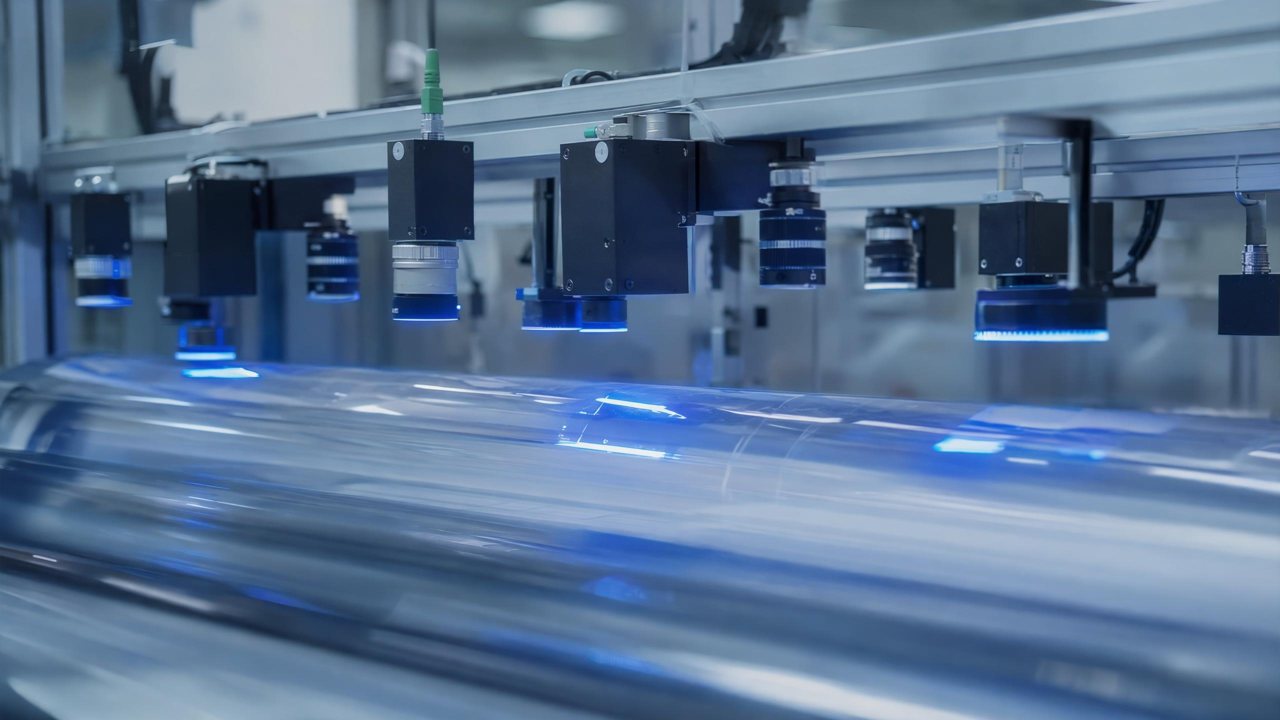
In chemical and materials production, especially in harsh industrial environments, detecting subtle anomalies on textured surfaces has always been a severe challenge for vision systems. Traditional rule-based inspection methods struggle to adapt to complex and variable textured backgrounds and environmental noise, while manual inspection is inefficient and prone to fatigue. DaoAI AI AOI Software System, with its innovative visual foundation model and unsupervised learning capabilities, provides an efficient and robust solution for defect detection on textured surfaces such as chemical films and composite materials, significantly improving product quality and production efficiency.
DaoAI AI AOI Software System (featuring visual foundation model for feature cognition, 5-minute 0-code programming with one good sample, APDT positive/few-shot learning with 1–20 good samples, semantic false positive filtering, and SDK/API/Docker support for 100% local private deployment) reduced the missed detection rate of surface defects on composite films from 2.5% to <0.4% and decreased manual re-inspection man-hours by -63% for a leading materials manufacturer, through unsupervised learning and semantic false positive filtering. In the chemical/materials industry, unsupervised anomaly detection on textured surfaces is a pervasive and critical quality control step. Taking a leading polymer materials manufacturer as an example, their core product is a composite film used in new energy batteries and special packaging, which has a microscopic textured surface. During production, it is prone to tiny defects such as scratches, foreign objects, bubbles, and indentations. These defects are often extremely small, diverse in form, and highly similar to the product's own texture features, making them difficult to effectively detect on high-speed winding production lines using traditional methods. This manufacturer required a vision inspection system capable of stable operation in harsh industrial environments (e.g., high temperature, dust, vibration, uneven lighting) to ensure high reliability and consistency of their outgoing products.
Pain Points: Why This Hurdle Was So Difficult to Overcome
Before adopting the DaoAI AI AOI Software System, this client faced multiple challenges: First, an extremely high missed detection rate, with approximately 2.5% of tiny defects not being captured by their existing vision system, leading to rework in downstream processes or final product failure, resulting in significant compliance risks and customer complaints. Second, persistently high false positive rates. Existing rule-based AOI systems often misidentified normal texture variations, environmental light changes, or even tiny dust particles on camera lenses as defects, leading to massive manual re-inspection workloads. Production line workers had to spend several hours daily individually confirming these, severely delaying production cycles. Third, inefficient changeovers. Whenever product models or process parameters were adjusted, the rule-based AOI system required several hours or even days to re-program and debug rules, leading to long production downtime and impacting flexible manufacturing capabilities.
The root cause of these difficulties lies in the complexity of textured surfaces and the challenges of harsh industrial environments. The surface texture of composite films is not uniformly consistent but exhibits a degree of randomness superimposed with periodicity, blurring the line between “normal” and “abnormal.” Traditional rule-based AOI struggled to establish universal thresholds to distinguish these subtle differences. Concurrently, chemical production sites are often accompanied by extreme conditions such as high temperatures, humidity, dust, and corrosive gases, placing stringent demands on the robustness of optical imaging systems and image processing. Fluctuations in ambient lighting, slight vibrations of the film during high-speed movement, and equipment vibrations can all introduce noise into images, further complicating detection. Furthermore, defect samples were scarce and difficult to obtain, making supervised learning methods that rely on large numbers of defect samples impractical.
Technical Principles
The DaoAI AI AOI Software System achieves a breakthrough in unsupervised anomaly detection on textured surfaces through its core visual foundation model and APDT (Anomaly Pattern Detection and Transformation) technology. The system first utilizes large-scale pre-trained visual foundation models to extract features from images. These foundation models have learned general visual semantics and feature representation capabilities from vast image data, enabling them to recognize high-level semantic features in images, rather than just pixel-level changes. During the detection phase, the system only requires a small number (1–20) of good samples for learning. The APDT algorithm constructs a feature distribution model of “normal” textures based on these good samples. When new images are input, the system compares them against the good sample model, and any region deviating from the normal distribution is flagged as a potential anomaly. This unsupervised learning model solves the problem of scarce defect samples, especially suitable for complex textured surfaces.
Compared to traditional rule-based AOI, the DaoAI AI AOI Software System eliminates the need for manual definition of complex detection rules and thresholds, greatly simplifying the programming and debugging process, making 5-minute 0-code programming with one good sample a reality. Compared to manual inspection, the AI AOI system offers higher stability, consistency, and efficiency, capable of continuous 24/7 operation, avoiding errors caused by fatigue and subjective judgment. More importantly, the system's semantic false positive filtering function intelligently judges based on contextual information and defect characteristics, effectively distinguishing between normal product texture fluctuations and true defects, significantly reducing false positive rates. In harsh industrial environments, the system's visual foundation model exhibits stronger robustness to environmental noise such as lighting changes and slight vibrations, ensuring stable feature extraction and detection accuracy.
Typical Application Scenarios
- **Surface Defect Detection for Polymer Films:** Detecting micron-level defects such as scratches, bubbles, foreign objects, indentations, and dirt on the surfaces of products like new energy battery separators, optical films, and packaging films. The challenge lies in films often being transparent or translucent, with complex coatings or calendering textures, where defects can be confused with texture features.
- **Surface Quality Inspection for Composite Material Sheets:** For carbon fiber composites, glass fiber reinforced plastics, and other sheet materials, detecting structural anomalies such as delamination, fiber breakage, resin rich/lean areas, pores, and pits. The difficulty arises from the inherent non-uniformity of the material structure, where defects are often hidden beneath complex fiber textures.
- **Uniformity and Integrity Inspection of Functional Coatings:** Checking the adhesion uniformity, thickness consistency, and presence of cracks, peeling, or exposed substrate in catalyst coatings, anti-corrosion coatings, insulating coatings, etc. The challenge is the diverse colors and reflective properties of coatings, and defects can be very subtle and difficult to distinguish.
- **Texture Anomaly Detection for Special Papers or Non-woven Fabrics:** Detecting defects such as fiber agglomeration, holes, damage, and oil stains in products like special filter paper and medical non-woven fabrics. The difficulty lies in the complex and random fiber structure of the materials, coupled with high demands for detection speed.
Case Study
A tier-1 composite materials supplier, whose production line processes tens of thousands of square meters of special films daily, relied primarily on manual inspection and a simple threshold-based rule AOI system before adopting the DaoAI AI AOI Software System. Due to the complex product surface texture and diverse defect types, the traditional AOI's missed detection rate was as high as 2.5%, leading to persistently high customer return rates. Concurrently, the rule-based AOI's false positive rate exceeded 15%, requiring 3 workers to spend a total of approximately 6 hours daily on re-inspection, significantly increasing operational costs and production pressure. During a production line upgrade, the supplier decided to deploy the DaoAI AI AOI Software System for online quality control. We first integrated the DaoAI AI AOI software onto their existing vision hardware. By collecting a small number of good sample images on-site for model training and optimizing the model under the guidance of our engineers, the entire system went from deployment to initial go-live in less than a week. After a month of stable operation and data accumulation, the system's performance far exceeded expectations.
“The DaoAI AI AOI Software System has not only significantly improved the quality reliability of our products, but more importantly, it has enabled us to respond to market changes in a more flexible and efficient way, truly realizing intelligent manufacturing.” — Quality Director, a tier-1 Composite Materials Supplier
DaoAI Solutions and Products
The core solution provided by DaoAI to this client was precisely the DaoAI AI AOI Software System. We achieved efficient deployment and excellent performance through the following steps: First, leveraging the feature cognition capabilities of the visual foundation model, the system quickly learned and established a “normal” texture feature model with only 10 good sample images provided by the customer, achieving 0-code automatic programming. Second, during deployment, we integrated the AI AOI software system into the client's existing industrial PCs and camera systems via SDK, ensuring 100% local private deployment, with no data leaving the factory, meeting the client's strict data security requirements. Third, the APDT positive/few-shot learning mechanism allowed the model to quickly adapt to product changeovers, completing new product detection model configuration within 5 minutes, greatly reducing downtime. Finally, the system's semantic false positive filtering function, combining comprehensive judgment of defect shape, size, and location, effectively distinguished texture noise from true defects, significantly reducing the manual re-inspection workload. Although this case primarily focuses on the software system, DaoAI's full range of products, such as DaoAI 2D/3D AI AOI equipment and DaoAI World foundation model, can also serve as extended solutions for more complex scenarios, providing comprehensive support from hardware to a unified platform.
After practical operational verification, the DaoAI AI AOI Software System achieved significant results on the client's production line. The missed detection rate for surface defects on composite films decreased from 2.5% to <0.4%, with detection accuracy consistently above 99.6%, greatly enhancing product quality and customer satisfaction. Concurrently, the false positive rate decreased by -62%, reducing manual re-inspection man-hours from 6 hours to less than 2.2 hours per day, a -63% reduction in human input, freeing up valuable labor for other critical processes. Changeover time was also reduced from several hours to less than 5 minutes, significantly improving the production line's flexible manufacturing capability and overall OEE (Overall Equipment Effectiveness).
FAQ
How does DaoAI AI AOI Software System cope with harsh industrial environments in the chemical industry?
Our system, through the powerful learning capabilities of its visual foundation model, is better able to adapt to environmental noise such as lighting changes, dust, and vibration. Its feature extraction mechanism is more robust to subtle interferences in images, ensuring stable recognition of product textures and defects even in complex environments. Additionally, 100% local private deployment minimizes the impact of network fluctuations.
For materials with complex textures, how does the AI AOI system distinguish between normal textures and subtle defects?
DaoAI AI AOI Software System utilizes APDT positive/few-shot learning technology. By learning from just a small number of good samples, it can build an accurate feature distribution model of “normal” textures. The system identifies any abnormal patterns that deviate from this normal distribution, and combined with semantic false positive filtering, effectively distinguishes between natural texture variations and true subtle defects.
If my production line has frequently changing product models, what is the changeover efficiency of the AI AOI system?
Our AI AOI software system supports 5-minute 0-code automatic programming with a single good sample. This means that when product models need to be changed, you only need to provide a few good sample images of the new product, and the system can automatically learn and generate a new detection model in a very short time, significantly reducing changeover downtime and improving the flexibility and efficiency of the production line.
This article was generated by AI. Customer cases are simulated scenarios based on real product capabilities and figures are illustrative; see product pages for official benchmarks.