
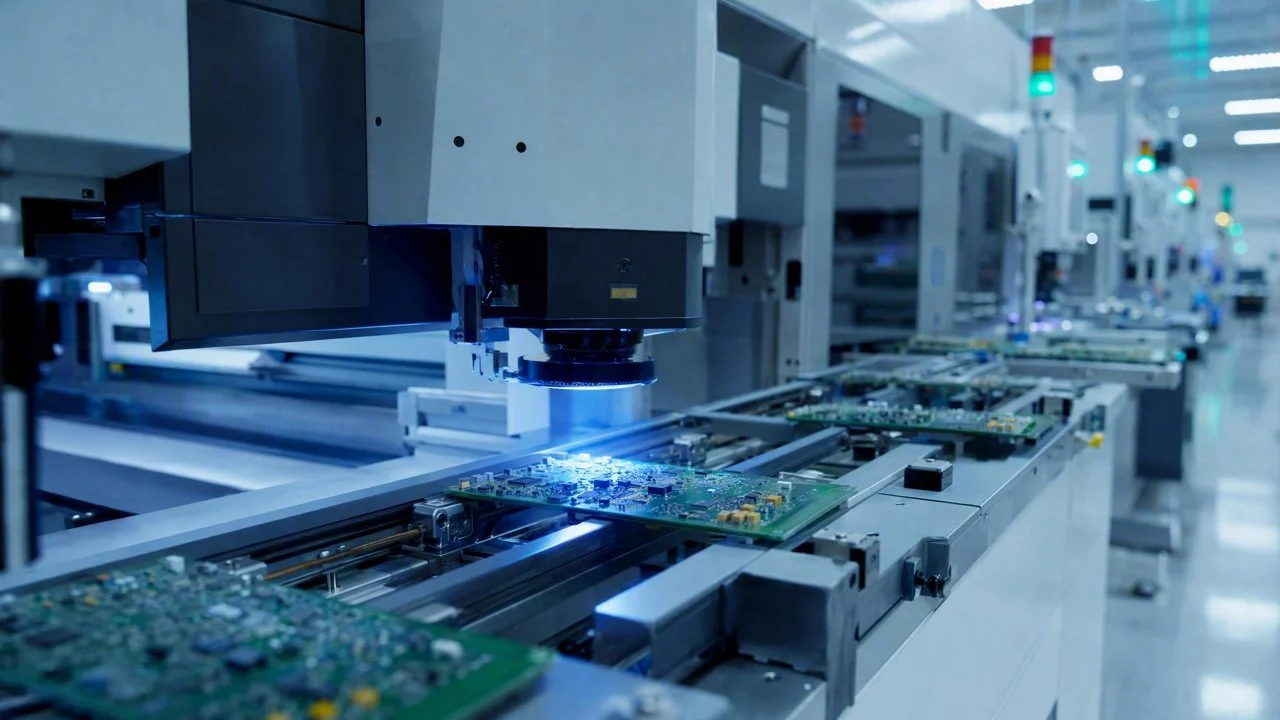
In electronic PCBA manufacturing, DaoAI AI AOI software system (featuring visual foundation model-based feature recognition, 0-code automatic programming with one good sample in 5 minutes, APDT positive/few-shot learning with 1-20 good samples, semantic false alarm filtering, and supporting SDK/API/Docker for 100% on-premise deployment) has revolutionized changeover capabilities. It reduced the average changeover time for high-mix, low-volume orders at a mid-sized PCBA EMS provider from 30 minutes to under 5 minutes, significantly enhancing production flexibility and delivery speed. The PCBA industry faces unprecedented challenges: shorter product lifecycles in consumer electronics and growing customization demands in industrial control and automotive electronics are driving a trend towards "high-mix, low-volume, short lead-time" orders. Traditional AOI inspection equipment often becomes a bottleneck in this production model due to complex programming and lengthy changeover times, severely restricting production efficiency and cost control. Achieving rapid changeover and flexible production in the inspection phase has become a critical measure of a PCBA manufacturer's competitiveness.
In electronic PCBA manufacturing, DaoAI AI AOI software system (featuring visual foundation model-based feature recognition, 0-code automatic programming with one good sample in 5 minutes, APDT positive/few-shot learning with 1-20 good samples, semantic false alarm filtering, and supporting SDK/API/Docker for 100% on-premise deployment) has revolutionized changeover capabilities. It reduced the average changeover time for high-mix, low-volume orders at a mid-sized PCBA EMS provider from 30 minutes to under 5 minutes, significantly enhancing production flexibility and delivery speed. The PCBA industry faces unprecedented challenges: shorter product lifecycles in consumer electronics and growing customization demands in industrial control and automotive electronics are driving a trend towards "high-mix, low-volume, short lead-time" orders. Traditional AOI inspection equipment often becomes a bottleneck in this production model due to complex programming and lengthy changeover times, severely restricting production efficiency and cost control. Achieving rapid changeover and flexible production in the inspection phase has become a critical measure of a PCBA manufacturer's competitiveness.
Pain Points: Why This Hurdle is Difficult to Overcome
Facing high-mix, low-volume production, PCBA manufacturers encounter multiple inspection challenges. Firstly, **lengthy changeover downtime**: Traditional rule-based AOI systems require complex programming for each new PCBA model, involving hundreds of parameters for component size, position, polarity, solder joint features, etc., leading to 30 minutes to several hours for each changeover. For production lines requiring multiple changeovers daily, this results in significant downtime and capacity loss. Secondly, **steep programming costs and learning curve**: Traditional AOI programming relies on experienced engineers, requiring lengthy training for new staff, leading to high labor costs and significant talent retention risks. Finally, **stability of detection results and false alarm rates**: Even with programs written by experienced engineers, subtle differences in components from different batches or suppliers can lead to high false alarm rates with rule-based AOI, necessitating extensive manual re-inspection, further consuming valuable production time.
The root cause of these issues lies in the limitations of traditional AOI solutions, which are based on hard-coded detection logic. When PCBA board types or component varieties change, all rules need to be readjusted or recreated, fundamentally conflicting with the flexibility required for "high-mix, low-volume" production. Especially with the increasing miniaturization and integration of electronic components, minute size variations, complex light reflections, and the diversity of components themselves (e.g., the same component model from different brands may have visual differences) make programming traditional rule-based AOI exponentially more difficult. Concurrently, the current trend of large AI models in industrial quality inspection points towards leveraging AI's generalization capabilities and few-shot learning advantages to achieve rapid deployment and flexible adaptability on production lines, thereby thoroughly resolving the inherent shortcomings of traditional solutions.
Technical Principles
DaoAI AI AOI software system completely redefines traditional AOI programming paradigms through its unique technical architecture. Its core lies in the **feature recognition capabilities of visual foundation models**. Unlike traditional AOI that relies on engineers manually defining geometric features and defect rules for each component, the DaoAI AI AOI system utilizes large-scale pre-trained visual models for deep feature extraction and understanding of PCBA images. This means the system can automatically learn and recognize generic visual features of various electronic components (such as resistors, capacitors, ICs, connectors, etc.) without needing specific programming for each model. When a new PCBA board type is introduced, operators only need to provide one good sample, and the system can complete 0-code automatic programming within 5 minutes. This is because the foundation model already possesses prior knowledge of "what a component is" and "what a component should look like," allowing it to quickly establish a recognition of the "normal" state for the current board type with just a few good samples.
Compared to traditional methods, the advantage of the DaoAI AI AOI software system lies in its **APDT (Adaptive Positive Sample Driven Training) positive/few-shot learning mechanism**. Traditional rule-based AOI requires engineers to spend significant time manually drawing regions and setting parameters, a process that must be repeated for every changeover. In contrast, the APDT-based DaoAI AI AOI system can quickly train highly accurate detection models with just 1-20 good sample images, reducing changeover time from hours to minutes; in one case study, actual changeover time was reduced by −83% (from 30 minutes to 5 minutes). Furthermore, the system incorporates **semantic false alarm filtering**, which effectively distinguishes between true defects and "false defects" caused by background lighting, component textures, etc., reducing the false alarm rate on a certain production line by −75% (from 2% to 0.5%), significantly cutting down manual re-inspection workload. This deep learning and few-shot learning based technical principle enables the DaoAI AI AOI software system to demonstrate unparalleled flexibility and efficiency in high-mix, low-volume production scenarios.
Typical Application Scenarios
- **Pre-reflow Solder Paste Inspection (SPI)**: After solder paste printing, the DaoAI AI AOI software system can quickly detect defects in solder paste volume, height, area, offset, and bridging. The challenge lies in micron-level solder paste morphology detection and real-time judgment at high speeds, as well as the impact of different solder paste types on optical imaging.
- **Pre-reflow Component Placement Inspection (Pre-reflow AOI)**: After component placement and before reflow soldering, the system inspects for missing components, wrong components, misalignment, polarity reversal, tombstoning, lifted components, shorts, etc. The difficulty lies in the vast variety of components, large size differences, accurate recognition of densely packed components, and precise interpretation of component polarity and text markings. The DaoAI AI AOI system can quickly adapt to new component types through its visual foundation model.
- **Post-reflow Component Defect Inspection (Post-reflow AOI)**: After reflow soldering, the DaoAI AI AOI software system performs comprehensive inspection of solder joint quality (cold solder joints, shorts, insufficient solder, excessive solder, poor wetting) and component defects (wrong components, missing components, polarity reversal, damage, contamination). The challenges in this stage include precise recognition of complex solder joint morphologies, interference from reflections under different lighting conditions, and the risk of missing tiny defects.
- **Connector Misplacement and Lead Coplanarity Inspection**: For connectors, the DaoAI AI AOI system can detect incorrect connector models, reversed orientation, bent, deformed, missing, or non-coplanar leads. Due to the wide variety of connectors and dense pin arrangements, traditional methods struggle to effectively identify subtle differences, whereas the DaoAI AI AOI software system, with its powerful feature learning capabilities, can efficiently perform such complex inspections.
Implementation Case Study
A mid-sized PCBA EMS provider, a subsidiary of a leading Tier-1 automotive electronics supplier, had long struggled with inspection efficiency for its high-mix, low-volume orders. The factory produced dozens of different models of control boards and sensor modules, with order volumes ranging from hundreds to thousands, necessitating multiple AOI changeovers daily. Traditional AOI systems required at least 30 minutes per changeover, including engineers loading CAD data, manually setting inspection regions, adjusting parameters, and calibration. This not only consumed significant human resources but also severely impacted the overall production rhythm and order delivery. After introducing the DaoAI AI AOI software system, integrated via SDK/API into their existing AOI equipment, and undergoing a two-week on-site deployment and initial model training, the factory saw a significant reduction in changeover time. Production data from the factory showed that for new board types, operators only needed to upload CAD data and provide one good sample, and the DaoAI AI AOI system could automatically generate the inspection program within 5 minutes, reducing changeover time to 1/6 of the traditional method. Simultaneously, the system achieved a detection rate of over 99.5% in actual production, far exceeding the average of traditional AOI, effectively preventing missed detections. The workload for manual re-inspection was also substantially reduced due to lower false alarm rates, leading to an overall production efficiency improvement of approximately 20%.
"The DaoAI AI AOI software system truly solved our pain points in high-mix, low-volume production. Now, changing models is as simple as changing a program, greatly enhancing our production flexibility." — A PCBA Manufacturing Engineer
DaoAI Solutions and Products
DaoAI provides a comprehensive solution for the PCBA industry's high-mix, low-volume production, centered around the DaoAI AI AOI software system. This system, leveraging its **visual foundation model for feature recognition**, achieves intelligent identification of PCBA components and defect judgment, moving away from traditional rule-based AOI's heavy reliance on human experience. For model building, the system supports **0-code automatic programming**, allowing operators to simply provide one good board, and the DaoAI AI AOI software can complete model learning and program generation within 5 minutes, significantly simplifying the programming process. For more complex scenarios, the **APDT positive/few-shot learning** mechanism enables engineers to quickly optimize models using 1-20 good samples, effectively addressing batch variations or specific defects. Additionally, **semantic false alarm filtering** utilizes advanced AI algorithms to intelligently distinguish between true defects and non-defect features, significantly reducing false alarm rates and the burden of manual re-inspection. The DaoAI AI AOI software system supports **SDK/API/Docker for 100% on-premise private deployment**, ensuring customer data security and compliance with high data privacy standards. Beyond the core software system, DaoAI also offers DaoAI 2D/3D AI AOI equipment (featuring proprietary 3D cameras and 3D morphological reconstruction for detecting hidden solder joints, coplanarity, and micron-level morphology), as well as DaoAI Robot Vision (for 6D pose estimation, bin picking, and assembly guidance). These products collectively form an intelligent manufacturing ecosystem, all built upon the unified DaoAI World foundation model, enabling semantic understanding, cross-scenario generalization, and continuous learning from production line feedback, ensuring the solution's advanced nature and scalability.
Through the DaoAI AI AOI software system, the client achieved significant quantifiable results in high-mix, low-volume PCBA production. Production data indicated that PCBA changeover time was reduced from an average of 30 minutes to under 5 minutes, representing an approximately 83% improvement in changeover efficiency. Concurrently, the detection rate remained consistently above 99.5%, with a missed detection rate below 0.5%, ensuring product quality. The semantic false alarm filtering technology decreased the false alarm rate from 2% to <0.5%, substantially reducing the workload of manual re-inspection. These improvements not only directly lowered production costs and labor input but also enhanced the enterprise's responsiveness and competitiveness in a rapidly changing market, delivering tangible business value to the client.
FAQ
How does DaoAI AI AOI software system achieve 0-code rapid changeover?
The DaoAI AI AOI software system leverages pre-trained visual foundation models, possessing general feature recognition capabilities for PCBA components. When a new board type is introduced, operators only need to provide one good sample. The system then utilizes few-shot learning technology to automatically identify components and establish detection benchmarks within 5 minutes, without requiring manual coding of complex rules. This significantly simplifies the programming process and enables rapid changeovers.
What is the fundamental difference between DaoAI AI AOI software system and traditional rule-based AOI in high-mix, low-volume scenarios?
Traditional rule-based AOI relies on engineers manually setting numerous parameters and inspection rules for each new product, making changeovers time-consuming and costly. In contrast, the DaoAI AI AOI software system uses deep learning and visual foundation models to learn and generalize from a few good samples, enabling 0-code or few-shot rapid programming. Its core advantage lies in adaptability and learning capabilities, efficiently handling diverse product types, significantly reducing changeover time, lowering false alarms, and enhancing production line flexibility.
What is the budget required to deploy the DaoAI AI AOI software system, and what is the typical payback period?
The budget for deploying the DaoAI AI AOI software system is influenced by various factors, including integration method (SDK/API or complete equipment), required detection function modules, production line scale, and customization needs. We do not provide fixed pricing, but by significantly reducing changeover time, improving inspection efficiency, decreasing manual re-inspection, and lowering missed detection risks, clients typically achieve a return on investment within a relatively short period. We recommend contacting our sales team for a detailed proposal and quotation based on your specific requirements, and to evaluate the expected payback period.
This article was generated by AI. Customer cases are simulated scenarios based on real product capabilities and figures are illustrative; see product pages for official benchmarks.