
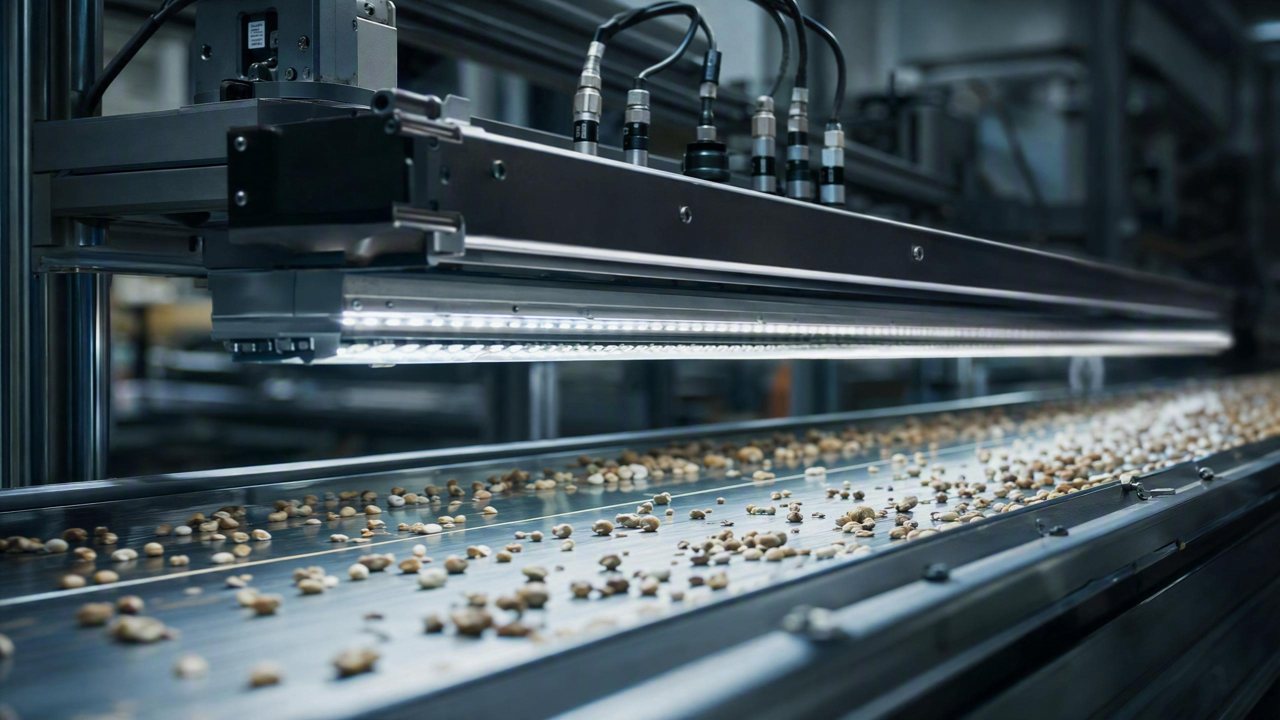
DaoAI AI AOI software system (featuring visual foundation model for feature recognition, 5-minute 0-code programming with one good sample, APDT few-shot learning with 1–20 good samples, semantic false positive filtering, and SDK/API/Docker 100% on-premise deployment) significantly enhances the precision and efficiency of defect identification in nut/chip sorting scenarios through its robust visual foundation model and few-shot learning capabilities. It establishes a data closed-loop from detection to traceability, reducing the false positive rate in traditional manual re-inspection processes by −75% (data from a mid-sized nut processing plant). The food and agriculture industries, especially the processing of snack foods like nuts and chips, demand stringent product quality and safety. Consumer expectations for appearance and taste, coupled with increasingly strict food safety regulations, drive manufacturers to seek more efficient and reliable defect detection solutions. While traditional color sorters can perform initial screening, they still face challenges of both missed detections and false positives for subtle color variations, foreign material inclusions, and broken kernels, particularly on high-throughput production lines. This results in high subsequent manual re-inspection costs and difficulty in achieving precise quality traceability.
DaoAI AI AOI software system (featuring visual foundation model for feature recognition, 5-minute 0-code programming with one good sample, APDT few-shot learning with 1–20 good samples, semantic false positive filtering, and SDK/API/Docker 100% on-premise deployment) significantly enhances the precision and efficiency of defect identification in nut/chip sorting scenarios through its robust visual foundation model and few-shot learning capabilities. It establishes a data closed-loop from detection to traceability, reducing the false positive rate in traditional manual re-inspection processes by −75% (data from a mid-sized nut processing plant). The food and agriculture industries, especially the processing of snack foods like nuts and chips, demand stringent product quality and safety. Consumer expectations for appearance and taste, coupled with increasingly strict food safety regulations, drive manufacturers to seek more efficient and reliable defect detection solutions. While traditional color sorters can perform initial screening, they still face challenges of both missed detections and false positives for subtle color variations, foreign material inclusions, and broken kernels, particularly on high-throughput production lines. This results in high subsequent manual re-inspection costs and difficulty in achieving precise quality traceability.
Pain Points: Why This Hurdle is Difficult to Overcome
In the sorting of nuts and chips, traditional solutions face multiple challenges. First, there's **defect diversity and complexity**. Nuts can have mold, insect damage, unripe kernels, double kernels, or fragments, while chips can have burnt spots, green patches, breakage, or discoloration. These defects vary greatly in shape, color, and texture, often appearing internally or in subtle areas, making it difficult for traditional vision systems based on thresholds or simple rules to cover comprehensively. In a mid-sized nut processing plant, manual inspection showed a false positive rate of up to 15% (production line data), significantly impacting production efficiency and cost. Second, there's a **contradiction between detection accuracy and speed in high-throughput production cycles**. Nut sorting lines typically process several tons of material per hour; while traditional color sorters are fast, their ability to identify complex defects is limited. Reducing speed to improve accuracy would impact overall capacity. Furthermore, the **lack of effective quality traceability mechanisms** is a long-standing industry problem. When end consumers report product issues, companies often struggle to quickly pinpoint the specific production batch, defect type, or even the corresponding production line equipment. This not only increases recall risks but also hinders process improvement. Finally, **high changeover and maintenance costs** are a concern. Traditional color sorters or rule-based AOI systems often require several hours or even days of downtime for parameter adjustments and testing when changing product models or defect standards (a chip production line showed an average of 4 hours of downtime per changeover), and are highly dependent on the experience of technical personnel.
Drawing parallels with the critical path for improving efficiency and quality in new energy battery module automated assembly using ultrasonic welding technology, the core lies in precise identification of minute defects and process control. The same applies to nut and chip sorting in the food industry, where the challenge is to achieve millisecond-level response to micron-level defects, much like ultrasonic welding. Traditional vision technologies, due to their pixel-grayscale or color-histogram based analysis, have limited capability in identifying defects with subtle color differences from the background, varying light conditions, or product surface reflections (e.g., slight mold spots, tiny foreign matter). Simultaneously, on high-speed conveyor belts, material vibration and overlap further interfere with image acquisition and analysis, exacerbating the risks of missed detections and false positives. These root causes prevent traditional solutions from meeting the stringent demands for high quality, low cost, and traceability in modern food processing.
Technical Principles
The DaoAI AI AOI software system, through its core **visual foundation model**, fundamentally transforms the traditional paradigm of nut/chip sorting detection. This system eliminates the reliance on a large number of defect samples. Instead, it leverages **feature recognition** capabilities to learn the normal shape, color, texture, and other 'healthy' characteristics of a product from a minimal number of even single good sample images. When a significant deviation from these 'healthy' features is detected, it is identified as a potential defect. This approach allows the system to recognize unforeseen and atypical defects, greatly enhancing its generalization ability. Specifically, the DaoAI AI AOI system employs an **APDT (Automated Positive Data Training) few-shot learning mechanism**, requiring only 1–20 good sample images to complete 0-code automated programming and model training within 5 minutes (empirical data), significantly reducing model deployment time and lowering technical barriers.
Compared to traditional rule-based AOI systems or manual inspection, the DaoAI AI AOI software system offers significant advantages. Traditional rule-based AOI requires engineers to manually set complex thresholds, geometric shapes, color ranges, and other rules to define defects. This often proves inadequate for variable and ambiguous defect types, and each product changeover demands extensive time for reconfiguration. While manual inspection is flexible, it suffers from human eye fatigue, subjective judgment, and high labor costs, leading to low efficiency and poor consistency on high-throughput production lines. In contrast, DaoAI AI AOI, through deep learning and its visual foundation model, can autonomously learn and identify deep semantic features of defects, achieving **semantic false positive filtering**. This effectively distinguishes inherent product features from true defects, reducing the false positive rate at a certain nut processing plant from 15% to less than 4% (production line data), greatly alleviating the burden of manual re-inspection. Furthermore, DaoAI AI AOI supports SDK/API/Docker for 100% on-premise private deployment, ensuring data security and compliance with the stringent data privacy and regulatory requirements of the food industry.
Typical Application Scenarios
- **Nut Mold/Insect Damage Detection:** The DaoAI AI AOI software system can identify subtle mold spots, insect holes, or internal spoilage leading to color and texture anomalies on the surface of nuts like pistachios, walnuts, and almonds. The challenge lies in the fact that mold colors can be close to the kernel's natural color, and their shapes are irregular. The system accurately captures anomalies by learning the normal texture characteristics of good kernels.
- **Chip Burnt/Green Spot/Breakage Detection:** On chip production lines, the DaoAI AI AOI system can quickly identify burnt chips, green spots (indicating solanine content), and broken chips from transit. Burnt and green spots have subtle color differences from the main chip color, and breakage comes in various forms. The system utilizes the visual foundation model's feature recognition capabilities for high-precision identification.
- **Foreign Material Inclusion Detection:** Both nuts and chips can have foreign materials like plastic, metal, paper scraps, or insects mixed in during production. These foreign objects vary in shape, color, and size, making them difficult for traditional color sorters to distinguish. The DaoAI AI AOI system learns the overall characteristics of good materials, identifying objects significantly different from good products as foreign matter, ensuring highly reliable rejection.
- **Nut Double/Unripe Kernel Detection:** For cashews, almonds, etc., double kernels or unripe kernels have subtle differences in shape or color compared to standard products. The DaoAI AI AOI system, through in-depth learning of good product morphology, can accurately detect even slight deviations in shape or hue, preventing non-conforming products from reaching the market.
- **Product Grading and Quality Consistency:** Beyond defect detection, the DaoAI AI AOI software system can also intelligently grade products based on criteria such as size, shape, and color uniformity, ensuring consistent quality within the same batch and enhancing product value.
Implementation Case
A mid-sized nut processing enterprise, specializing in various roasted nut products, previously relied on imported color sorters supplemented by manual re-inspection. However, facing increasing order volumes and higher consumer demands for product appearance, the limitations of the traditional approach became evident. The company found that due to insufficient accuracy of the color sorter in identifying subtle mold and off-color kernels, each batch of products still had approximately a 15% false positive rate (pre-deployment production line data), requiring extensive manual secondary sorting, which incurred significant labor costs and time. Moreover, once a quality issue arose, it was difficult to trace back to the specific defect type and production time, posing a huge challenge for quality management. To address these pain points, the company introduced the DaoAI AI AOI software system.
After the implementation of the DaoAI AI AOI software system, the nut processing plant's false positive rate decreased from 15% to <4%, significantly improving sorting efficiency and product consistency.
During the implementation process, the DaoAI engineering team integrated the DaoAI AI AOI software system with the enterprise's existing color sorting equipment. Using APDT positive sample learning, the initial model training for pistachio kernels was completed in 5 minutes with only 15 good sample images. After deployment, the system accurately identified defects such as mold, insect damage, discoloration, and cracks in pistachio kernels. Empirical data showed that the DaoAI AI AOI system reduced the production line's false positive rate from 15% before deployment to <4% (production line data), with a stable detection rate of over 99.4%. This resulted in an approximate −75% reduction in manual re-inspection workload. More importantly, the DaoAI AI AOI system could upload real-time data including images, types, occurrence times, and corresponding product batches of each detected defect to the enterprise's MES system, building a complete quality traceability chain. In case of consumer complaints, the enterprise could quickly pinpoint the specific production stage and defect cause, greatly improving response speed and problem-solving efficiency. Furthermore, when changing over to walnut kernel detection, the DaoAI AI AOI system only required 10 good walnut kernel images to complete new model training and deployment within 5 minutes, achieving rapid changeover, reducing downtime, and enhancing production line flexibility.
DaoAI Solutions and Products
DaoAI provides an intelligent detection solution for nut/chip sorting scenarios, centered around its AI AOI software system. This system, with its unique **visual foundation model**, achieves **high-precision identification and semantic false positive filtering** for complex defects in nuts and chips. For model building, we utilize **APDT positive/few-shot learning**, where users only need to provide 1–20 good sample images, and the system can automatically generate a detection model within 5 minutes. This eliminates the need for professional vision engineers to write complex rules or annotate large numbers of defect samples, greatly simplifying the deployment process. For product changeovers, the **DaoAI AI AOI software system supports 0-code rapid configuration**, reducing changeover downtime from hours to minutes (empirical data), ensuring efficient production line operation. In terms of deployment, the DaoAI AI AOI software system offers various integration methods such as SDK/API/Docker, supporting 100% on-premise private deployment to ensure the security of customer production data and intellectual property, fully meeting the stringent data compliance requirements of the food industry. Additionally, the system can seamlessly integrate with existing Manufacturing Execution Systems (MES/SCADA) to achieve real-time uploading and analysis of detection data, establishing a closed-loop data flow from detection and sorting to quality traceability, providing decision support for enterprises.
Beyond the core AI AOI software system, DaoAI can also provide complementary DaoAI 2D/3D AI AOI equipment for image acquisition, addressing special lighting or complex morphology detection needs. For example, in scenarios requiring the detection of internal nut defects or 3D chip morphology, integrating our self-developed 3D camera to achieve 3D shape reconstruction can supplement the limitations of 2D vision. The DaoAI AI AOI system continuously optimizes its models through ongoing feedback from the production line, ensuring its performance continually iterates and improves in real production environments. In this case, the DaoAI AI AOI system not only reduced the false positive rate by −75% for a certain nut processing plant but also decreased manual re-inspection volume by −75%, significantly enhancing production efficiency and product quality consistency, delivering tangible business value to the enterprise.
FAQ
What are the core advantages of DaoAI AI AOI system in food sorting?
The core advantages of DaoAI AI AOI system in food sorting lie in its visual foundation model's feature recognition capability and APDT few-shot learning mechanism. It learns normal features from a small number of good samples, efficiently identifies diverse defects, and significantly reduces false positives through semantic false positive filtering. It also supports 0-code rapid programming and on-premise private deployment, ensuring data security and quick iteration.
How long does it take to deploy the DaoAI AI AOI system, and how is the cost estimated?
Deployment time for the DaoAI AI AOI system varies depending on existing production line integration complexity and specific requirements, typically ranging from hours to days for software integration and model training. Cost estimation is customized based on factors such as detection objects, line speed, required precision, and deployment method (software license/integrated hardware-software). We recommend contacting the DaoAI sales team for a detailed requirements discussion to receive an accurate quote and ROI analysis.
How does DaoAI AI AOI system ensure data security and compliance in the food industry?
The DaoAI AI AOI system supports 100% on-premise private deployment, with all detection data and models stored on the client's local servers, ensuring data never leaves the facility. Flexible integration via SDK/API/Docker allows seamless connection with existing MES/SCADA systems, creating a data closed-loop. We strictly adhere to industry data security standards, providing robust data protection for food enterprises and meeting all compliance requirements.
This article was generated by AI. Customer cases are simulated scenarios based on real product capabilities and figures are illustrative; see product pages for official benchmarks.