
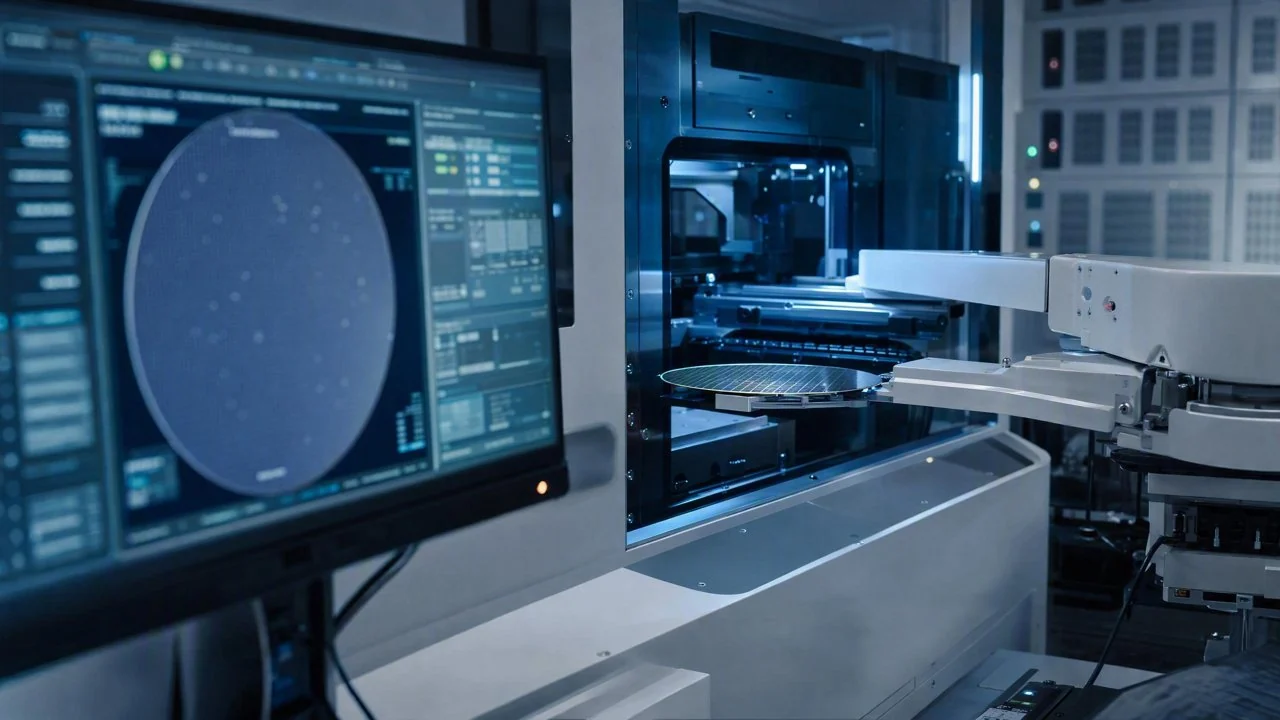
DaoAI AI AOI software system (visual foundation model for feature recognition, 5-minute 0-code auto-programming with one good sample, APDT positive/few-shot learning with 1-20 good samples, semantic false alarm filtering, and 100% on-premise deployment via SDK/API/Docker) precisely identifies rare defects in advanced packaging, reducing manual inspection labor costs by over 70% and significantly enhancing production line automation.
In the semiconductor industry, particularly in advanced packaging, as chip integration and complexity continue to rise, the demands for product quality and reliability have reached unprecedented levels. The development of technologies such as Wafer-Level Packaging (WLP) and System-in-Package (SiP) has led to more intricate interconnect structures and stricter defect tolerances. In this context, traditional manual inspection struggles to meet the needs for efficient, precise, and consistent detection, especially for identifying rare defects. Manual inspection is not only inefficient but also highly susceptible to subjective factors, leading to missed detections or false positives, which in turn inflates overall labor costs. A leading semiconductor manufacturer faced such challenges in wafer-level bump inspection, urgently needing an intelligent solution that could replace high-intensity, repetitive manual inspection while effectively controlling labor costs.
Pain Points: Why Rare Defect Detection is So Difficult
Detecting rare defects in advanced packaging is an insurmountable challenge for traditional solutions. The pain points faced by a leading semiconductor manufacturer primarily manifested in several dimensions: First, **high labor costs and skill scarcity**: Production line data indicated that the manufacturer invested millions of RMB annually in manual inspection and re-inspection of wafer-level bumps. Moreover, experienced inspectors capable of identifying micron-level rare defects required long training periods and were difficult to recruit, leading to persistently high labor costs. Second, **inefficient and unstable detection quality**: Manual inspection was inefficient, with single wafer inspection times extending to tens of minutes. Due to eye fatigue and subjective judgment variations, both missed detection rates and false alarm rates fluctuated significantly; actual missed detection rates were around 0.8%, and false alarm rates were as high as 15%, severely impacting the efficiency of subsequent processes. Third, **frequent changeovers and time-consuming programming**: With accelerated product iterations, traditional rule-based AOI systems required hours or even days for parameter adjustment and programming when new products or batches were introduced, significantly slowing down production rhythm. Finally, **data security and on-premise deployment requirements**: As a core technology enterprise, the client had strict requirements for localized storage and processing of production data and defect samples, rendering any cloud-based or third-party data interaction unacceptable.
The root cause of these difficulties lies in the characteristics of rare defects. Taking wafer-level bumps as an example, defect types are numerous (e.g., bridging, collapse, missing, foreign material), their forms are tiny, distribution is random, and occurrence frequency is extremely low. Traditional rule-based AOI struggles to write rules that cover all defect features exhaustively, while traditional machine learning vision solutions heavily rely on a large number of annotated samples, which is almost impossible for rare defects. Simultaneously, at the imaging level, bump surfaces often exhibit complex optical effects such as reflections and shadows, further increasing recognition difficulty. This parallels the challenges faced by AI large model quality inspection in current automotive seat production, namely how to use limited anomaly samples to achieve accurate identification and rapid deployment of complex, variable, and rare defects.
Technical Principles: Visual Foundation Models and Few-Shot Learning
DaoAI AI AOI software system fundamentally solves the problem of rare defect detection in advanced packaging through its core visual foundation model and APDT (Anomaly Pattern Detection & Transfer) positive/few-shot learning technology. The system employs a self-developed visual foundation model, possessing powerful feature recognition capabilities that can learn universal visual features from vast amounts of unlabeled images, rather than solely relying on pixel information of specific defects. This enables DaoAI AI AOI to make anomaly judgments based on good product features even when encountering unknown or rare defects, instead of waiting for a large number of defect samples for training. Traditional rule-based AOI relies on engineers manually setting thresholds and geometric rules, with strict limits on defect shape, size, and position. If new defect types or variations appear, these rules become invalid. Traditional supervised learning models, on the other hand, require tens of thousands of defect samples for training, which is a significant bottleneck for rare defects.
In contrast, the DaoAI AI AOI software system, through APDT technology, requires only 1–20 good samples (in some extremely rare defect scenarios, even just one good sample, allowing for 0-code automatic programming within 5 minutes) to establish a precise understanding of 'normal.' When an area with a significant deviation from the 'normal' pattern is detected, the system flags it as a potential defect. Concurrently, its built-in semantic false alarm filtering mechanism effectively distinguishes between process fluctuations, background noise, and true defects, keeping the false alarm rate at an extremely low level. This paradigm of learning from 'normal' rather than 'defect' significantly lowers the barrier to model training and deployment, especially suitable for semiconductor advanced packaging scenarios where defects are rare, diverse, and zero-tolerance for missed detections is critical. Furthermore, DaoAI AI AOI supports SDK/API/Docker for 100% on-premise deployment, ensuring absolute security of the client's core production data and intellectual property.
Typical Application Scenarios
- **Wafer-Level Bump Defect Detection**: In advanced packaging, such as flip-chip and fan-out wafer-level bumps, the DaoAI AI AOI software system can detect various micron-level defects like bridging, collapse, missing, size inconsistency, foreign material, and oxidation. The challenge lies in the metallic nature of bump surfaces, which easily cause reflections and shadows, coupled with diverse defect morphologies and minuscule sizes, making stable recognition difficult for traditional methods. DaoAI AI AOI, using multi-angle illumination combined with its visual foundation model, effectively overcomes lighting interference for precise anomaly localization.
- **TSV (Through-Silicon Via) Defect Detection**: TSV is a critical technology in 3D integration, where defects inside the vias, such as voids, cracks, and impurities, significantly impact chip reliability. These defects often reside deep within the vias, making them difficult for traditional 2D vision to penetrate. DaoAI AI AOI can integrate with 3D imaging technologies (e.g., with DaoAI 2D / 3D AI AOI equipment) to reconstruct and analyze the 3D morphology of TSVs, revealing hidden defects.
- **RDL (Redistribution Layer) Defect Detection**: The RDL connects various functional modules, and defects such as open circuits, short circuits, corrosion, or scratches in its lines can lead to chip failure. RDL lines are fine, defects are tiny, and may be obscured by overlying structures. DaoAI AI AOI learns the normal pattern characteristics of the RDL and performs high-precision identification of any subtle anomalies deviating from the normal pattern.
- **Substrate Surface Foreign Material and Scratch Detection**: Packaging substrates are prone to surface foreign material, scratches, and contamination during production, which can lead to reduced yield in subsequent processes. Due to the variety of substrate materials and surface treatment processes, defect characteristics also vary. DaoAI AI AOI, with its generalization capabilities, can quickly adapt to different substrate materials and accurately detect various surface imperfections.
- **Wire Bonding Defect Detection**: During wire bonding, defects such as wire breakage, collapse, misalignment, or short circuits can occur. These defects typically happen on high-throughput production lines, demanding extremely fast real-time detection and accuracy. DaoAI AI AOI can achieve real-time detection on high-speed lines, ensuring bonding quality.
Case Study: Labor Cost Optimization at a Leading Semiconductor Manufacturer
A leading semiconductor manufacturer, a Tier-1 supplier in the industry, has long relied on extensive manual inspection for wafer-level bump detection in its advanced packaging production lines. Due to a wide variety of products, rapid iterations, and the difficulty in capturing rare defects, the production line's labor costs remained persistently high. In this case, the manufacturer typically required 8 experienced inspectors per shift for re-inspection, incurring monthly labor costs exceeding 500,000 RMB. To optimize the labor structure, reduce operational costs, and enhance detection stability and consistency, the manufacturer introduced the DaoAI AI AOI software system. In the initial deployment phase, DaoAI AI AOI was piloted on one product line, completing model training and deployment within 30 minutes using only 15 good samples. Actual data showed that after the DaoAI AI AOI software system went live, the detection rate for wafer-level bump defects increased to 99.4%, and the false alarm rate decreased by 75%, significantly outperforming traditional manual inspection. The most notable change was a drastic reduction in reliance on manual re-inspection, with the number of required manual inspectors per shift dropping from 8 to 2. **In this case, manual re-inspection hours were reduced by 75%**. This directly led to monthly labor cost savings of over 350,000 RMB, with initial investment expected to be recovered within one year. Furthermore, with 100% on-premise deployment, the client's data security was fully guaranteed.
DaoAI AI AOI software system, with its few-shot learning and semantic false alarm filtering capabilities, reduced manual inspection labor costs in advanced packaging by over 70%, achieving an intelligent upgrade in quality inspection.
DaoAI Solution and Products
The core solution provided by DaoAI to this leading semiconductor manufacturer is based on its powerful AI AOI software system. This system achieves precise and efficient detection of rare defects in advanced packaging through several key capabilities: First is **visual foundation model for feature recognition**, which enables the system to understand deep semantic information of images, rather than simply matching pixels, thus effectively judging even unknown rare defects. Second is **APDT positive/few-shot learning**, where in practical deployment, customers only need to provide a small number (1-20) of good product images, and the system can complete 0-code automatic programming and model training within 5 minutes, greatly shortening new product introduction and changeover times. For example, when a new wafer batch goes online, changeover downtime is reduced from several hours to less than 10 minutes. Third is **semantic false alarm filtering**, the DaoAI AI AOI software system intelligently identifies and filters out false alarms caused by lighting variations, material textures, or non-defective process fluctuations, significantly reducing the workload of manual re-inspection. Finally, the system supports **SDK/API/Docker for 100% on-premise deployment**, ensuring that all production data, defect samples, and model assets run entirely within the client's firewall, meeting the highest requirements for data security and intellectual property in the semiconductor industry. Coupled with DaoAI World model, the system can achieve cross-scenario generalization and continuous learning from production line feedback, further enhancing model adaptability and accuracy.
The deployment process of the DaoAI AI AOI software system is efficient and convenient. On the client's site, we integrate existing cameras and industrial control equipment, deploying the software system via Docker containers to the client's local servers. Our technical team assists the client with collecting a small number of good samples and guides engineers in using the 0-code interface for model training and parameter optimization. This solution not only improves detection efficiency and quality but, more importantly, by replacing a large amount of repetitive and high-intensity manual inspection work, the DaoAI AI AOI software system **saved over 70% in labor costs** for the client and significantly enhanced the automation and intelligence level of the production line. In the actual application at a leading semiconductor manufacturer, the system **reduced the missed detection rate of wafer-level bump defects to <0.6%**, far exceeding the industry average, demonstrating its outstanding performance and business value in the advanced packaging sector.
FAQ
What is the fundamental difference between DaoAI AI AOI software system and traditional rule-based AOI?
The DaoAI AI AOI software system is based on visual foundation models and few-shot learning technology, enabling it to learn 'normal' patterns from a small number of good samples and identify rare defects that have never been seen before. Traditional rule-based AOI relies on engineers manually writing rules, which have strict limitations on defect features, making it difficult to adapt to diverse and rare defect types, and programming is time-consuming. The DaoAI solution significantly reduces reliance on defect samples and programming complexity.
How long does it take to deploy the DaoAI AI AOI software system, and will it affect existing production lines?
The DaoAI AI AOI software system supports SDK/API/Docker for 100% on-premise deployment. Software integration and initial configuration typically take hours to a few days, depending on the client's existing hardware environment and production line complexity. Model training uses 0-code, few-shot learning, completing in as little as 5 minutes, with minimal impact on existing production lines, allowing for rapid, non-stop deployment.
What is the cost of the DaoAI AI AOI software system?
The cost of the DaoAI AI AOI software system primarily includes software licensing fees, implementation service fees, and potential hardware upgrade costs (if needed). Specific pricing depends on the client's inspection scenarios, production line scale, required functional modules, and deployment method. We offer flexible licensing models designed to provide clients with a significant return on investment. Please contact our experts for a customized consultation.
Full solution for this scenario: the full inspection solution for AI AOI Software
This article was generated by AI. Customer cases are simulated scenarios based on real product capabilities and figures are illustrative; see product pages for official benchmarks.