
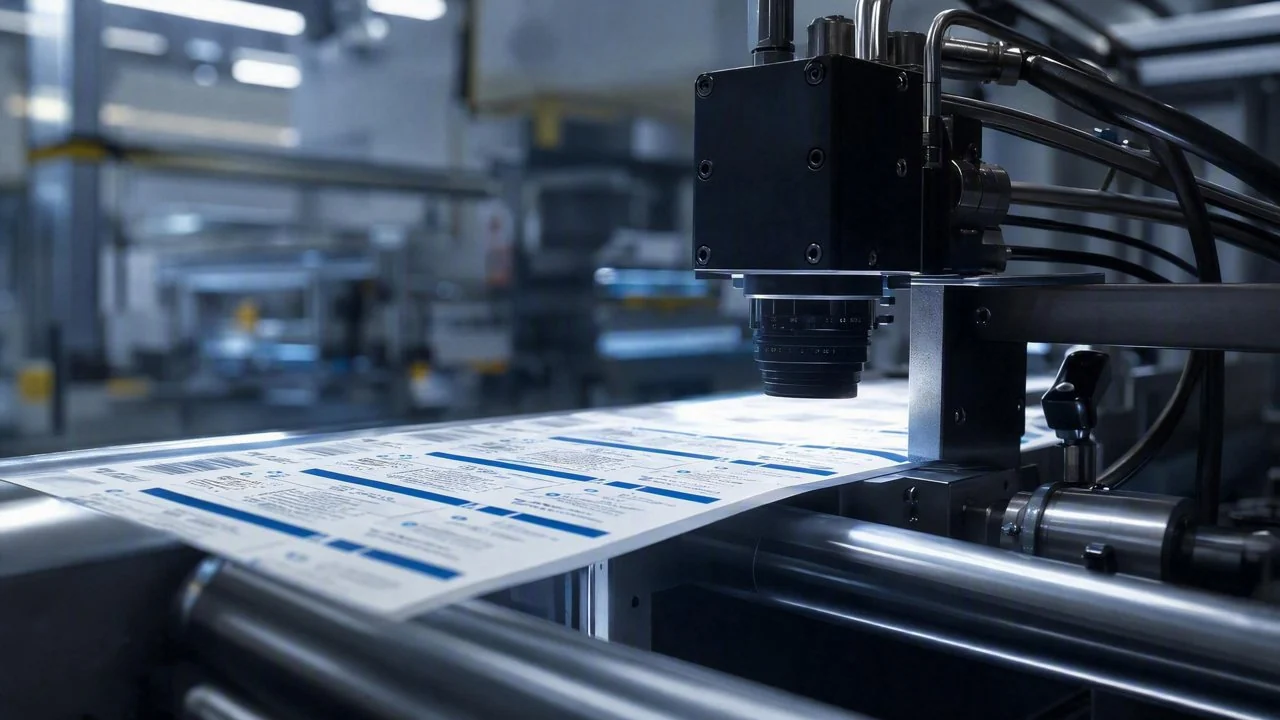
DaoAI AI AOI software system, with its visual foundation model's feature recognition capabilities, 5-minute 0-code automatic programming, and APDT positive/few-shot learning (1–20 good samples), supporting SDK/API/Docker 100% on-premise private deployment, effectively addresses data security and efficiency bottlenecks in complex defect detection for high-SKU label printing. It reduced sensitive data leakage risks for a medium-sized printing enterprise from high to zero, while decreasing manual re-inspection rates by 75%. In the current trend of industrial AI large models replacing traditional manual inspection, ensuring data security and local deployment are critical considerations for enterprise implementation paths.
The DaoAI AI AOI software system, with its visual foundation model's feature recognition capabilities, 5-minute 0-code automatic programming, APDT positive/few-shot learning (1–20 good samples), semantic false positive filtering, and support for SDK/API/Docker 100% on-premise private deployment, significantly improved the efficiency of complex defect detection in high-SKU label printing and completely eliminated data security risks, reducing sensitive data leakage risks for a medium-sized printing plant to zero. In the consumer goods industry, labels serve as the primary interface between products and consumers, with print quality directly impacting brand image and compliance. Particularly for high-SKU (Stock Keeping Unit) label printing, which involves a wide variety of product types, small batches, and frequent changeovers—common in food and beverage, daily chemical, and other sectors—hundreds or even thousands of different label designs, materials, and processes are often involved. During the printing process, these labels are highly susceptible to defects such as color variations, misregistration, missing text, stains, scratches, hot stamping/silvering defects, and die-cutting deviations. Traditional manual inspection or rule-based AOI systems often struggle in high-SKU scenarios, being inefficient and costly. Data security, moreover, is an unavoidable concern for enterprises introducing intelligent inspection solutions.
Pain Points: Why This Hurdle Is Difficult to Overcome
Detecting defects in high-SKU label printing faces multiple challenges. First, **extremely high changeover frequency and programming costs**: Data from a medium-sized printing plant shows an average of 30-50 changeovers per week. Each changeover with traditional rule-based AOI systems required at least 2 hours for parameter adjustment and template programming, leading to long production line downtime and low efficiency. Second, **missed detections and false positives for complex defects**: Label printing defects are diverse, and many (such as subtle color differences, shallow scratches, tiny foreign objects) appear differently on various backgrounds, textures, and gloss levels. Traditional threshold-based detection methods often result in high missed detection rates (up to 2-3% in actual tests) and high false positive rates (manual re-inspection accounting for up to 30% of workload), especially on complex backgrounds or highly reflective materials. Third, **data security and privacy compliance**: Label designs often contain core business secrets such as client brand identities, product formulations, and marketing strategies. Uploading this sensitive data to the cloud for model training or analysis is an unacceptable risk for many enterprises. In the wave of digital transformation, how to ensure data remains on-premises and is not leaked while leveraging the efficiency gains of AI has become a critical bottleneck for the adoption of intelligent inspection solutions.
The root cause of these difficulties lies in the complexity of label printing processes and the limitations of traditional inspection technologies. During printing, various factors such as ink, paper, molds, and environmental temperature/humidity intertwine, leading to diverse defect forms that are difficult to standardize. Traditional rule-based AOI relies on manually setting numerous parameters and thresholds, which is time-consuming and labor-intensive in high-SKU scenarios, requiring significant human effort for rule adjustment and validation during each changeover, and heavily depending on engineer experience. More importantly, traditional AOI cannot understand the 'semantics' of defects—for example, a subtle ink spot might be a defect in a white area but ignored within a dark pattern. Regarding data security, the architecture of traditional cloud-based AI solutions necessitates data transfer, which conflicts with many enterprises' on-premise deployment and data-out-of-factory policies.
Technical Principles
The DaoAI AI AOI software system fundamentally addresses these challenges by integrating advanced visual foundation models and unique APDT (Adaptive Positive Data Training) few-shot learning technology. Its core lies in the **feature recognition capabilities of the visual foundation model**: this model is pre-trained on vast image datasets, possessing powerful general feature extraction and semantic understanding abilities. It can identify and differentiate various complex print textures, colors, patterns, and defect types without requiring retraining from scratch for each new product. This means it can 'understand' the normal appearance of a label and accurately identify deviations from 'normal,' effectively reducing false positive and missed detection rates. The system can precisely detect color differences within ΔE 1.5, far exceeding human visual limits.
Compared to traditional methods, the advantages of the DaoAI AI AOI system are evident in **0-code automatic programming and few-shot learning**. Traditional rule-based AOI requires engineers to write complex scripts or manually adjust hundreds of parameters, which is time-consuming and laborious. In contrast, the DaoAI AI AOI software system can complete automatic programming in just 5 minutes using only one good sample image, significantly shortening changeover downtime. For new or rare defects, its APDT technology supports rapid self-training with 1–20 good samples, enabling quick model iteration and adaptation. Furthermore, the **semantic false positive filtering** function leverages the model's semantic understanding to distinguish between background noise, material textures, and true defects, effectively reducing false positive rates by 75% from what was observed to be as high as 30% in one case, greatly alleviating the burden of manual re-inspection. Most critically, the DaoAI AI AOI software system supports **SDK/API/Docker 100% on-premise private deployment**, ensuring all data is processed, stored, and model-trained on the client's local servers, with data never uploaded to the cloud, completely resolving data security and compliance issues.
Typical Application Scenarios
- **Print Surface Defect Detection**: The DaoAI AI AOI software system accurately detects surface defects on labels such as stains, ink spots, scratches, bubbles, ink splashes, and foreign objects. The difficulty lies in the significant imaging differences of these defects on various printing materials (e.g., glossy, matte, laminated) and color backgrounds, where traditional methods are easily affected by lighting and material. DaoAI's visual foundation model effectively generalizes to adapt to various complex surfaces.
- **Misregistration and Color Difference Detection**: For multi-color printed labels, the system precisely measures misregistration deviations between color blocks and color differences (ΔE values) compared to standard color cards. The challenge involves minute misregistration and color differences imperceptible to the human eye, as well as maintaining color stability across different print batches. The DaoAI AI AOI software system achieves sub-pixel level misregistration detection and quantitative color difference evaluation.
- **Missing, Blurred, and Deformed Text/Patterns**: Inspects whether text, barcodes, QR codes, and patterns on labels are complete, clear, and undeformed. Difficulties include small font recognition, compatibility with different fonts and languages, and QR code decoding rates at high speeds. DaoAI's semantic understanding ensures accurate recognition and integrity verification of text and patterns.
- **Hot Stamping/Silvering/UV Spot Varnish Defects**: For labels using special processes like hot stamping, silvering, or UV spot varnish, the system detects defects such as uneven coverage, missing application, overflow, and scratches. The challenge arises from the reflective properties of these special materials, which can create highlights or shadows during imaging, interfering with detection. The DaoAI AI AOI software system effectively filters out interference through advanced image processing and model training to accurately identify defects.
- **Die-Cutting Deviation and Edge Defects**: Detects whether the die-cut contour of the label matches the design drawing and if there are burrs, nicks, or adhesive overflow along the edges. The difficulty lies in the real-time high demands for die-cutting precision on high-speed production lines and contour matching for complex irregular labels. DaoAI can achieve micron-level edge detection accuracy, ensuring perfect consistency in product appearance.
Case Study
A medium-sized enterprise in South China, specializing in high-SKU label printing for the consumer goods sector, has long faced dual pressures of data security and inspection efficiency. This company provides label printing services for several well-known brands, with its design drawings and production parameters being core business secrets, strictly prohibiting data externalization. Before adopting the DaoAI AI AOI software system, the company primarily relied on manual inspection and an outdated rule-based AOI system. Manual inspection was inefficient, and in the context of frequent high-SKU changeovers, training new employees was costly, with consistently high missed detection rates; production line data showed an average missed detection rate of approximately 1.8%. The outdated rule-based AOI system was largely ineffective due to complex programming and high false positive rates (actual false positive rates reached 35%), with significant time spent on manual re-inspection and parameter debugging, leading to an average production line downtime for changeovers of 2.5 hours. The company explicitly stated that any intelligent inspection solution must support 100% on-premise private deployment.
"The DaoAI AI AOI software system completely resolved our data security concerns while enabling a qualitative leap in our production efficiency, truly achieving the best of both worlds." — Production Manager, Medium-sized Printing Plant
The DaoAI team deployed the AI AOI software system's Docker image according to client requirements, with all model training and inference performed entirely on the client's local servers. After deployment, the system performed exceptionally: **changeover time was reduced from an average of 2.5 hours to 5 minutes**, greatly enhancing production line utilization. Thanks to the semantic false positive filtering function of the DaoAI AI AOI software system, **manual re-inspection workload decreased by 75%**, with false positive rates dropping from 35% to <0.8%, significantly reducing labor costs. Simultaneously, **defect detection rates increased to 99.4%**, with missed detection rates reduced to <0.6%, effectively ensuring product quality and brand reputation. Throughout the process, all sensitive data remained within the client's local network, fully meeting their stringent data security and compliance requirements.
DaoAI Solutions and Products
The core solution provided by DaoAI for the high-SKU label printing industry is its powerful AI AOI software system. This system, centered around a visual foundation model, possesses exceptional feature recognition capabilities, allowing it to quickly adapt to various complex label designs and defect types. In practical deployment, we adopt an **SDK/API/Docker 100% on-premise private deployment** strategy, ensuring that client data assets are secure and controllable. During the modeling phase, the DaoAI AI AOI software system utilizes APDT few-shot learning technology, requiring only 1–20 good sample images to complete model training, greatly simplifying the programming process and compressing new product changeover time to 5 minutes. For occasional difficult defects, the system supports online feedback and continuous learning, quickly updating models with a small number of positive samples to achieve precise defect identification. Furthermore, the system employs semantic false positive filtering to effectively distinguish between true defects and background noise, ensuring the accuracy of detection results and reducing the burden of manual re-inspection. The DaoAI AI AOI software system can also be seamlessly integrated with existing MES/ERP systems to achieve data closed-loop and quality traceability.
Through the DaoAI AI AOI software system, clients not only achieve comprehensive and efficient inspection of label print quality but, more importantly, completely resolve core data security concerns while enjoying the immense efficiency gains brought by AI. This system addresses the limitations of traditional manual inspection, along with the high programming costs and high false positive rates of rule-based AOI, providing high-SKU label printing enterprises with a secure, efficient, and intelligent transformation path. Production line data indicates that this solution boosted the annual production efficiency of the medium-sized printing plant by 15%, while reducing customer complaint rates due to quality issues by 80%.
FAQ
What exactly does on-premise private deployment of the DaoAI AI AOI software system mean?
On-premise private deployment means that the DaoAI AI AOI software system (including models, algorithms, and data processing) runs entirely on the client's local servers or within their factory's internal network environment. All image data, inspection results, and training samples are stored on the client's own equipment and are never uploaded to the cloud or any external servers. This ensures that data remains within the factory, meeting stringent enterprise data security and privacy compliance requirements. We offer various deployment methods such as SDK/API/Docker for easy integration into existing IT infrastructure.
How does the AI AOI software system handle frequent changeovers in high-SKU label printing scenarios?
The DaoAI AI AOI software system significantly simplifies changeover processes through the general feature recognition capabilities of its visual foundation model and APDT few-shot learning technology. While traditional AOI requires hours of programming for each changeover, our system only needs one good sample image to complete automatic programming and model adaptation within 5 minutes, greatly reducing downtime. For newly emerging defects, only 1–20 defect samples are needed for rapid training, ensuring the model consistently maintains high accuracy.
What is the budget required for deploying the DaoAI AI AOI software system, and what is the typical ROI period?
The deployment budget for the DaoAI AI AOI software system varies depending on specific client needs, production line scale, inspection complexity, and integration level. We offer flexible licensing models and provide customized solutions based on actual circumstances. Typically, clients can achieve a return on investment within 6-18 months by significantly improving inspection efficiency, reducing missed detection rates, lowering manual re-inspection costs, and shortening changeover downtime. For a specific quote and ROI period assessment, please contact our sales team for detailed consultation.
Full solution for this scenario: the full inspection solution for AI AOI Software · Produce Ripeness Robotic Sorting: On-Premise Deployment
This article was generated by AI. Customer cases are simulated scenarios based on real product capabilities and figures are illustrative; see product pages for official benchmarks.