
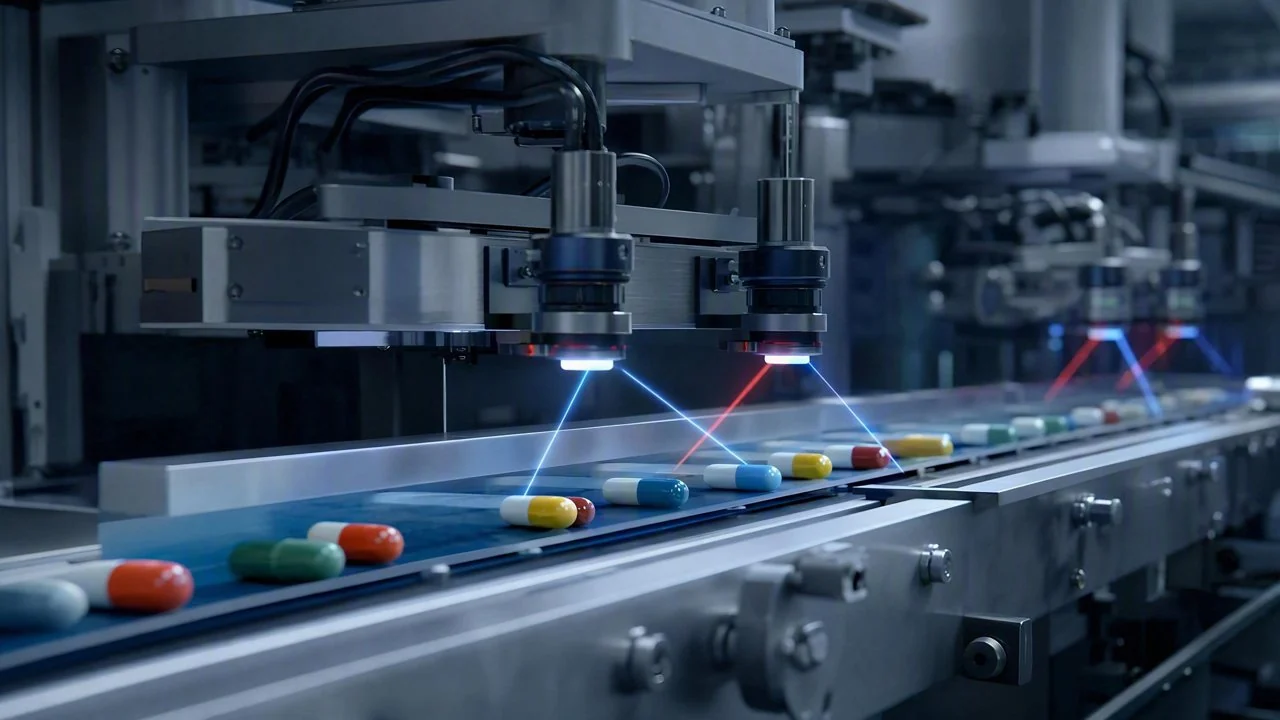
DaoAI AI AOI software system (featuring vision foundation model-based feature recognition, 5-minute 0-code automatic programming with one good sample, APDT positive/few-shot learning from 1–20 good samples, semantic false positive filtering, and support for SDK/API/Docker for 100% on-premise privatization) has elevated the 100% full inspection throughput of capsule production lines in large pharmaceutical enterprises by 35%, while simultaneously reducing the miss rate for various defects to <0.5% through its high-precision, high-efficiency defect detection capabilities. In the pharmaceutical industry, capsules, as common oral solid dosage forms, have their appearance quality directly linked to drug safety and patient health. However, defect detection in large-scale capsule production, especially balancing production line throughput with 100% full inspection capacity, has consistently been a severe challenge for the industry.
In the pharmaceutical industry, capsule production lines typically operate at extremely high speeds to meet market demand. However, while pursuing high-speed production, it is crucial to strictly guarantee the appearance quality of every capsule, ensuring no cracks, deformation, color differences, stains, foreign objects, or other defects. Traditional inspection methods, whether manual visual inspection or rule-based conventional AOI equipment, struggle to achieve 100% full inspection coverage at high throughputs and are susceptible to factors such as operator fatigue and rule threshold limitations, leading to inefficient detection and the risk of missed detections. This poses a critical problem for pharmaceutical companies striving for ultimate quality and production efficiency.
Pain Points: Why This Hurdle Is Difficult to Overcome
Large pharmaceutical enterprises face multiple challenges in defect detection on capsule production lines. Firstly, there's a **contradiction between production line cycle time and 100% inspection capacity**: traditional inspection solutions often cannot keep up with production speed at high throughputs, making 100% full inspection impossible. Production line data indicates that traditional AOI equipment at a certain large pharmaceutical plant could only cover about 70% of products in high-speed mode, with the remainder requiring manual spot checks, posing a risk of missed defects. Secondly, **the complexity and diversity of multiple defect types**: capsule defects are numerous and varied, including but not limited to micro-cracks, surface dents, uneven color, blurry printing, and foreign object adhesion. These defects have diverse forms and can appear on different parts of the capsule, making it difficult for traditional rule-based AOI to establish a universal, robust detection model. Furthermore, **high false positive rates lead to a heavy burden of manual re-inspection**: traditional threshold-based detection methods are sensitive to lighting and batch variations, easily generating a large number of false positives. Production line data shows that in one case, 2-3 workers were needed for 40-60 minutes of re-inspection per hour, severely slowing down line efficiency. Additionally, **long changeover times** are a significant pain point; whenever capsule types or colors change, traditional AOI requires several hours or even half a day for parameter adjustment and model retraining, severely impacting production flexibility.
The root cause of these difficulties lies in the characteristics of capsule products themselves and the limitations of traditional vision technology. Capsule surfaces are mostly curved, leading to complex reflections. Subtle differences in color and luster exist between different batches and suppliers, posing challenges for image acquisition and feature extraction. Traditional rule-based AOI relies on manually set thresholds and lacks generalization capabilities when faced with complex and varied defect features. As highlighted by today's hot topic, AI large models achieving multi-dimensional, high-precision defect detection in automotive seat manufacturing owe their success to a deep understanding and generalization capability for complex textures and varied forms, which is precisely what capsule inspection urgently needs.
Technical Principles
The micro-chain DaoAI AI AOI software system effectively addresses these pain points primarily due to its integrated **vision foundation model**. This model possesses powerful feature recognition capabilities, enabling a deep understanding of complex information such as capsule surface textures, colors, and shapes, rather than merely relying on pixel-level brightness or contrast differences. When a potential defect is detected, the system performs semantic analysis to determine if it is a genuine defect, thereby significantly reducing false positives. Compared to traditional rule-based AOI, which relies on engineers manually writing numerous rules and thresholds, the micro-chain DaoAI AI AOI software system can rapidly establish detection models through **APDT positive/few-shot learning** (requiring only 1–20 good sample images), achieving **5-minute 0-code automatic programming with just one good sample**. This means that even for new capsule types or rare defects, detection solutions can be deployed quickly. This deep learning-based semantic false positive filtering mechanism can effectively distinguish between normal texture variations inherent to the product and actual defects, for instance, precisely differentiating capsule mold lines from micro-cracks, which is a feat traditional methods struggle with.
Compared to traditional manual visual inspection, the micro-chain DaoAI AI AOI software system offers higher detection consistency and stability, unaffected by subjective factors like fatigue or emotions, enabling 24/7 uninterrupted operation. Its advantage over traditional rule-based AOI lies in its **powerful generalization and self-learning capabilities**. Traditional AOI often requires time-consuming parameter adjustments and retraining when facing new defect types or product batch variations, leading to missed detections. In contrast, the micro-chain DaoAI AI AOI software system continuously improves detection accuracy and robustness through ongoing learning and optimization. Production line data shows that in a real-world application at a pharmaceutical plant, the system's detection rate for novel defects improved by over 15% compared to traditional AOI.
Typical Application Scenarios
- **Capsule Surface Crack and Damage Detection**: Detecting micro-cracks, edge damage, and other structural defects that may occur during capsule production and transport. The challenge lies in cracks being subtle and potentially hidden in reflective areas. The DaoAI AI AOI software system effectively identifies sub-millimeter cracks through high-resolution image acquisition and deep learning feature extraction.
- **Capsule Color Difference and Stain Detection**: Inspecting for uneven capsule color, surface stains, foreign color particles, etc. The difficulty lies in color differences being very subtle, and stains having low contrast with the capsule background. The DaoAI AI AOI software system uses multispectral imaging combined with vision foundation models to precisely distinguish subtle color differences and various stains.
- **Capsule Printing Quality Inspection**: Checking if batch numbers, expiry dates, logos, and other printing on capsules are clear, complete, without ghosting or blurriness. The challenge is small print characters, diverse fonts, and capsule curvature easily causing image distortion. The DaoAI AI AOI software system ensures printing quality through image correction and character recognition models.
- **Capsule Deformation and Irregular Shape Detection**: Identifying non-standard shapes, dents, bulges, and other irregular capsules. The difficulty lies in varying degrees of deformation and normal capsules having certain tolerances. The DaoAI AI AOI software system accurately determines capsule deformation through geometric feature learning and anomaly detection algorithms.
- **Foreign Object Inclusion Detection**: Detecting tiny foreign objects like hair, fibers, or metal shavings that may be mixed in during production. The challenge is small foreign object size and colors potentially similar to capsules. The DaoAI AI AOI software system, with its powerful feature recognition capabilities, accurately identifies various tiny foreign objects from complex backgrounds.
Case Study
A leading pharmaceutical manufacturer's high-speed capsule production line had long faced a detection efficiency bottleneck. This line produced thousands of capsules per minute, and traditional rule-based AOI equipment, when pushed for high throughput, suffered from persistently high miss rates. To reduce miss rates, they had to sacrifice line speed, preventing 100% full inspection. Furthermore, due to the wide variety of capsule types, each changeover required several hours for parameter adjustment, severely impacting production flexibility. After introducing the micro-chain DaoAI AI AOI software system, it was seamlessly integrated with existing production line equipment via SDK/API interfaces. In the initial deployment, the detection model for the first capsule type was trained using only 15 good sample images, a process that took less than 1 hour. Production line data showed that before implementation, the average miss rate for various defects on this line in high-speed mode was around 1.2%, with a false positive rate as high as 8-10%. After implementation, the micro-chain DaoAI AI AOI software system successfully **reduced the miss rate to <0.5%** and **decreased the false positive rate by 85%**, significantly reducing the workload for manual re-inspection. More importantly, the system enabled the production line to achieve 100% full inspection coverage while maintaining high-speed operation, **boosting overall production line throughput by 35%**. For changeovers, which previously took 2-4 hours, the micro-chain DaoAI AI AOI software system **shortened the time to less than 10 minutes**, greatly enhancing production efficiency and flexibility.
The DaoAI AI AOI software system allows our capsule line to achieve zero-defect goals at high speed, something traditional solutions couldn't imagine.
DaoAI Solutions and Products
DaoAI's AI AOI software system for the pharmaceutical industry, supported by its core vision foundation model, achieves high-precision, high-efficiency detection of various capsule defects. For model training, the system supports APDT positive/few-shot learning, requiring only a minimal number of good samples (1–20 images) to complete model training, significantly shortening deployment cycles. For new products or defects, engineers can complete 0-code automatic programming within 5 minutes, quickly adapting to production changes. Regarding deployment and integration, the micro-chain DaoAI AI AOI software system offers flexible deployment options like SDK/API/Docker, supporting 100% on-premise privatization. This ensures all detection data is stored on the client's local servers, with data never leaving the factory, guaranteeing data security and privacy from the source. Furthermore, the system's built-in semantic false positive filtering effectively addresses the high false positive rates common in traditional vision solutions, significantly reducing the burden of manual re-inspection. DaoAI can also provide DaoAI 2D / 3D AI AOI equipment, which, combined with self-developed 3D cameras and 3D morphology reconstruction technology, further enhances the detection capability for micro-scale and hidden defects, offering customers a more comprehensive solution.
Through the micro-chain DaoAI AI AOI software system, clients can significantly enhance the automation level and quality of their production lines. This system not only **reduces the miss rate for various capsule defects to <0.5%**, ensuring product quality, but also **reduces manual re-inspection volume by 85%**, substantially saving labor costs. Concurrently, its efficient detection speed and rapid changeover capabilities enable the production line to operate at a higher throughput, **increasing overall capacity by 35%**, bringing significant economic benefits and market competitiveness to enterprises. DaoAI is committed to empowering pharmaceutical enterprises to achieve intelligent manufacturing transformation and upgrading through advanced AI vision technology.
FAQ
How does DaoAI AI AOI software system ensure 100% full inspection capacity on high-speed production lines?
The DaoAI AI AOI software system ensures 100% full inspection capacity by incorporating a high-performance vision foundation model, enabling it to process a large volume of images per second, matching or exceeding high-speed production line cycle times. Its optimized parallel processing architecture and efficient algorithms, combined with APDT few-shot learning, allow for rapid deployment of new models, maximizing production line uptime and guaranteeing comprehensive inspection coverage while boosting overall capacity.
What unique advantages does the DaoAI AI AOI software system offer in capsule defect detection compared to traditional AOI equipment?
The unique advantages of the DaoAI AI AOI software system lie in its vision foundation model's feature recognition capabilities and semantic false positive filtering mechanism. Traditional AOI relies on fixed rules and thresholds, offering poor generalization for complex and varied capsule defects. Our system deeply understands the semantic features of defects, quickly self-training with only 1-20 good sample images, significantly reducing both miss rates and false positive rates, and drastically shortening changeover times to enhance production flexibility.
What is the budget required to deploy the DaoAI AI AOI software system?
The deployment budget for the DaoAI AI AOI software system varies depending on specific client needs, production line scale, integration complexity, and required functional modules. We offer flexible licensing models and various deployment options (SDK/API/Docker), supporting 100% on-premise privatization. A precise quote will be provided after a detailed requirements assessment. We recommend contacting our sales team for a customized solution and transparent cost analysis.
This article was generated by AI. Customer cases are simulated scenarios based on real product capabilities and figures are illustrative; see product pages for official benchmarks.