
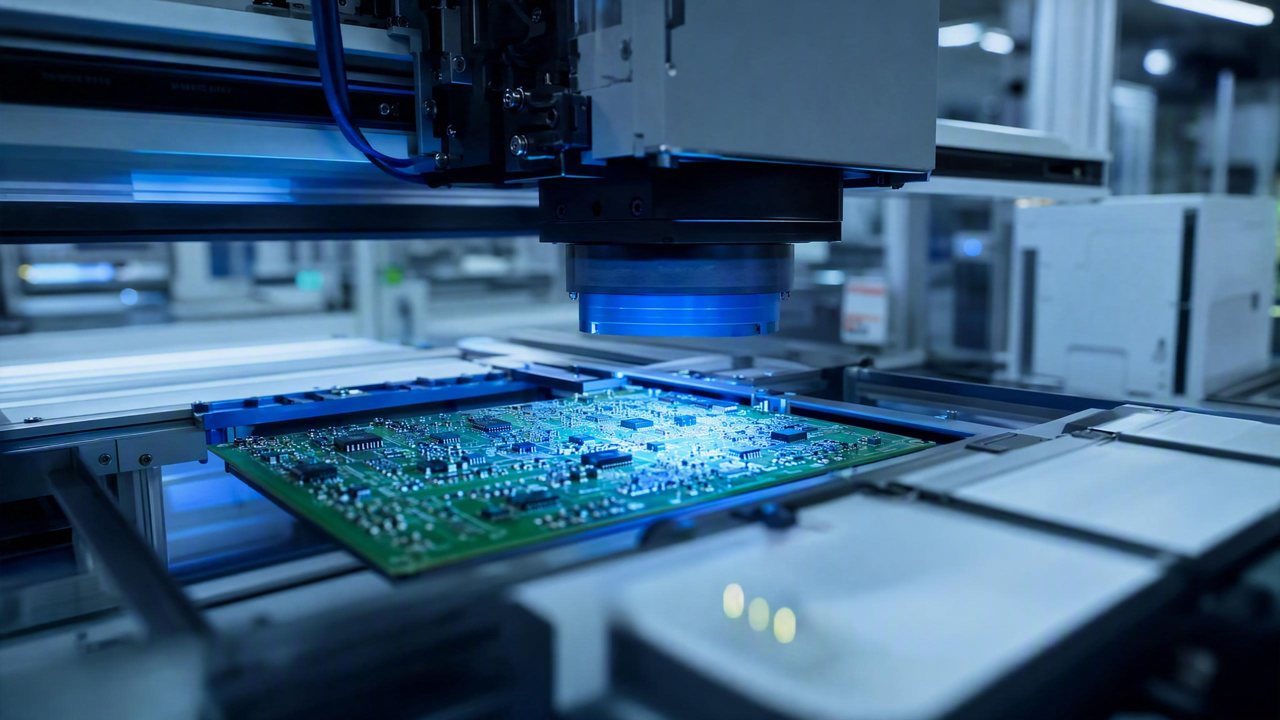
The DaoAI AI AOI software system (featuring visual foundation model for feature recognition, 5-minute zero-code programming with one golden sample, APDT few-shot learning with 1-20 good samples, semantic false positive filtering, and SDK/API/Docker support for 100% on-premise deployment) significantly improved inspection efficiency and production throughput by reducing solder paste inspection (SPI) false positive rates from the industry's traditional 15% to below 4% through APDT few-shot self-training. In the electronics/PCBA manufacturing sector, accelerating product iterations and increasing precision demands pose unprecedented challenges for quality control during production. Solder joint quality, a critical indicator of electronic product reliability, directly impacts final product performance and cost. Traditional manual inspection and rule-based AOI systems are increasingly revealing their limitations when dealing with complex, varied defect types and high-precision requirements.
In the electronics/PCBA manufacturing sector, accelerating product iterations and increasing precision demands pose unprecedented challenges for quality control during production. Solder joint quality, a critical indicator of electronic product reliability, directly impacts final product performance and cost. Traditional manual inspection and rule-based AOI systems are increasingly revealing their limitations when dealing with complex, varied defect types and high-precision requirements. Taking solder paste inspection (SPI) after printing as an example, this stage directly affects the yield of subsequent pick-and-place and reflow soldering processes. Any minor defect can lead to the scrap of the entire product. A leading PCBA manufacturer, whose production lines cover various high-density PCBA products such as smartphone motherboards and high-performance computing modules, has extremely high requirements for the inspection accuracy of solder joint integrity, bridging, cold solder joints, insufficient solder, and excessive solder defects. Frequent production line changeovers also make traditional solutions difficult to adapt.
Pain Points: Why This Hurdle Is Difficult to Overcome
This leading PCBA manufacturer faced multiple challenges in solder joint defect inspection after solder paste printing. Firstly, high false positive rates. Traditional rule-based AOI systems, unable to interpret complex optical textures and minor deformations, often misidentified non-defect areas as defects, leading to a huge workload for manual re-inspection. Production line data showed that traditional AOI's false positive rate exceeded 15%, significantly slowing down the production rhythm. Secondly, when introducing new products or changing production lines, traditional AOI required hours or even days for program tuning and threshold setting, severely impacting production efficiency, with an average downtime of 4 hours per changeover. Furthermore, for some extremely minute defects, such as slight collapses at the solder joint edges or subtle deviations in solder ball diameter, traditional AOI struggled to consistently detect them, increasing the risk of missed detections and affecting the final product reliability.
The root cause of these pain points lies in the diversity and complexity of solder joint defects, as well as the inherent limitations of traditional inspection technologies. Under optical imaging, PCBA solder joints exhibit rich surface reflections, shadows, and texture variations. Especially on high-density, fine-pitch components, tiny lighting changes or angle differences can lead to misjudgments. Traditional rule-based AOI relies on engineers manually setting a large number of geometric dimensions, grayscale thresholds, and other rules. These rules are difficult to cover all variations and are highly sensitive to changes in ambient light, PCB material, solder paste type, etc. When new types of solder paste or more precise components are introduced, the original rules often become invalid, requiring significant human effort for reprogramming. Moreover, one of the current challenges for industrial AI large models in quality inspection is the high cost and time-consuming nature of acquiring high-quality annotated samples, especially in the PCBA field where specific defect samples are scarce, making it difficult for traditional deep learning models to be quickly deployed and generalized.
Technical Principles
The DaoAI AI AOI software system fundamentally solves the above problems through its core visual foundation model and APDT (Adaptive Positive Data Training) few-shot self-training technology. The system abandons the hard-coded logic of traditional rule-based AOI, instead utilizing deep learning for feature recognition of solder joint images. Its visual foundation model is pre-trained on massive industrial image data, possessing strong generalization capabilities, and can understand high-dimensional features such as solder joint geometry, texture, and reflective properties, rather than simple pixel values. During inspection, the system can distinguish between normal solder joints and various defects, including but not limited to solder bridging, cold solder joints, insufficient solder, excessive solder, tombstoning, and displacement.
Compared to traditional methods, the APDT few-shot self-training technology of the DaoAI AI AOI software system is its core advantage. When facing new products or new defect types, traditional AOI requires a large number of defect samples for training or extensive manual rule adjustments. In contrast, APDT only needs 1-20 good sample images to complete model self-training and deployment within 5 minutes. This technology leverages positive sample guidance and self-supervised learning to build a precise understanding of the 'normal' state using a small amount of good data, thereby identifying 'abnormal' states. This means engineers do not need to collect and annotate hard-to-obtain defect samples, greatly accelerating model deployment and production line changeover speed. Furthermore, the DaoAI AI AOI software system also incorporates a semantic false positive filtering mechanism, which combines contextual information to determine the authenticity of defects, further reducing false positive rates. In a practical application at a leading PCBA manufacturer, the false positive rate for solder joint defects was reduced from 15% to 3.8%, significantly improving inspection efficiency and reducing the workload of re-inspection personnel.
Typical Application Scenarios
- **Solder Paste Inspection (SPI) for Solder Joint Defects:** Inspecting the volume, area, height, displacement, and bridging defects of solder paste printed on PCB pads before reflow soldering. The challenge lies in the strong reflection and easy collapse of solder paste surfaces, leading to high false positives in traditional solutions. The DaoAI AI AOI software system can accurately identify minute solder paste defects.
- **Post-Placement Component Missing, Misalignment, Polarity Reversal:** Inspecting whether components placed on the PCB are correct, accurately positioned, and have correct polarity. The difficulty arises from the wide variety of components and their tiny sizes, especially for hidden solder joints at the bottom of BGA/QFN packages. The DaoAI AI AOI software system, combined with its visual foundation model, can accurately recognize component features and orientation.
- **Post-Reflow Solder Joint Quality Inspection:** Inspecting solder joints after reflow soldering for bridging, cold solder joints, insufficient solder, excessive solder, tombstoning, solder balls, and other defects. This is a critical stage for PCBA quality control, where solder joint morphology is complex. The DaoAI AI AOI software system can handle various complex solder joint shapes and lighting conditions, ensuring high detection rates.
- **Connector Pin Coplanarity and Deformation:** Inspecting whether connector pins are bent, deformed, or have poor coplanarity. Such defects significantly impact electrical connections, and traditional methods struggle with quantification. The DaoAI AI AOI software system can achieve micron-level precision in detecting pin morphology.
- **PCBA Surface Scratches, Dirt, Foreign Object Detection:** Performing appearance defect inspection on the PCBA surface. The difficulty is that defect features are often inconspicuous and easily confused with the background. The DaoAI AI AOI software system can identify anomalies by learning normal textures.
Implementation Case Study
A leading PCBA manufacturer, a global leader in electronic product contract manufacturing, has extremely high demands for inspection efficiency and accuracy on its production lines. Before adopting the DaoAI AI AOI software system, the manufacturer's solder joint defect inspection after solder paste printing primarily relied on traditional rule-based AOI. Production line data showed that its false positive rate remained high, averaging 15.6%, leading to significant human resources being dedicated to secondary re-inspection daily, severely impacting production rhythm. Furthermore, during new product launches or production line changeovers, traditional AOI programming and debugging were time-consuming, averaging 4.5 hours of downtime per changeover, placing immense pressure on production schedules.
To address these pain points, the manufacturer decided to introduce the DaoAI AI AOI software system. During implementation, the DaoAI team first analyzed the on-site data and utilized the APDT few-shot self-training capability. Using only 10 good sample images, the AI model training for their various complex solder joint defects was completed in less than 5 minutes. After deployment, the system seamlessly integrated with existing SPI equipment, enabling real-time, high-precision inspection of solder paste quality. Post-launch, the DaoAI AI AOI software system in this case reduced the false positive rate for solder joint defects by 75%, to below 3.8%, significantly reducing the manual re-inspection workload. Concurrently, production line changeover time was shortened from an average of 4.5 hours to 5 minutes, greatly enhancing production line flexibility and efficiency. The manufacturer's representative stated that the DaoAI AI AOI software system not only significantly improved inspection quality but also brought tangible economic benefits and production efficiency gains.
"The DaoAI AI AOI software system, with its APDT few-shot self-training capability, truly addressed our pain points of frequent changeovers and high-precision inspection, significantly reducing false positives and greatly improving line efficiency."
DaoAI Solutions and Products
The DaoAI AI AOI software system provided by WeLinkirt is specifically designed to solve industrial quality inspection challenges. Its core capabilities lie in the visual foundation model's feature recognition and APDT few-shot self-training technology. Users only need to provide 1-20 good sample images, and the system can complete model programming in 5 minutes, achieving zero-code automated deployment. For PCBA solder joint inspection, the DaoAI AI AOI software system can identify various complex defects and effectively distinguish between true defects and false positives through its semantic false positive filtering mechanism. The DaoAI AI AOI software system supports various deployment methods such as SDK/API/Docker, enabling 100% on-premise private deployment to ensure customer data security. For scenarios requiring more complex 3D morphological inspection, the DaoAI 2D/3D AI AOI equipment offers self-developed 3D cameras and 3D morphology reconstruction capabilities to inspect hidden solder joints, coplanarity, or micron-level morphology. Furthermore, the DaoAI World model, as a unified foundation, enables semantic understanding, cross-scenario generalization, and continuous learning from production line feedback to constantly optimize inspection performance.
By deploying the DaoAI AI AOI software system, this leading PCBA manufacturer achieved multi-faceted business value. Actual measurement data showed that the missed detection rate for solder joint defects consistently remained below <0.5%, ensuring high product reliability. The false positive rate was reduced by 75%, significantly decreasing the manual re-inspection workload and freeing re-inspection personnel from high-intensity, repetitive tasks. Production line changeover time was shortened from several hours to 5min, notably improving production line flexibility and utilization. These improvements not only reduced operating costs but also enhanced overall production efficiency and product competitiveness, accelerating the customer's digital transformation process.
FAQ
How does DaoAI AI AOI software system's APDT few-shot self-training technology work?
APDT (Adaptive Positive Data Training) technology is a core advantage of the DaoAI AI AOI software system. It uses self-supervised learning with a small number of good samples (typically just 1-20 images) to enable the model to precisely understand the characteristics of 'normal' products, thereby efficiently identifying all 'anomalies' or defects that deviate from the normal state during production. This approach avoids the reliance of traditional deep learning on a large number of defect samples, significantly reducing the difficulty and time cost of model training and deployment, especially suitable for scenarios with rare defects or frequent production line changeovers.
What are the advantages of DaoAI AI AOI software system over traditional rule-based AOI for PCBA solder joint inspection?
Compared to traditional rule-based AOI, which relies on engineers manually setting numerous geometric dimensions and grayscale thresholds, the DaoAI AI AOI software system uses a visual foundation model for feature recognition, enabling it to understand more complex image textures and deformations for more accurate defect identification. It can reduce false positive rates by 75%, significantly cutting down manual re-inspection efforts. Simultaneously, APDT few-shot self-training technology shortens changeover programming time from hours to 5 minutes, greatly enhancing production line flexibility and efficiency, making it more advantageous for high-mix, low-volume production.
What is the approximate budget required to deploy the DaoAI AI AOI software system?
The budget for the DaoAI AI AOI software system is influenced by various factors, including the complexity of the PCBA products you need to inspect, production line integration requirements, annual licensing models (per device or per inspection volume), and whether accompanying 2D/3D hardware equipment is needed. We offer flexible deployment plans and licensing models to suit customers of different scales and needs. We recommend contacting our sales engineers who will provide a customized solution and detailed quotation based on your specific scenario and requirements, ensuring that the budget investment maximizes actual business value.
This article was generated by AI. Customer cases are simulated scenarios based on real product capabilities and figures are illustrative; see product pages for official benchmarks.