
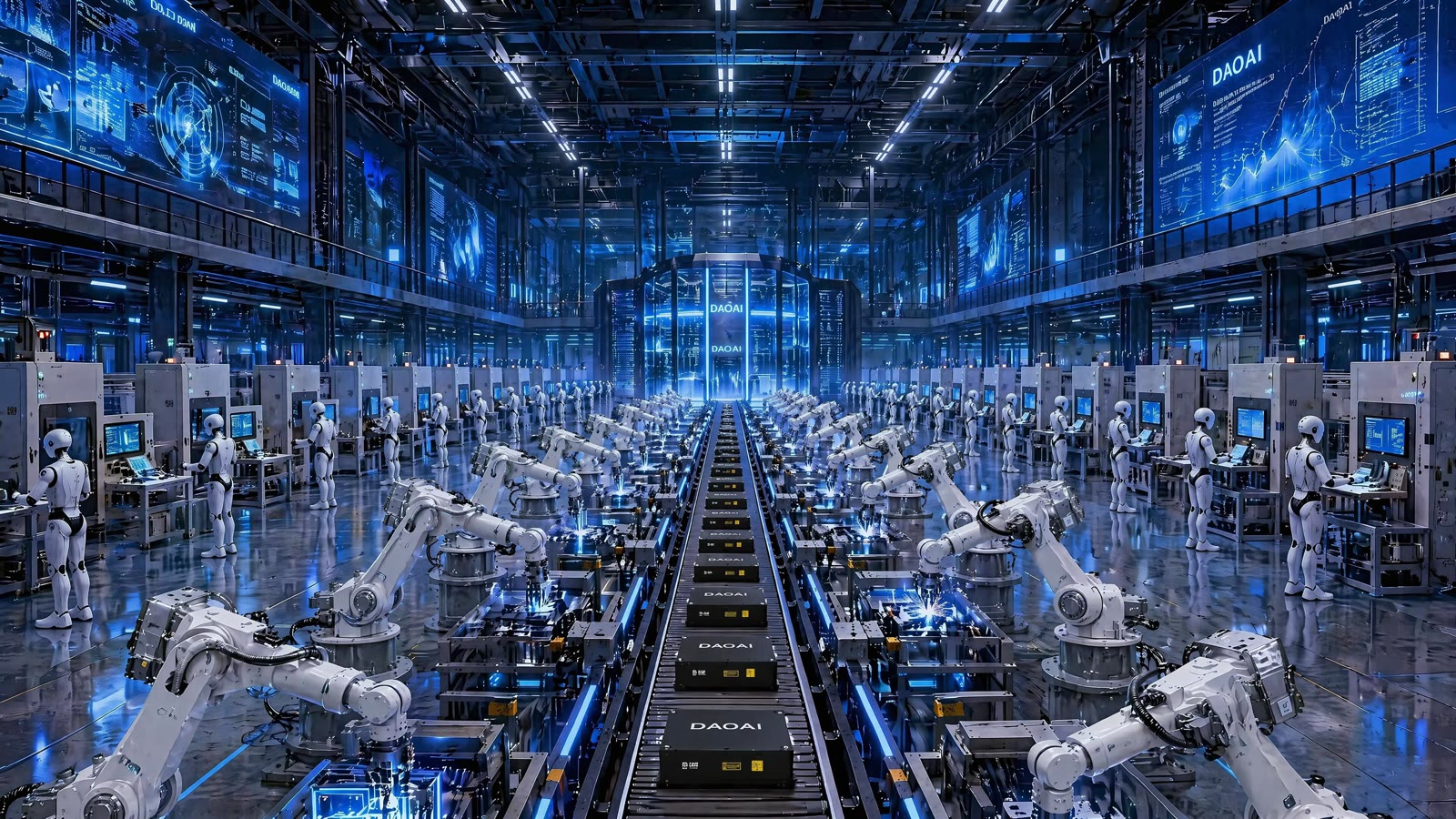
The hard part on a line is never the textbook defect. It is a board never seen before, a same-colour component on a same-colour substrate, a part face-up but rotated ninety degrees. In those moments a system either decides, or calls a human back to reprogram it.
ACI in this article stands for Auto Cognitive Inspection — the next-generation term for AI AOI: keep the A and the I, and replace the O (optical) with C (cognitive), because the decision basis is cognition rather than the imaging method. The full argument is set out in From AI AOI to ACI.
As of 30 June 2026, DaoAI ACI cognitive inspection had reached 1,000 deployed units across 100 customers in semiconductor and PCBA manufacturing. In today's industry context the number alone is not remarkable; what it implies is — the system now has to behave the same across models, lines and batches, and consistency is never proven on a demo bench.
For physical AI on a line: arms decide how hard to press, eyes decide whether it counts.
01 The three things customers get stuck on
On semiconductor and PCBA lines the same three obstacles come up again and again, and none of them is caused by a shortage of compute.
- No defect data: a new product has just been introduced, the defects have not happened yet, and the negative-sample library a rule-based method needs simply does not exist
- Unstable lighting: ambient light, board reflectivity and batch colour shift move, and thresholds built on colour and pixel comparison drift with them
- Programming takes a skilled engineer hours: a new board means redrawing ROIs and retuning thresholds — the line waits for a person, and the person is not always there
All three point at one gap: a comparison-based principle knows what a part should look like; it does not know whether what it sees now counts. So every changeover, every batch variation and every drift in lighting calls a human back to reprogram or retune.
02 Why cognition rather than comparison
DaoAI calls this generation ACI: what has gone out of date in AOI is not the A or the I but the O — "optical" pins the whole category to one imaging modality, a visible-surface object and a compare-against-template rule.
The difference lands in feature space rather than colour space: the system understands a component's identity instead of matching pixels and colours. Black parts on black boards and silver traces under silver wire separate naturally; rotation, flipping and surface contamination still localise. Modelling takes one good sample — one to twenty covers a component family — with no CAD drawings and no pre-collected defect library.
- Scan one reference board from the current batch; the system learns component positions and appearance
- Components, pins and polarity are mapped in seconds, with no hand-drawn ROIs
- Decision thresholds are derived from the sample, so line operators can run it
Auto-programming completes in thirty seconds to five minutes, where the conventional route takes a skilled engineer three to five hours; one-click modelling reaches 98% inspection accuracy, and false calls drop by roughly 80% against an existing rule-based system. (typical achievable ranges in anonymised industry scenarios; actual figures vary with process, component and existing defect library, and on-site measurement governs)
Back to those three obstacles: no defect data — positive-sample learning looks only at good parts; unstable lighting — the decision happens in feature space and does not drift with colour and pixels; hours of skilled programming — one sample, a few minutes, and a line operator can run it. The three obstacles do not map to three features; they map to one change in the decision principle.
03 A thousand units tests consistency, not peak capability
DaoAI COO Zhang Yu puts it plainly: “By the thousandth unit, the supply chain, the line, the test regime and the delivery standard have all become part of the product. Customers do not want one unit to be exceptionally accurate; they want this batch to behave like the last one.”
Once equipment is wired into a customer's own line and data loop, the last thing anyone wants is one batch behaving differently. That is why the inspection software is called an operating system: it governs imaging and motion below, presents a stable decision interface above, and behaves the same across models and batches.
ACI OS is the operating system for all ACI and next-generation AOI equipment, in two halves: visual recognition and cognitive decision (the brain), and motion control of camera and gantry (the cerebellum). It runs out of the box on our own systems, or embeds into existing 2D/3D equipment and line software through SDK, REST API or Docker.
Inference runs at the edge of the line with decision latency below 12 ms and works with the network down; sample images and results never leave the plant and are never used to train any third-party model. What sharpens with use is the customer's own line, not a shared foundation.
04 What customers use it for
On anonymised lines already in production it is used where changeover is frequent and batches are small, at stations where same-colour and high-reflectivity surfaces make conventional methods over-report, and during new product introduction when defect forms are still moving and no sample library has had time to accumulate. An operator marks one false call on the review screen, the model updates and reloads, and that class of error stops recurring — what the data loop accumulates is a model specific to that line. (typical achievable ranges in anonymised industry scenarios; actual figures vary with process, component and existing defect library, and on-site measurement governs)
05 A thousand units is the entry ticket
Seen this way the thousandth unit is not a finish line but a scale mark: cognitive inspection is leaving curated samples for real lines with incoming variation, process drift and new defects. The capabilities that matter hide in unremarkable moments — whether the first board after a changeover can be inspected straight away, whether same-colour parts get over-reported, whether an unseen defect slips through the first time it appears.
“A thousand units does not prove how accurate we can be,” says Zhang Yu. “It proves we can deliver the same judgement, consistently. The real long run starts now.”
The arm has to know how hard it is pressing; the eye has to know whether what it sees counts. Without either half, the model has not really entered the physical world.
FAQ
What does a thousand units mean here?
As of 30 June 2026 it is the cumulative number of deployed DaoAI ACI cognitive inspection units, across 100 customers in semiconductor and PCBA manufacturing, counting both complete systems delivered and ACI OS embedded into existing customer equipment.
What is the core difference from conventional AOI?
The decision principle. AOI compares against templates or rules and knows what a part should look like; ACI uses the feature cognition of a visual foundation model to answer whether what it sees counts as a defect, modelling from one good sample without CAD drawings or a defect library.
Does any data leave my plant?
No. Sample images and inspection results never leave the plant and are never used to train any third-party model; inference runs at the line edge with decision latency below 12 ms and works with the network down.
Full solution for this scenario: the full inspection solution for ACI OS
This article was generated by AI. Customer cases are simulated scenarios based on real product capabilities and figures are illustrative; see product pages for official benchmarks.