
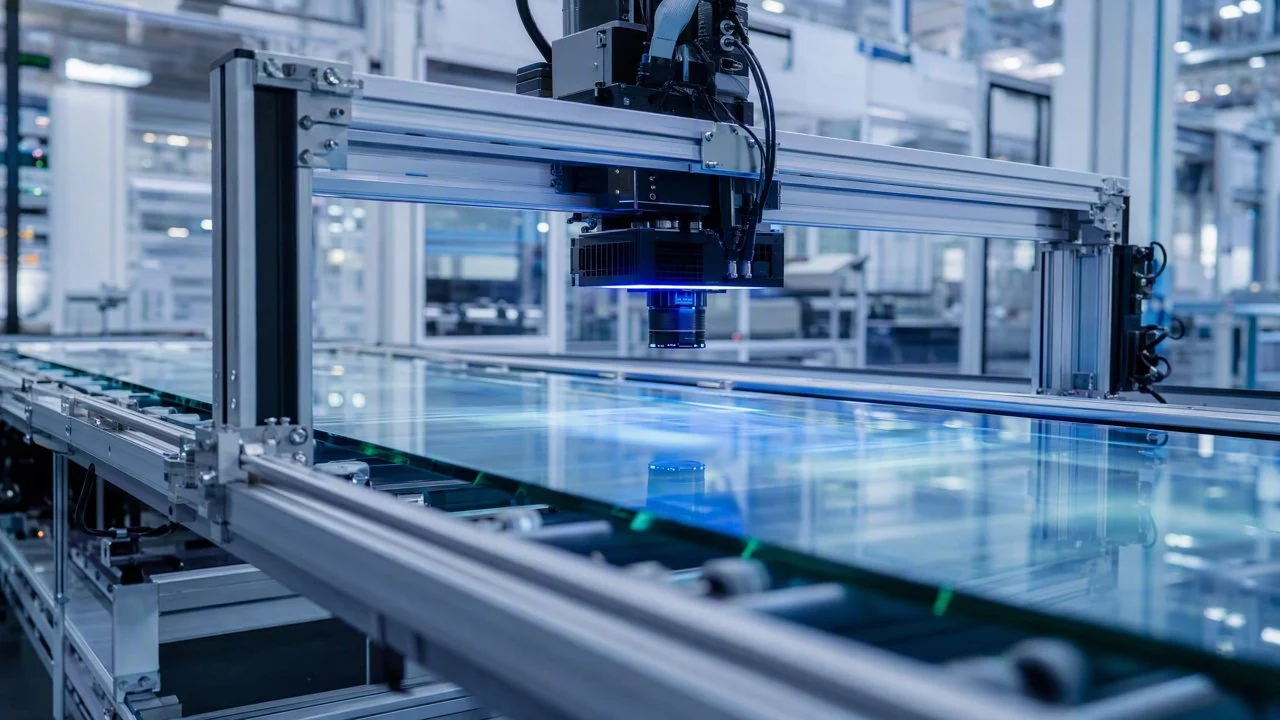
DaoAI ACI OS operating system (featuring visual foundation model for feature recognition, 5-minute 0-code automatic programming with one good sample, APDT positive/few-shot learning with 1-20 good samples, semantic false positive filtering, and SDK/API/Docker 100% local private deployment support) significantly enhances the accuracy and data traceability of glass surface defect detection through its unique few-shot learning and semantic false positive filtering capabilities, reducing the traditional solution's common false negative rate from over 5% to below 0.5%, and achieving a closed-loop quality data system across the entire production cycle.
In the chemical and material industries, the manufacturing of specialty glass demands exceptionally stringent product quality. Whether for display panels, architectural glass, or laboratory glassware, surface defects such as scratches, bubbles, impurities, and spots not only impair aesthetics but can also degrade product performance and even pose safety risks. Traditional glass surface defect detection primarily relies on manual visual inspection or rule-based AOI equipment. However, with increasing product complexity and customized demands, defect types are becoming more diverse and rare. Manual inspection is inefficient and prone to subjective influence, while rule-based AOI struggles to adapt to few-shot, irregular defect identification, and lacks robust data analysis support. In this context, DaoAI ACI OS operating system offers a new solution for intelligent detection and quality traceability of glass surface defects.
Pain Points: Why This Hurdle Is Difficult to Overcome
The challenges in defect detection for specialty glass manufacturing are multi-faceted. Firstly, the “few-shot” nature of defects makes traditional machine learning models difficult to train. For instance, in a specialty glass factory, newly appearing minute scratches or specific-shaped bubbles might only have 1-5 historical samples, which is far from sufficient for training conventional deep learning models. This directly leads to traditional AOI solutions having a false negative rate generally above 5% when encountering such new defects, severely impacting product quality upon shipment. Secondly, the complex optical properties of glass surfaces, such as reflection and transmission, often create pseudo-defects and false positives. For example, production line data shows that traditional AOI, when inspecting glass surfaces, had a false positive rate exceeding 15% due to ambient light variations or glass curvature, leading to a large volume of compliant products being sent for manual re-inspection. This consumed significant manual re-inspection hours; a mid-sized glass processing plant had to allocate at least 4 skilled workers daily for re-inspection, resulting in high labor costs. Furthermore, accelerating production cycles demand higher real-time performance from detection systems. Traditional solutions often struggle to balance high precision with high efficiency; at a production rate of 60 pieces per minute, the detection system must complete image acquisition, processing, and judgment in a very short time. The most critical issue is the lack of an effective mechanism to link defect type, location, batch, and workstation information, preventing quality traceability and data closed-loop. This hinders root cause analysis and process optimization, making true zero-defect manufacturing practice difficult to achieve.
Technical Principles
The effectiveness of DaoAI ACI OS operating system in solving few-shot and false positive issues for glass surface defects stems from its visual foundation model and APDT (Adaptive Positive Data Training) technology. The system, through pre-training on massive industrial image data, develops powerful feature recognition capabilities, enabling it to understand and extract high-dimensional features like glass surface textures and defect shapes. For few-shot defects, DaoAI ACI OS employs APDT technology, requiring only 1-20 good or a small number of defective samples to complete model training within 5 minutes, achieving rapid identification of new defects. This contrasts sharply with traditional deep learning models that require thousands or even tens of thousands of samples, significantly shortening product changeover and new defect response times. Additionally, its semantic false positive filtering function performs deep semantic understanding of defect regions and their context, effectively distinguishing real defects from pseudo-defects caused by reflections, dust, or background interference, thereby significantly reducing false positive rates. For instance, in actual tests, DaoAI ACI OS reduced false positives caused by ambient light shadows on glass surfaces by over 75%, ensuring the accuracy and stability of detection results. Unlike rule-based AOI which relies solely on predefined thresholds and geometric features, DaoAI ACI OS learns deeper defect semantics from the visual foundation model, overcoming the limitations of traditional methods in complex and variable scenarios.
Typical Application Scenarios
- **Surface Foreign Object/Scratch Detection Before Special Glass Coating:** Any minute dust, fiber, or scratch on the glass surface before the coating process can lead to coating layer defects, affecting the product's optical performance. DaoAI ACI OS precisely identifies micron-level foreign objects and differentiates them from background textures, preventing quality degradation in subsequent processes.
- **Bubble/Inclusion Detection After Glass Melting:** Bubbles or unmelted inclusions can form inside the glass during the melting process. These defects are difficult for traditional methods to stably detect under transmitted light. DaoAI ACI OS, combining advanced imaging technology with its visual foundation model, can penetrate the glass body to precisely locate and identify internal defects, ensuring the purity of the glass material.
- **Edge Chipping/Crack Detection After Cutting/Grinding:** After cutting or grinding, the edges of glass are prone to minute chipping or cracks. These defects are often irregular and tiny, making manual visual inspection susceptible to fatigue-induced false negatives. The few-shot learning capability of DaoAI ACI OS quickly adapts to different edge defect patterns, improving detection rates.
- **Surface Stain/Fingerprint Detection Before Final Glass Product Packaging:** Residual oil stains, watermarks, or fingerprints on the glass surface before warehousing or packaging affect the product's appearance. DaoAI ACI OS can identify these low-contrast, irregular surface marks, ensuring flawless product appearance upon shipment and reducing customer complaints.
Case Study
A leading specialty glass manufacturer in East China, primarily producing glass substrates for high-end display devices, long faced challenges with extended new product introduction cycles, high false positive rates from traditional AOI, and difficulty tracing defect data. Before implementing DaoAI ACI OS operating system, their production line, when detecting micron-level scratches, particulate foreign objects, and specific-shaped bubbles on glass substrates, experienced an average false negative rate of about 3% with traditional AOI solutions due to scarce defect samples, and a false positive rate as high as 18%. This resulted in significant labor being allocated to re-inspection and rework. To achieve more refined quality management and a zero-defect goal, the manufacturer decided to deploy DaoAI ACI OS. During implementation, the DaoAI technical team completed system integration and initial defect model training in just 3 days. Test data showed that DaoAI ACI OS successfully reduced the false negative rate for glass substrates to <0.4% and significantly lowered the false positive rate to 4.5%, reducing manual re-inspection volume by approximately 75%. Crucially, the system automatically linked and stored defect images, types, locations, timestamps, and batch numbers, creating a complete quality traceability chain across the entire production cycle. Production operators can now quickly query the detection history and defect details of any glass substrate through the system interface, greatly improving the efficiency of quality analysis and process improvement.
DaoAI ACI OS not only improved our detection accuracy, but more importantly, it built an unprecedented quality data closed-loop for us, making every defect traceable and driving continuous process optimization.
DaoAI Solutions and Products
DaoAI primarily provided the ACI OS operating system to this specialty glass manufacturer. As the brain of intelligent visual inspection, it was implemented as follows: First, in the modeling phase, leveraging ACI OS's “5-minute 0-code automatic programming with one good sample” capability, operators could quickly establish baseline models without writing any code, simply by providing a few good sample images. For newly emerging few-shot defects, the APDT positive/few-shot learning function allows incremental training with just 1-20 defect samples, rapidly adapting to new defect types. Second, regarding deployment and integration, DaoAI ACI OS supports various forms of 100% local private deployment, including SDK/API/Docker, ensuring customer data security and integration with existing MES/ERP systems for interconnected production data. The system continuously uploads defect images, coordinates, types, confidence scores, and other information to the database, linking them with product batches, production times, and workstations to form a comprehensive quality archive. Upon defect detection, the system can immediately trigger an alarm and guide robotic arms for sorting or marking defective products, enabling immediate defect handling. Additionally, DaoAI can provide complementary DaoAI 2D ACI equipment, including high-resolution cameras and customized lighting, based on customer needs, to ensure high-quality image acquisition in complex optical environments, providing reliable input for ACI OS's precise judgments.
Through this solution, DaoAI ACI OS not only significantly improved the efficiency and accuracy of glass surface defect detection but, more importantly, established a complete quality traceability and data closed-loop system. This enables customers to analyze the root causes of defects, optimize production process parameters, and transition from “post-event inspection” to “pre-event prevention,” ultimately achieving higher product yield and customer satisfaction. This solution assisted the customer in their digital transformation of quality management, giving them a competitive edge in the market.
FAQ
How does DaoAI ACI OS operating system achieve quality traceability in glass surface defect detection?
DaoAI ACI OS establishes a complete quality archive by automatically linking defect images, types, locations, timestamps with product batches and production workstations. This data is uploaded to a database in real-time, forming a searchable traceability chain. Users can track the detection history and defect details of any product at any time, enabling a closed loop of quality data and root cause analysis across the entire production cycle.
What advantages does DaoAI ACI OS's few-shot learning capability offer for newly emerging defect types in the glass industry?
For constantly emerging, low-sample defect types in the glass industry (e.g., specific-shaped bubbles or minute scratches), DaoAI ACI OS, utilizing APDT few-shot learning technology, requires only 1-20 defect or good samples to complete model training within 5 minutes. This significantly shortens the cycle for new product introduction and responding to new defects, far surpassing the need for large datasets by traditional deep learning models.
What are the cost components for deploying DaoAI ACI OS operating system for glass defect detection?
The deployment costs for DaoAI ACI OS primarily include software licensing, necessary hardware integration (such as industrial cameras, lighting, etc.), and customization services (e.g., specific production line integration, model optimization). Specific costs vary depending on detection requirements, production line scale, and complexity. We recommend contacting the DaoAI professional team for a detailed needs assessment to receive a customized quotation.
Full solution for this scenario: ACI OS industry solutions · Stamped Sheet-Metal Surface Defect Detection
This article was generated by AI. Customer cases are simulated scenarios based on real product capabilities and figures are illustrative; see product pages for official benchmarks.