
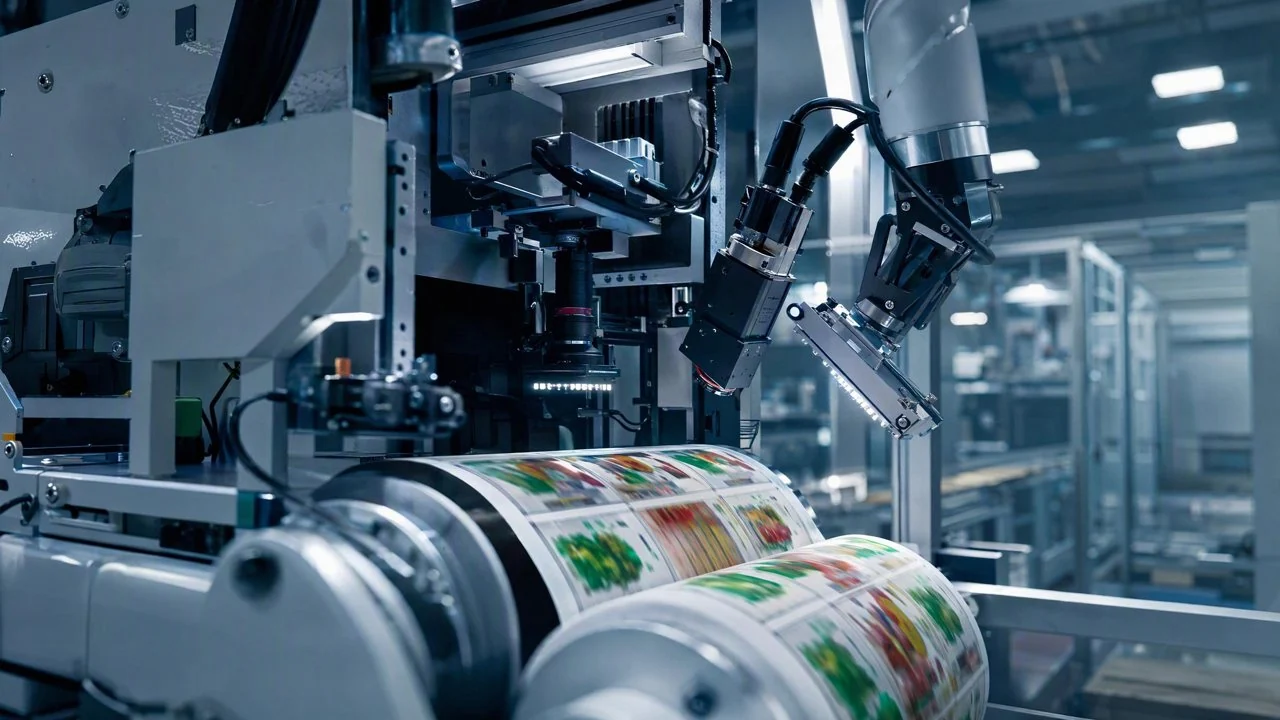
DaoAI AI AOI software system (featuring visual foundation model for feature recognition, 5-minute zero-code programming with one good sample, APDT positive/few-shot learning from 1–20 good samples, semantic false positive filtering, and SDK/API/Docker support for 100% local private deployment) significantly enhances production line flexibility and efficiency in the consumer goods high-SKU label printing industry. It achieves this by reducing the programming time for high-mix low-volume inspection from the traditional average of 30 minutes to under 5 minutes, thanks to its unique zero-code rapid changeover capability.
In the fiercely competitive consumer goods market, brands are continuously launching high-SKU, high-mix, low-volume products to meet personalized demands and market segmentation. This directly leads to unprecedented challenges in production flexibility for product packaging, especially in label printing. A leading consumer goods label printing factory, a supplier to many well-known brands, processes dozens or even hundreds of different label specifications, materials, and designs daily. Traditional quality inspection solutions, whether relying on manual visual inspection or rule-based AOI systems, struggle to adapt to such frequent changeover demands, resulting in low production efficiency and high costs. DaoAI AI AOI software system precisely addresses this core pain point, offering a transformative solution that ensures both quality and efficiency in label printing.
Pain Points: Why This Hurdle Is Difficult to Overcome
Quality inspection in high-SKU label printing faces multiple challenges. Firstly, **inefficient changeover**: traditional rule-based AOI systems require experienced engineers to manually write or adjust complex inspection rules and parameters for each product model change. According to one label printing factory, each changeover programming takes an average of 30-60 minutes, which can lead to several hours of downtime per day in a high-mix, low-volume production model. Secondly, the **dilemma of balancing under-detection and false positives**: minute defects on labels, such as uneven ink, misregistration, missing text, scratches, color deviations, and visual interferences caused by material properties (e.g., transparent films, metallic films), make it difficult for traditional AOI systems to maintain low under-detection rates while keeping false positive rates acceptable. The industry's average under-detection rate often exceeds 1.5%, with false positive rates as high as 10-15%, necessitating extensive manual re-inspection. Finally, **high labor costs and fatigue**: facing high-speed production lines, manual visual inspection is not only inefficient but also prone to fatigue, leading to inconsistent quality and requiring multiple quality inspectors per shift, resulting in high labor costs. For example, a high-speed label printing line can produce hundreds of meters of labels per minute, making it impossible for human eyes to effectively track and inspect, leading to high under-detection rates, while frequent false positives further increase the workload of manual re-inspection, creating a vicious cycle.
The root cause of these difficulties lies in the **complexity of label printing processes** and the **visual diversity of inspection objects**. The variety of label materials (paper, plastic films, metallic films, special coatings) and surface treatments (lamination, UV, hot stamping, embossing) results in diverse imaging characteristics; differences in printing processes (offset, flexo, digital printing) lead to varied defect morphologies; high-precision registration requirements are extremely sensitive to minute deviations; and consumer labels often feature complex designs, including a large amount of tiny text, gradient color blocks, embossed textures, etc., all of which are easily misidentified as defects by traditional AOI. For instance, while AI large models enhance complex defect recognition in automotive seat production line quality inspection, the challenge in label printing is more about 'variability' than 'complexity,' emphasizing rapid adaptation to new models. Traditional AOI requires designing complex rule sets for each label type, which is difficult to generalize, making changeover programming a bottleneck for efficiency.
Technical Principles
The reason why DaoAI AI AOI software system can solve the aforementioned challenges lies in its core capabilities: **visual foundation model for feature recognition** and **APDT positive/few-shot learning mechanism**. Unlike traditional rule-based AOI, which relies on engineers to manually define defect features and thresholds, DaoAI's system incorporates a powerful visual foundation model. This model is pre-trained on vast amounts of image data, enabling a deep understanding of underlying features such as objects, textures, colors, and shapes in images. When a new label model is introduced, users only need to provide 1–20 good sample images, and the DaoAI AI AOI software system can automatically learn and build the 'normal' visual model for that specific model within 5 minutes, without any code programming. This 'zero-code automatic programming' capability significantly simplifies the changeover process, reducing hours of programming effort for traditional rule-based AOI systems to mere minutes.
Compared to traditional methods, the DaoAI AI AOI software system demonstrates significant advantages. Traditional rule-based AOI requires complex algorithms and parameters to be written for each defect type, heavily relying on the engineer's experience, and struggles to adapt to new defect patterns, leading to high false positive and under-detection rates. In contrast, DaoAI's system employs **semantic false positive filtering** technology, which distinguishes real defects from non-defective visual interferences (e.g., textures, reflections) through semantic understanding of the defect area, thereby significantly reducing the false positive rate. For example, in a label printing case, the DaoAI AI AOI software system reduced the false positive rate from 12% with traditional solutions to <1.5%. Furthermore, its support for SDK/API/Docker for 100% local private deployment ensures customer data security and system response speed, which is crucial for consumer goods manufacturers with strict requirements for data security and real-time performance.
Typical Application Scenarios
- **Label Text and Barcode Print Quality Inspection**: Detects clarity, completeness, presence of ghosting, ink spots, breaks in text, and print quality/readability of barcodes and QR codes. The challenge lies in small text, high information density, and significant variations in fonts, sizes, and colors. The DaoAI AI AOI software system accurately identifies various text defects through its visual foundation model.
- **Registration Deviation and Color Difference Inspection**: For multi-color printed labels, it checks if different color layers are accurately registered, whether there is color bleed or misalignment, and if the overall color tone meets the standard sample. The difficulty lies in precisely quantifying micron-level registration deviations and subtle color differences with human eyes or traditional rules. The DaoAI AI AOI software system achieves sub-pixel level registration accuracy detection.
- **Surface Scratch, Stain, and Material Defect Inspection**: Identifies scratches, ink stains, foreign particles, and substrate defects such as wrinkles, bubbles, or damage on the label surface. The challenge is that these defects vary greatly in form and appearance under different lighting and backgrounds. DaoAI's semantic false positive filtering technology effectively distinguishes real defects from background textures.
- **Die-cutting Accuracy and Edge Integrity Inspection**: Detects if the die-cut edges of labels are smooth, free of burrs, nicks, or glue overflow, and if the die-cut dimensions conform to design specifications. The difficulty lies in complex curve edges and high precision requirements. The DaoAI AI AOI software system performs high-precision fitting and deviation analysis for complex edges.
- **Hot Stamping/Embossing Process Defect Inspection**: Detects the completeness, gloss, presence of missing or misaligned hot stamping areas, and the clarity, depth, and consistency of embossed patterns. The challenge is that metallic luster and three-dimensional textures pose difficulties for imaging and defect recognition. The DaoAI AI AOI software system ensures effective detection through its robust recognition capabilities for special materials.
Case Study
A leading consumer goods label printing factory, processing over 50 different label models daily, had long been plagued by downtime losses due to frequent changeovers and pressure from manual re-inspection. Before adopting the DaoAI AI AOI software system, the factory used a traditional rule-based AOI system, where engineers typically spent 30-45 minutes adjusting parameters and programming rules for each new label. Production data showed that weekly downtime due to changeovers accumulated to over 8 hours. Furthermore, the traditional system had an average false positive rate of 12%, requiring 2-3 full-time quality inspectors for manual re-inspection, and even more during peak periods. To meet market demands for flexible production and rapid delivery, the factory decided to deploy the DaoAI AI AOI software system, opting for a 100% local private deployment model to ensure data security.
"The DaoAI AI AOI software system has truly enabled us to achieve 'production on demand.' The frequent changeover downtimes of the past are now history. We are now confident in accepting more small-batch, highly customized orders." – Production Manager, Consumer Goods Label Printing Factory
After deployment, the DaoAI AI AOI software system demonstrated outstanding performance. With its zero-code automatic programming capability, the programming time for new label models was significantly reduced. In this case, production line data showed that changeover programming time decreased from an average of 30 minutes to less than 5 minutes, reducing weekly downtime caused by changeovers by over 70%. Concurrently, thanks to the powerful generalization capabilities of the visual foundation model and semantic false positive filtering, the system's defect detection rate increased to over 99.6%, while the false positive rate significantly dropped from the original 12% to <1.5%, greatly reducing the workload of manual re-inspection. Now, only 1 quality inspector is needed for patrolling and minimal re-inspection, optimizing labor costs significantly. The deployment of the DaoAI AI AOI software system not only improved production efficiency but also gave the factory a competitive edge in high-mix, low-volume orders.
DaoAI Solutions and Products
DaoAI provides a comprehensive solution for the consumer goods label printing industry, centered around the DaoAI AI AOI software system. This system, with its **visual foundation model for feature recognition**, eliminates the need for manual feature engineering, allowing rapid adaptation to various complex label patterns and defect types. During the model building phase, users only need to provide a small number of good samples (APDT positive/few-shot learning, 1–20 good samples), and the system can complete model training within 5 minutes, achieving **zero-code automatic programming**. For production line changeovers, this means operators can switch inspection tasks quickly without any programming knowledge. Furthermore, the DaoAI AI AOI software system integrates **semantic false positive filtering** to effectively distinguish real defects from background interferences, significantly reducing false positive rates and improving inspection accuracy. The system supports various deployment methods, including SDK/API/Docker, enabling **100% local private deployment** to ensure customer data security and system response speed, and integration with existing MES/ERP systems.
To further optimize the overall solution, DaoAI can also provide complementary DaoAI 2D / 3D AI AOI equipment, utilizing self-developed 3D cameras and 3D morphology reconstruction technology for more precise inspection of label surface flatness and embossing depth. For example, for special labels requiring high-precision 3D inspection, this equipment can detect micron-level morphological defects. For data closed-loop, through the DaoAI World model, the system can continuously learn from production line feedback, constantly optimizing model performance. The DaoAI AI AOI software system not only solves current quality inspection pain points in label printing but also builds a continuously evolving intelligent quality inspection system, delivering tangible business value to customers. In one case, the DaoAI AI AOI software system reduced changeover programming time from 30 minutes to less than 5 minutes, significantly boosting production efficiency and effectively lowering manual re-inspection costs.
Quantified Results
The deployment of the DaoAI AI AOI software system in consumer goods label printing has yielded significant quantifiable results. In a real-world application at a leading consumer goods label printing factory, **changeover programming time** was dramatically reduced from an average of 30 minutes with traditional solutions to **<5 minutes**, leading to a weekly reduction in production line downtime of over 70%. The system achieved a **defect detection rate** of over **99.6%**, effectively ensuring product quality. Concurrently, thanks to its advanced semantic false positive filtering technology, the **false positive rate** significantly decreased from 12% with traditional systems to **<1.5%**, greatly alleviating manual re-inspection pressure; according to the factory's data, quality inspection labor input was reduced by 60%. These improvements not only directly lowered operational costs but also enhanced the client's order fulfillment capabilities and market competitiveness, accelerating the enterprise's transformation towards flexible intelligent manufacturing.
FAQ
How does DaoAI AI AOI software system achieve zero-code rapid changeover?
The DaoAI AI AOI software system incorporates a visual foundation model. Through its APDT positive/few-shot learning mechanism, by simply providing 1–20 good sample images, the system can automatically build an inspection model for a new product within 5 minutes, without requiring any manual code or rule programming, thus enabling rapid changeover.
What is the budget required to deploy the DaoAI AI AOI software system?
The budget for the DaoAI AI AOI software system depends on various factors, including deployment scale, required inspection functionalities, whether complementary hardware integration is needed, and specific service support levels. We offer flexible licensing and deployment options. We recommend contacting our sales team, who will provide a customized quote and detailed proposal based on your specific requirements.
How does DaoAI AI AOI software system ensure data security and local private deployment?
The DaoAI AI AOI software system supports various deployment methods such as SDK/API/Docker, enabling 100% local private deployment. This means all data processing and model operations occur on the client's local servers, ensuring data never leaves the factory. This fundamentally guarantees customer data security and privacy, while also providing ultimate real-time response speeds.
Full solution for this scenario: the full inspection solution for AI AOI Software · High-SKU Label Print Inspection
This article was generated by AI. Customer cases are simulated scenarios based on real product capabilities and figures are illustrative; see product pages for official benchmarks.